
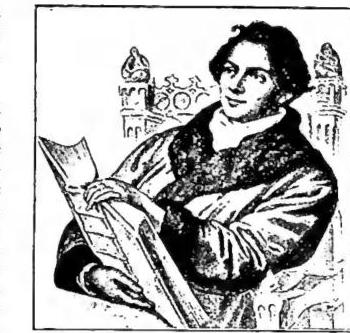
**TISCHENDORF, LOBEGOTT (Aenotheus), FRIEDRICH CONSTANTIN** von. — Protestant biblical scholar, born at Lengenfeld near Zwickau in Saxony on 18 January 1815, died at Leipzig on 7 December 1874. Extraordinary professor in 1845, he became professor of New Testament and biblical palaeography, a chair created especially for him in 1859; but his academic activity was limited.
He attended the Gymnasium at Plauen (1829–34), then studied theology at Leipzig (1834–38), acquiring a solid knowledge of the classical and New Testament fields. He was especially influenced by Professor Johann Georg Benedikt Winer (1798–1858), who carried out sound research in New Testament philology while holding the Bible in the highest veneration. STRAUSS, D (v.), whom T. called Luftbildner (“creator of phantoms”), was attacking the genuineness of the Gospels, T. remained wholly faithful to that genuineness and, employing all the resources of modern scholarship, devoted himself to restoring the most ancient, original text of the Bible. While still a student he applied himself to textual-critical studies, which he continued when he taught at the Erziehungsanstalt of Pastor Zehme. Returning to Leipzig
Among many other things, he edited no fewer than 24 texts of the Greek New Testament, which he divided into eight editions, based on his principal recensions of the New Testament. The outline is as follows: rec. A: Leipzig 1841, Koehleriana (I); Paris 1842, Didot “Catholic Gr.-Lat.,” minor edition (II); Paris 1842, Didot “non-Catholic” (III); rec. B: Leipzig 1849, Winter (IV); Leipzig 1849, Tauchnitz (V); Leipzig 1854, Mendelssohniana Gr.-Lat. German; there 1855, 1857, 1861, 1864, 1867, 1870, ed. academica; there 1858, Mendelssohniana Gr.-Lat.; there 1862, Tauchnitz (VI); Leipzig 1854, Mendelssohniana Gr.-German; there 1865, Mendelssohniana trilingual, 2nd edition (VI); rec. C: Leipzig 1859, Winteriana, 7th major edition; minor edition (VII); rec. D: Leipzig 1869–72, Hinrichs, 8th major edition; 1872, minor edition; there 1873, Tauchnitz, 3rd edition; there 1873, Mendelssohniana, ed. academica; there 1873, Brockhaus (VIII).
He began his research in Paris, from October 1841 to January 1843. He became famous by deciphering the Codex Ephraem rescriptus, a palimpsest that others had studied only with partial success (edition, Leipzig 1843–45, 2 vols.); he also devoted himself to the Codex Claromontanus (there 1852). In order to earn his living, he agreed to collate other manuscripts, and prepared the two Paris editions of 1842, perfecting them with new readings found in the codices he had examined. One of these, produced according to the opinion of J. N. Jager, is called “the Catholic edition,” and in the prolegomena to the 7th maior edition (pp. cxxiv–cxxvii) T. discusses at length the reasons that led him to produce it: besides the desire to promote the study of the Bible among Catholics, the fact that the Vulgate retained much of the Vetus latina, closely dependent on the Greek text, so that the Vulgate virtually contains a codex close to those ancient majuscules that he was seeking. It is called Catholic because among the various readings it always chooses the one close to the text of the Vulgate, the version authorized for Catholics, and provides a “Vulgatized” Greek text. From the Catholic standpoint, this edition can at most have some usefulness for a critical apparatus of the Vulgate of the New Testament.
From Paris, in 1843, T. went to Italy, stopping at Turin, Milan, Venice, Modena, Florence, Rome, and Naples, always in pursuit of manuscripts. The result was the edition of the Codex Amiatinus (Leipzig 1850, 2nd edition 1854). In Rome he had the Codex Vaticanus in his hands for only six hours, despite the benevolence of Gregory XVI (v.), because
an edition of it had already MAGI (v.); but he examined it once more in Rome in 1866 and published Novum Testamentum Vaticanum post Angelum Mai aliosque imperfectos labores ex ipso codice (Leipzig 1867).
In 1844 T. departed for the East, where, among other acquisitions or transcriptions of codices, he discovered, copied, and acquired the Codex Sinaiticus. He described that discovery in Reise in den Orient (2 vols., Leipzig 1845–46) and in Aus dem Lande der Bibel (there 1862); but he had to contend with slanders directed against him: Anfechtungen der Sinaibibel (there 1863); Waffen der Finsternis wider die Sinaibibel (there 1863); Die Sinaibibel (there 1871). C. R. Gregory (Prolegomena..., Leipzig 1894, pp. 279–361, and Textkritik, there 1900–1902, pp. 12–29, 971–80), who completed the prolegomena to the Octava critica maior, had to obtain documents from the tsarist Foreign Ministry to demonstrate that T. had not taken that treasure from the monks of St. Catherine’s at Mount Sinai. In 1844 he had rescued 43 pages of that precious codex from the flames (published as Codex Friderico-Augustanus, Leipzig 1846), and copied another; in 1853 he stayed for several weeks with the monks without finding any further trace of it; in 1859, as he was leaving, he saw the other leaves in a red cloth with the monastery steward and copied during the night the entire Pastor Hermas (v.), whose Greek text had been lost in the West. Then, in Cairo, at the monastery on which that of Sinai depended, after delicate negotiations, he was able to copy, gathering by gathering, the 110,000 lines of that codex. A decade of negotiations between the Tsar and the monks followed, and the codex was able to pass into the Imperial Library of St. Petersburg, until the Bolsheviks sold it to the Bodleian Library at Oxford (1935). As early as 1862 T. had prepared a large edition of it in Leipzig, in four volumes, as well as a Nov. Test. Sinaiticum. The Sinaiticus accounts for the major difference between the 7th maior edition, which is closer to the textus receptus, and the 8th critica maior, the best in terms of the richness of its apparatus. It is human, however, that T. somewhat exaggerated the value, extraordinarily great though it was, of that codex.
T. also concerned himself with apocryphal works and, as a good Lutheran, sought manuscripts useful to the Protestant cause. Here is a list of his major publications, among which is also found the text of the 29 majuscule codices, including 14 palimpsests, with which he enriched biblical scholarship: Monumenta sacra inedita (Leipzig 1846); Evangelium Palatinum ineditum (there 1847); Vetus Testamentum Graece sec. LXX interpretes (2 vols., there 1850, 1862, 1873; he would have produced a more up-to-date edition had he not been forestalled by death); De Evangeliorum apocryphorum origine et usu (The Hague 1851); Acta Apostolorum apocrypha (Leipzig 1851); Synopsis evangelica (there 1851, 1864, 1871, 1878: with the Greek text increasingly emended); Evangelia apocrypha (there 1853); Von der Wahllat Christi (a Roman manuscript attesting to the Protestant doctrine of justification, there 1855); Anecdota sacra et profana (there 1855); Hermae Pastor Graece (there 1856); Monumenta sacra inedita: Nova collectio (there 1857–70: 9 vols., but vols. VII and VIII are missing); Nov. Test. Latine, Textum Hieronymi... (there 1864); Apocalypses apocryphae (there 1866); Philonea inedita altera (there 1868); Clementis Romani epistulae (there 1872); Biblia s. Vet. Test. Hieronymi interprete (there 1873). For other works cf. C. R. Gregory, Prolegomena (there 1894), pp. 7–22.
When, shortly after 1860, Renan’s Life of Jesus (which T. calls «Zerrbildner», “distorter”) and Strauss’one (v.) were published, T. defended the authenticity of the New Testament in two writings: Wann wurden unsere Evangelien verfasst? (4 German editions, very many versions; Leipzig 1865, etc.); Haben wir den ächten Schrifttext der Evangelisten und Apostel? (there 1873).
(courtesy of Mons. A. P. Frutar)
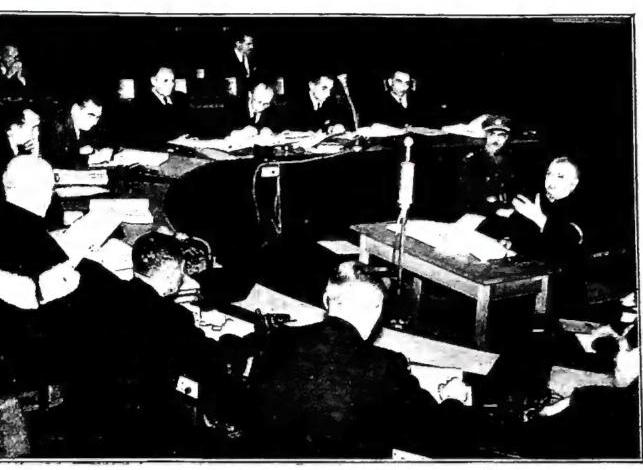
TISO, JOZEF — Mons. J. T. delivering his defense before the People’s Tribunal (17–18 March 1947) — Bratislava.
struggle against the subversives of the Bible; and the critical apparatus of his Octava critica maior has not yet been surpassed. His theoretical principles of textual criticism, however, have been superseded: it is no longer sufficient to collate the oldest codices; one must investigate more deeply the history of the text and its branches into various families. Minuscule codices have been discovered whose value is equal to that of certain majuscules. The material, moreover, has increased considerably, especially thanks to the biblical papyri (v.), and the ancient biblical versions now provide new useful material. The number of majuscules themselves has also increased, with the discovery, for example, of the codex of Korideth.
When the Apparatus criticus internationalis, being prepared by American scholars on the manuscripts according to the most advanced textual criticism, is published, it will certainly constitute a better working tool than T.’s Octava critica maior; but this will in no way detract from T.’s merits in the history of textual criticism and in the defense of the Bible.