
THEGLATHPHALASAR III. – Assyrian king from 745 to 727 B.C. (Assyrian Tuhulti-apil-Ešarra, “My trust is the heir son of Ešarra,” or the warrior god Ninurta, whose father is Enlil [v.] under the name of Ešarra; Hebr. Tiglath-Pilēser [*II Reg. 16:7] or Tilgath-Pilnēšer [I Par. 5:6; II Par. 28:20] or Tilgath-Pilnēšer [I Par.* 5:26]). The true founder of the Neo-Assyrian Empire, he “might be regarded as the most remarkable figure in Assyrian history” (S. Smith).
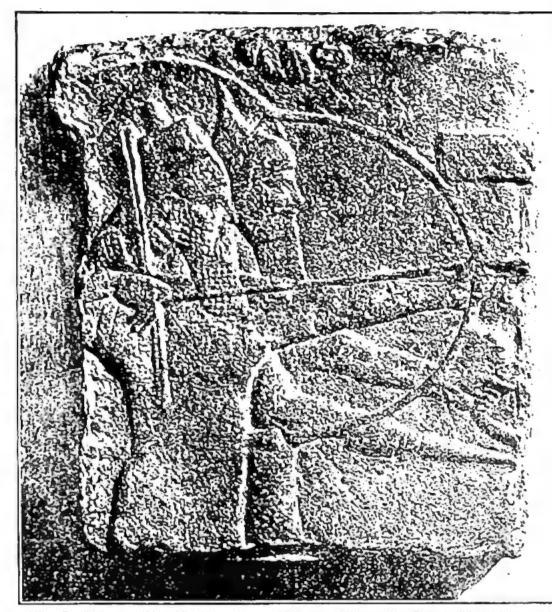
(by E. Unger, Die Reliefs T. 1 III, from Nimrud, Constantinople 1927, pl. 1)
THEGLATHPHALASAR III. - Fragment of a relief from Nimrud: T. wielding the bow in combat.
was fortified at Arpad, he was besieged (743); Sarduris came to his aid with a great army and many allied vassals; all were defeated by T. in the region of Kummuh (Commagene of the classical authors), which compelled the kings of Damascus, Tyre, Kummuh, Què (Cilicia), Gurgum, and Carchemish to pay tribute. Besieged Arpad fell in 740, and the city, the king, the people, and the gods were severely punished, so that later the Rabshakeh (v.) Sennacherib (v.) used this example to inspire terror (Is. 36:19). In 739 T. prepared his attack against Urartu; he placed the regions of Ullubu and Kirþi under direct Assyrian administration. In 738 he had to deal with Azri'āu, usurper of the kingdom of Ja'udi or Šam'al, who led a coalition of 19 other rebellious cities in Syria and Phoenicia. It is debated whether this Azri'āu was identical with Azaria (or Uzziah [v.]), king of Judah; it is, however, more probable that they were different. Azri'āu was defeated, and Panamu II, T.'s faithful servant, who «ran (close) beside the wheel of his lord's chariot... among great kings» (inscription of Bar-Rekub, cf. B. Landsberger, Šam'al, Ankara 1948, pp. 68-72), regained possession of Šam'al. Then Rasin (or Razon [v.]) Manahem (v.) of Samaria also sent tribute, as did Zabibija, queen of Arabia. In 737 T. made another incursion into Media to replenish his supply of horses, advancing as far as the region of Teherān and Demavend («mountain of lapis lazuli»). In 735 came the march toward the capital of Urartu. Sarduris was defeated at the gates of Turušpaš (or Tušpaš), on Lake Van; but T. did not achieve definitive success: the rocks on which the city was built were impassable for siege engines, and the defenders were supplied with provisions by water.
The heavy blow dealt to Urartu allowed T. to turn his attention to the southwest: in 734 he marched on Gaza; he took Gezer (reliefs), after which Hanno of Gaza fled to Egypt. By occupying the region, he isolated the Palestinian and Phoenician powers from Egyptian aid. He then took advantage of the situation reflected in Is. 7 and of the ACAZ (v.), king of Judah, reported in II Reg. 16:7: PHARES (v.), or Péqah of Israel, had placed him in a difficult position by besieging Jerusalem in order to force him to join their coalition. The Assyrian king did not delay in invading Samaria, conquering a great number of cities (II Reg. 15:27-30). Osea (v.) rebelled against Phacee, who fled alone, but later returned to Samaria, where he was murdered by Osea. Osea was confirmed as king by T., but Galilee, the plain of Esdraelon, and Gilead were taken from the Kingdom of Israel to form the Assyrian provinces of Mogidu (Megiddo) and Gal'aza (Gilead). With incredible devastation of the neighboring region, the fate of Razon and Damascus was sealed the following year (732), when Damascus was captured by T.: it was the end of the Aramaeans' independence. The impression was such that, on hearing the news, Mitinti of Ashkelon went mad, and his son hastened to submit as a vassal. While T. held court in conquered Damascus, envoys from Tyre and from Samsi, queen of the Arabs, arrived, after she had suffered an incursion. Achaz (Jauhazi) too, full of zeal for his master and lord, brought him so much tribute that he had to melt down the last metal ornaments of the temple and palace furnishings; he even opened Judah to the religious influence of Assyria, as the affair of the altar shows (II Reg. 16).
In Babylonia, however, a confused situation was developing after the death of Nabonassar (734). His son Nabû-nâdin-zêr was killed in 732, the second year of his reign, by the rebel Nabû-šum-ukin (ruling in 731), who in turn was removed (730) by Marduk-mukin-zêr (Assyrian Ukîn-zêr), chief of the Bît-Amukkani, a Chaldean tribe. T. hastened there in 729 and besieged Ukîn-zêr at Sapia, his extremely well-fortified capital, which it is not known whether he succeeded in capturing. But before its gates he received the submission Merodach-Baladan (v.). At the New Year in Babylon he led Bêl in procession, thereby becoming, through this ritual, king of that Phul (v.).
T. was, in many respects, an innovator and reformer. He prepared his undertakings by systematic methods. He improved the armament of his troops, making it lighter and more practical; he took particular care with the technique of the «chariots». From his time onward, the art of reliefs shows greater «realism» and more indications of landscape. In order to unify his empire, he systematically transferred a large part of the population of the subjugated countries; he was not, however, the first to use such a method, which did not seem as strange in the Ancient East as it does to us (S. Smith): its purpose was to provide employment for the population and to reclaim the land, as well as to amalgamate the various peoples. T.'s administration, harsh in punishment but prudent in works of peace, brought about the revival of industry and agriculture and concerned itself with the fate of the transferred populations. The peoples were transferred, whenever possible, to countries with similar languages—for example, the Aramaeans of Damascus were settled among the Aramaeans east of the Tigris. Desert regions were reclaimed through irrigation, which made a certain degree of prosperity possible for the transferred populations. Commerce and industry also flourished again in the cities of Assyria and among the various regions. Patriotism does not seem to have suffered greatly: the capture of Nineveh in 612 did not result from treachery by that loosely organized population, which, with the exception of Babylonia, which became independent, fought to the last man. - Vedi tav. II.