LACHIS. — An important city of southern Palestine, which in various periods served as a strategic position and stronghold. Sacred Scripture relates that L., inhabited by the Canaanites and ruled by a king, was taken by Joshua (Jos. 10, 3.31 ff.; 12, 11; cf. 15, 21). Roboam, son of Solomon, fortified it, like other cities of Judea, around 920 B.C. (II Par. 11, 9). L. witnessed the death of King Amasia (189 B.C.) beneath the blows of his assassins (II Reg. 18, 19; II Par. 25, 27). In the time of Isaiah, under Ezechia, in 702, the Assyrian king Sennacherib besieged it (II Reg. 14, 19; II Par. 32, 9; cf. Mich. 1, 13) and from there sent messengers to Jerusalem to demand its surrender (II Reg. 18, 17; 19, 18; Is. 36, 2; 37, 8). A century later Nabuchodonosor besieged L. (Ier. 34, 7) and captured it in 589–588 B.C. After the Babylonian exile L. was again inhabited by Jews (Neh. 11, 30).
The name of the city, written La-ki-Ia, occurs several times in the letters (1410–1360 B.C.) from el-‘Amärnah, which reveal the collusion of L. and its princes with the invaders called Habiru (v. [cf. J. Knudtzon, Die El-Amarna-Tafeln, Lipsia 1907–15, nn. 287 ff., 328 ff., 331, 335]). A vivid image of the city besieged by the Assyrians is provided by the contemporary reliefs found at the gates of Sennacherib’s palace at Ninive (H. Gressmann, Altorientalische Bilder, 2nd ed., Lipsia 1927, nn. 137–41; cf. also DB, IV, cols. 15, 23–26).
These biblical and extrabiblical reports naturally arouse the desire to ascertain L.’s exact location as well, and to obtain archaeological information from II. After an initial attempt to identify L. with Tell el-Hes, the identification of L. with Tell ed-Duwejr, near el-Qubejbeh, 25 km. west of Hebron, in the hills between the Philistine plain and the mountains of Judah, is now generally accepted. Tell ed-Duwejr is one of the most important ruin-hills in Palestine and corresponds perfectly to the importance that L. had in history.
Excavations were conducted there in 1932–38 under the excellent direction of J. L. Starkey. These excavations revealed that the city’s origins go back to the third millennium B.C. The first inhabitants settled in the natural caves located on the western slope of the tell. When the population later moved to the site of the present tell, they continued for centuries to bury their dead in those caves; the numerous tombs yielded abundant archaeological material. During the Middle Bronze Age (2000–1600), the city received its first defensive walls. In the Late Bronze Age (1600–1200), it enjoyed great prosperity, extending its suburbs into the ancient defensive ditch, which by then had already been partially filled in. It is noteworthy that during this period a small temple was built in this ditch rather than within the city itself. This ditch-temple, as the excavators called it, provided valuable contributions to knowledge of this archaeological period, among them a water vessel bearing an alphabetic inscription of the Proto-Sinaitic type. The flourishing of this Canaanite period came to an end with the burning of the city in the thirteenth century B.C.; this may perhaps be connected with the Israelite invasion (cf. Jos. 10, 3,31 ff.). During the monarchy, the Israelites undertook to fortify the city effectively against any aggression, surrounding it with a double wall and defending the access ramp and the entrance at the southwest corner with a double gate, one outer and one inner, with towers and strong bastions. The clear signs of destruction, however, show that the city was unable to withstand either the Assyrians or the Babylonians.
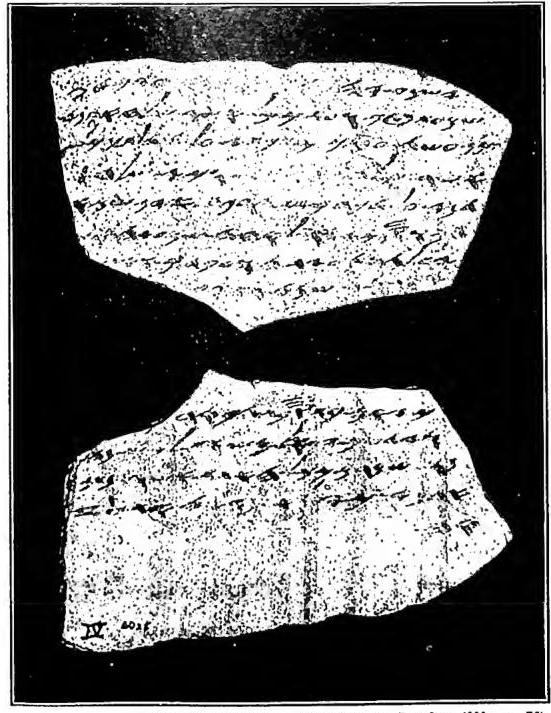
It was precisely in a layer of rubble and ashes from this last Judaean period (ca. 589–588 B.C.), in a passageway of the outer gate, that the most brilliant and absolutely unique discovery was made in 1935: eighteen ostraca (v.), on which several Hebrew words had been written in a firm and practiced hand in the ancient alphabet. In 1938, three more ostraca were found. Most of these documents consist of letters addressed to the defender of L., and are in part perfectly legible. They are the first pre-exilic personal documents found in Palestine. They reflect the social and political life of Jeremiah’s time and of the faltering kingdom of Judah; they speak of prophets, the king, a minister of the king, Jerusalem, a journey to Egypt, and so forth. They mirror the language spoken at that time in Judea: the same perfectly classical Hebrew found in editions of the Law and the Prophets. The ostraca also illustrate the manner in which the biblical text was written at that time.