BIBBIA

BIBLE. – A collection of books regarded as sacred, differing in number between Jews and Christians.

OUTLINE:

I. Names and divisions

II. Sacred character

III. Canon

IV. Original texts

V. Ancient versions

VI. Modern versions

VII. Polyglot Bibles

VIII. Interpretation of the Bible

IX. Reading of the Bible

X. The Bible in literature

XI. The Bible in the Divine Office

XII. The Bible in art.

I. NAMES AND DIVISIONS

The term is the transcription of the Greek βιβλίον (plural of βιβλίον) "books," signifying the books par excellence, the sacred books that form the aforementioned collection. In Vulgar Latin, as in similar cases, it became a feminine singular, *biblia*, from which it has further passed into the various modern languages: Italian *biblia*, French *bible*, Spanish *biblia*, English *bible*, etc. The same collection, by a similar process, is also called the Scripture par excellence, or Sacred Scripture. This term corresponds to the Greek διὰ γραφή (διὰ γραφή, αἱ γραφή, αἱ γραφή, αἱ γραφή, αἱ γραφή, αἱ γγραφή, αἱ γγραφή, αἱ γγραφή, αἱ γγραφή, αἱ γγραφή), which was already employed in antiquity and is still in use among the Greeks.

This collection of books differs in quantity among the Jews and among Christians, and among Christians it differs between Catholics and non-Catholics. Christians, without distinction, divide the collection into the Old (or Ancient) Testament, which is of Hebrew origin, and the New Testament, which is of Christian origin; for this reason the Jews reject the New Testament. In turn, the Protestants agree with the Jews in the number and quantity of books that constitute the Old Testament, differing from the Catholics.

The ancient Jews divided the books of the Bible (Old Testament) into three groups: the *Tōrāh* "law," that is, the Pentateuch; the *Nēbī'īm* "prophets," that is, their writings; and the *Kēthūbīm*, "writings (sacred)," that is, the hagiographa. This grouping is very ancient, and is already found in the 2nd century B.C. in the prologue prefixed to the book of Ecclesiasticus by its Greek translator; it is the most commonly used by present-day Israelites to designate the Bible, less frequently by them with the comprehensive terms *sēphārīm*, "sacred books," *kithbīhē haq-qōdēs*, "holy writings," and the like.

With reference to content, the books of the Old Testament can be grouped into legal books, or historical-legal, which contain especially the sacred legislation of the Hebrew people; historical books, which narrate the history of that people; prophetic books, containing writings composed by the Hebrew prophets; sapiential or didactic books, which impart especially practical norms for honest and wise conduct.

As to literary form, the books of the Old Testament are either prosaic or poetic: some, especially the legal books, use only prose; others, like the book of Psalms, only poetry; others mix the two, usually giving greater or lesser predominance to poetry, as in Job and the prophetic books.

The New Testament, in terms of content, consists of historical writings, such as the Gospels and the Acts of the Apostles; didactic writings, such as the various Epistles or Letters; and one prophetic writing, which is the Apocalypse.

The term Testament, by which Christians designate the two parts of the entire Bible, has a historical-theological meaning, as it alludes to the two great periods in which the divine Revelation was realized. The term corresponds to the Hebrew bērith, and to the Greek διαθήκη, both indicating a "covenant" or "alliance" concluded between several persons, and more recently the "testament" made by a dying person regarding their own goods. Thus, as Old Testament (cf. Hebr. 8, 13) was designated the ancient period of the Revelation in which God had made a "covenant" or "alliance" with the single nation of Israel; as New Testament (cf. Mt. 26, 28; II Cor. 3, 6), instead, was designated the second period, in which the ancient "covenant" was replaced by the new one and all nations were indistinctly called to participate in the fruits of the redemption of Jesus Christ. And since such redemption is the effect of the death of Jesus Christ, the new "covenant" is at the same time his "testament" (cf. Hebr. 9, 15-17).

Today all the books of the entire Bible are divided into chapters, and each chapter is divided into short sections called "verses"; chapters and verses are numbered in progressive order, and according to this numbering they are cited: e.g., Gen. 3, 15, indicates verse 15 of chapter 3 of Genesis. This division into chapters was introduced at the beginning of the 12th century by the English cardinal Stephen Langton in the text of the Latin Vulgate, from which it was subsequently brought into the Hebrew and Greek texts; the Latin and Greek manuscripts prior to Langton’s time follow other criteria for chapter division, while the Hebrew text is divided in relation to the public reading to be done in the synagogues and according to the norms of the rabbinic schools of the first centuries of Christianity. The division into verses also has the same origin for the Hebrew text; for the New Testament various divisions into verses were attempted over the centuries, until in the mid-16th century that introduced by Robert Estienne (Stephanus) in the Latin Bible prevailed. Often neither the division into chapters nor that into verses corresponds logically to the concepts of the text, and it would be easy to improve in many points: but they now have an exclusively practical value, for citations and comparisons.

Here, therefore, is the list of the books that constitute the Catholic Bible (the asterisk * indicates the deuterocanonical books, the asterisk in parentheses [*] the books that have deuterocanonical sections):

OLD TESTAMENT: A) The Pentateuch (historico-legal books): Genesis; Exodus; Leviticus; Numbers; Deuteronomy. B) Historical books: JONAH; Judges; Ruth; 1 and 2 Samuel (or 1 and 2 Kings); 1 and 2 Kings (or 3 and 4 Kings); 1 and 2 Paralipomenon (or Chronicles); 1 and 2 Esdras (or Ezra and Nehemiah); * Tobit; * Judith; (*) Esther; * 1 and * 2 Maccabees. C) Sapiential or didactic books: Job; Psalms; Proverbs; Ecclesiastes; Song of Songs; * Wisdom; * Sirach. D) Prophetic books: Isaiah; Jeremiah; Lamentations; * Baruch (with the Letter of Jeremiah); Ezekiel; (*) Daniel; 12 Minor Prophets (Hosea, Joel, Amos, Obadiah, Jonah, Micah, Nahum, Habakkuk, Zephaniah, Haggai, Zechariah, Malachi).

NEW TESTAMENT: A) Historical books. Gospels: Matthew; Mark; Luke; John; Acts of the Apostles. B)

Didactic writings. Letters of Paul: Romans; 1 Corinthians; 2 Corinthians; Galatians; Ephesians; Philippians; Colossians; 1 Thessalonians; 2 Thessalonians; 1 Timothy; 2 Timothy; Titus; Philemon; Hebrews. Catholic Letters: James; 1 Peter; 2 Peter; 1 John; 2 John; 3 John; Jude. C) Prophetic book: Revelation.

This is the order, except for 1–2 Maccabees, in which the books of the Bible are arranged in modern editions of the Latin Vulgate. In the Old Testament, however, this order does not correspond to that of the Hebrew Bible or, to a lesser extent, to the Greek Septuagint version from which the Latin Vulgate derives. The order of the first five books (from Genesis to Deuteronomy) is constant; in the Hebrew Bible they form the first group, called the Tôrâh (“Law”). The second group, called Nêbhîm (“Prophets”), is divided in the Hebrew Bible into “former” and “latter”: the former contains the books from Joshua to all the Kings, the latter contains the 12 Minor Prophets, Isaiah, Jeremiah, and Ezekiel. Finally, the third group, called Kêthûbhîm (“Writings”), or Hagiographa, contains in order Psalms, Proverbs, Job, Song of Songs, Ruth, Lamentations, Ecclesiastes, Esther, Daniel, Ezra and Nehemiah, Chronicles. The five books from Song of Songs to Esther inclusive form a separate collection called the Five Scrolls (Hebrew Mêgillôth).

The books of the Old Testament contained in the Hebrew Bible are therefore 24; to these the Latin Vulgate, following the Greek Septuagint, adds the 7 “deuterocanonical” books (8, if the Letter of Jeremiah is separated from Baruch).

II. Sacred Character

At this point a fundamental question naturally arises: why were only the books just listed, and not others, included in the collection called the Bible? What was the criterion by which these alone, unlike others, were chosen, or by what quality were they admitted to the collection called the Bible?

The general criterion for their selection was that ancient tradition—first Jewish and then Christian—recognized them as “sacred” books, in contrast to other books that were not so recognized. The foundation of this recognition, namely the intrinsic quality by which a book was acknowledged as “sacred,” was the book’s “inspiration,” whereby it is not a human book but a divine one, having God as its principal author and man as its secondary or instrumental author. Yet this quality of the Bible’s books is so important, both historically and theologically, that it must be studied separately (v. ISPIRAZIONE).

III. Canon

The Greek word “canon” (κανών), meaning “rule” or “norm,” has been used since the 4th century to designate the collection of the Bible’s sacred books. From that time one speaks of canonical books in contrast to non-canonical ones, depending on whether they are or are not part of the aforementioned collection or canon. The terms protocanonical and deuterocanonical, however, are of more recent formation: they go back to Sixtus of Siena (16th century), who thereby wished to distinguish, among the books that make up the canon of the Old Testament, those that were unanimously recognized by all as part of the collection from those whose inspired character had been questioned over the centuries. This distinction is used almost exclusively by Catholics, since Protestants and Jews call the deuterocanonical books apocrypha, excluding them from the biblical canon. These books, as stated above, are: Tobit, Judith, Wisdom, Sirach, Baruch, the two Books of Maccabees, and certain passages of Daniel (3:24–90; 13; 14) and Esther (10:4–16:24).

Since this character is supernatural, only the Church, as the depositary of the doctrine of Jesus Christ, has the faculty to declare infallibly which book possesses the character of inspiration and is therefore to be included in the biblical canon. Hence the sure criterion for knowing whether a book should form part of this collection is tradition, which goes back to apostolic times. In practice, this criterion also reduces, in various respects, the one advocated by some Catholics of the prophetic or apostolic origin of the books composing the Bible.

I. Canon of the Old Testament

It is undeniable that this tradition, even when its apostolic origin can be securely demonstrated, was not always free from doubt, especially with regard to the canon of the Old Testament. Among the Jews in the 1st century A.D. we find a notable divergence, which perhaps goes back to an even earlier period.

The Jewish historian Flavius Josephus (Contra Apionem, I, 8-9) transmits, without explicitly naming individual titles, a canon that excluded the deuterocanonical books; on the other hand, the Greek version known as the Septuagint, made by Alexandrian Jews several centuries before Christ, also contains the deuterocanonical books, which demonstrates that these books were read in synagogue assemblies and considered inspired. The divergence seems due to a rigorism among Palestinian scribes and rabbis, who tolerated no book originally written in Greek, and who were also suspicious of books originally composed in Hebrew or Aramaic when they did not appear as the work of an author endowed with the prophetic charisma (cf. 1 Macc. 4:46; 14:41); so that the indispensable requirements of a sacred book were almost fixed in the Hebrew language, in the prophetic quality of the supposed author prior to Ezra, and in the Palestinian origin of the book. This rigorism was not shared by the Hellenized Jews of the diaspora, who generally read the Bible in the Greek version. Moreover, there are indications to suppose that even among Palestinian Jews, at first, these books, especially the older ones, were admitted. It suffices to recall that the Jews of the diaspora originally had to receive their canon from their coreligionists in Palestine, the center of all Judaism, and thus received from them also the deuterocanonical books. When, however, later, the rigorism of the Palestinian scribes reduced the canon to the protocanonical books alone, even the Alexandrians accepted this judgment, repudiating the ancient version of the Septuagint. With regard to Jesus Christ and the Apostles, although they left no official catalogue of inspired and canonical books, from their allusions preserved in the New Testament and from their frequent use of the Septuagint, it results in practice that they also considered the deuterocanonical books as inspired. This is also the norm of the earliest Fathers, who indifferently cite or use both series of books (Clement of Rome, Hippolytus, Irenaeus, Tertullian, Clement of Alexandria, Cyprian). So that for the first two centuries there is no uncertainty regarding the inspiration and authority of the deuterocanonical books. Only toward the end of the 2nd century did frequent controversies with the Jews, who now unanimously rejected the deuterocanonical books, lead the apologists not to draw their arguments from these writings not accepted by their adversaries. This was a practical norm to follow, more than a theoretical principle; however, doubts soon arose, even among some Christians. We find symptoms of this in Melito of Sardis (c. 160-80), who in a passage preserved by Eusebius of Caesarea (Hist. eccl., IV, 26) reports as the authentic canon the Palestinian one, explicitly affirming that he is reporting information obtained during a journey to Palestine. The same canon is reported by Origen, who, however, uses the deuterocanonical books as inspired. In later times this opinion spread more noticeably in the Greek Church; it was adhered to

ATHANASIUS, CYRIL OF JERUSALEM, EPIPHANIUS, GREGORY OF NAZIANZUS, and some others, in compiling the list of sacred books, although in practice they did not consistently adhere to that opinion, since it is not difficult to find in their works citations of deuterocanonical books as inspired.

At that time a threefold distinction of the books of the Bible began to circulate among the Greeks: mention was made of certain books or those accepted by all (ὁμολόγουμενα), of controversial books (ἐντολές γόμνα), and of spurious or apocryphal books. The second term included our deuterocanonical books. How little rooted was the rejection of such books is confirmed by the unconditional acceptance of them by numerous other Church Fathers and by the decision of the Council of Constantinople of 692, called the Trullan, which, although in a form not entirely clear, referred to the complete canon, always maintained unchallenged in the Greek Church, at least until the rise of Protestantism.

Article illustration

In the Latin Church the first to adhere to the Jewish canon were HILARY OF POITIERS, RUFINUS OF AQUILEIA, and JEROME. The first two were influenced by the example of ORIGEN, of whom they professed themselves disciples; the third, who before going to the East seems to have accepted the complete canon, with his authority generated doubts in later authors. However, the great majority of writers categorically maintained the inspiration and canonicity of the controversial books. A representative of this opinion was AUGUSTINE, who through his personal work and the conciliar pronouncements he promoted preserved the genuine tradition of the Church. The Roman See had already pronounced itself decisively in favor of these books with INNOCENT I (405); some years later the Decree, erroneously called Gelasian, established the constant norm of faith for the following centuries, until the ecumenical Councils of Florence (1441) and Trent (1546) solemnly sanctioned II. Nevertheless, the authority of JEROME, who had caused some to hesitate and stray in the Middle Ages (HUGH OF ST. VICTOR, NICHOLAS OF LYRA, and a few others), is still felt in ST. ANTONINUS, archbishop of Florence (d. 1459), and in Cardinal CAJETAN (1532), who denied to the deuterocanonical books an authority binding in matters of faith.

Man, while rejecting ecclesiastical tradition, nevertheless showed some hesitation in repudiating the deuterocanonical books, and was content merely to relegate them to the end of his translation. Yet already Andreas Bodenstein (Karlstadt) proved more resolute: in his book De canonicis Scripturis (1520) he adopted the Jewish canon, which soon became universal among Protestants, who thus excluded the disputed books from their editions of the Bible, designating them as apocryphal. The attitude of the Protestants was likewise repudiated by the Greek schismatic Church, which condemned some of its followers who inclined toward the Reformers’ opinion (Cyril Lucaris and Metrophanes Critopoulos); nevertheless, in the 17th century hostility toward the deuterocanonical books spread in Russia, among the Slavic countries, and even in Greece, where it found many adherents, the question of the canon being declared a free and non-dogmatic issue by ecclesiastical authority.

Among rationalistic critics, who deny inspiration, this question assumes a secondary character, since all the books of Scripture are treated like any profane book.

2. Canon of the New Testament

Better documented is the formation of the canon of the New Testament. Here, often the inspired authors themselves indicate the occasion and other circumstances that caused the composition of the writing; we also find clear hints of the formation of more or less extensive collections, containing at least a part of the apostolic writings. St. Peter speaks of the letters of St. Paul as if they enjoyed equal authority to the books of the Old Testament (II Pt. 3, 15-16). The Apostolic Fathers did not hand down a complete catalogue of the books composing the New Testament; often even in their quotations, made more in the sense than literally, it is difficult to determine with exactness the book to which they refer; however, the ever-increasing number of such quotations, more or less direct, in the writings of Clement of Rome, Polycarp, and Ignatius, allows us to believe that such authors, especially the latter, possessed a complete corpus at least of the writings of St. Paul. Other authors bear witness to the existence of other books, such as Papias of Hierapolis for the Gospels, from which Tatian towards the end of the 2nd century composed his Diatessaron. A proof that among the early Christians a canon of the books of the New Testament was already in use is the reaction that arose against Marcion (v.), when he wished to compile another according to his own personal and heterodox principles. From the replies of Irenaeus, Tertullian, and Hippolytus, it is clear that Marcion was not the first to fix a collection of inspired writings, as A. Harnack would have it, but only a reformer of the common canon according to his particular ideas. It may be, however, that his boldness induced the Church to express in a more precise manner its own traditional thought; in fact, from that time (ca. 170-80) comes a document in the Roman Church of the greatest importance for the history of the canon of the New Testament, namely the Muratorian Fragment or Canon, discovered by L. A. Muratori in 1740: it bears witness that four Gospels were recognized as inspired (the first is not mentioned, and only a decade of the second survives, the document being mutilated at the beginning), 13 letters of St. Paul (it does not mention the one to the Hebrews), the Acts, two or three letters of John, the letter of Jude, the Apocalypse, and perhaps two letters of Peter, one of which was controversial.

From this almost official document, it already appears that a slight doubt was forming and persisting: some books are not mentioned at all, others can be read as indicated only if one accepts a fortunate correction of the text, as some scholars wish regarding the letters of Peter. More explicit attestations from later authors confirm a real perplexity in some Churches regarding the admission of certain books. In particular, the letter to the Hebrews and the Apocalypse were contested, for which the doubt was almost divided between the Western and Eastern Church: the former showed reluctance to incorporate the letter

PAULINA, while the other, for reasons especially connected with the margins, harbored a certain distrust of the Johannine Apocalypse.

If we add the doubts and disagreements, manifested here and there, regarding some of the Catholic Epistles, namely James, Jude, 2 Peter, 2 and 3 John, we may count seven controversial books (ἀντιλεγόμενα) even for the New Testament. But this disagreement, due to other reasons but in part also to the difficulty of originally bringing all the inspired writings to every Church, was less profound than that which occurred for the canon of the Old Testament.

Little by little the divergences were smoothed out, the doubts diminished; especially in the West the distrust toward the Epistle to the Hebrews vanished, following the teaching of the great doctors who pronounced themselves in favor of the controversial works. Jerome and Augustine, the Councils of Hippo (393) and of Carthage (397 and 419) supported their admission in a precise manner; in the same sense Pope Innocent I expressed himself (405; Denz-U, nn. 92, 96). In the East, however, the doubts persisted longer; especially in the Church of Antioch, and among the Syrians who followed its lead, there was a reluctance to recognize the canonicity of the Apocalypse and of some Catholic Epistles (2 Peter, 2 and 3 John, Jude). By the time of Justinian every disagreement within the Byzantine Empire had vanished. Among the Syrians recognition came more slowly, since at first their Bibles lacked the disputed books; the rest never admitted the Apocalypse, 2 Peter, 2 and 3 John, Jude, as is attested by Isho'dad of Merv (850) and Ebedjesu (1318).

The uterus at first particularly opposed the Epistle of James, calling it the “epistle of straw,” because it was contrary to his theological cornerstone of salvation by faith alone. In practice, at the beginning of the Reformation there was great disagreement on this point among the most authoritative Protestants; later, little by little, the disputed books were readmitted, so that from the 17th century onward there was no difference regarding the canon of the New Testament between Catholics and Protestants.

For writings not admitted to the biblical canon V. APOCRYPHA.

IV. ORIGINAL TEXTS

A fundamental presupposition in the study of any ancient writing is the fidelity and exactness of the documents that have preserved II. In this respect, no profane writing has had so many investigators throughout the history of its transmission as the Bible, especially the New Testament. Naturally, the investigation extends both to the original texts and to the most important ancient versions.

3. Old Testament

It was written for the most part in Hebrew (with a few brief passages in Aramaic), and only a few of its books, such as 2 Maccabees and Wisdom, were originally composed in Greek; likewise, only in this latter language do we possess the other deuterocanonical books, which were originally written in Hebrew or Aramaic.

The history of the Hebrew text of the Old Testament is quite simple from the first Christian centuries onward, when the text took on a precise form and was subsequently transmitted almost perfectly unchanged. Very little, however, is known of the earlier period, when the text underwent significant modifications, which we can today only vaguely assess. In 1948, biblical scrolls from the 2nd century B.C. were discovered among the mountains of Judea. Many Hebrew codices, although not very ancient (none dating back beyond the 10th century A.D.), were painstakingly collated by scholars, among whom Gian Bernardo De Rossi (q.v.) stands out around 1800; yet this vast work has yielded a homogeneous Hebrew text, since the rare variants are entirely secondary and never deeply affect the meaning. Thus, this minute examination testifies to a text that was already uniform at the time of the drafting of our oldest Hebrew codices. However, this certainty does not extend to the more than a thousand years that separate our codices from the original writings. By resorting to the comparison of ancient versions and following the testimonies of ancient Jewish and Christian writers, one can still trace back to the first centuries of the Christian era; and even for this period, the most scrupulous investigations merely confirm the faithful transmission of the text, safeguarded by the meticulous “hedge around the Torah,” as the vast work of the Masoretes (q.v.) was defined.

Article illustration

But tracing back to the pre-Christian period, the textual divergences appear both evident and significant. For this period we possess the Samaritan Pentateuch, the Septuagint version—which is the most important and was based on a Hebrew text recension prior to the Maccabees—the very brief Nush papyrus, and the writings of Flavius Josephus; in addition to these, even the Hebrew text of the Bible offers clear proof that in ancient times the transmission of the biblical text was not accurate or precise. We indeed find passages repeated several times, even within the same book (as in the Psalms), which often testify to textual diversity hardly attributable solely to scribal errors; moreover, the greater abundance of variants in the books that form the last two collections of the Hebrew Bible (namely the “Prophets” and the “Hagiographa”) demonstrates that these collections arose at a time when scribal activity, which began in the Persian period, was still relatively ineffective. However, such textual divergences, however serious in individual books like Samuel, Ezekiel, Jeremiah, Proverbs, do not affect the overall substance of the individual works. The modifications, when not due to scribal negligence or editorial license, sometimes stem from a misunderstanding of the text, which was often provoked by the imperfections of Hebrew writing, which lacked vowels. The introduction, in fact, of special signs (ca. 6th century A.D.) to indicate Hebrew vowels contributed greatly, together with the entire work of the Masoretes, to preserving the fixed text faithfully; it is the text which, as we have said, was transmitted with singular precision up to the invention of printing.

In 1525 the first complete Hebrew Bible was published in Venice, under the care of Jacob ben Chajjim (the Rabbinic Bible); from that edition up to the critical editions of C. D. Ginsburg (London 1908–26) and R. Kittel (Leipzig 1906; 3rd ed. revised by P. Kahle entirely on the basis of the oldest manuscripts, Stuttgart 1929), printed editions have multiplied, always with the utmost fidelity. Therefore we can say that today we hold in our hands the Hebrew text as it was read in the 1st–2nd centuries A.D., that is, a copy substantially—but not literally—faithful to the lost original autographs. Comparison with ancient versions, particularly with the Septuagint, can often suggest correct emendations; at other times a cautious and well-founded conjecture may restore the original reading.

4. New Testament

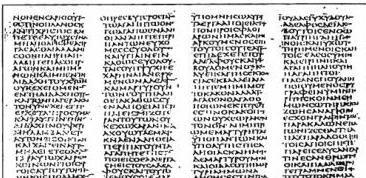
If for the Old Testament we have a wide gap in the history of manuscript transmission, for the New Testament we are more fortunate. No ancient text, not even the most celebrated of classical authors, can boast of manuscripts as numerous and of such high antiquity as those of the New Testament, whose manuscripts number over 4,000; some of them date back to the 4th century, while more or less fragmentary papyri (such as Chester-Beatty, Egerton, etc.) take us back even to the 2nd century. The multitude of manuscripts does indeed present us, it is true, with an extraordinary number of variants, perhaps exceeding the number of words, but this disagreement is much more apparent than real. In fact, most of the variants are either obvious scribal errors or insignificant alterations due to particular spellings in the Greek of the Koine dominated by the "iotacism."

To distinguish the individual manuscripts (a system, in truth, quite complicated and which has therefore gained little acceptance) is found in the highly erudite work Die Schriften des N. T. (4 vols., Berlin-Göttingen 1902-12). However, this work did not fully satisfy scholars; therefore, a commission, headed by E. von Dobschütz, set out to produce a new critical edition of the New Testament.

Numerous manual editions have contributed to the dissemination of the critically scrutinized text: such as the minor edition by von Soden (1913), the widely circulated edition by E. Nestle, based on a comparison of the three major editions (Tischendorf, Westcott-Hort, B. Weiss), those by the Catholics M. Hetzenauer (1892-1900), E. Bodin (2nd ed. 1918), H. I. Volges (2nd ed. 1922), and A. Merk (1933, 6th ed. 1948).

Taking into account the work of von Soden and other critics, scholars today tend to group the manuscripts into three or four classes according to the various books, distinguished by unique characteristics. The first of these classes, which von Soden designated with the siglum H (= Hesychius), is considered the best, as it is free from contaminations due to the influence of parallel passages and less affected by puristic tendencies. The principal manuscripts representing this class are the Vaticanus (B) and the Sinaiticus (s). The second class, marked by von Soden with the siglum I (= Jerusalem) and represented by Codex D (Beza), exhibits various amplifications, paraphrases, omissions, etc., which characterize the so-called Western text. The third family, marked with the siglum K (= Koinē, “common”), has characteristics peculiar to the Antiochene school, particularly due to the influence of Lucian: this family is distinguished by its polished language and its tendency toward additions, with the Codex A (Alexandrinus) being its principal representative. Finally, many manuscripts, according to various scholars, derive from the school of Caesarea in Palestine, such as the Lake and Ferrar groups, which have distinctive features. This classification, proper to the Gospels, undergoes various modifications when applied to the other books of the New Testament. Often a manuscript, depending on the different books, may belong to various families and classes. Of all the classes, the first is the best, being characteristic of Egypt, and it is upon this that critical editions are primarily based (cf. TEXTUAL CRITICISM).

V. ANCIENT VERSIONS

The Bible is today the most widely circulated book in the world; yet this diffusion has been achieved over the centuries only to a small extent by its original Hebrew and Greek texts, and to a far greater extent by the numerous versions in various ancient and modern languages. Indeed, of the original texts, the Hebrew could be read and understood only by a very limited number of people, since the Hebrew language was known by few Jews living outside Palestine, and even by not many of those in Palestine several centuries before the Christian era; the Greek texts, on the other hand, including the entire New Testament, were accessible to a much wider circle, since Greek had been the international language of the Roman Empire in the last centuries B.C., even among the Jews of the Diaspora. However, as Christianity spread to regions where the common language was not Greek, and later as new languages arose in regions already reached by Christianity, the Bible was gradually translated into other languages so that the people might understand the content of the sacred books during liturgy: in fact, the common motive for the preparation of the various ancient versions, first among the Jews and then among Christians, was to enable the Bible to be understood in public and, secondarily, in private liturgical reading.

The long series of versions includes both ancient and modern languages. While some ancient versions began to appear when the canon of the Old Testament was not yet fixed and closed, modern versions continue even today and will continue in the future. Ancient versions are of particular importance as documents for the ascertainment or critical reconstruction of the primitive biblical text, and their importance is usually all the greater the greater the antiquity of the version. Modern versions, in their earliest period, are notable monuments of their respective languages, since the complete or partial translation of the Bible into the vernacular is almost always one of the first products of the various European literatures; in their more recent period, modern versions may have an exegetical value, as essays in the interpretation of biblical meaning.

Since the ancient versions will all be treated individually elsewhere, we give here a collective summary presentation, referring for each to the respective entry.

The earliest translations of the Old Testament were into the Greek language. The oldest, and the only one preserved in its entirety, is that known as the Septuagint (v.), whose beginnings date back to the 3rd century B.C. With the rise of Christianity, this version was adopted by Christians, who drew their biblical quotations from it in their controversies against the Jews. This was the main reason why, during the 2nd century A.D., the Jews repudiated the Septuagint as unfaithful (though previously they had held it in special veneration) and replaced it with other Greek versions, complete or partial, made by Jews and now reaching us only in fragments (v. GRECIA, VERSIONI, della B).

Almost contemporaneously with the translation of the Septuagint, and likewise among the Jews, translations into Aramaic were being formed, which, after the Christian era, began to be committed to writing, thus giving rise to that complex of versions generally called Targums, i.e., “translations” (v. TARGUM).

Meanwhile in the West, with the spread of Christianity there, the need was felt to have the Bible translated into Latin, and particularly into the popular Latin of the time. To meet this need, work began as early as the 2nd century A.D. on one, or perhaps more than one, Latin version, though these were made not from the Hebrew text but from the Greek of the Septuagint. The history of these early Latin versions, sometimes collectively but inaccurately referred to as the Itala, is extremely complicated and has been little explored to this day; they were later in part superseded and in part incorporated into the new version made from the Hebrew text by St. Jerome, now known as the Vulgate (v. VOLGATA).

As early as the 3rd century, versions into Coptic began to be made for the use of Christians in Egypt, i.e., into that language formed from a mixture of ancient Egyptian and Greek which was spoken there by the lower classes. Coptic versions exist in the southern dialect, or Sahidic, in the dialects of Middle Egypt, i.e., Fayyumic and Achmimic, and in the northern dialect, or Bohairic, all based on the Greek text of the Septuagint, and only part of them have come down to us (v. COPTE, VERSIONI, della B).

In Syriac, the Old Testament was begun to be translated between the 2nd and 3rd centuries AD directly from the Hebrew text; then the deuterocanonical books were translated from the Greek of the Septuagint, and the series thus completed was called the Pēšītā version, “simple.” The New Testament was translated several times and according to various criteria: the earliest translation is that of the Diatessaron of Tatian (q.v.), in which he combined the four Gospels, hence called “mixed”; a little later, but already in the 2nd century, the Gospels were translated separately, hence called “separate,” of which we have two different recensions, the Curetonian (from its discoverer W. Cureton [q.v.]) and the Sinaitic (from the place where it was found). In the 5th century a new version, or radical revision, of the New Testament appeared, attributed to Rabbūlā of Edessa, which was joined to the Pēšītā of the Old Testament; Rabbūlā’s text lacked the deuterocanonical books of the New Testament, which were added later. Later Syriac versions are: the Philoxenian (6th century), from the Septuagint text according to the recension of Lucius; the Syro-Hexaplar (7th century), from the Septuagint text according to the recension of the Hexapla of Origen; and some others of lesser importance (q.V. SIRACH, VERSIONS, sub B).

The Ethiopian or Abyssinian version was begun in the 5th century: based on the Greek text of the Septuagint, it was later subjected to some revisions. The Armenian version (q.V. MESROP), of the 5th century, was based on the Greek text of the Septuagint. The Gothic version was completed in the 4th century, on the Greek text of the Septuagint, by Ulfilas, the Arian bishop of the Goths. The Georgian version seems to date to the 5th century; it was based on the Greek text of the Septuagint but also shows the influence of the ancient Armenian version. The Old Slavonic (paleoslavic) version was begun in the 9th century by SS. Cyril and Methodius; later it underwent numerous additions and modifications. The Arabic versions, of various types, do not go back beyond the 9th century and depend on Hebrew or Greek texts according to the different authors.

Article illustration
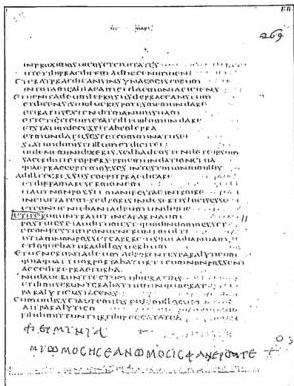
(From Coder Bovar, *Phatnomyhies repraesentatus*, Cambridge 1989. Bihina - Greek-Latin text. Codex Beza (D), 6th century. Latin text of Afr. 1, 38-2, 3.)

VI. MODERN VERSIONS

Italian. - The first attempts at translating the Bible into the vernacular in Italy date back to before Dante. More than true translations, these are usually amplifying and explanatory paraphrases, made for devotional purposes, and extended to individual books or only to extracts, especially from the Gospels. The vernacular used is usually Tuscan, sometimes Venetian. The text from which the translation is made is normally the Latin of the Vulgate, in some cases represented by one of the recensions prior to that fixed at the University of Paris at the beginning of the 13th century, which soon spread also to Italy: this would lead to the conclusion that some of these vernacularizations date back to the early 1200s; exceptionally, translations were also made from French versions. These early attempts, almost all unpublished, have not yet been sufficiently explored and studied.

With the 14th century, the first complete Bibles in the vernacular began to appear, resulting from the combination of previous partial translations, mostly anonymous; so that, depending on the choices made by the different compilers, the complete copies could differ in the various books translated. These Bibles, still transmitted in manuscript form, are today very rare and almost always, either due to the incompleteness of the original collection or to the ravages of time, lack some books. Sometimes individual books bear the name of the translator at the head: among the various names mentioned, the most worthy of note is Fra Domenico Cavalca, to whom the translation of the Acts is attributed; this attribution is also found in solitary copies of that book, but it always leaves room for doubt as to whether Cavalca was not the translator but only the authoritative reviser of a previous translation of the Acts, as seems to result from a comparison of the texts contained in the various copies. Other famous names put forward in connection with 14th-century vernacular Bibles, such as Iacopo da Varagine and Iacopo Passavanti, have no justification in the manuscript tradition. A famous example of these complete Bibles is the one once belonging to Francesco Redi (now preserved only from Genesis to part of the Psalms: Florence, Laurenziana Ashburnham 1102, from the year 1466); Redi used it for the annotations to his Dittamno and the Accademia della Crusca for its Vocabolario.

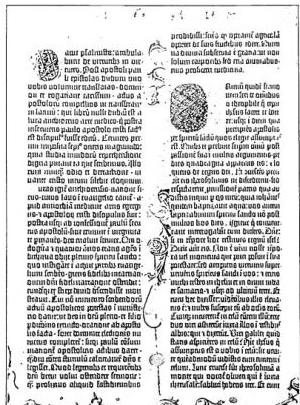
With the invention of printing, the complete vernacular Bible soon came to the fore with two editions in 1471, both in Venice. The first appeared on 1 August (B. d'ag.) from the presses of the German printer Vendelino da Spira with the title B. dignamente vulgarizzata per il clarissimo religioso duon Nicolao Malermi Veneziaio..., 2 vols. in-fol., in 2 columns; the seco

Article illustration
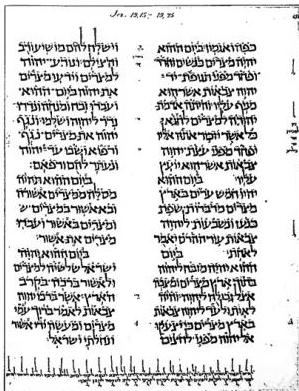
(from the Babylonian-Petropolitan Codex, edited by H. Stier, Hamburg 1630.

Bible — Hebrew text. Petropolitan Codex (year 1009). Is. 20, 1-21,6. It contains, besides the Hebrew text, the marginal masorah. The vowel signs are those of the Babylonian system, preceding the Tiberian, now in use.

B. thus completed certainly showed a fidelity and uniformity that partial translations could not have, but it also greatly damaged their fourteenth-century language, thereby considerably diminishing their almost unique merit. Nevertheless, the B. of Malermi enjoyed great favor, which had many editions during the incunabula period and almost 20 throughout the sixteenth century; the edition published in Venice in 1773, although it still bears the name of Malermi, is in reality a reworking by the Paduan Alvise Guerra, of Jansenist tendencies, who largely replaced the ancient translation with his own or others’. The “B. d’ott.”, i.e., the Jensonian, used fourteenth-century manuscripts without altering them—as it seems—but perhaps integrating them where they were lacking with passages taken from the “B. d’ag.”; it is certain that the two B. agree almost verbatim in the New Testament and also in the Psalms, while they differ greatly in the Old Testament. Because it was so rough and of varied origin, the Jensonian B. found no favor and was never reprinted, becoming extremely rare. It was, however, published again during the nineteenth century, due to the renewed love for vernacular texts of the “good century” of the language: but an initial attempt by the Venetian Society of Bibliophiles stopped at the first volume (B. volgare, testo di lingua secondo l’edizione del 1471 di Nicolò Fenson, Venezia 1846) because of difficulties arising with ecclesiastical authority and the printer, and all copies ended up destroyed in the printing house or scattered; it was instead Carlo Negroni who managed to produce the complete edition (La B.Volgaresecondola raraedizione del ott. MCCCXLXI. 10 voll., Bologna 1882-87). The text of the Jensonian has value not for biblical criticism, but only for the history of the Italian language, although even on this point some exaggeration has occurred.

There are then many editions of fourteenth-century versions, especially of the Psalms, printed during the nineteenth century out of love for linguistic texts: these therefore interest philologists.

At the time of Protestantism, biblical versions of a new kind also began to appear in Italy. Almost contemporaneously with Luther’s German Bible, there appeared in Italy the version by the Florentine Antonio Brucioli, first limited to the New Testament (Il Nuovo Testamento di Cristo Jesu Signore e Salvatore nostro, di greco nuovamente tradotto in lingua toscana, Venezia, Lucentino Giunti, 1530, reprinted several times subsequently) and shortly afterward extended to the whole Bible (La B., quale contiene i sacri libri del Vecchio Testamento tradotti nuovamente da la hebraica verità... Coi divini libri del Nuovo Testamento, in-fol., Venezia, Lucentino Giunti, 1532).

Il Brucioli was of marked Protestant tendencies, although officially he did not separate from the Church, and his version, which soon became common among exiled Italian Protestants, was placed on the Index already in 1559; as for his literary nature, it is a rough and uncultured translation, and his alleged determination of the original texts was in reality achieved through the assiduous use of Sante Pagnini’s Latin version for the Hebrew text and that of Erasmus for the New Testament. It was reprinted several times, even with Brucioli’s commentaries in which his Protestant tendencies appear more clearly; a new edition with extensive modifications was prepared for the use of the Protestants of Geneva (there, at Francesc Duomo, 1562) by Filippo Rustici.

From the Catholic side, shortly after Brucioli’s version, there appeared that of the Dominican from the Florentine convent of S. Marco, Sante Marmochino (La B. nuovamente tradotta dalla Hebraica verità in lingua Thoscana per Maestro Santi Marmochino, in-fol., Venice, Lucantonio Giunti, 1538).

This version, which the author claims was completed in twenty-two months, was in reality based more on Sante Pagnini’s related version than on the Hebrew text itself, with frequent recourse to the Vulgate; for the New Testament it employs the version made shortly before by Fra Zaccaria of the same convent of S. Marco, based on the Greek text (Il nuovo Testamento tradotto in lingua toscana dal r. p. fra Zaccheria, Venice, Lucantonio Giunti, 1536). Marmochino’s version met with little favor and was reprinted only in 1546.

During the same 16th century, there were numerous partial versions of the Bible, especially of the New Testament; some were published even outside Italy, and very many were in verse. Almost all of them are devoid of any scientific value, and those in verse also lack literary merit; some betray Protestant tendencies. Yet how widespread in Italy were the vulgar versions of the Bible, even before Protestantism arose, is shown by the preface that the regular canon Isaia or Esaya da Este Patavino prefixed to his *Expositione sopra la cantica di Salomone*, printed in 1504 in Venice “by Bartolameo de Zanni da Portese.” There he justifies himself for having written this biblical exposition not in Latin but in the vernacular, affirming that it was “necessary for many”: “because of the cheapness of printing, the whole most sacred Bible had been reduced to this lowliness; and from the Sundays, and whichever one brings and reads it, among the spinning wheels of wool, in the gatherings (company, groups) of neighbors it was discussed, in which even the Canticle was included.” It is possible that when the author speaks of “the whole most sacred Bible” he is alluding to the two Venetian editions of 1471, the only complete ones that existed in his time, but he certainly intends also to refer to other partial editions that appeared here and there after those, and which, taken together, constituted almost as many complete Bibles. Moreover, it is highly significant that these versions were extremely widespread among the common people, so much so that they were sung “by little women among the distaffs and spindles.”

A curious piece of information is then offered by a biography of St. Charles Borromeo (preserved in an unpublished manuscript consulted by the author of the present article), according to which this Paul [i.e., Charles Borromeo] before his death (1590) “wished that the Bible be printed in the Italian language, a language known to all, so that they might read it,” and this wish of his was carried out in the press of His Holiness. But since this vernacular translation seemed untimely to various cardinals and to Philip II, King of Spain, the latter sent his own ambassador from Rome to remonstrate with the Pope, who however dismissed the ambassador in a violent manner. Yet of this Roman edition no trace whatever exists (cf. on this point J. Le Long, *Bibliotheca Sacra*, I, Paris 1723, pp. 357–58).

There followed a long period in which in Italy Catholics ceased to produce new translations or editions, because of the rule established in 1559 and reaffirmed in 1564 by the Index to halt the spread of Protestantism, a rule that required a special written permission to read the Bible in the vernacular. In this period there appeared the most important Protestant version, due to Giovanni Diodati (q.v.), published with notes in 1607 in Geneva.

At this time, vernacular Bibles in Italy were practically represented only by Protestant texts. This concerned Benedict XIV, who, by a decree of the Index of 13 June 1757, modified the previous rule, allowing the reading of vernacular versions approved by the Holy See or published under the supervision of the bishops; moreover, the same Pope, privately, recommended the preparation of a new Italian version conducted in accordance with these norms. This greater freedom soon produced its effects, and within a few years three new Italian versions were published.

The first was that which appeared in 1773 as a reprint of the Malermi Bible, though in reality it was almost entirely a new work by Alvise Guerra, of whom mention has been made above. The second depended on the French Bible known as the Port-Royal Bible, due to Isaac Louis Le Maistre de Sacy, and published under the title *Sacra Scrittura giusta la Volgata in lingua latina e volgare colla spiegazione del senso letterale e del senso spirituale tratta dai Santi Padri e dagli autori ecclesiastici dal Sign. Le Maistre de Sacy* (Venice 1775–85). However, in the Italian edition, while the notes are those of Le Maistre de Sacy, the text is translated not from the French but with great fidelity from the Latin of the Vulgate.

The third was the Bible of Antonio Martini (q.v.), who produced an entirely new work for his time and circumstances. Of this, the New Testament first appeared (6 vols., Turin 1769–71), dedicated to King Charles Emmanuel III and soon reprinted, followed by the Old Testament (16 vols., ibid. 1776–81). Welcomed by most with praise, and by some with such bitter hostility that an attempt was even made to have it prohibited by the Church, Martini’s version was praised in a brief of Pius VI addressed to the author on 17 March 1778. However, the Tuscan Jansenists sought to appropriate it by producing a spurious edition, which nevertheless was limited to the New Testament and a small part of the Old Testament (11 vols., Florence 1779–83). The many editions, both complete and

**The text of the version in volgare**

**The text of the version in volgare**

**The text of the version in volgare**

**The test o of the version in volgare**

**The text of the version in volgare**

**The text of the version in volgare**

**The text of the version in volg are**

**The text of the version in volgare**

**The text of the version in volgare**

**The test o of the version in volgare**

**The text of the version in volgare**

**The text of the version in volgare**

**The text of the version in volg are**

**The text of the version in volgare**

**The text of the version in volgare**

**The test o of the version in volgare**

**The text of the version in volgare**

**The text of the version in volgare**

**The text of the version in volg are**

**The text of the version in volgare**

**The text of the version in volgare**

**The test o of the version in volgare**

**The text of the version in volgare**

**The text of the version in volgare**

**The text of the version in volg are**

**The text of the version in volgare**

**The text of the version in volgare**

**The test o of the version in volgare**

**The text of the version in volgare**

**The text of the version in volgare**

**The text of the version in volg are**

**The text of the version in volgare**

**The text of the version in volgare**

**The test o of the version in volgare**

**The text of the version in volgare**

**The text of the version in volgare**

**The text of the version in volg are**

**The text of the version in volgare**

**The text of the version in volgare**

**The test o of the version in volgare**

**The text of the version in volgare**

**The text of the version in volgare**

**The text of the version in volg are**

**The text of the version in volg are**

**The test o of the version in volg are**

**The text of the version in volg are**

**The text of the version in volg are**

**The text of the version in volg are**

**The text of the version in volg are**

**The text of the version in volg are**

**The test o of the version in volg are**

**The text of the version in volg are**

**The text of the version in volg are**

**The test o of the version in volg are**

**The text of the version in volg are**

**The text of the version in volg are**

**The test o of the version in volg are**

**The text of the version in volg are**

**The text of the version in volg are**

Il testo della versione in voll gare

Il test o della versione in voll gare

Il testo della versione in voll gare

Il testo della versione in vollgare

Il testo della versione in voll gare

Il test o della versione in voll gare

Il testo della versione in voll gare

Il testo della versione in vollgare

Il testo della versione in voll gare

Il test o della versione in voll gare

Il testo della versione in voll gare

Il testo della versione in vollgare

Il testo della versione in voll gare

Il test o della versione in voll gare

Il testo della versione in voll gare

Il testo della versione in vollgare

Il testo della versione in voll gare

Il test o della versione in voll gare

Il testo della versione in voll gare

Il testo della versione in vollgare

Il testo della versione in voll gare

Il test o della versione in voll gare

Il testo della versione in voll gare

Il testo della versione in vollgare

Il testo della versione in voll gare

Il test o della versione in voll gare

Il testo della versione in voll gare

Il testo della versione in vollgare

Il testo della versione in voll gare

Il test o della versione in voll gare

Il testo della versione in voll gare

Il testo della versione in vollgare

Il testo della versione in voll gare

Il test o della versione in voll gare

Il testo della versione in voll gare

Il testo della versione in vollgare

Il testo della versione in voll gare

Il test o della versione in voll gare

Il testo della versione in voll gare

Il testo della versione in vollgare

Il testo della versione in voll gare

Il testo della versione in voll gare

Il testo della versione in vollgare

Il testo della versione in voll gare

Il testo della versione in voll gare

Il testo della versione in vollgare

Il testo della versione in voll gare

Il testo della versione in voll gare

Il testo della versione in vollgare

Il testo della versione in voll gare

Il testo della versione in voll gare

Il testo della versione in vollgare

Il testo della versione in voll gare

Il testo della versione in voll gare

Il testo della versione in vollgare

Il testo della versione in voll gare

Il testo della versione in voll gare

Il testo della versione in vollgare

Il testo della versione in voll gare

Il testo della versione in voll gare

Il testo della versione in vollgare

Il testo della versione in voll gare

Il test o della versione in voll gare

Il testo della versione in voll gare

Il testo della versione in vollgare

Il testo della versione in voll gare

Il test o della versione in voll gare

Il testo della versione in voll gare

Il testo della versione in vollgare

Il testo della versione in voll gare

Il test o della versione in voll gare

Il testo della versione in voll gare

Il testo della versione in vollgare

Il testo della versione in voll gare

Il test o della versione in voll gare

Il testo della versione in voll gare

Il testo della versione in vollgare

Il testo della versione in voll gare

Il test o della versione in voll gare

Il testo della versione in voll gare

Il testo della versione in vollgare

Il testo della versione in voll gare

Il test o della versione in voll gare

Il testo della versione in voll gare

Il testo della versione in vollgare

Il testo della versione in voll gare

Il test o della versione in voll gare

Il testo della versione in voll gare

Il testo della versione in vollgare

Il testo della versione in voll gare

Il test o della versione in voll gare

Il testo della versione in voll gare

Il testo della versione in vollgare

Il testo della versione in voll gare

Il test o della versione in voll gare

Il testo della versione in voll gare

Il testo della versione in vollgare

Il testo della versione in voll gare

**The text of the version in volgare**

**The text of the version in voll gare**

**The test o of the version in voll gare**

**The text of the version in voll gare**

**The text of the version in volgare**

**The text of the version in voll gare**

**The test o of the version in voll gare**

**The text of the version in voll gare**

**The text of the version in volgare**

**The text of the version in voll gare**

**The test o of the version in voll gare**

**The text of the version in voll gare**

**The text of the version in volgare**

**The text of the version in voll gare**

**The test o of the version in voll gare**

**The text of the version in voll gare**

**The text of the version in volgare**

**The text of the version in voll gare**

**The test o of the version in voll gare**

**The text of the version in voll gare**

**The text of the version in volgare**

**The text of the version in voll gare**

**The test o of the version in voll gare**

**The text of the version in voll gare**

**The text of the version in volgare**

**The text of the version in voll gare**

**The test o of the version in voll gare**

**The text of the version in voll gare**

**The text of the version in volgare**

**The text of the version in voll gare**

**The test o of the version in voll gare**

**The text of the version in voll gare**

**The text of the version in volgare**

**The text of the version in voll gare**

**The test o of the version in voll gare**

**The text of the version in voll gare**

**The text of the version in volgare**

**The text of the version in voll gare**

**The test o of the version in voll gare**

**The text of the version in voll gare**

**The text of the version in volgare**

**The text of the version in voll gare**

**The test o of the version in voll gare**

Il testo della versione in volgare

Il testo della versione in volgare

Il testo della versione in volgare

Il testo della versione in volgare

Il testo della versione in volgare

Il testo della versione in volgare

Il testo della versione in volgare

Il testo della versione in volgare

Il testo della versione in volgare

Il testo della versione in volgare

Il testo della versione in volgare

Il testo della versione in volgare

Il testo della versione in volgare

Il testo della versione in volgare

Il testo della versione in volgare

Il testo della versione in volgare

Il testo della versione in volgare

Il testo della versione in volgare

Il testo della versione in volgare

Il testo della versione in volgare

Il testo della versione in volgare

Il testo della versione in volgare

Il testo della versione in volgare

Il testo della versione in volgare

**The test or of the version in voll gare**

**The text of the version in voll gare**

**The text of the version in vollgare**

**The text of the version in voll gare**

**The test or of the version in voll gare**

**The text of the version in voll gare**

**The text of the version in vollgare**

**The text of the version in voll gare**

**The test or of the version in voll gare**

**The text of the version in voll gare**

**The text of the version in vollgare**

**The text of the version in voll gare**

**The test or of the version in voll gare**

**The text of the version in voll gare**

**The text of the version in vollgare**

**The text of the version in voll gare**

**The test or of the version in voll gare**

**The text of the version in voll gare**

**The text of the version in vollgare**

me amatito: et redditio quia ego ade quii. Quia per te ade minimitatis et lingua minit. Ade ade per Deum et dignitiis. Ade ade per malum et pere ade. Ade ade.

Quam ade ad.

Quam ade.

Quam ade ad.

Quam ade.

Quam ade ad.

Quam ade.

Quam ade ad.

Quam ade.

Quam ade ad.

Quam ade.

Quam ade ad.

Quam ade.

Quam ade ad.

Quam ade.

Quam ade ad.

Quam ade.

Quam ade ad.

Quam ade.

Quam ade ad.

Quam ade.

Quam ade ad.

Quam ade ad

initiated under the direction of S. Garofalo, of whom the following have appeared to date: *Daniele* (Turin 1947), *Epistole cattoliche* (ibid. 1947), *Ezechiele* (ibid. 1948), *Introduzione generale* (ibid. 1948).

From the Protestant side, there exist various partial translations (New Testament, Psalms, Job) by Giovanni Luzzi, later incorporated into his complete translation *La Sacra B.* translated from the original texts and annotated (12 vols., Florence 1927–30), which largely follows the theories of Lucien Gautier.

French. — Evidence of partial translations of the Bible into the langue d'oïl dates back to the 12th century; around 1100 a monk from Normandy translated the Psalms, surviving in two different recensions, and shortly thereafter the Apocalypse and the four Books of Kings were translated; around 1250 King Louis IX had a translation of the entire Bible prepared for his personal use, which was reproduced in many copies. New versions, following the one ordered by Louis IX, were made by King S. (c. 1350), by Raoul de Presles (1380) at the behest of Charles V, and partially by others. Translations into the langue d'oc or Provençal are preserved for the New Testament in 13th-century manuscripts; older ones, extending also to the Psalms, were some versions that arose among the early inhabitants of the district of Metz (late 12th century), which have not been preserved.

The first printed French Bible is the Bible historiale, a work by Guyart des Moulins who, toward the end of the 13th century, had compiled a kind of Sacred History, taking as its basis the Historia scholastica of Peter Comestor, inserting into it the historical books of the Bible, and publishing this compilation as Livres de la Bible historiales. The biblical books missing from this work, namely those not of a historical nature (Psalms, Prophets, Epistles, Apocalypse), were later added, drawn from the translation of Louis IX already at the beginning of the 14th century; this heterogeneous version became widely diffused, and with the invention of printing it had 12 editions from 1478 to 1542. The first, containing only the New Testament, appeared in Lyon, perhaps in 1478; the first complete edition was published in Paris in 1487 (2 vols. in-fol.) by order of Charles VIII and under the care of his confessor Jean de Rely.

An anonymous translation of the New Testament was printed in Paris in 1523; subsequently expanded with the other books, the entire Bible appeared in Antwerp in 1530. Its author was the humanist Jacques Le Fèvre d'Étaples (Faber Stapulensis), who translated from the Vulgate, rarely from the Greek of the New Testament, though having before him the Bible historiale. Placed on the Index in 1546 for traces of Protestantism, it received a purged Catholic edition (Louvain 1550), which became the usual one for French Catholics until the 17th century.

In Switzerland at Serrières, near Neuchâtel, in 1535 the first Protestant French Bible was published, the work of Pierre Olivétan, who had made extensive use of the versions of Santi Pagnini, of Frasmo, and also of that of Le Fèvre. Olivétan’s translation had various editions, revised by Beza (1551), by Bertrand (1588) and others, and finally by J. F. Osterwald; this last, with further adjustments, became the standard text of French Protestants. Other Protestant versions were those of Sébastien Châtillon (Castellio), rough and incorrect (Basel 1555), Le Clerc (Amsterdam 1703), Le Cène (ibid. 1741), and a few others of lesser importance. Many Catholic versions of the New Testament appeared during the 17th century.

The most widespread of the French translations came from a Jansenist milieu and is the Bible of Port-Royal, commonly known as the “Bible de Sacy” from the name of its principal author (Sacy is an anagram of Isaac Louis Le Maistre). In the translation work Isaac Louis was assisted by his brother Antoine and by Antoine Arnauld, while other Jansenists added most of the notes. The New Testament first appeared in 1667 at Amsterdam, issued under the name of Mons (whence the appellation “Bible de Mons”), and later the Old Testament (Paris 1672–95). Faithful and clear, this version found great favor even among Catholics, and was reprinted many times even without the notes. In the very text of this version Fr.

Louis de Carrière inserted a kind of explanatory paraphrase (Commentaire littéral, Paris 1701-16); this text was later furnished with a lengthy commentary, drawn from various authors, and formed the so-called “B. di Vence” (Avignon 1767-73).

A. Godeau’s translation (Paris 1668) was made from the Vulgate in the form of a paraphrase; that of N. Legros, first published anonymously (Cologne 1739), received a much improved new edition (1753). From the Vulgate translated E. de Genoude (Paris 1820-24), which suffers from inaccuracy; J. Bourassé and P. Janvier (Tours 1865), an illustrated edition by Doré; J. B. Glairé (Paris 1871-73), which enjoyed wide diffusion; A. Arnaud (ibid. 1881); J. Verdunoy (Digne 1927-29). Still in wide use today are those of the publisher P. Lethielleux (D. P. Drach, Trochen and others) in 27 volumes and of L. C. Fillion (8 vols., Paris 1903-1904). Prevailing among Catholics, however, is the translation made from the original texts with brief notes by A. Crampon, La Sainte Bible (7 vols., Tournai 1894-1904), later reprinted in a single volume (rev. ed., Paris 1939). Of rigorously scientific character is the collection Études Bibliques (ibid. 1903 ff.), in which certain books of the Old Testament and almost all of the New have appeared, translated and furnished with ample introductions and commentaries; likewise the series directed by L. Pirot (d. 1939) and A. Tricot, La Sainte Bible (ibid. 1935 ff.), still in course of publication.

Among Jewish translations are to be mentioned that of S. Cahen (18 vols., Paris 1831-39), which carries the Hebrew text en face and critical notes, and that edited under the direction of Zadoc Kahn by the French rabbinate (2 vols., ibid. 1890-1906), very exact in its translation and faithful to traditional Jewish exegesis.

In the Protestant field, E. Reuss’s translation (18 vols., Paris 1874-81) aimed to introduce into practice the results of the German critical school, with the result that it disrupted the traditional order of biblical books according to the presumed chronology of that school; it did not gain wide diffusion. On the other hand, the translation of L. Segond (Geneva 1874, Lausanne 1888, and reprints) met with a favorable reception. Of a popularizing character is the Version synodale (Paris 1914 ff.), published under the auspices of the Société Biblique de France; of a scientific character is the Bible du centenaire (ibid. 1916 ff.) under the auspices of the Société Biblique de Paris.

SPANISH. — Spain had quite early at least partial translations of the Bible into Castilian: a decree of King James I of Aragon, dated 1233, forbade the use of the Scriptures in the vernacular so as to oppose the propaganda of the Albigensians. Under Alfonso X the Wise (1252–86) other versions appeared, partly based on the Vulgate and partly on the Hebrew text, preserved in manuscripts of the Escorial; for Spain was in the Middle Ages an outstanding cultural centre for the Jews, and knowledge of the Hebrew language was widespread there. A translation from the Hebrew was made by the rabbi Moses Arragel of Guadalajara (1430), preserved in the famous manuscript of the House of Alba, published recently (2 vols., Madrid 1920–22). Another translation from the Hebrew was made by Jom Tob Athias and other exiled Jews, the so-called “Ferrariense,” because it was printed at Ferrara in 1533.

At the time of the Reformation the severe restrictions imposed by the Spanish Inquisition meant that in the Catholic sphere only partial translations were prepared, usually of the Gospels and Psalms, and these moreover were published only later. On the other hand, in the Protestant sphere there appeared outside Spain the New Testament of Francisco de Enzinas (alias Dryander or Duchesne, Antwerp 1543), the New Testament with the Psalms by Juan Pérez de Pineda (Venice, actually Geneva 1557), and finally the complete Bible by Casiodoro de Reina, translated from the original texts but conforming to the version of Sante Pagnini, printed at Basel in 1569 and called from its initial device La biblia del Oso. This translation, revised by Cipriano de Valera who published it under his name (Amsterdam 1602), became the usual Bible of Spanish Protestants.

In more recent times Catholics published, besides some partial translations, the complete Bible translated from the Vulgate by Felipe Scio de S. Miguel (Valencia 1790–93), reprinted several times, and another, even better one by Félix Torres y Amat (Madrid 1823–25), reprinted also recently (1928). Two translations based on the original texts have appeared recently in Madrid: Nácar-Colunga (1945), J. M. Bover–F. Cantera (1947).

CATALAN. — Translations of the Bible into the language of Catalonia must have circulated from the 13th century onwards, revised or partially renewed in later centuries, but they remained unpublished. The first printed edition was that of the whole Bible translated by Bonifacio Ferrer, brother of St Vincent, published with revisions by Jacme Borrel (Valencia 1477), of which only a fragmentary copy survives. After this, there were only rare partial editions.

In the 20th century scientific translations from the original texts have been begun, and are still in course of publication.

PORTUGUESE. — The first known Portuguese versions are rather paraphrases and historical summaries. The Epistles and Gospels for the entire liturgical year were translated by Gonzalo Garcia de S. Maria (Saragossa, 1485), and the Catholic Epistles and Letters by Bernardo de Brivega (Lisbon, 1505). Complete translations include a Protestant one begun by João Ferreira de Almeida and completed by others (New Testament, Amsterdam 1681; Old Testament, Tranquebar 1710–53), and a Catholic one by António Pereira de Figueiredo (Lisbon 1778–90), the latter recently reissued with new commentary by Santos Farinha (1902–1904). Other modern versions are paraphrastic or limited to the New Testament; new translations of the entire Bible are now in progress both in Portugal and in Brazil.

ENGLISH. — Already in the 8th century, partial versions of the Bible in Old English existed in the British Isles, though almost all have been lost. In the 14th century, new English versions resumed, beginning with the Psalms translated by William of Shoreham and those by Richard Rolle of Hampole; around 1380, J. Wycliffe translated the New Testament and shortly afterward, assisted by Nicholas of Hereford, the Old Testament as well. This translation, revised by John Purvey (1388), enjoyed wide circulation.

The first printed translation was William Tyndale’s New Testament (Cologne–Worms 1525), followed by his Pentateuch (Marburg 1531). Soon afterward (1535), Miles Coverdale published the entire Bible, based on Luther’s German and the Latin Vulgate and Sante Pagnini’s Latin. A fusion of Tyndale’s and Coverdale’s work appeared as the Matthew’s Bible, edited by John Rogers (Antwerp 1537); with various revisions, it gave rise to the edition prepared by Richard Taverner and to the one known as The Great Bible (both printed in London 1539). The Geneva Bible (Genevan Bible), issued in Geneva 1557–60, met with great success, surpassing even the Bishop’s Bible (London 1568), prepared under the direction of a dozen Anglican bishops and thus of quasi-official authority. All were eventually surpassed by the King James Bible, known as the Authorized Version (London 1611); prepared over seven years by several committees totaling fifty members, it worked from the Bishop’s Bible while comparing it with the original texts and carefully revising it from a linguistic standpoint. For its conceptual and literary merits, the Authorized Version earned and has retained unparalleled prestige to this day and exerted a profound influence on English literature.

Emendations and improvements, requested by the times and by the progress of studies, were proposed repeatedly to the Authorized Version; until, in 1870, a double Anglo-American commission was appointed, which published the result of its work for the New Testament in 1881, for the Old Testament in 1885, and for the deuterocanonical books in 1895. This new revision was called the Revised Version.

Faced with all these English versions, English Catholics produced the ancient translation prepared by exiles in France and based on the Vulgate, of which the New Testament appeared at Reims (1538) and the Old Testament at Douai (1609–10): it has its literary merits and received some revised editions. A new and excellent Catholic translation from the original texts (Westminster Version) is nearing completion.

Among the English versions produced by Jews, the most recent and important is *The Holy Scriptures according to the Masoretic Text* (Philadelphia 1917), prepared by a commission of Jewish scholars especially for synagogue worship.

There are also very many other English translations, almost all of them Protestant, prepared either for popular dissemination or for scholarly purposes; the latter, accompanied by more or less extensive commentaries, form special series.

German. — Fragments of a version in the ancient Romance or Teutonic language date back to the 9th century and come from partial translations. From the 14th century onward, attempts multiplied and spread: thus numerous translations of the entire Bible were produced by various authors, using different methods and in various dialects, but always from the Latin of the Vulgate. The first printed edition, edited by G. Mentel (Strasbourg 1466), reproduces one such complete translation and was reprinted many times during the incunabula period; various editions also included another complete Bible in a different dialect, as well as other partial translations.

At the rise of Protestantism, of which a powerful vehicle was the German Bible of Luther, German Catholics hastened to publish vernacular translations of their own, based on the Vulgate but inspired by Luther’s translation and also taking into account earlier translations. Thus appeared the New Testament of J. Beringer (Speyer 1526) and that of G. Emser (Dresden 1527), the complete Bible of J. Dienenberg (Mainz 1534), that of J. Eck (Ingolstadt 1537), and later that of C. Ulenberg (Cologne 1630), which had various reprints with modifications. Other new Catholic translations were published from the close of the 18th century, among which met with great favor that of the Benedictine H. Braun (Augsburg 1788–97), subsequently revised by M. Feder (1803), by J. Fr. Allioli (1830–32), and by H. Arndt (1899–1901); considerable diffusion was also achieved by that of V. Loch and W. K. Reischl (Regensburg 1851–66), reprinted even recently (1914–15). Many are the Catholic translations made in the 20th century from the original texts; that of N. Schlogl (Vienna 1920–22) was placed on the Index; others include those of P. Riessler and R. Storr (Mainz 1924–34), E. Henne and C. Rösch (1934–40), and the series of scholarly commentaries on the Old Testament (Nikel-Schultz, at Münster) or on the New (Fr. Tillmann) or on both (Feldmann-Herkene, at Bonn).

Among Protestant translations, that of Luther had capital importance in every respect. As early as 1521 Luther began work on the New Testament, publishing it in 1522; for the next twelve years he continued steadily to work on the rest of the Bible, which he published in its first complete edition from the Lufft press at Wittenberg in 1534: Biblia, das ist die gantze heilige Schrifft, Deutsch. Luth. (Wittenberg, MDXXXIV). But even after this edition Luther continued to work on his translation, improving it through nine subsequent editions, down to the final one of 1545, which remained the standard.

The success was enormous: from the single printing house of Lother in Wittenberg alone, between 1534 and 1584, no fewer than 100,000 copies of Luther’s Bible were produced, not counting those from other printing houses. For the followers of the Reformation, the German Bible of 1534 was the greatest gift bestowed by Luther upon the German people. And indeed, the merits of this translation were singularly outstanding from a linguistic and literary standpoint, for with it Luther created, out of a great variety of local dialects, the unified language that would later become that of the German nation.

Quite different, however, is the judgment that must be passed on the scientific and theological value of the work: Luther translated from the original texts, assisted by Melanchthon, Aurogallus (q.v.), and others, while consulting the Septuagint, the Vulgate, especially the translation of Santi Pagnini, and the Postillae of Nicholas of Lyra (so much so that it was said, *Nisi Lyra lyraset, Lutherus non saltasset*); but his knowledge of Hebrew, of which he boasted so much, was not very great, and it forced him on several occasions to seek the opinion of rabbis. Moreover, his work aimed above all at spreading his theological ideas, and this led him to be tendentious in certain points so as to attribute to the biblical text those very ideas of his: the case of Rom. 3:28 is well known, where he translates that man is justified by faith alone, whereas the original text does not contain the word “alone.” Although it became the classical book of Protestantism and of the German nation, Luther’s translation gradually revealed itself as increasingly in need of corrections; and indeed, these were carried out in the countless editions that followed, though with the drawback that the Lutheran text was altered at the whim of individuals. An edition of semi-official authority appeared in 1833, but although it corrected many points in the Lutheran text, it proved inadequate for learned Protestants, who therefore drew up lists of other passages that required emendation.

Outside Germany, the “Zurich Bible” (1530), prepared by Swiss Protestants and later subjected to various corrections and updates, enjoyed great importance and is still popular today. On the other hand, numerous other translations prepared by the various factions of early Protestantism (Antitrinitarians, 1527; Calvinists, 1579; Socinians, 1630) or by later philosophical currents (Pietists, 1726–42; “Rationalists,” 1735) have disappeared from use.

In the 19th century, major series of commentaries with philological-critical character began to appear and were well received: among the most recent, we may recall for the Old Testament those of W. Nowack (*Handkommentar*, Göttingen 1893 ff.), E. Sellin (*Kommentar*, Leipzig 1913 ff.), and O. Eissfeldt; and for the New Testament those of Th. Zahn (*Kommentar*, 1903 ff.) and H. Lietzmann (*Handbuch*, Tübingen 1911).

DUTCH-FLEMISH. — The Flemish-speaking regions produced various paraphrases of either the Gospels or the Old Testament narrative, which are of value only from a philological standpoint. A Catholic translation based on the Vulgate was made by Nicolaas van Winge (Louvain 1548) and revised by Moretus (Moretus; Antwerp 1599). The translation begun by Th. Beelen (Louvain 1850) and left incomplete by him was completed by various continuators and published in Bruges (1849–96) under the care of the Belgian expositor. A new Catholic translation by various collaborators began in 1894; another appeared in 1935 and following years.

Many Protestant translations were made, the first of which, limited to the New Testament, appeared in Antwerp in 1522. The first complete Bible was published in 1526 by the publisher Liesveld (“Liesveld Bible”), often reprinted with improvements. In 1558 there appeared the one called, from the place of publication, the “Emden Bible.” All were surpassed by the State Bible, so called because its preparation, ordered by the Synod of Dort in 1619, was approved by the States General in 1637; it appeared in that year in Leiden and was reprinted very frequently. Other complete versions appeared at the beginning of the 19th century; the version called “synodal,” because ordered by the Synod of 1848, had among its various collaborators the radical critic A. Kuenen. There also exists a translation prepared by Jews (1826 and following).

Other Versions. — Of translations into other languages a brief mention will suffice.

In Russian the oldest versions are in Old Church Slavonic: isolated books were published at the beginning of the 16th century, and the complete Ostrog edition appeared in 1581; subsequently other versions drew closer to the spoken Russian; in the 19th century new complete translations appeared, encouraged by the Russian Bible Society and the British and Foreign Bible Society.

In Polish the first attempts at translation are found in manuscripts of the 14th–15th centuries; the first complete version is that of Jan (Giovanni) of Lublin (Cracow 1561), followed by the better one of Jakub Wujek (there 1593–99), often reprinted even with modifications; the Protestants had the “Danzig Bible” (there 1632), by various authors and often reprinted.

In Hungarian the first attempts date from the 14th century; with the introduction of printing, editions of parts of the New Testament began; the complete version of Gáspár Károlyi (Vizsoly 1590, revised in 1608) is used by Protestants, while that of György Káldi (Vienna 1625, revised in 1862 and often reprinted) is used by Catholics.

In Bohemian (Czech) there were numerous partial versions in the 14th–15th centuries, from which arose the first complete edition (Prague 1488); of singular linguistic importance is the “Kralice Bible” (there 1579–93), the work of the “Bohemian Brethren” used by Protestants, from which in part derive the Catholic “St. Wenceslas Bible” (Prague 1677–1715) and that of Prochaska (1778–80).

In Swedish versions were already circulating in the time of St Bridget of Sweden; the first complete translation is the “B. of Gustavus Vasa,” prepared by Laurentius and Olaus Petri from Luther’s German; the “B. of Charles XII,” prepared on the same model, was the official text until 1917, when it was replaced by a new translation prepared by various learned commissions.

In Danish the first complete translation is the “B. of Christian III” of 1550, which later underwent various revisions.

In Norwegian partial versions appeared already in the 13th century; subsequently, in Norway Danish translations were used—owing to political dependence on Denmark—so that Norwegian translations were not published until the 19th century.

In Irish various types of paraphrastic versions circulated in the Middle Ages, fragments of which have come down to us; the New Testament version by W. O’Donnell (Dublin 1630) is Anglican; the Old Testament was translated by Bedell (London 1686) and partially by the Catholic Mac Hale (Tuam 1861).
VII. B. POLYGLOTS. — The large number of biblical texts, both in the original languages and in ancient versions, soon made it desirable to have these various texts arranged for each passage on a single page, so that at a glance one could perceive the points of agreement and disagreement. As early as antiquity, Origen (q.v.) met this need with his monumental work, the Hexapla (q.v.). More modest attempts were made in the late Middle Ages, from which some manuscripts of the Psalms have survived where the text is arranged in several columns side by side, each corresponding to a different language. The first printed edition was the Psalterium octaplum (Genoa 1516) by the Dominican Agostino Giustiniani, containing in eight columns the Hebrew text and its version, the Vulgate, the Septuagint, Arabic, the Targum and its version, and annotations.

After this partial attempt, the great polyglot editions of the entire Bible began.

The first is the one financed by Cardinal Ximenes de Cisneros and printed in Spain at Alcalá de Henares (Latin Complutum) in 1514–17, known as the “Complutense.” It was edited by Andreas de Creta, assisted by other scholars. It is in six volumes and contains the Old Testament in Hebrew (on the left), the Vulgate (in the center), and the Septuagint with a Latin translation (on the right); for the Pentateuch it adds the Targum of Onkelos with a Latin translation. For the New Testament it offers the Greek and the Vulgate. Volume VI contains a Hebrew (and Aramaic)-Latin lexicon, a Hebrew grammar, and indices. Only 600 copies were printed, at a cost of 50,000 scudi.

The second is the Polyglot printed by Christophe Plantin in Antwerp in 1569–72, also called the “Royal” because it was sponsored by Philip II; it was edited by Arias Montano, in eight volumes. For the Old Testament it offers the texts of the Complutense, adding the Targum even for books after the Pentateuch. For the New Testament it offers the Greek, Latin, and Syriac texts. Volume VI also contains the complete Bible translation by Sante Pagnini; volumes VII–VIII contain lexicons, grammars, and various treatises.

The third polyglot, more sumptuous than all the others, was published in Paris between 1629 and 1645, financed by Le Jay (Jaius) and edited by the Maronites Gabriel Sionita and Abraham Ecchelensis, by Jean Morin, and a few others. It is in ten volumes; in addition to the texts of the Antwerp polyglot, it includes the Samaritan Pentateuch and paraphrase, and the Syriac and Arabic versions (with Latin translations) of the protocanonical books of the Old Testament. Despite its typographic magnificence, the Paris polyglot, though it has its merits, is the least useful for scholarly purposes.

The fourth polyglot, of scientific value superior to all the previous ones, is the London edition, which appeared in 1654–57, edited by the Anglican bishop B. Walton with the assistance of other scholars. It is in six volumes. In addition to the texts of the Paris edition, it includes the Pentateuch and the Gospels in Persian, and the Psalms, the Canticle, and the New Testament in Ethiopic. Volume I contains useful prolegomena by Walton, and Volume VI the critical apparatus. To this edition is to be joined the *Lexicon heptaglottum* of E. Castellus, a notable monument of learning and skill that still retains its value today.

Subsequent polyglots of lesser scope include: that of S. Bagster, which also includes versions in modern languages (2 vols., London 1831; 2nd ed., ibid. 1874); that of R. Stier and W. Theile (4 vols., Bielefeld 1847–55; 5th ed., 1900); that of Ed. de Levante (London 1890); all of these are Protestant. The Catholic one is that of F. Vigouroux, *La Sainte Bible polyglotte* (8 vols., Paris 1898–1909), which offers the Hebrew text, the Septuagint, the Vulgate, and the French, with introductions and notes.

VIII. INTERPRETATION OF THE BIBLE

The Bible is a complex of inspired books, that is, books having God as their principal author and intended for mankind; for this reason some of the Fathers called the Bible a “letter from God to man.” Man is therefore the recipient of this letter, which he must read and understand. But understanding this letter is not easy for many reasons, which arise both from its divine element (the sublimity of revealed truths) and from its human element (the various authors with their particular mentalities, customs, etc.; the vicissitudes of textual transmission, etc.). As an inspired writing, the Bible forms part of the divine Revelation, in which God has revealed mysteries, included prophecies, and imparted norms of faith and morals; moreover, it was written in different languages and at different times, among peoples whose customs differ greatly from those of today, in circumstances that vary from book to book, alludes to historical facts and situations of which we often no longer have clear knowledge, and frequently individual books either depend on older writings now lost or have undergone various kinds of modifications over the centuries. All these facts must be kept in mind when reading the Bible so as to avoid the danger of attributing to it meanings that it does not in fact possess, that is, of making God say what He has never said.

The whole body of rules for interpretation, whether theological or philological-historical, constitutes a separate discipline called hermeneutics (v.). The interpretation or exegesis (v.) of the Bible has had many distinguished exponents, some of whom gave rise to important trends and “schools.”
IX. READING OF THE BIBLE — The practice of reading individual books of the Bible, even before they were collected together, is very ancient both in Judaism and in Christianity. Among the Jews, the Greek and Aramaic versions arose precisely to make the Hebrew text of the Bible intelligible (see above: Ancient Versions). The synagogue reading led to a division of the biblical text into many parts, each of which was to be read on a Sabbath or feast day: at first the Pentateuch, the main object of the reading, was divided into 167 sedarim, corresponding to readings for a three-year cycle; later it was divided into 54 sections (parashot), corresponding to readings for a single year. Subsequently, after the reading from the Pentateuch, a passage (haftarah) from the Prophets began to be read; later still, readings from the Five Scrolls or Megilloth were reserved for certain feasts, namely the Song of Songs at Passover, Ruth at Pentecost, Lamentations on the anniversary of the destruction of Jerusalem (9th of Av), Ecclesiastes at Tabernacles, and Esther at the feast of Purim. From the practice of the synagogues, the reading of passages from the Old Testament was transmitted to the first Christian assemblies, passages which were chosen especially from the prophetic books, as those which most clearly had foretold the future Messiah; soon, however, to these prophetic passages were added readings from the Gospels and the Epistles. But there was no stable and uniform norm for the quality and quantity of biblical passages to be read in Christian assemblies; this depended on local customs as well as on the judgment of the individual bishops who presided over those assemblies. Nevertheless, later, especially from the 6th century, customs and laws began to take shape whose further development and establishment are intertwined with the history of the various Eastern and Western Christian liturgies.

Private reading of the Bible was also very widespread, both in Judaism and in Christianity. The rabbis,

Jerome complains of the irreverent and vulgar character that discussions on Holy Scripture had taken on in his time, which «is what the gossiping old woman, the doting old man, the wordy caviller, and in general all and sundry, arrogate to themselves, tear apart, teach, before having learned it» (Ep. 53, Ad Paulin.). But despite such abuses, there are no traces of

Measures taken by the Church to limit private reading of the Bible up to the Middle Ages. In 1199 Innocent III wrote to the bishop of Metz, instructing him to investigate the origin and intent of certain vernacular translations that were spreading in that region, without, however, condemning in general the reading of the Bible in the vernacular (PL 214, 695-99). Actual prohibitions of vernacular Bibles came shortly afterward, but always limited to certain regions and without the intervention of the Roman See: the Council of Toulouse in 1229 prohibited their use by the laity in the context of the struggles against the Albigensians and Waldensians (in Mansi, XXIII, 197), with the 14th canon; the assembly held in 1234 at Tarragona in Spain under James I issued a similar prohibition also affecting clerics (in Mansi, XXIII, 329); the Council of Oxford in 1408 issued an identical prohibition at the time of its inception; and how common it was, before the Lutheran movement, to read the vernacular Bible is shown, for the Venetian region, by the preface of Isaiah da Este cited above, which states that the entire Bible was sung in gatherings of women spinning yarn. In other Italian regions too it is established that, before Luther, the reading of the Bible in the vernacular was customary (cf. Archivio Storico Italiano, Florence 1842, App. I, p. 334).

Even among Christians, private reading of the Bible, much recommended and widely practiced, became a field of abuses. Already in the early 5th century John Chrysostom urged his faithful not to limit themselves to listening to the reading of the holy books in church, but to reread them at home in order to reflect further on what they had heard in passing and to deepen their understanding (PG 51, 90); on the other hand,

The frequent use of the Bible gave rise to various customs, often moving, sometimes strange, and not infrequently reprehensible. Both Jews and Christians always held the material volume of Holy Scripture in particular veneration: just as in the synagogues the volume of the Law was and is preserved in a special ark, so too in Christian liturgy it is treated with special honors; in the Byzantine rite the honors accorded to the book of the Gospels are equal to those given to the Eucharist.

Similarly, out of respect, the worn-out biblical volumes were not destroyed by the Jews, but were deposited in an underground place near the synagogue, the so-called *gēnizāh*, where they remained unused for centuries. In Christian councils, already from the 8th century, it was customary to place the volume of the Bible at the center, as on a seat of honor; the same was done in tribunals, especially with the volume of the Gospels. A devotional practice among the Jews was the use of *tefillin* (v.) containing certain passages from the Bible (Ex. 13:1–16; Deut. 6:4–9), applied during prayer on the forehead and the left arm (cf. Deut. 6:8); other similar scrolls were buried beneath the doorways of Jewish houses (*mēzūzōth*).

Among Christians, it was customary to wear around the neck a small scroll containing passages from the Gospels; this practice is already attested in the 4th century, and finds its counterpart among Muslims in passages from the Qur’an carried in the same way for devotion. It was also customary to place the volume of the Gospels at the bedside of the sick, or to recite before them John 1:1–14; this prologue was also recited on important occasions in life or in grave dangers: for example, it is said that Christopher Columbus recited it when, during navigation, he was struck by severe storms. Other passages from the Bible, especially from the Psalms, were considered appropriate for various joyful or sorrowful circumstances in life. The Bible was also consulted to make important decisions, to know the future, to uncover hidden things, and to discover secrets: to practice these divinatory *sortes*, a whole formulary gradually developed concerning the manner of opening the biblical volume, reading it, and drawing conclusions from it, etc. Besides these abuses born of superstition, there were also those born of irreverence: among the ancient Jews, it is attested that the Song of Songs was chanted at banquets like a profane song (Toseph., *Sanhedrin*, XII, 10); among Christians, especially in the age of the Renaissance, the custom spread widely of using passages from the Bible to compose jokes, parodies, pasquinades, and similar irreverent and often outright irreverent things, against which the Council of Trent opposed itself (Session IV, *De editt. et usu s. librorum*). But even later, no less incongruous oddities could still be heard from certain preachers, who twisted words and sentences from the Bible to apply them according to their own arbitrary whims—as is recounted of

GALILEI who, wishing to attack his astronomical researches, applied to him the verse "Viri Galilei, quid statis aspicientes in caelum?" (Acts 1:11).

X. THE BIBLE IN LITERATURE

The influence exerted by the Bible upon the various literatures and the figurative arts surpasses that of any other book. Among the Jews, in fact, this influence was quite limited for special reasons: in the literary field, the Jewish production after Christianity and up to the Middle Ages was largely juridical-traditional, and in this respect it may perhaps appear as one vast work of biblical exegesis according to Pharisaic norms, but it offers none of those inventive elements which constitute artistic literature; in the field of the figurative arts, moreover, a very serious obstacle for the Jews was always the ancient prohibition against producing images of living beings, whether of man or of animal (Ex. 20:4; Deut. 4:15-19), so that Orthodox Judaism could not cultivate sculpture or painting except for secondary ornamental purposes. This prohibition was often violated, and recent excavations have brought to light the ruins of synagogues, built in Palestine and elsewhere (Dura-Europos) in the early centuries of the Christian era, in which paintings of biblical characters appear; but such cases always represent exceptions, which under the influence of the surrounding Greco-Roman culture may have been more or less tolerated, but were never approved by Orthodox Judaism.

The first Christians, most of whom came from paganism, while not having this prejudice against artistic representations, spontaneously turned to the Bible as a source of inspiration for literary compositions. Yet the Christian literature that has come down to us from the first three centuries, although rich in biblical themes, is exegetical or homiletic in character: rare are the poetic compositions, some of which are Gnostic. With the 4th century, Christian lyric flourishes in full vigour: in the West, biblical subjects are treated by Juvencus, Prudentius, Paulinus, Sedulius, Marius Victorinus and a few others; in the East, among the Greeks, only Gregory of Nazianzus is worthy of mention, while among the Syrians poets of the highest calibre are St. Ephrem (q.v.). A vast synthesis of the history of mankind from a biblical and apologetic viewpoint is St. Augustine’s *De civitate Dei* (q.v.). Of some importance later will be certain Latin poets (Arator, Venantius Fortunatus), while among the Greeks Romanus the Melodist, George of Pisidia and others will excel.

With the rise and formation of various vernacular literatures in Europe, more or less dependent on classical forms and Christian tradition, the Bible immediately appears as their principal animating force: directly inspired by the Bible are the Anglo-Saxon poet Caedmon (7th c.) in his works, the Heliand and other compositions of early German (9th c.) and French (10th c.) poetry. Biblical themes were very frequently treated in those “mysteries” and sacred representations from which modern drama in various nations draws its first origins. Then comes Dante in Italy, whose Comedy depends for its concepts and expressions on the Bible far more than modern commentators are wont to admit. With the Renaissance, the Bible still exerts wide influence, though its derivations are often distorted, clothed in alien classical expressions or paired with paganizing concepts. Protestantism, by force of its principles, brings about a total adherence to the Bible even in poetic compositions, which seem all the more faithful to the new doctrine the more they draw on biblical material both in thought and in word: Luther’s religious poems and Milton’s Paradise Lost are typical productions of this tendency, among many other German, English, and French writings. Catholic Counter-Reformation reacts to Protestantism in this field as well, but in a piecemeal and occasional manner, stripping the Bible of forms and concepts (used especially in contemporary epic poetry) without producing representative works of particular note. The Latin Catholic poems De partu virginis (1526) by Sant’Anastasio and the Christiade (1535) by M. G. Vida stand apart. Later, the best of Klopstock’s production is biblical, not only in the Messiade (1772) but also in his dramas; his contemporary in Italy is Alfonso Varano, whose biblical Visioni were highly esteemed in his time, especially by Monti. The latter, speaking of the Bible as a literary work, expressed this judgment: “I therefore love David more than the other poets, and I believe no one will wish to condemn this partiality of mine. Homer, Pindar, Virgil are great and majestic: but David (not to mention the Prophets, especially Isaiah) David is something more. Whoever does not perceive the difference between him and them, so much the worse for him. This is a matter of feeling, and whoever cannot convince himself is useless to seek others’ reasons.” Romanticism, by its very spirit, drew copiously from the Bible, in Italy and abroad; the Inni sacri of Manzoni, inspired by and in part even in expression biblical, are, in Carducci’s judgment, the highest level of 19th-century Italian lyric poetry.

BIBLIA: PERIODICALS. — *The Expositor*, London 1875 ff.; *Zeitschrift für die alttestamentliche Wissenschaft*, Giessen 1881 ff. (with supplements from 1896); *The Expository Times*, Edinburgh 1889 ff.; *Revue biblique*, Paris 1892 ff.; *Zeitschrift für die neutestamentliche Wissenschaft*, Giessen 1900 ff. (with supplements from 1923); *Biblische Zeitschrift*, Freiburg 1923, 1923–1930; *Biblica*, Rome 1920 ff.; *Estudios bíblicos*, Madrid 1920–1930, 1942 ff.

ENCYCLOPEDIAS AND SPECIAL DICTIONARIES. — *DB*, 5 vols.; *DB*, 5 vols. I–IV so far. — T. K. Cheyne and J. Sutherland Black, *Encyclopaedia Biblica*, 4 vols., London–New York 1890–1903; H. Guthe, *Kurzes Bibelwörterbuch*, Tübingen 1903; C. Piercy, *Murray’s Illustrated Bible Dictionary*, London 1908; J. Hastings, *Dictionary of the Bible*, 4 vols. with an extra volume, Edinburgh 1910; id., *Dictionary of Christ and the Gospels*, 2 vols., 1910; id., *Dictionary of the Apostolic Church*, 2 vols., 1910; id., *The International Standard Bible Encyclopedia*, 5 vols., Chicago 1915; G. Kittel, *Theologisches Wörterbuch zum Neuen Testament*, 4 vols. so far, Stuttgart 1933–42; K. Galling, *Biblisches Reallexikon*, Tübingen 1937; E. Kalt, *Biblisches Reallexikon*, 2nd ed., 2 vols., Paderborn 1938.
COLLEZIONI CATTOLICHE. — Biblical Studies, Early Christian Writings in Br. 1806-1930; *Études bibliques*, Paris 1903 seq.; Biblical Doubts, Münster in W. 1908-32; Old Testament Treatises, 1910-1920 seq.; New Testament Treatises, 1910-1920 seq.; New Testament Treatises, 1910-1923 seq.; Biblical Newspapers of the Old and New Testaments, Göttingen 1903 seq.; Biblical Newspapers of the Old and New Testaments, Göttingen 1903 seq.; Biblical Newspapers of the Old Testament, Leipzig 1903 seq.; Biblical Newspapers of the Old Testament, Leipzig 1903 seq.; Biblical Newspapers of the Old Testament, Leipzig 1903 seq.; Biblical Newspapers of the Old Testament, Leipzig 1903 seq.; Biblical Newspapers of the Old Testament, Leipzig 1903 seq.; Biblical Newspapers of the Old Testament, Leipzig 1903 seq.; Biblical Newspapers of the Old Testament, Leipzig 1903 seq.; Biblical Newspapers of the Old Testament, Leipzig 1903 seq.; Biblical Newspapers of the Old Testament, Leipzig 1903 seq.; Biblical Newspapers of the Old Testament, Leipzig 1903 seq.; Biblical Newspapers of the Old Testament, Leipzig 1903 seq.; Biblical Newspapers of the Old Testament, Leipzig 1903 seq.; Biblical Newspapers of the Old Testament, Leipzig 1903 seq.; Biblical Newspapers of the Old TestamentT., Leipzig 1903 seq.; Biblical Newspapers of the O. T., Leipzig 1903 seq.; Biblical Newspapers of the O. T., Leipzig 1903 seq.; Biblical Newspapers of the O. T., Leipzig 1903 seq.; Biblical Newspaper of the O. T., Leipzig 1903 seq.; Biblical Newspapers of the O. T., Leipzig 1903 seq.; Biblical Newspapers of the O. T., Leipzig 1903 seq.; Biblical Newspaper of the O. T., Leipzig 1903 seq.; Biblical Newspapers of the O. T., Leipzig 1903 seq.; Biblical Newspapers of the O. T., Leipzig 1903 seq.; Biblical Newspaper of the O. T., Leipzig 1903 seq.; Biblical Newspapers of the O. T., Leipzig 1903 seq.; Biblical Newspapers of the O. T., Leipzig 1903 seq.; Biblical Newspaper of the O. T., Leipzig 1903 seq.; Biblical Newspapers of the O. T., Leipzig 1903 seq.; Biblical Newspapers of the O. T., Leipzig 1903 seq.; Biblical Newspaper of the O. T., Leipzig 1903 seq.; Biblical Newspapers of the O. T., Leipzig 1903 seq.; Biblical Newspaper of the O. T., Leipzig 1903 seq.; Biblical Newspapers of the O. T., Leipzig 1903 seq.; Biblical Newspapers of the O. T., Leipzig 1903 seq.; Biblical Newspaper of the O.T., Leipzig 1903 seq.; Biblical newspapers of the O.T., Leipzig 1903 seq.; Biblical newspapers of the O.T., Leipzig 1903 seq.; Biblical newspaper of the O.T., Leipzig 1903 seq.; Biblical newspapers of the O.T., Leipzig 1903 seq.; Biblical newspapers of the O.T., Leipzig 1903 seq.; Biblical newspapers of the O.T., Leipzig 1903 seq.; Biblical newspaper of the O.T., Leipzig 1903 seq.; Biblical newspapers of the O.T., Leipzig 1903 seq.; Biblical newspapers of the O.T., Leipzig 1903 seq.; Biblical newspaper of the O.T., Leipzig 1903 seq.; Biblical newspapers of the O.T., Leipzig 1903 seq.; Biblical newspapers of the O.T., Leipzig 1903 seq.; Biblical newspapers of the O.T., Leipzig 1903 seq.; Biblical newspaper of the O.T., Leipzig 1903 seq.; Biblical newspapers of the O.T., Leipzig 1903 seq.; Biblical newspapers of the O.T., Leipzig 1903 seq.; Biblical newspaper of the O.T., Leipzig 1903 seq.; Biblical newspapers of the O.T., Leipzig 1903 seq.; Biblical newspapers of the O.T., Leipzig 1903 seq.; Biblical newspaper of the O.T., Leipzig 1903 seq.; Biblical newspapers of the O.T., Leipzig 1903 seq.; Biblical newspapers of the O.T., Leipzig 1903 seq.; Biblical newspaper of the O.T., Leipzig 1903 seq.**TABOR**

The name of a mountain in Palestine, located in the eastern part of the plain of Esdraelon, about 10 km east of Nazareth. It rises almost isolated to a height of 588 m above sea level and 400 m above the surrounding plain. Its shape is that of a truncated cone, with a flat summit covering about 1200 m in circumference. The mountain is composed of limestone and is covered with vegetation, especially on its northern and eastern slopes. The summit offers a magnificent panorama of the surrounding region, including the plain of Esdraelon, the mountains of Galilee, the Jordan Valley, and the mountains of Gilead.

In the Old Testament, Tabor is mentioned as a boundary point between the tribes of Zebulun, Issachar, and Naphtali (Joshua 19:12, 22, 34). It is also noted as a place of worship (Hosea 5:1; Psalm 89:12). According to tradition, it was on Mount Tabor that the Transfiguration of Jesus took place (Matthew 17:1-9; Mark 9:2-8; Luke 9:28-36). This event is commemorated by the construction of a basilica on the summit, which has been a site of pilgrimage since the early Christian centuries.

The mountain has been fortified at various times in history. In the 12th century, the Crusaders built a fortress on its summit, which was later destroyed by Saladin. In the 18th century, the Franciscans established a monastery on the mountain, which still exists today.

BIBL.:
F. M. ABEL, *Géographie de la Palestine*, Paris 1933-1938; G. A. SMITH, *The Historical Geography of the Holy Land*, London 1931; E. SCHÜRER, *Geschichte des jüdischen Volkes im Zeitalter Jesu Christi*, Leipzig 1901-1909; V. TRASFIGURAZIONE.

---

**TABORITI**

A radical faction of the Hussite movement in Bohemia during the 15th century. The name derives from the town of Tábor, founded in 1420 by the Hussites as a center of their religious and political activities. The Taborites were known for their extreme views and military prowess, playing a significant role in the Hussite Wars (1419-1434).

The Taborites rejected the authority of the Church hierarchy, the veneration of saints, and many traditional Catholic practices. They advocated for a return to the simplicity of the early Church, emphasizing the authority of Scripture and the priesthood of all believers. Their leader, Jan Žižka, was a brilliant military commander who organized the Hussite forces into a formidable army.

The Taborites were involved in numerous battles against both Catholic forces and more moderate Hussite factions, such as the Utraquists. Despite their military successes, internal divisions and external pressures eventually led to their decline. The Battle of Lipany in 1434 marked the end of their dominance, though some Taborite communities persisted for several decades afterward.

Article illustration
BIBL.:

H. KAMINSKY, *A History of the Hussite Revolution*, Berkeley 1967; F. G. HEYMANN, *John Žižka and the Hussite Revolution*, Princeton 1955; J. MACEK, *The Hussite Movement in Bohemia*, Prague 1958; V. HUSSITI.

---

**TACITO, CORNELIO**

A Roman historian and senator, born around 56 A.D. in either Gallia Narbonensis or northern Italy. Tacitus is considered one of the greatest historians of ancient Rome, known for his works *Annales* and *Historiae*, which cover the history of the Roman Empire from the death of Augustus to the death of Domitian.

Tacitus' writings are characterized by their critical and often pessimistic view of imperial power, as well as their literary style, which combines rhetorical flourish with a keen analytical mind. His works provide valuable insights into the political, social, and military history of the early Roman Empire. Tacitus also wrote *Germania*, a ethnographic study of the Germanic tribes, and *Agricola*, a biography of his father-in-law, Gnaeus Julius Agricola, who was a governor of Britain.

Despite his critical stance toward the emperors, Tacitus served in various administrative and military positions under several of them, including Nerva and Trajan. His works were largely forgotten during the Middle Ages but were rediscovered during the Renaissance and have since been highly influential in the study of Roman history.

BIBL.:
R. SYME, *Tacitus*, Oxford 1958; M. GRIFFIN, *Seneca: A Philosopher in Politics*, Oxford 1976; C. W. MENDELL, *Tacitus: The Man and His Work*, New Haven 1957; V. STORIOGRAFIA.

---

**TACITO, SILVIO**

(Also known as Pope Innocent VII, 1404-1406). Born Cosimo de' Migliorati in Sulmona, Italy, around 1339, he was elected pope on October 17, 1404, during the Western Schism. His pontificate was marked by the ongoing conflict between the Roman and Avignonese obediences, as well as internal strife within Rome itself.

Silvio Tacito's brief reign was troubled by political instability and financial difficulties. He attempted to mediate between the rival factions but was largely unsuccessful. His efforts to restore order in Rome were hampered by the opposition of the Colonna family and other powerful Roman nobles. He died on November 6, 1406, and was buried in St. Peter's Basilica.

BIBL.:
L. PASTOR, *The History of the Popes from the Close of the Middle Ages*, London 1906-1933; W. ULLMANN, *The Origins of the Great Schism*, London 1948; V. INNOCENZO VII.T., Leipzig 1903 seq.; Biblical newspapers of the O. T., Leipzig 1903 seq.; Biblical newspaper of the O. T., Leipzig 1903 seq.; Biblical newspapers of the O. T., Leipzig 1903 seq.; Biblical newspaper of the O. T., Leipzig 1903 seq.; Biblical newspapers of the O. T., Leipzig 1903 seq.; Biblical newspaper of the O. T., Leipzig 1903 seq.; Biblical newspapers of the O. T., Leipzig 1903 seq.; Biblical newspapers of the O. T., Leipzig 1903 seq.; Biblical newspaper of the O. T., Leipzig 1903 seq.; Biblical newspapers of the O. T., Leipzig 1903 seq.; Biblical newspaper of the O. T., Leipzig 1903 seq.; Biblical newspapers of the O. T., Leipzig 1903 seq.; Biblical newspaper of the O. T., Leipzig 1903 seq.; Biblical newspapers of the O. T., Leipzig 1903 seq.; Biblical newspapers of the O. T., Leipzig 1903 seq.; Biblical newspaper of the O. T., Leipzig 1903 seq.; Biblical newspapers of the O. T., Leipzig 1903 seq.; Biblical newspaper of the O. T., Leipzig 1903 seq.**BIBLICAL JOURNALS OF THE OLD TESTAMENT**

The series *Biblische Zeitungen der A. T.* (Biblical Journals of the Old Testament) began publication in Leipzig in 1903 and continued in subsequent years. These journals were dedicated to the study and exegesis of the Old Testament, providing scholarly contributions, critical analyses, and discussions on biblical texts, historical contexts, and theological interpretations.

BIBL.:
For further studies, see the individual volumes of *Biblische Zeitungen der A. T.*, Leipzig 1903 seq.; and related works on Old Testament exegesis and biblical scholarship.

and of Bible Versions, Amiens 1892; C. R. Gregory, Prolegomena to the 8th major edition of C. Tischendorf’s N. T. graeca, Leipzig 1894; C. D. Ginsburg, Introduction to the Masoretic-Critical Edition of the Hebrew Bible, London 1897; H. von Soden, Die Schriften des N. T. in ihrer ältesten erreichbaren Textgestalt, I. 1-3, Berlin 1902-10; I, 2nd ed., Göttingen 1911; T. H. Weir, A Short History of the Hebrew Text of the O. T., London 1907; C. R. Gregory, Die griechischen Handschriften des N. T., Leipzig 1908; A. S. Geden, Outlines of Introduction to the Hebrew Bible, Edinburgh 1911; E. Jacquier, Le N. T. dans l’Église chrétienne, II: Le texte du N. T., Paris 1913; N. Peters, Der Text des A. T. und seine Geschichte, 3rd ed., Münster 1921; A. Robertson, An Introduction to the Textual Criticism of the N. T., New York 1925; G. Sacco, La Kainé del N. T. e la trasmissione del sacro testo, Rome 1928; G. Pasquali, Storia della tradizione e critica del testo, Florence 1934; M.-J. Lagrange, Introduction à l’étude du N. T., II: Critique textuelle, Paris 1935; C. H. Dodd, The Present Task in N. T. Studies, Cambridge 1936; S. M. Zarb, Il testo biblico, Rome 1939; F. G. Kenyon, Our Bible and the Ancient Manuscripts, London 1939.
POLIGLOTTE. - A. Scheler, Geschichte der Entstehung der berühmten Plantinischen Polyglottenbübel, in Serapeum, 6 (1845), pp. 241-51, 265-72; F. J. Delitzsch, Studien zur Entstehungsgeschichte der Polyglottenbübel des Kard. Ximenes, 3 voll., Lipsia 1871, 1878, 1886; E. Mangenot, Polyglottes, in DB, V, pp. 513-529; M. Revilla Rico, La Poliglotta de Alcalá, Madrid 1917; E. Mangenot, La Polyglotte d'Alcalá, in Revue du clergé français, 101 (1920), pp. 102-14, 150-94, 254-72; D. Ramos Frechilla, La poliglotta de Arias Montano, in Revista española de estudios bíblicos, 3 (1928), pp. 27-1940.
CATHOLIC COMMENTARIES. - Biblia sacra... cum selectissimis litteralibus commentariis, 28 vols., Venice 1745-49; La Sainte Bible avec introd. et commentaires, Paris 1875-94; R. Corneby and others, Cursus scripturae sacrae, 1888; S. Schäfer, Kurzgefasster für catholic schools, London 1901; S. Schäfer, Kurzgefasster wissenschaftlicher Kommentar, Vienna 1901; S. C. Fillion, La Sainte Bible commentée, 4th ed., 8 vols., Paris 1903-1904; J. Nikel, Exegetisches Handbuch zum A. T., Münster in W. 1912; S. F. Tillmann, Die heilige Schrift des N. T., Bonn 1914; F. Feldmann-H. Herkene, Die heilige Schrift des A. T., 1912; S. F. Feldmann-H. Herkene, Die heilige Schrift des A. T., 1912; S. F. Feldmann-H. Herkene, Die heilige Schrift des A. T., 1912; S. F. Feldmann-H. Herkene, Die heilige Schrift des A. T., 1912; S. F. Feldmann-H. Herke, Die heiligen Schrift des A. T., 1912; S. F. Feldmann-H. Herke, Die heiligen Schrift des A. F., 1912; S. F. Feldmann-H. Herke, Die heiligen Schrift des A. F., 1941.
COMMENTARII CATHOLICI. - Biblia sacra... cum selectissimis litteralibus commentariis, 28 voll., Venezia 1745-49; La Sainte Bible avec introd. et commentaires, Parigi 1875-94; R. Corneby et altri, Cursus scripturae sacrae, 1888; S. Schäfer, Kurzgefasster für catholic schools, Londra 1901; S. Schäfer, Kurzgefasster wissenschaftlicher Kommentar, Vienna 1901; S. C. Fillion, La Sainte Bible commentée, 4th ed., 8 voll., Parigi 1903-1904; J. Nikel, Exegetisches Handbuch zum A. T., Münster in W. 1912; S. F. Tillmann, Die heilige Schrift des N. T., Bonn 1914; F. Feldmann-H. Herkene, Die heilige Schrift des A. T., 1912; S. F. Feldmann-H. Herkene, Die heiligen Schrift des A. T., 1912; S. F. Feldmann-H. Herkene, Die heiligen Schrift des A., 1912; S. F. Feldmann-H. Herkene, Die heiligen Schrift des A., 1912; F. Feldmann-H. Herkene, Die heiligen Schrift des A., 1912; S. F. Feldmann-Herke, Die heiligen Schrift des A., 1912; S. F. Feldmann-Herke, Die heiligen Schrift des B., 1912; S. F. Feldmann-Herke, Die heiligen Schrift des B., 1912; S. Feldmann-Herke, Die heiligen Schrift des B., 1912; S. F. Feldmann-Herke, die heiligen Schrift des B., 1912; S. F. Feldmann-Herke, die heiligen Schrift des B., F., 1912; S. F. Feldmann-Herke, die heiligen Schrift des B., F., 1912; F. Feldmann-Herke, die heiligen Schrift des B., F., 1912; S. F. Feldmann-Herk, die heiligen Schrift des B., F., 1912; S. F. Feldmann-Herk, die heiligen Schrift der B., 1912; S. F. Feldmann-Herk, die heiligen Schrift der B., 1912; S. F., 1912; S. F. Feldmann-Herk, die heiligen Schrift der B., 1912; S. Feldmann-Herk, die heiligen Schrift der B., 1912; S. F., 1912; S. F., 1912; S. F., 1912; S. F., 1912; F. Feldmann-Herk, die heiligen Schrift der B., 1912; S. F., 1912; S. F. Feldmann-Herk, die heiligen Schrift der B., 1912; S. F., 1912; S. Feldmann-Herk, die heiligen Schrift der B., 1912; S. F., 1912; S. F., 1912; S. F., 1912; S. F., 1912; F. Feldmann-Herk, die heiligen Schrift der B., 1912; S. F., 1912; S. F. Feldmann-Herk, die heiligen Schrift der B., 1912; S. F., 1912; S. Feldmann-Herk, die heiligen Schrift der B., 1912; S. F., 1912; S. F., 1912; S. F., 1912; S. F.,F., 1912; S. Feldmann-Herk, die heiligen Schrift der B., 1912; S. F., 1912; S. F., 1912; S. F., 1912; S. F., 1912; F. Feldmann-Herk, die heiligen Schrift der B., 1912; S. F., 1912; S. F. Feldmann-Herk, die heiligen Schrift der B., 1912; S. F., 1912; S. Feldmann-Herk, die heiligen Schrift der B., 1912; S. F., 1912; S. F., 1912; S. F., 1912; S. F., 1912; F. Feldmann-Herk, die heiligen Schrift der B., 1912; S. F., 1912; S. F. Feldmann-Herk, die heiligen Schrift der B., 1912; S. F., 1912; S. Feldmann-Herk, die heiligen Schrift der B., 1912; S. F., 1912; S. F., 1912; S. F., 1912; S. F., 1912; F. Feldmann-Herk, die heiligen Schrift der B., 1912; S. F., 1912; S. F. Feldmann-Herk, die heiligen Schrift der B., 1912; S. F., 1912; S. Feldmann-Herk, die heiligen Schrift der B., 1912; S. F., 1912; S. F., 1912; S. F., 1912; S. F., 1912Feldmann-Herk, *Die heiligen Schrift der B.*, 1912; S. F., 1912; S. F. Feldmann-Herk, *Die heiligen Schrift der B.*, 1912; S. F., 1912; S. Feldmann-Herk, *Die heiligen Schrift der B.*, 1912; S. F., 1912; S. F., 1912; S. F., 1912; S. F., 1912; F. Feldmann-Herk, *Die heiligen Schrift der B.*, 1912; S. F., 1912; S. F. Feldmann-Herk, *Die heiligen Schrift der B.*, 1912; S. F., 1912; S. Feldmann-Herk, *Die heiligen Schrift der B.*, 1912; S. F., 1912; S. F., 1912; S. F., 1912; S. F., 1912; F. Feldmann-Herk, *Die heiligen Schrift der B.*, 1912; S. F., 1912; S. F.Feldmann-Herk, *Die heiligen Schrift der B.*, 1912; S. F., 1912; S. Feldmann-Herk, *Die heiligen Schrift der B.*, 1912; S. F., 1912; S. F., 1912; S. F., 1912; S. F., 1912; F. Feldmann-Herk, *Die heiligen Schrift der B.*, 1912; S. F., 1912; S. F. Feldmann-Herk, *Die heiligen Schrift der B.*, 1912; S. F., 1912; S. Feldmann-Herk, *Die heiligen Schrift der B.*, 1912; S. F., 1912; S. F., 1912; S. F., 1912; S. F., 1912; F. Feldmann-Herk, *Die heiligen Schrift der B.*, 1912; S. F., 1912; S. F. Feldmann-Herk, *Die heiligen Schrift der B.*, 1912; S. F., 1912; S. Feldmann-Herk, *Die heiligen Schrift der B.*, 1912; S. F., 1912; S. F., 1912; S. F., 1912; S. F., 1912; F. Feldmann-Herk, *Die heiligen Schrift der B.*, 1912; S. F., 1912; S. F. Feldmann-Herk, *Die heiligen Schrift der B.*, 1912; S. F., 1912; S. Feldmann-Herk, *Die heiligen Schrift der B.*, 1912; S. F., 1912; S. F., 1912; S. F., 1912; S. F., 1912F., 1912; S. F., 1912; S. F., 1912; S. F., 1912; F. Feldmann-Herk, *Die heiligen Schrift der B.*, 1912; S. F., 1912; S. F. Feldmann-Herk, *Die heiligen Schrift der B.*, 1912; S. F., 1912; S. Feldmann-Herk, *Die heiligen Schrift der B.*, 1912; S. F., 1912; S. F., 1912; S. F., 1912; S. F., 1912; F. Feldmann-Herk, *Die heiligen Schrift der B.*, 1912; S. F., 1912; S. F. Feldmann-Herk, *Die heiligen Schrift der B.*, 1912; S. F., 1912; S. Feldmann-Herk, *Die heiligen Schrift der B.*, 1912; S. F., 1912; S. F., 1912; S. F., 1912; S. F., 1912; F. Feldmann-Herk, *Die heiligen Schrift der B.*, 1912; S. F., 1912; S. F. Feldmann-Herk, *Die heiligen Schrift der B.*, 1912; S. F., 1912; S. Feldmann-Herk, *Die heiligen Schrift der B.*, 1912; S. F., 1912; S. F., 1912; S. F., 1912; S. F., 1912; F. Feldmann-Herk, *Die heiligen Schrift der B.*, 1912; S. F., 1912; S. F. Feldmann-Herk, *Die heiligen Schrift der B.*, 1912; S. F., 1912; S. Feldmann-Herk, *Die heiligen Schrift der B.*, 1912; S. F., 1912; S. F., 1912; S. F., 1912; S. F., 1912; F. Feldmann-Herk, *Die heiligen Schrift der B.*, 1912; S. F., 1912; S. F. Feldmann-Herk, *Die heiligen Schrift der B.*, 1912; S. F., 1912; S. Feldmann-Herk, *Die heiligen Schrift der B.*, 1912; S. F., 1912; S. F., 1912; S. F., 1912; S. F., 1912; F. Feldmann-Herk, *Die heiligen Schrift der B.*, 1912; S. F., 1912; S. F. Feldmann-Herk, *Die heiligen Schrift der B.*, 1912; S. F., 1912; S. Feldmann-Herk, *Die heiligen Schrift der B.*, 1912; S. F., 1912; S. F., 1913; S. Feldmann-Herk, *Die heiligen Schrift der B.*, 1912; S. F., 1912; S. F. Feldmann-Herk, *Die heiligen Schrift der B.*, 1912; S. F., 1912; S. F., 1912; S. F., 1912; S. F., 1912; F. Feldmann-Herk, *Die heiligen Schrift der B.*, 1912; S. F., 1912; S. Feldmann-Herk, *Die heiligen Schrift der B.*, 1912; S. F., 1912; S. F., 1912; S. F., 1912; S. F., 1912; F. Feldmann-Herk, *Die heiligen Schrift der B.*, 1912; S. F., 1912; S. F. Feldmann-Herk, *Die heiligen Schrift der B.*, 1912; S. F., 1912; S. Feldmann-Herk, *Die heiligen Schrift der B.*, 1912; S. F., 1912; S. F., 1912; S. F., 1912; S. F., 1912

The use of psalms, hymns, and songs—among which biblical psalms may also be included—is recommended by St. Paul (Eph. 5:19; Col. 3:16).

It must also be kept in mind that a large part of apostolic preaching developed in synagogue gatherings, in which, as Christ did (Lk. 4:16 ff.), so too the Apostles drew material for Christian teaching from the readings of “the Law and the Prophets” (Acts 13:15; 15:21). It is evident that they continued to follow the same method even after believers separated from the synagogue. In this way, the Bible (for Christians, both the Old and New Testaments) became a principal part of Christian worship. Justin, one of the earliest authors to describe the liturgy, expressly mentions the reading of “the memoirs of the Apostles” and “the writings of the prophets” (Apol. I, 67; PL 6, 429). Tertullian, when mentioning biblical readings in the liturgy, adds that of the singing of psalms: *prout Scripturae leguntur aut psalmum canuntur* (De An., 9). From this period onward, witnesses to the use of the Bible in the liturgy multiply: the homilies of the Fathers indicate the readings and biblical songs that had passed into the liturgy.

With the rise and development of monasticism, non-Eucharistic forms of worship multiplied throughout the day, and thus there occurred a further, more intense penetration of the Bible into monastic liturgy, which was longer than cathedral liturgy. According to the testimony of Egeria (P. Geyer, *Itinera Hierosolymitana*: CSEL, 39, pp. 71 ff.), great development first took place in the singing of psalms, which the *monazones* and *parthenae* sang during night vigils not only on Sundays but daily. Less prominent were the readings from other biblical books, and only on Sundays did the bishop read a single Gospel passage, though this could be followed by comments from more than one of the presbyters present (op. cit., p. 74). Both on Mount Sinai and in Egypt, the practice of reciting the entire Psalter was introduced (St. Benedict, *Regula Monachorum*, 18), a custom later imitated in Milan on the eve of certain feasts (M. Magistretti, *Beroldus sive Ecclesiae Ambrosianae Mediol. Kalendarium*, Milan 1894, pp. 57 ff.).

The Nestorian monks even came to recite it twice in 24 hours: once at the night vigils and once during the daytime hours. Gradually, however, more limited forms emerged in the Palestinian system, which established the first recitation at 12 daytime psalms, 12 evening psalms, and 12 for the night; St. Benedict (Reg., 9, 18) fixed the number of psalms at 12 for the night vigils, 6 for Lauds, 3 for all the minor hours, and 4 for Vespers, approaching the more mitigated forms of the Divine Office followed by the secular clergy. Outside Jerusalem, the 12 lessons of the Paschal Vigil formed a precedent that became daily and was often extensively developed in the monastic centers of Syria and Egypt, particularly regarding biblical readings in the Office. After each series of psalms, an entire book of Holy Scripture was often read (Abbot John and Sophronia at Sinai read one of the canonical letters of St. James, St. Peter, and St. John after every 50 psalms). Gradually, however, shorter forms returned, especially due to the practice of lectio continua (q.V. below), though in such a way as to read the entire Scripture over the course of a year; and finally, to the briefest forms, when the Roman Breviary of the Clergy spread through the work of the Minor Friars (v. BREVIARIO).

When the cycle of readings for the Mass was established, the biblical readings of the Office were adapted to its order. During the Paschal season, for example, the most zealous read the New Testament at the Night Office (Cassian, *De Coenobiorum institut.*, II, 6; PL 49, 90), just as it was read at Mass (St. John Chrysostom, *In principio Actor.*, 4, 5-6: PG 51, 105; St. Augustine, *Sermo* 315, 1, 1: PL 38, 1426).

Article illustration

Even today, this concordance can be seen, not only during the Paschal season (though in a more summary manner) but also on other days of the year, for example, on the Sunday before Lent, and always on Sundays and feast days with regard to the Gospel reading. Generally, however, the principle of lectio continua took shape and prevailed, according to which the entire Bible, excluding the psalms, was read in segments over the course of the annual cycle, just as the Psalter was recited in its entirety over the course of a week. Thus, the Bible, divided into pericopes, replaced the so-called lectionaries.

With the rise of breviaries, the order of biblical readings remained, but often only the beginning of these readings was read, and even today this is still the case, so that nominally the entire Scripture is read in the canonical Office.

The great importance that the Church attributes to the reading of Holy Scripture in the Office has a profound reason. The Bible is for the Church the written Word, just as Christ is the “Word made flesh among men,” and the Eucharist and the Sacraments are the presence of the Word in the Church (St. Leo the Great, *Serm.* 52, 1: PL 54, 314: “so that in our very hearts, to have heard what was read is no different from having seen what was done”).

Article illustration

The Scriptures, especially in monasticism, are interpreted as the true Christ, and therefore reading the Bible is, in a sense, receiving the mystery of the Body and Blood of Christ (Evagrius Ponticus, Speculum Monachorum, nos. 118-20: ed. H. Gressmann, Mönchspiegel [Texte u. Untersuch., 39], Leipzig 1913, p. 163; cf. Jerome, In Eccles., 2 and 3: PL 23, 1033 and 1039: “hoc solum habemus in praesenti saeculo bonum, si vescamur carne eius et cruore potemur, non solum in mysterio [Eucharistia] sed etiam in Scripturarum lectione”).

In this sense cf. D. Gorce, La lectio divina, I: St Jérôme et la lecture sacrée, Paris 1925, pp. 336 ff.; O. Casel, Mysteriengegenwart, in Jahrbuch f. Liturgiewissenschaft, 8 (1928), pp. 208 ff.

Salvatore Marsili

XII. The Bible in Art

In the Bible, the divine book par excellence, artists have always found and will always find an inexhaustible source of inspiration.

The evolution of biblical iconography, from the earliest representations in the catacombs and early medieval codices to the great works of the greatest artistic geniuses from Michelangelo to Raphael, Dürer, Rubens, Rembrandt, and Tiepolo, marks the very path taken by art over centuries of figurative civilization.

1942. Biblical Scenes

That the sacred texts of both the Old and New Testaments should immediately have presented themselves as the principal source of inspiration for Christian artistic creations is hardly surprising. Among the ways of employing them, however, early art had to choose between purely illustrative, symbolic, or typological approaches. Having matured in environments already accustomed to finding reflections of the lives and deaths of mortals in the legends of gods and goddesses, it decisively opted for the symbolic. The new facts introduced into the overall decoration proved, in various cases, to be paradigms of the new faith, credited by the classical world with symbolic value. Even though certain chronological uncertainties still do not always allow for a rigorous classification of the surviving figurative material, it can be said that for the painting of the catacombs, soon followed by the sculpture of sarcophagi and even the decoration of places of worship, this has been, from the outset, the principal aim—despite the diversity of nuances and aspects—namely, to document through the events of the Old and New Testaments the certainty of eternal salvation for the faithful follower of Christ.

Alongside the primitive scenes of Noah in the ark, Daniel among the lions, Jonah saved—scenes in which the concept of deliverance through divine intervention predominates—there arise representations such as Moses striking the rock, the Baptism of Christ or baptism in general, the raising of Lazarus, and so forth. Alongside the sacrifice of Abraham, the Three Children in the furnace, and the story of Susanna, there soon appear the earliest prophecies of the prophets and the classically Christological scene of the Epiphany, as well as the conversation with the Samaritan woman.

In the act of an epic under St. Sebastian, the parable of the Good Shepherd is flanked by the miraculous feeding of the multitudes in the desert and the healing of the demoniac by the Sea of Tiberias. Even before the middle of the third century, the so-called Christian chapel at Dura Europos gathers around the Good Shepherd scenes of Adam and Eve, the pious women at the tomb, the paralytic, Peter saved from the waves, the Samaritan woman, and David and Goliath—a transparent series of themes alluding to the death of sin in the waters of Baptism on Easter Day.

Even when, with the close of the third and in the first half of the fourth century, the biblical repertoire reaches its full development, the principal aim remains firm: namely, to illustrate, through eclectic groupings of biblical events, the work of salvation prepared in the chosen people, accomplished by Christ during His earthly ministry, and continued through the means He instituted within His Church.

Scenes relating to the creation and sustenance of man, the offerings of Cain and Abel, the blessings of the patriarchs, Moses removing his sandals and receiving the Law, the rain of manna and the falling of quails, Job, Tobias with the fish, the Three Children before Nebuchadnezzar, Habakkuk with food for Daniel, Daniel with the Babylonian serpent, Elijah taken up to heaven, the vision of Ezekiel, Balaam with the ass—all these amplify the cycle of the Old Testament. With the Annunciation to the Angel, the Magi following the star, the Nativity, the Sermon on the Mount, the Christological cycle develops and is completed with the earliest scenes of the Passion, such as the Entry into Jerusalem and Jesus before Pilate.

The miracles of Christ extend to the raising of Jairus’s daughter, the healings of the blind, the paralytics, the possessed, the leper, the woman with the hemorrhage, the daughter of the Canaanite woman, and the lame; and a prominent place is occupied, not without special intent, by the blessing of the loaves and fishes and the miracle at Cana.

To Peter, head of the Church and now intimately associated with the figure of Christ, there is a tendency to form a cycle: the prediction of his denial, the so-called *cathedra Petri*, his arrest, and the miracle of the spring—both the latter events probably drawn from apocryphal sources.

Despite the rather haphazard distribution of scenes in many iconographic groups and despite the frequency of certain scenes being due to mere contingent causes, there are numerous cases in which a programmatic distribution of themes is evident, sought to focus attention on the principal spiritual realities: faith, the Eucharist, and the Church. This same tendency, at once eschatological and mystical, continues and operates even when, from the year 340 A.D. onwards, art begins to turn toward more typological and allegorical directions. In this period, the penultimate of funerary art, in which biblical scenes become rare, giving way to monumental and representative combinations, cycles of the Passion of Christ and of the princes of the Apostles are created, intended to highlight by contrast the idea of the triumph of the Savior and the saved; Job, Isaac, and Abel become prototypes of the suffering Jesus; the Jewish Joseph is contrasted with Christ both in His passion and in His triumph; the Entry into Jerusalem leads beyond Calvary to glory in heaven. At the same time, more narrative groups are created, such as the Crossing of the Red Sea and sarcophagi with the cycle of the Pool of Bethesda.

Such widespread and frequent use of biblical scenes in the most important branches of art could not fail to have repercussions on all genres of the "minor arts." These scenes receive a special direction when used merely as illustrated figures in manuscripts of sacred books (e.g., the Quedlinburg Italy, the Vienna Genesis, the Cottonian Bible, the Joshua Roll, the Rabbula Codex, the Rossano Codex, the Sinope Codex, etc.), in which, naturally, art seeks a realistic depiction and thus a more extensive and less symbolic portrayal of the events narrated. It is highly probable that the miniatures exerted at least a formal influence on the biblical cycles adorning ancient places of worship, although these do not abandon typological intentions nor lack examples of monumental creations composed on the spot. Thus, for example, the scenes on the triumphal arch of Santa Maria Maggiore in Rome and those of Abel, Abraham, and Melchizedek at San Vitale in Ravenna clearly go beyond narrative intentions. Even the compositions of wooden doors seem to obey certain programmatic laws. Frequent on the walls of the central nave was the juxtaposition of a cycle from the Old Testament with one from the New Testament, both provided with legends or tituli; a custom that would lead to the "concordances" between the two Testaments.

Bibl.: G. Millet, Recherches sur l'iconographie de l'Evangile, Parigi 1916; K. Künstle, Ikonographie der christlichen Kunst, I. Friburgo in Br. 1928; J. D. Stefanescu, Iconographie de la Bible, Parigi 1938, e le grandi pubblicazioni del Wilpert.

Luciano De Bruyne

2) Codici e edizioni. — I più antichi codici del Vecchio e Nuovo Testamento hanno quale ornamento essenziale la bellezza della scrittura e la preziosità della materia. Tuttavia i grandi cicli decorativi che appaiono nelle chiese di Roma e Milano fino dal sec. IV lasciano supporre la esistenza anche in Italia di codici figurati (v. MINIATURA) del Vecchio e Nuovo Testamento, prima di quella età, alla quale, ad ogni modo, va assegnata la B. di Quedlinburg, opera di un maestro italiano dell'Italia settentrionale che non sembra dipendere, per le illustrazioni, da precedenti esemplari. Appartengono, invece, al sec. VI e ad una corrente pittorica indubbiamente bizantina i fogli residui della B. di Cotton che sono al British Museum di Londra. E alle varie gradazioni dell'arte orientale, fra il sec. V e il VI appartengono anche altre Genesi (v.) di Sinope, DE EVANGELIO (v.) del monaco di Rabbüla e del codice purpureo di Rossano.

Article illustration

Col VII sec. si direbbe che in Italia si spenga qualsiasi attività in questo campo mentre oltralpe, specie nelle isole britanniche, vengono prodotti codici con figurazioni bibliche di grande interesse quale quelle della B. detta Amiatina (Firenze, bibl. Laurentiana, Cod. Am. 1) che C. Coelfrido abate di Yarrow in Inghilterra offrì alla basilica Vaticana. Di particolarissimo interesse il complesso gruppo delle B. miniate in numerosi centri in più o meno diretto rapporto con la corte imperiale dei Carolingi (v. ARTE) riflettenti tutte, in vario grado, gli elementi del rinnovato gusto classicheggiante. Allora, fra il sec. VIII e il IX, in Italia i codici ebbero come esclusiva decorazione le iniziali ornate, alcune riecheggianti forme orientali, altre quelle in uso negli ambienti ultramontani.

Durante l'età romanica anche la produzione dei codici miniati fu sempre più attiva per tutta Europa assumendo nei diversi centri aspetti diversi a seconda della evoluzione delle scuole pittoriche locali. Ciò non impedì che in molti codici si continuassero a ripetere forme antiquate: così in una B. della certosa di Calci ed in un'altra molto bella che è a Perugia (bibl. Com. cod. L. 59) opera del sec. XII. A Montecassino al tempo dell'abate Desiderio (1058-87) anche nelle miniature di testi biblici s'affermano gli stessi caratteri della contemporanea pittura (v. ARTE).

During the Romanesque period, there must have been very active workshops producing illuminated codices in the monasteries of Rome, Farfa, and Subiaco, since there is a notable group of Bibles whose miniatures reflect the styles of contemporary Roman painting. Thus the Bible from the monastery of S. Valentino near Amelia (Parma, Bibl. Pal. cod. 386), that from the cathedral of Todi (Bibl. Vat. cod. Vat. lat. 10405), another from S. Cecilia in Trastevere of the late 11th century (ibid., cod. Barb. lat. 587), and another from the Pantheon (ibid., Cod. Vat. lat. 12.958). These Bibles, of large format and therefore called "Atlantic," show similarities among themselves also in their script and frequent illustrations. Also belonging to the Roman group and produced between the 11th and 12th centuries is the Bible that Henry IV (1111–34) donated to the Abbey of Hirsau in Germany (Munich, Staatsbibl., Cod. 13001). In the Bibl. Vat. there is also an Atlantic Bible from Farfa decorated by a Catalan miniaturist (Cod. Vat. lat. 5629); others produced in the monastery of Grottaferrata repeat the characteristics of Byzantine codices. Among the Tuscan Bibles reflecting the various currents of pictorial taste in that region, one preserved in the comune of Montalcino, perhaps from S. Antimo, is particularly interesting, its initials showing relations even with French Romanesque taste, and one in the Bibl. Cap. of Lucca (Cod. 1) which has characteristics similar to those of the Pisan school of painting of the 13th century. During the 13th century there are no Bibles of certain Roman provenance, but the one called "of Corradino," formerly in the Spitzer collection, and especially another in the Bibl. Com. of Catania, have Cavallinesque characteristics. Among the Bibles produced between the 13th and 14th centuries, one should also recall the Vatican Bible (Cod. Vat. lat. 36), almost certainly illuminated in Rome, and another in the library of the Royal Franciscans in Fribourg.

During the Gothic period, the production of illuminated Bibles intensified, though with few changes in the method of illustration.

Article illustration

Nevertheless, the moralized Bible said to be of St. Louis is magnificent; today it is divided between the British Museum (Harley 1526–27), the Bibl. Nat. of Paris (Cod. lat. 11560), Oxford (Bodl. 270 B.), and the Treasury of the Cathedral of Toledo. It is the work of a French miniaturist of the late 13th century and contains as many as 5,000 miniatures arranged within eight medallions per page, illustrating side by side the narrative and the allegorical meaning of the verses of the Bible.

Among the 14th-century Bibles, mention should be made of that in the Cantonal Library of Lausanne and the German one belonging to Wenceslas, which is in the Library of Vienna (Cod. 2759-60). The 15th century saw a splendid flourishing of illuminated Bibles. Notable among these is the one in the Library of Geneva, the work of Guyart des Moulins, who also authored the one in the Vatican (Barb. lat. 613). Beyond these, the most beautiful is perhaps the one made for the Duke of Urbino, illuminated by Attavante degli Attavanti, now also in the Vatican (Cod. Urb. lat. 1-2), and the one of Borso d'Este (Modena, Bibl. Est.), illuminated between 1455 and 1462 by a group of Emilian miniaturists who carried on the tradition of Pisanello and Mantegna.

Also worthy of note is the seven-volume Bible in the archives of Lisbon, commissioned in Florence and executed by the miniaturists of the workshop of Attavante. In the second half of the 15th century, the production of splendidly illuminated codices was prodigious throughout Europe, including some highly prized Bibles at the triumphal advent of the art of printing. Between 1453 and 1455, Johann Gutenberg and his partner Johann Fust in Mainz produced their first book: a magnificent Bible of which 45 copies survive, 12 on vellum, most now in public collections. The copy in Paris (Bibliothèque Mazarine), decorated by the miniaturist Henricus Cremer, is generally cited. In 1460, a second Bible was published from the same workshop. Printing houses then sprang up everywhere, many in convents, producing thousands of copies of Sacred Books, some in decorated editions no longer with miniatures but with sometimes colored engravings, and the Bible spread everywhere. From the 16th to the 18th century, editions multiplied, sometimes to admirable effect. During the 19th century, attempts were made to renew iconography or at least to interpret ancient texts with a modern spirit. Bida and Tissot, to illustrate the Old and New Testaments, went to paint watercolors in Palestine, and a great Bible was published in Amsterdam, illustrated by 26 of the leading artists of the last century, including Alma Tadema, Gérôme, Puvis de Chavannes, and among the Italians, Michetti, Morelli, and Segantini. In 1864, Gustave Doré (Strasbourg, 6 Jan. 1832; Paris, 23 Jan. 1883) published a remarkable series of engravings to illustrate the Bible. The work, executed in a spirit marked by veristic naturalism,