
TITO (Τίτος), saint. — A pagan by origin and perhaps an Antiochene, he was a companion and able collaborator of St. Paul, especially in restoring peace to the Christian community of Corinth (c. 57). The Apostle left him temporarily in Crete to reorganize the Churches of the island, and shortly afterward summoned him to Nicopolis in Epirus by means of a brief letter (v. PASTORALS, LETTERS; TIMOTHY), written perhaps from Macedonia in 66. During Paul’s final imprisonment, T. went to Dalmatia (II Tim. 4:9); in the following years, according to unanimous tradition, he was bishop of Crete until his death, which occurred at an advanced age.
Since he is never mentioned in Acts (an omission difficult to explain), some identified him with other known figures (Timothy, Silas, Titius Justus), but without foundation. He first appears with Paul and Barnabas on their way to Jerusalem for the Council of the Apostles (c. 49–59): the presence of an exemplary Christian, converted from paganism (perhaps by Paul himself, who calls him “son”: Tit. 1:4) and uncircumcised, was the living expression of the Gospel freed from the Law (Gal. 2:1, 3). He was again with Paul at Ephesus (54–58), together with Timothy and others, though he seems to have acted with greater independence from the Apostle. After Timothy’s and Paul’s own failure at Corinth (v. CORINTHIANS, vol. IV, col. 253 ff), he agreed to go there, perhaps carrying the intermediate letter “of many tears,” and succeeded in restoring order in that Church (II Cor. 7:6, 13; 12:17 f.). He returned once more to Corinth to complete the collection and perhaps as bearer of II Cor. In character he differed from Timothy: perhaps older than he, and certainly stronger in the face of difficulties. He was probably still with St. Paul on the journey from Rome to the East after the latter’s release; at this time he was charged with reorganizing the Christian communities of Crete, founded perhaps by those Cretans converted about thirty years earlier (Act. 2:11). He then followed or rejoined the Apostle, a prisoner in Rome in 66, from where he proceeded, certainly for apostolic reasons, to Dalmatia, apparently to Paul’s displeasure, since the latter had been left almost alone (II Tim. 4:9 ff.).
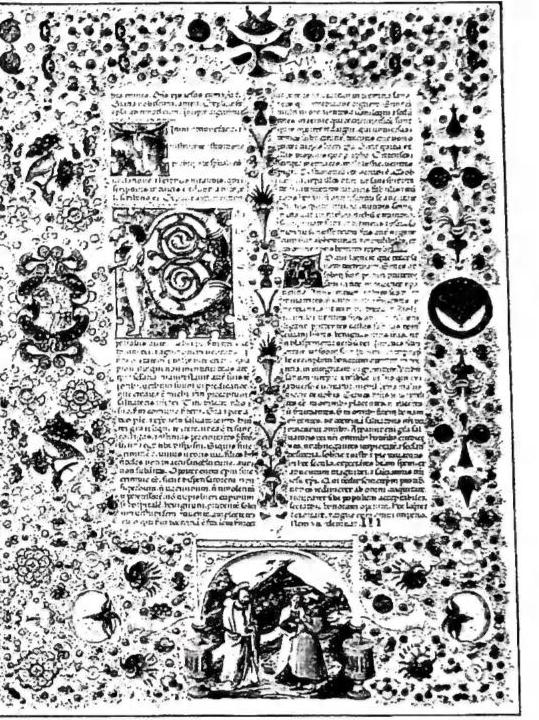
(courtesy of Senator G. Treccani)
TITO, saint — Incipit of the Epistle of St. Paul to T. The Borso d’Este Bible, with miniatures executed between 1455 and 1461 — Modena, Biblioteca Estense, vol. II, f. 210.
Pius IX introduced his feast by decree of 18 May 1854. His body, which had remained for a long time at Gortyna, the capital of Crete, was transferred to Venice, to the Basilica of St. Mark. Andrea, bishop of Crete (d. 740), wrote an enthusiastic eulogy of him (PG 97, 1141–69).
LETTER OF S. PAUL TO T. — Written by s. Paul at approximately the same time and for the same needs as the 1st to Timothy (v.), when compared with it, it presents a case analogous to that of Col. compared with Eph., and is generally considered to be slightly later than I Tim., although the ecclesiastical hierarchy appears in it less developed. According to the final annotation in some manuscripts, it was written from Nicopolis, but this may be a conjecture prompted by Tit. 3, 12; it is more probable that Paul wrote it from some place in Macedonia, before reaching Epirus.
The literary authenticity, admitted in antiquity even by Tatian, presents fewer difficulties than that of I Tim. and was called into question only because of its affinities with the latter; even the proponents of the “fragmentary theory” recognize in Tit. numerous phrases or “notes” that are certainly authentic. In the Pastorals s. Paul displays a more refined literary culture than in his other epistles, and in this one too the citation of various sources may be observed. Tit. 1, 12 ff. approvingly quotes a verse by the Cretan poet Epimenides (6th century B.C.), calling him a “prophet,” perhaps because his compatriots regarded him as such (Cicero, Divin., I, 18); notwithstanding the approval of the sacred writer, ample room remains for poetic hyperbole and exceptions. Tit. 3, 5-8 perhaps quotes a baptismal liturgical hymn (analogous to that of I Tim. 3, 16; cf. I Cor. 14, 26; Eph. 5, 14, 19). Some resemblance to I Pt., written around the time when Paul was in Rome for the first time, has also been noted.
Its content is analogous to that of I Tim., of which Tit. appears to be a summary.
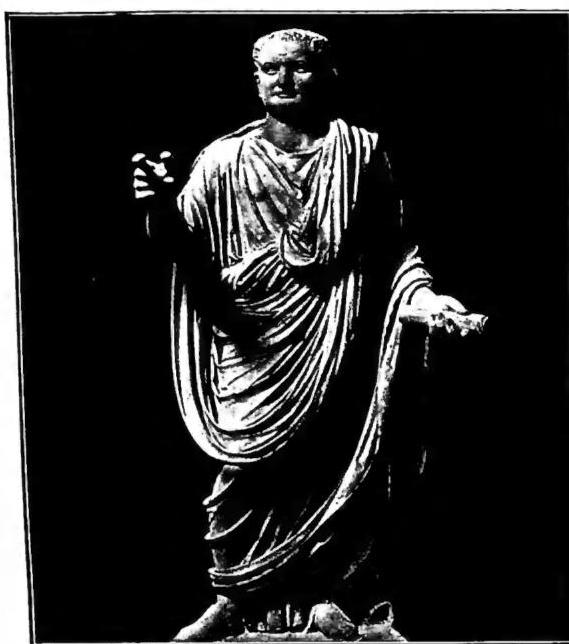
(Alinari photograph)
TITO, ROMAN EMPEROR — Togate statue of the emperor T. (1st century) — Vatican Museum, Braccio nuovo.
gelo (1, 1-4). Then the Apostle reminds T. that he left him in Crete to set those communities in order, especially by appointing bishops suited to their delicate task (1, 5-9). The Christians of Crete, both because of their natural inclinations and because of the tendencies stirred up by the false teachers, must be treated firmly (1, 10-16). He must therefore never tire of reminding the various categories of people, with all the authority of his office and by his personal example, of their duties, in conformity with the Christian ideal, which is a holy life awaiting the « glory of the great God »: for this very reason Jesus became incarnate and offered himself in sacrifice, thereby giving us the possibility of being born to a new life through Baptism, « the washing of regeneration and renewal » (2, 1-3, 11). Paul concludes by arranging to meet T. at Nicopolis and recommending that he make provisions for the journey of a certain Zenas, a jurist, and the celebrated evangelizer Apollo. Greetings and the blessing follow (3, 12-15).