
VENEZIA, PATRIARCATO di. - Patriarchate and capital city of the province in Veneto.
The diocese has a population of 362,564 inhabitants, of whom 357,250 are Catholics, distributed across 94 parishes.
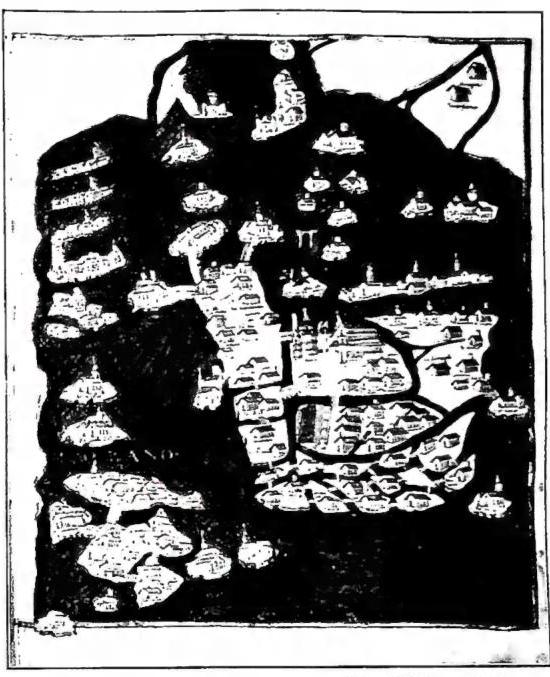
I. THE REPUBLIC
At the end of the 8th century, Paul the Deacon warned his readers about the difference between the V. of the Roman era (v. VENETO) and that of his own time, noting that the former «non solum in paucis insulis, quas nunc Venetias dicimus constat» (Hist. Langob., II, 14). Yet even in his time, this second V. was not limited only to a few islands, but encompassed the lagoon territory from Cavarzere to Caorle, the lagoons of Marano (soon joined to the Friulan Duchy), and those of Grado, along with a narrow strip of mainland defended by a great coastal forest stretching from Grado all the way to Ravenna. The activities of the inhabitants of this area in the 6th century are known from the emphatic praises bestowed upon them by Cassiodorus in his letters; they were fishermen and sailors who kept communications alive throughout the territory and were capable of rendering useful services to public authorities. Among them found refuge those who were gradually forced to leave the neighboring cities of Aquileia, Concordia, Oderzo, and Altino during the successive barbarian invasions down to the Lombard one. Thus arose the major centers of Grado, Caorle, Cittanova dell'Estuario (later called Heraclea, now Grisolera), Equilium (Jesolo, Cavazuccherina), Torcello, Malamocco (later Chioggia), each of which had an episcopal see. Despite rivalries, the most important center after Grado was Cittanova, which seemed destined to dominate the others. All this country remained subject to the Exarchate of Ravenna under the government of tribunes who, at least by the fall of the Exarchate (751), had, like other lands, at their head a dux directly subject to the Empire of Constantinople. Nevertheless, more or less peaceful contacts with neighboring Lombard dukes and sovereigns (who never held power over the sea) could not fail to occur, eventually establishing, during the 8th century, fairly stable borders. With the advent of the Carolingian dynasty under Charlemagne, it seemed for a moment that mutual interests would counsel closer political relations with the formation of a party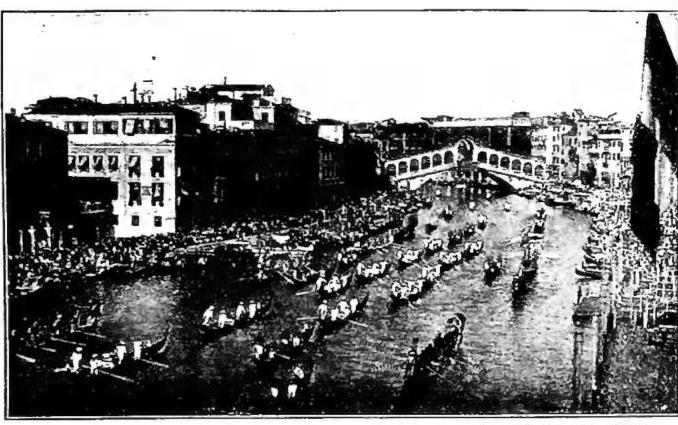
How much Constantinople concerned itself with preserving a sovereignty that was nonetheless becoming increasingly nominal is demonstrated by contacts with V.: tribunes and dukes were occasionally decorated with the pompous titles of patricians, hypati, protospatharii, proedri, and matrimonial ties were also forged with the most prominent families. However, after 840, this did not prevent Venetian independence from being secured through repeated pacts with the sovereigns of the continent; thus, while dependence on Constantinople attenuated more and more, no feudal ties of any sort were created with the hinterland, and instead V.'s full autonomy was established. Certainly, the internal regulations by which it was governed were not so secure and precise as to prevent internal rivalries, uprisings, and even cruel repressions. Among the refugees who had brought with them the remnants of ancient fortune and the local inhabitants who possessed experience of the sea, a social body had formed, held together by common public and private needs, without preventing the gradual emergence within it of localities and families capable of exercising a preponderance in the common assembly, to the point of actually directing the course of affairs and holding the leading roles in politics. Figures rich in experience and energy created their own adherents, formed parties, and held a predominance to the point of forming a sort of ducal dynasty: thus the Parteciaci were followed by the Candiani (932-76), who did not hesitate to lean on the sovereigns of the Saxon house, and then by the Orseoli (976-1032). The first major military enterprise at sea was that conducted by Pietro II Orseolo in the year 1000 along the Dalmatian coast from Zadar to Ragusa to crush the violence of the Slavic pirates who infested the Adriatic and had dared to attack Grado and V. itself and demand tribute. Thus began that right to the defense of the gulf that V. reserved for itself, excluding any other armed fleet from the Adriatic, and which later found its solemn symbol in the rite of the marriage of the sea celebrated every year on Ascension Day. In this way, those broader and more secure commercial relations with Constantinople, Alexandria, Syria, and the entire Levant as far as the Black Sea—which were the primary reason for V.'s prosperity—could be maintained. Corresponding to these strengthened relations and to the greater well-being that was being realized with the rise of the Italian Communes and the increase in their agricultural and industrial production, which facilitated the possibility of lucrative exchanges, is V.'s concern to keep open the communications and markets of the hinterland, supporting the socio-political aspirations of the Communes themselves and favoring their leagues in defense of liberties. Hence the hostile attitude against Frederick Barbarossa and Frederick II and the constant purpose of drawing, even by force, the patriarch of Aquileia and the Istrian cities into the sphere of its own interests.
V. Crusades; but it had no scruples about subjugating the Fourth Crusade to its own interests when, with the assistance of Western warriors, it first wrested Zadar from Hungarian rule and then directed its ships under Doge Enrico Dandolo against Constantinople (1201-1204), where the Latin Empire was established, lasting until 1261 (v. II), and the Latin patriarchate was reserved for Venetian prelates. This increased the importance and prestige of V.; but after 1261 the possibility also opened up for Genoa to expand its fortunes under the Palaiologoi as far as the Black Sea, thereby entering into competition with V. This competition turned into open hostility after the definitive fall of Acre (1291), when a first war took place between the two Republics (1294-99); then a second (1350-55) followed by V.'s loss of Dalmatia (1358), and finally an even more serious third one in 1375, when V. Friuli, Hungary, and Padua against II. Yet it managed to blockade Chioggia, drive out the Genoese, and conclude the Peace of Turin in 1381, following which it reconquered much of what had been lost, re-established its prestige in the East, and expanded its trade, especially with Egypt: twice a year its ships in "caravan" visited the most distant markets of the East and reached as far as Flanders; they transported pilgrims to the Holy Land at fixed times; the silver ducato (minted in 1193) and the zecchino or gold ducato (minted in 1284) enjoyed secure credit in exchanges. V. splendor, thanks also to the immunities it enjoyed and was able to protect for citizens and interests entrusted to the baili who resided permanently in the most frequented places.
Meanwhile, internal regulations had proceeded in tandem. An aristocracy of the most powerful families that had formed in Rialto, excluding any representation from the lesser centers, tenaciously endeavored to limit the doge's authority, imposing its own control upon him and obliging him to swear a promissio or program of government, while removing the people from government by reducing the powers of the popular assembly to nothing. Therefore, alongside the doge were placed two, then six (one for each sestiere of the city) savi (sapientes); in 1223 the Quarantia, the supreme tribunal of the State, was constituted; and the three heads of the Quarantia together with six councilors and the doge constituted what after 1423 was called the Signoria, and in turn, together with the 6 savi grandi, the 5 savi di terraferma, and the 5 savi agli ordini, they formed the Collegio, a sort of cabinet. On the other hand, the assembly was supplanted by the Maggior Consiglio reserved for the members of the most important families, whose number—restricted by particular conditions—was further limited in 1297 with the "serrata" (closing) of the Maggior Consiglio under Doge Pietro Gradenigo; this assembly formed the basis of the State, and appointments to the most important offices were reserved for it, excepting that of the doge, which was reached through a complicated system of scrutinies. The soul of the State instead was the Consiglio dei Pregadi (Senate), within which the major business of the State was discussed; it was definitively organized in 1229 with 60 members elected by the Maggior Consiglio, to which the Zonta of another 60 members was later added. Also participating were the members of the Collegio and the procurators of S. Marco, whose number grew in the 15th century.
up to 9, whose duty was the supervision of the Basilica, of ad pius causa legacies, and of charity; the three avogadori di commu, fiscal agents to uphold the rights of the State; and later the inquisitors. The state treasurers were the camerlenghi, who resided at Rialto, while special duties were entrusted to other commissions for the protection of public finance or morality. In 1310, on the occasion of conspiracies and riots, the Council of Ten was established and made permanent in 1335: it was presided over in monthly rotation by three of its members called the "Chiefs of the X"; to them was entrusted the supreme police and surveillance service for the safety of the State, and it proceeded with absolute speed and secrecy, controlling the work of all magistrates and diplomats, including the doge. It concentrated so much authority, to the detriment of the other supreme orders of the State, that towards the end of the 16th century it became necessary to limit its powers. The people gathered in their scuole (schools), in which nobles also participated, in arts, and in confraternities, the latter mostly bound to religious Orders; whereas the clergy took no part whatsoever in public offices of any rank, except, at least in early times, that of notary. Public offices were unpaid, including embassies, and compensation was disbursed only for extraordinary expenses. Although interferences were not lacking, the system of government functioned very well and long aroused the admiration of those who recognized its stability and upright procedure.
The intricate events of the hinterland, complicated by Austrian and Hungarian ambitions, had offered the occasion and imposed the necessity upon V. for a more effective intervention than in the past. With the conquest of Friuli (1420), all Venetian cities (except Mantua) now entered its dominion, which in 1426-27 also included Bergamo, Brescia, and other minor districts. Consequently, V. found itself more closely entangled in the network of mutual jealousies and conflicts that agitated relations among the various Italian powers, beginning with Ferrara. Mistress of Ravenna in 1441, of Faenza, Rimini, and other places in Romagna after the fall of Valentino (1503), and of Otranto, Brindisi, Trani, Gallipoli, and other places in the Kingdom of Naples, it provoked against itself the League of Cambrai (1509) among the Empire, France, and Spain, which Julius II also joined to get his share, whereupon it seemed it would be reduced within its lagoons. But the harsh war that followed forced V. Apulia, yet allowed it to recover the rest of its dominion in Italy and retain it, albeit with exposed and uncertain borders on the Isonzo, until the Napoleonic invasion.
More serious for Venice, starting from this time, were the repercussions on its trade from the Portuguese discovery of the new route to the East Indies, while the system of relations it had managed to create with Alexandria and the Eastern Mediterranean was disintegrating. Indeed, with the Turkish penetration into Europe in the second half of the 14th century, there began that absorption of territories that led to the capture of Constantinople (1453) and the conquest of almost the entire Balkan and Greek region where V. also had possessions and interests. By now V. was the only maritime power to resist Turkish might in the seas of the Levant after the Turks were able to arm a fleet; and this even when the European powers, troubled by dynastic disputes or the lust for aggrandizement at the expense of others, rather than lending a helping hand, readily accused it of faithlessness if it was forced to come to terms with the Turk. Urged on by the popes, beginning with Eugene IV, and ever aided by them, it poured forth ships, wealth, and captains in a struggle that lasted until the end of the Candia War (1669); fortresses and islands were lost and retaken, sometimes repeatedly, with alternating fortunes. In 1470 one of the major bulwarks, Negroponte, fell; and to prevent Cyprus too from falling into Turkish hands, V. Cornaro, widow of James II of Lusignan, king of the island (d. 1473), to cede the dominion to it in 1489 and set about fortifying it; but the campaigns of 1500-1503 in alliance with Alexander VI, and of Preveza with Paul III in 1539-40, did not lead to the hoped-for results. Even after that
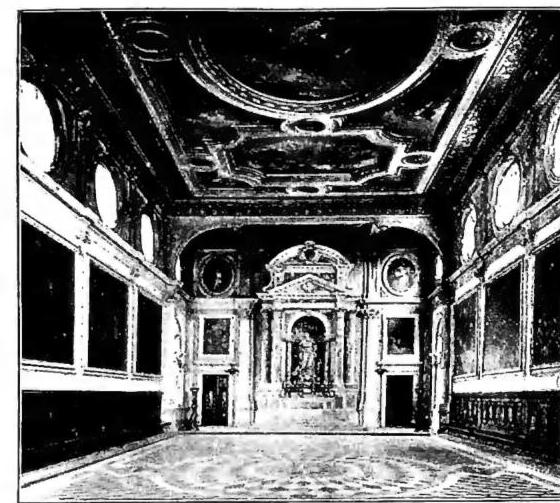
VENEZIA - Hall of the Scuola Grande of S. Giovanni Evangelista. Walls and ceiling with canvases and frescoes from the 16th-17th centuries; on the altar, statue of S. Giovanni by G. M. Morlaiter (18th century).
Venetian historiography properly begins with the Cronaca of Deacon Giovanni around the end of the 10th century (cf. G. Monticolo, La Cronaca del diac. Giovanni, Perugia 1899). Earlier chronicles are merely dry, more or less reliable lists (G. Monticolo, Cronache veneziane antichissime, Rome 1890); the so-called Chronicon Altinate (ed. MGH, Script., XIV, pp. 1-69) is nothing more than a patchwork of diverse origin and age, of very limited authority. On these uncertain data Andrea Dandolo, later doge, compiled his history, whose authority begins with his own times (14th century; ed. RIS, XII, 1). Marin Sanudo (v.) carried the Vita dei Dogi (ibid., XXII, iv) up to the end of the 15th century, when his famous Diarii, which reach up to 1533, begin. Contemporary with those of Sanudo are the Diarii veneziani of G. Priuli (RIS, XXIV, II, III, iv). At the end of the 15th century, the humanist M. Antonio Sabellico compiled a history of V. in Latin with a humanist character, which was later followed by those of Pietro Bembo, Paolo Paruta, and others of an official character, until the 18th century marked the beginning of erudite studies by Filiani, Galliccioli, and others; this led to the great comprehensive work, still useful: S. Romanin, Stor. document. di V., 10 vols., Venice 1842-78, later reprinted. Critical investigations into the period of origins followed: A. Gfrörer, Gesch. Venedigs bis 1084, Graz 1872, Italian trans. by P. Pinton, 1876-78; H. Kretschmayr, Gesch. von Venedig, 2 vols., Gotha 1905-20; W. Lenel, Venetianisch-historische Studien, Strasbourg 1911; R. Cessi, V. ducale, 2 vols., Padua 1928-1931; id., Le republ. di V. e il problema adriatico, Naples 1953. Numerous are the histories of major families and investigations into particular periods and episodes of Venetian history by Barozzi, Fulin, Della Santa, Corgno, Cessi, and many others. Good compendiums include those of R. Fulin, Breve sommario di stor. ven., Venice 1914; Ch. Diehl, Une république patricienne. Venise, Paris 1915; E. Musatti, Stor. di V., 2 vols., Milan 1919; A. Battistella, La republ. di V. nei suoi undici sec. di stor., Venice 1921. For literary history, comprehensive works: G. Degli Agostini, Notizie istor.-crit. intorno agli scritt. venez., 2 vols., Venice 1752-54; A. Cicogna, Iscriz. venez., 5 vols., ibidem 1824-43 (a work left incomplete); M. Foscarini, Della letter. venez., 2nd ed., ibidem 1854; P. G. Molmenti, La storia di V. nella vita privata, 5th ed., Bergamo n.d.
Pio Paschini
II. THE PATRIARCHATE OF GRADO
The ecclesiastical origins of V. are closely linked with the formation Aquileia (v.) Grado (v.), and particularly of the latter, which was established following the Three Chapters (v.). The extinction of that schism (late 7th century) did not restore unity, and the patriarchate of Grado continued to exist despite repeated legal and even violent attempts by Aquileia. The communities established along the coastline and in the islands of the gulf obeyed Grado when V. did not yet exist; when the settlement formed at Rialto later gained strength and political importance, the patriarch, who was consistently chosen from the leading Venetian families, preferred to reside there, also due to the progressive decline of Grado and the domineering ambitions of the patriarch-prince of Aquileia. Thus the patriarch Vitale IV Candiano (d. 1018) so-journed in V., at the church of S. Silvestro, which had been granted to the jurisdiction of the patriarch of Grado as early as 989, without thereby officially transferring the see thither. The patriarch Enrico Dandolo (1131-86), forced to take refuge in V. II, patriarch of Aquileia, built the Patriarchal Palace there behind the church of S. Silvestro; a palace which Pope Boniface VIII (1294-1303) later made independent of the jurisdiction of the bishop of Castello. The Doge Vitale Michiel II (1156-1172) very soon recovered Grado, but the same patriarch Dandolo obtained permission in 1177 from Alexander III to transfer his residence to V. Curia, tribunals, and ordinary diocesan jurisdiction, not only over the parish of S. Silvestro, but also over those of S. Giacomo dell'Orio, S. Martino, S. Cassiano, S. Matteo di Rialto, S. Bartolomeo, and over the monasteries of S. Maria dei Crocferi and S. Clemente in Isola. Interference and disputes were frequent between the two authorities, one metropolitan and the other suffragan, existing in the same city, whether over rights perhaps not clearly defined, or over the ambitions of some patriarch to continually expand his diocesan jurisdiction within V., or due to the indiscipline of ecclesiastics who declared themselves dependent now on one and now on the other, so as not to depend on anyone. It is true that Alexander III himself wrote on Jan. 21, 1178, to the Doge Sebastiano Ziani, exhorting him to lend his support so that the patriarchal see of Grado might be transferred to V.; but on Apr. 31 the doga died and the matter was never spoken of again.
Upon the death in 1451 of the patriarch of Grado, Domenico VI Michiel, Nicholas V, by the bull Regis Aeterni of Oct. 8, 1451, suppressed the bishopric of Castello (Venezia) and the patriarchate of Grado; he united their revenues, rights, privileges, burdens, and jurisdictions, and established the patriarchate of V., Lorenzo Giustiniani (v.), the last bishop of Castello, as the first patriarch. The ecclesiastical province of Grado, with its suffragan bishops, was erected into the patriarchal province of the Church of V. On Dec. 23 the bull was executed in the cathedral of S. Pietro di Castello, and thus resulted the patriarchate of V., which extended its diocesan jurisdiction over all the parishes of the city (with the exception of S. Marco, which was governed as an abbazia nullius), over the parishes of Grado and Latisana, over the vicariate of Campardo (Conegliano) which later consisted of six parishes (S. Giovanni Battista di Fior di sopra; S. Lorenzo di Pianzano; S. Vendemiano; S. Martino di Bibano; S. Pietro di Zoppé; S. Giustina di Fior di sotto), over the curacy of S. Martino di Torre di Mosto, the sole survivor of the suppressed diocese of Heraclea or Cittanova, united to the patriarchate of Grado in 1440; and later over the parish of S. Giovanni Battista di Jesolo, risen from the ruins of the ancient diocese of Equilio, suppressed and united to the patriarchate of V. in 1466; and over the parish of S. Giovanni Battista di Gambarare, an ancient estate of the abbey of S. Ilario. The metropolitan jurisdiction extended over the dioceses of maritime V. (Caorle, Torcello, Chioggia). The patriarchate of V. ARA, with its suffragans of Veglia, Ossero, Arbe, which Adrian IV, by a brief of Feb. 22, 1155, had subjected to the patriarch of Grado; a jurisdiction constantly confirmed by the Pontiffs and continually contested by the people of Zara, until under the patriarch Gianfranco Morosini (1644) it was deemed the better course to retain at least the mere title of such supremacy.
III. THE DIOCESE OF OLIVOLO OR CASTELLO
It is believed that in 421 the first houses and the first church arose in Rialto, spiritually subject to the bishop of Padua who found refuge, from time to time, on the maritime island of Malamocco. In any case, by the 8th century there was a community of twenty-five islands with their respective churches. Once the ducal castle was established at Rialto, near the church of S. Teodoro, then the principal patron of the nascent community, and the relics of s. Marco arrived from Alexandria in 828, a vote was taken for the erection of a sumptuous basilica in honor of the holy Evangelist, who became the principal patron and, with his lion, the living symbol of V. Obscure instead are the true origins of the bishopric of Olivolo, which had jurisdiction over the islands andits center more towards the sea with the Cathedral dedicated to s. Pietro and the baptistery to the Baptist; in 1091 it changed its name to that of the bishopric of Castello. Notwithstanding riots and rebellions of various kinds, in the course of the centuries new churches, convents, monasteries, hospitals, and pious works arose. By 1450, one hundred and forty churches had already arisen (six of which no longer existed); without taking into account the reconstructions, which rose to as many as fifty in the 12th century alone.
The Rialtine islands, now all regulated and united by bridges, constituted the city of V., divided into seventy districts (parishes) with their respective churches, almost all collegiate, united into five groups under the title of filial churches headed by a collegiate church (parochial mother or baptismal church). The monastic movement, which began with the Benedictines in the 800s, and perhaps earlier, and with the Benedictines in 727, became rapid after the year 1000; and by 1450 there are twenty-seven religious Orders with forty-nine houses (19 female and 30 male) and their respective church: Benedictines (9), Benedictines (3), Camaldolese (1), Regular Canons of S. Antonio of Vienna (1), Regular Canons of S. Spirito (1), Lateran Regular Canons of the Most Holy Savior of Bologna (1), Lateran Regular Canons of Holiness of Lucca (1); Secular Canons of S. Giorgio in Alga (1), Carmelites of the primitive observance (1), Knights of S. Giovanni (1), Teutonic Knights (1), Carthusians (1), Cistercians (1), Crociferi (1), Dominican nuns (1), Dominicans (2), Hermit nuns of S. Agostino (7), Hermits of S. Agostino (1), Hermits of S. Girolamo of Fiesole (1), Augustinian hermits of Monte Ortone (1), Hermits of S. Girolamo (1), Franciscan Poor Clares (1), Friars Minor (5), Jesuits (1), Olivetans (1), Servites of Mary (2), Humiliati (1). Twelve hospitals, seven of which with their own church, and other non-parochial churches complete the crown of one hundred and thirty-four churches that adorned V. in the middle of the 16th century; all rich in art and precious relics brought largely from the East. The basilica of S. Marco stood out, reconstructed in 1063 in its definitive form. It soon became the ducal chapel with its primicerius and its clergy. In 1071 the work of adorning it with mosaic works and precious marbles transported from the East began, and it was solemnly consecrated on October 8, 1094, in which year the body of s. Marco, of which all trace had been lost, was miraculously discovered (June 25). In 1053 Pope Leo IX passed through V. Germany; after his death a parish church will be dedicated to his name. In 1177 Alexander III met Barbarossa in V. Papacy, but the issues never touch religion (interdict of 1309-13 on the occasion of the war for Ferrara). The series of its bishops, with negligible exceptions, is a series of holy pastors. One, Angelo Correr, wore the tiara under the name of Gregory XII (1406-16); the last, Lorenzo Giustiniani (v.), rose to the honors of the altars. V. laity. I (v.), who in 978 left the dogeship to lead a solitary and penitent life, d. January 10, 997; s. Gerardo Sagredo (v. GERARDO di CAVAD); bl. Pietro Acotanto, father of the poor, beggar for the love of God, d. August 26, 1187; bl. SALOMONE (v.), Dominican, d. May 31, 1314. Another Venetian (Gabriele Condulmer) became pope under the name of Eugene IV (1431-47) when Lorenzo Giustiniani ascended to the bishopric of Castello (1433) and in the height of the Renaissance imprinted a robust seal of spirituality upon V., whereby, despite multiple snares, it was able to resist Protestant propaganda. The Council of Trento was accepted in full in the very year of its conclusion (1564).
IV. IL PATRIARCATO A VENEZIA
Dalla metà del '400 alla seconda metà del '700 continua il ritmo di erezioni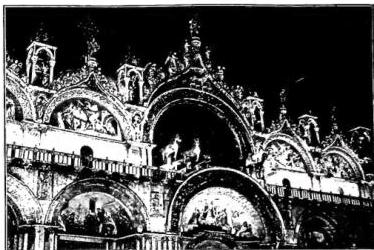
V. developed further, while those of newer institution—such as Capuchins and Capuchin nuns, Discalced Carmelites and Carmelite nuns, Carmelites of the Mantua congregation, Fatebenefratelli, Philippians, Minims, Reformed Minors, Jesuits, Mekhitarists, Somascans, Theatines, etc
always found a good welcome, competing in a noble rivalry for the spiritual life of the city. With the canonical suppression of seven Orders (Humiliates, 1462; Venetian Priory of the Teutonic Knights, 1592; Canons Regular of S. Spirito and Crociferi, 1656; Secular Canons of S. Giorgio in Alga; Hermits of S. Girolamo di Fiesole and Jesuits, 1668), whose assets were handed over to the Republic for the wars against the Turks, V. counted forty religious Orders in eighty-one houses by the middle of the 18th century. In the first half of the 16th century, Gian Pietro Carafa (Paul IV) and St. Gaetano Thiene provided a shining example of charity and faith in the city; and Venetian nobility gave Girolamo Emiliani (v.), d. 13 Feb. 1537, and St. Gaetano's faithful companion and imitator, Giovanni Marinoni (v.), d. 13 Dec. 1562, to the altars. In this era, two resounding ecclesiastical interdicts, caused by controversies of a political nature, interrupted peaceful relations with the Holy See: the one under Sixtus IV in 1483 on the occasion of the war for Ferrara, and that of 1509 under Julius II on the occasion of the League of Cambrai, which V. error. The interdict of Paul V in 1605 had greater resonance in the public life of the time. Prompted by reasons more strictly concerning ecclesiastical discipline, it struck the city as well as the entire subject territory on the mainland, causing genuine crises of conscience. Jesuits, Capuchins, and Theatines obeyed the Pope and were expelled from the Venetian States. The Senate was particularly relentless against the Jesuits, issuing a decree of perpetual eviction, although they found a way to return in 1657. The conflict, dangerous in every respect, was resolved thanks to the mediation of the King of France. On the occasion of the plague of 1630, which claimed 46,536 victims in the city alone, the Republic vowed the magnificent temple of S. Maria della Salute. This century also had its saints: Brindisi (v.), born of a Venetian family (d. 22 July 1619), and the Ven. Gregorio Barbarigo, bishop of Bergamo and later of Padua (d. 18 June 1697). The Venetian nobility continued in the luminous wake of the Giustiniani, producing a series of twenty-nine patriarchs (the last, Lodovico Frangini, d. 29 Feb. 1804), some of whom died in the odor of sanctity, along with many bishops and cardinals, and three other pontiffs: Paul II (1464-71; Pietro Barbo),Alexander VIII (1689-91; Pietro Ottoboni), Clement XIII (1758-69; Carlo Rezzonico).
Nevertheless, ARPI (v.) Micanzio (v.) on the occasion of the interdict of 1606 and the controversy accompanying it, persisted among the consultori in iure who assisted the Signoria in ecclesiastical controversies, favoring its jurisdictionalist tendencies. The Apostolic See favored the Republic in financing the long war of Candia and the Morean War by allowing it to draw upon ecclesiastical property, particularly that of religious orders; but the Republic, following the widespread fashion throughout Europe, presumed to proceed on its own authority, making use of political-religious theories that granted it a right in this matter; thus it introduced a prohibition against churches receiving testamentary inheritances, placed restrictions on Mass offerings, etc. From 1768 onwards, it issued a series of laws entirely contrary to the freedom of the Church. Clement XIII protested in vain; V. II. In reality, the Republic was in its death throes and needed money. It began with the amalgamation and suppression of various convents: seven in the city (Carmelites of the Mantua Congregation of S. Angelo della Giudecca, 1768; Lateran Canons Regular of S. Maria della Carità, 1768; Benedictines of S. Niccolò di Lido, Castello, 1771; Camaldolese of S. Giovanni Battista della Giudecca, 1771; Benedictine commendatory abbey of S. Gregorio, 1776; Cistercians of S. Cristoforo, 1787), but well over three hundred in the State. It was the end of the Republic. V., which for eleven centuries had not seen a foreign foot, had to witness the parade of French republican armies right in its heart, in the magnificent Piazza di S. Marco (16 May 1797). The provisional government was the first storm against religious institutions. The advent of Austria in the same year, following the Treaty of Campo Formio, brought relative calm, and Pius VII was elected on the island of S. Giorgio Maggiore on 14 May 1800, four months after the death of his very pious patriarch, Federico Maria Giovannelli (10 Jan. 1800). The Napoleonic storm was in full swing. In 1806-1807 all schools, Confraternities, and Fraterne of whatever kind and purpose (over 700 in V. alone) were suppressed; in 1807 eleven convents and eighteen monasteries were concentrated and suppressed; in 1808 the seventy parishes were reduced to forty and then to thirty; in 1810 the remaining nineteen convents and twenty-22 monasteries were also suppressed. With the exception of a few churches that for various reasons were later reopened to worship, of the sixty that were suppressed, almost all are now demolished! Exempted from suppression were: the Mekhitarist Monks (Armenians of S. Lazzaro in the island), the Hospitallers of S. Servolo in the island, the Basilian Nuns (Greek), the Salesian Nuns (French) of S. Giuseppe di Castello, S. Giorgio dei Greci, S. Giorgio degli Schiavoni, S. Croce degli Armeni, and the Scuola di S. Rocco. In 1807 the transfer of the cathedral seat from S. Pietro di Castello to S. Marco was ordered, with the merger of the two Chapters: the patriarchal of S. Pietro and the ducal of S. Marco, with twenty then-living beneficiaries who were gradually to decrease to fourteen. The patriarch, along with all his offices, also had to move to S. Marco into a provisional residence until 1851, when he took up permanent quarters in the present palace. In 1815 Austria returned, and it was necessary to think about reconstruction. The bull of 1 May 1818 by Pius VII suppressed the dioceses of Torcello and Caorle and united them to V. (12 parishes), while removing Grado, Latisana, and the vicariate of Campardo (6 parishes). Thus the patriarch counted 32 parishes in the city (including Giudecca, Lido, Gambarare) and 12 in the vicariates of Caorle, Murano, and Torcello. The same bull assigned as suffragans the dioceses of Adria, Belluno and Feltre, Ceneda, Chioggia, Concordia, Padua, Treviso, Verona, Vicenza, and temporarily Udine, an arrangement that remains in force to this day. From 1819 to 1859 thirteen male and fifteen female religious houses were reopened, some of newly founded. Congregations began to appear, especially female ones; this was a time of intense charitable activity that flourished in particular institutions for the benefit of children and youth.
With the events of 1866 V. Italy, and in 1867 the law of 7 July 1866 was applied. By great fortune, although confined to the cramped quarters of a few premises, some religious were able to remain under the aegis of the so-called "Religious Associations" recognized by the same law; the nuns remained in their monasteries, albeit nationalized, up to the number of six, and thus the churches remained open for the convenience of the faithful. The last thirty years of the 19th century marked a wave of sectarian anticlericalism; but the clergy, accused of being pro-Austrian and anti-Italian, worked instead for the good of V. Italy. There arose the Institute for Juvenile Delinquents desired by the great heart of the young priest Carlo Coletti; the Institute for Female Youth erected by the parish priest Don Giuseppe Solesin; the Work of the Evening and Holiday Patronahes founded by the priests Giovanni B. Piemonte and Angelo Bortoluzzi; and the Opera dei Congressi which prepared and anticipated the political activity of Italian Catholics. Thus one reaches the threshold of 1900 with the great Eucharistic Congress (1897) desired and led by Card. Patriarch Bl. Giuseppe Sarto (v. PIO X). The last fifty years, featuring the two world wars, remember Card. Pietro La Fontaine and Card. Adeodato Giovanni Piazza, who saved V. from German threats. In 1919 the parish of S. M. Assunta di Malamocco along with the island of Poveglia, detached from the diocese of Chioggia, was united to the patriarchate; and in 1927 eleven parishes (including Mestre), detached from Treviso.
V. ISTITUTI
First among the most illustrious Venetian institutions is certainly the Biblioteca Marciana (now national): it contains an initial collection from the Republic, augmented by the bequest of Card. Bessarione of 900 manuscripts, largely Greek; various private collections were subsequently added, among which, in the 19th century, that of the Dominicans of the Zattere, which made it rich in numerous rare editions, such as the collection of Aldines and in particular the famous illuminated Breviary left by Card. Domenico Grimani. Housed at first near the church of S. Marco, it was transferred to the famous "Libreria" that the Senate had built in 1559 by Jacopo Sansovino. It was moved in 1812 to the Palazzo Ducale when that building was annexed to the Royal Palace (Procuratie Nuove). In 1904 it moved to the premises of the former Mint (Zecca), suitably adapted, and in 1929 it also regained the old Libreria building when the Procuratie were assigned a different use.The Archivio di Stato, founded in 1815, was accommodated in the old, large convent of the Conventuals at the Frari and comprises the Archive of the Venetian Republic, unfortunately damaged by fires, such as the disastrous one of 1571, along with the holdings of numerous monasteries, convents, and confraternities of the Dominant City and its dominion; a primary source of the highest order not only for the history of V. Italy, but also for that of other States of the nearby Levant and the East. In 1869 Giovanni Querini-Stampalia bequeathed to his city his Library rich in manuscripts, joined to an art gallery and a museum, which he had gathered to preserve the memories of the past, thus rescuing them from dispersion.
A rich collection of Venetian manuscripts (including those of C. E. Cicogna) and coins is part of the Museo Civico Correr, begun in 1836 and now housed in the Procuratie Nuove on Piazza S. Marco. Close to the Museo Correr is the Archaeological Museum, formed with an initial bequest to the Republic by Card. Domenico Grimani (d. 1523) and his nephew Giovanni, patriarch. In the Patriarchal Seminary and the sacristy of the church of the Salute, the rich Manfredini Gallery and Museum was arranged in the 19th century. In the grandiose Palazzo Rezzonico, a Museum of 18th-century Venice was recently established; whereas in Palazzo Pesaro, the Museum of Oriental Art and the Gallery of Modern Art found a home in 1928. A precious collection is also the one that Baron Franchetti assembled in the restored Ca' d'Oro, which joined the marvelous Venetian collections.