
GRADO. — The ancient name of G. is Gradus, the first port of call for ships bound for Aquileia along the Natisone (like Gradus Arnensis = S. Pietro a Grado near Pisa and Gradus Massaliorum near Marseille), and not Aquae gradatae; the settlement of Gradus stood at the edge of an inhabited and cultivated countryside, almost entirely free of water, and not on an island.
The history of G. properly begins in 568, when the patriarch of Aquileia, Paolo, moved there in the face of the irruption of the Lombards into Venetia. But it was already then a strong and secure place, provided with religious and residential buildings; the Byzantine Empire was able to maintain itself there until Venice replaced it during the eighth century. Meanwhile, at the beginning of the seventh century, the new patriarchate of Aquileia was established in Lombard territory; while at G. the succession of patriarchs continued, since they could no longer set foot in ancient Aquileia. Thus, only a few kilometres apart, there came to be two patriarchates, of which that of G. was restricted almost exclusively to the island of the same name, though it was metropolitan see of the small Venetian bishoprics that arose along the coast as far as Chioggia. In 1451 the patriarchate was transferred by Niccolò V to Venice, and its first patriarch was s. Lorenzo Giustiniani, previously bishop of Castello. From then on, G. was merely a parish.
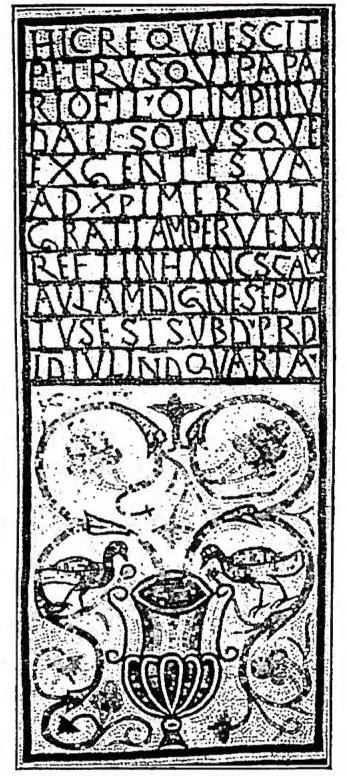
(phot. Soprintendenza, Trieste)
GRADO – Mosaic funerary inscription of a Jewish Pietro who converted to Christianity, found in the rectangular hall beneath the Duomo (5th century).
5th century and rebuilt in the 9th; it too had a baptistery. Near G., on the island of Barbana, there is a sanctuary of the Madonna, to which pilgrims come from throughout the region; particularly picturesque are those of the first Sunday of July and of the Assumption. - Vedi tav. LXXIV.