
LORENZO, Saint and Martyr. — Archdeacon of the Roman Church, put to death on 10 August 258, together with the subdeacon Claudius, the priest Severus, the reader Crescention, and the door-keeper Romanus, and buried on the Via Tiburtina in a crypt of the cemetery of the Agro Verano, which soon took his name and only later that of Ciriaca (v. cf. Lib. Pont., I, p. 155). The circumstances of his martyrdom are closely connected with the swift execution, four days earlier, in the cemetery of Callistus, of Pope Sixtus II and the deacons Januarius, Magnus, Vincent, Stephen, Felicissimus, and Agapitus, all victims of Valerian’s second edict of persecution (cf. S. CYPRIAN, Epist., 80 to Successus: CSEL, III, II, pp. 839–40 and Lib. Pont., loc. cit.). His feast is celebrated on 10 August in both Western (obligatory until the reductions of the early 19th century) and Eastern liturgies.
I. LIFE
The best-known episodes of the martyrdom of ST. LAURENCE are: the moving interview with Pope Sixtus in prison; the clandestine distribution of the Church’s goods to needy faithful hidden in various parts of the city; his arrest at the moment of the Pope’s execution following his public declaration to the Pontiff that the “treasures” of the Church had been distributed; his presentation, three days later, of a crowd of poor people to the judge as the Church’s treasures; his interrogation, torture, and finally execution on the gridiron, accompanied by the sarcastic words addressed to the judge: “Behold, wretched man, you have roasted one part; turn the other and eat.” His burial took place in the crypt of the estate of the widow Cyriaca on the Via Tiburtina. These events, which unfolded within four days, are described in great detail (speeches, healings, conversions, etc.) in the so-called history of the Decian persecution, narrated in the historical romance known as the Passio Polychronii (BHL, 4753; cf. H. Delehaye, Recherches sur le légendier romain. La passion de st Polychronius, in Analecta Bollandiana, 51 [1933], pp. 34-71 [critical introduction], 71-98 [critical edition]), of which three recensions exist, each with its own peculiarities, dating from the end of the 5th century to the beginning of the 7th (gentle personal communication from P. Franchi de’ Cavalieri, who has a critical edition in preparation; cf. also P. Guidi, “Coemeterium Cyrincum” o “Coemeterium Laurentii,” in Ric. di arch. crist., 26 [1950], pp. 163, 166; the text published by Fr. Delehaye represents the latest recension).While there is no doubt that the overall drama of St. Laurence as described in the aforementioned Passio is legendary, certain details—such as the meeting with Sixtus II, the presentation of the poor to the tyrant, and the execution on the gridiron with the sarcasm in its earliest form: “Take it, turn it, and eat”—are already attested in passages from St. Ambrose (De officiis, I, 41; II, 28; Epist. XXXVII, 36-37: PL 16, 90-92, 149-50, 1139; Hymn De s. Laurentio: PL 17, 1254-55) and were later exploited with rhetorical variations by Prudentius (Peristephanon, II), St. Augustine (Serm. 302-305: PL 38, 1385-1400), St. Maximus of Turin (Homil. 71: PL 57, 679-80; cf. also other homilies attributed to St. Maximus, ibid., 675-82), St. Peter Chrysologus (Serm. 135: PL 52, 565-67), St. Leo the Great (Serm. 85: PL 54, 486), and in certain liturgical formulas found in the Roman Sacramentaries, the Missale Gothicum (ed. H. M. Bannister, London 1917, pp. 111-12), and especially the Visigothic Orational (cf. ed. J. Vives, Barcelona 1946, pp. 370-72).
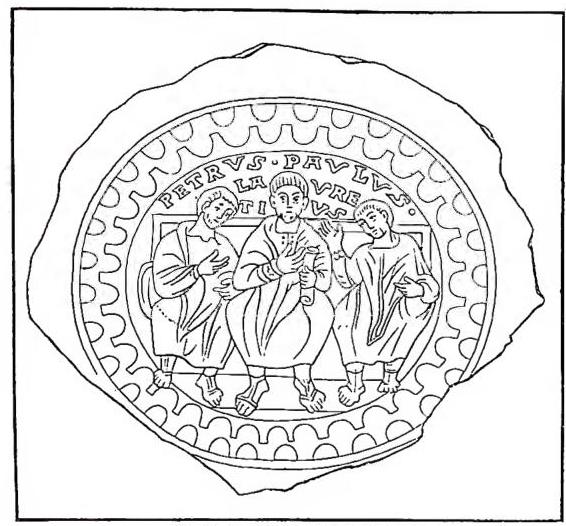
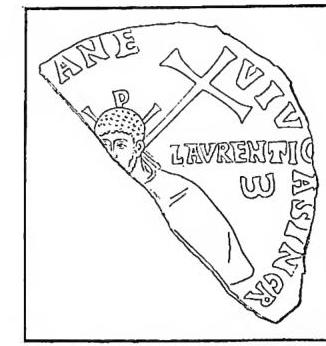
The details regarding the arrest and appearance of St. Laurence before the judge, which do not accord well with the swift application of Valerian’s decree of persecution (episcopi et presbyteri et diacones in continenti animadvertantur) against Sixtus and his companions, have been considered legendary data, reminiscences of other hagiographical texts adapted to St. Laurence in order to link his passion with that of the martyrs of August 6 and, in a certain sense, to justify his delayed martyrdom. The texts studied and the comparisons made by P. Franchi de’ Cavalieri and Fr. H. Delehaye are certainly significant in this regard, yet they do not a priori rule out the possibility that in Rome there existed a genuine tradition—embellished with evident rhetorical flourishes by St. Ambrose—concerning the tragic capture and end of St. Laurence precisely by means of fire, a punishment known to have been inflicted, also under Valerian, on St. Fructuosus and his deacons Augurius and Eulogius in Tarragona. Moreover, the verb animadvertere used in the decree of persecution in Cyprian’s version could refer to other forms of capital execution besides beheading. It is certain that the execution on the gridiron became the distinctive iconographic motif of St. Laurence, as can be seen from the medallion of Successa (late 4th century), if its authenticity is admitted, from the mosaic of the so-called Mausoleum of Galla Placidia in Ravenna (c. mid-5th century), and subsequently from countless other monuments. The Spanish origin attributed to St. Laurence by the Passio Polychronii (ed. cit., p. 91) is also legendary in character. It is worth noting that the preface of Mass XII in the so-called Leonine Sacramentary (ed. C. L. Feltoe, Cambridge 1896, p. 98) describes him as a “citizen” of Rome.
LORENZO, santo, martire - S. L. seated between the apostles Peter and Paul. Gold-glass (late 4th–early 5th century).
II. CULTO
Il centro propulsore del culto prestato al protodiacono L. è stato il suo sepolcro all'Agro Verano su cui Costantino (314-35) fece costruire una basilica comunicante con la sottostante cripta mediante gradus ascensionis et descensionis (Lib. Pont., I, p. 181). Nella stessa località sorsero poi altre basiliche: cioè la melior (non ancora identificata), quella ad corpus di Pelagio II (579-90) e l'altra di Onorio III (1216-27; cf. W. Frankl-E. Josi-R. Krautheimer, Le esplorazioni nella basilica di S. L. nell'Agro Verano, in Riv. di Arch. crist., 26 [1950], pp. 9-50). Dal sec. XII la basilica di S. L. al Verano è annoverata tra le Patriarcali (v. BASILICA).Nell'ambito dell'Urbe si ebbe nell'antichità e soprattutto nel medioevo tutta una fioritura di chiese e cappelle (ca. 35) dedicate a s. L. (cf. C. Huelsen, Le chiese di Roma nel medio evo, Firenze 1927, pp. 280-97), le quali sorsero su tutti i luoghi dove, secondo la fantasia popolare, si sarebbero svolte le principali scene del martirio di s. L. Meritano un particolare ricordo il titolo eretto da papa Damaso sulla propria casa paterna, l'attuale S. L. in Damaso (cf. F. Lanzoni, I titoli presbiteriali di Roma antica nella storia e nella leggenda, in Riv. arch. christ., 2 [1925], pp. 201-202) e quello di Lucina dedicatogli da Sisto III (432-40), donde il nome di S. L. in Lucina (cf. ibid., p. 204), o anche, a cominciare da s. Gregorio di Tours, di basilica ad craticulum (cf. B. Pesci, L'itinerario romano di Sigerico arctiv. di Canterbury, ibid., 13 [1936], pp. 51-55). Va pure ricordato il S. L. in Palatio, oratorio privato del papa nel patriarchio lateranense. Secondo il Grisar, l'orazione in onore di s. L. nel ringraziamento della Messa dovrebbe provenire da quello che il papa recitava in questo oratorio prima dell'esilio avignonese; ma è forse più probabile che si sia voluto associare s. L. ai «Tre Fanciulli» tutti vittime del fuoco (cf. H. Grisar, Il Sancta Sanctorum ed il suo tesoro sacro, Roma 1907, p. 32; J. A. Jungmann, Missarum sollemnia, II, Vienna 1949, pp. 558-59).
Il primo documento che ricordi il dies natalis di s. L., è la Depositio Martyrum: «IIII id. Aug. Laurenti, in Tiburtina» (ed. R. Valentini-G. Zucchetti, Codice topografico di Roma, II, Roma 1942, p. 23). In ordine di precedenza, sin dalla fine del sec. IV la festa di s. L. veniva subito dopo quella dei ss. Apostoli Pietro e Paolo, essendo considerato come il duce della vittoria di Roma sul paganesimo e degno riscontro di s. Stefano (cf. Prudenzio, Peristephanon, II, vv. 2-4 e passim), ragione per cui s. Agostino chiama il 10 ag. dies Romae solemnisimus qui magna frequentia populi celebratur (Serm. XIII, del 10 ag. 401, edito dal Denis, riprodotto in G. Morin, Miscellanea agostiniana, I, Roma 1930, p. 55; cf. anche il
Sermo 303, del 10 ag. 425-30: PL 38, 1393), cui fa eco il prefazio della XII Messa del cosiddetto Sacramentario leoniano: «de beati tamen solemnitate Laurentii peculiarius prae caeteris Roma laetatur» (ed. C. L. Feltoe, Cambridge 1896, p. 98; E. Bourque, Etude sur les Sacramentaires Romains, Città del Vaticano 1949, pp. 138-139). L'importanza di s. L. si rivela anche dall'ordine stazionale; Settuagesima: s. Lorenzo;
Preceduta da una solenne vigilia che si teneva nella basilica del Verano (cf. Vita s. Melaniae senatricis Romae, 5, ed. M. Rampolla del Tindaro, S. Melaniae giuniore senatrice romana, Roma 1905, pp. 5-6 e nota a pp. 266-268), la festa di s. L. era seguita da un'ottava. Difatti il cosiddetto Sacramentario leoniano contiene le Messe della vigilia (3 formulari, il I, X, XII) e dell'ottava, e 10 formulari per la Messa del giorno natalizio (ed. C. L. Feltoe, Cambridge 1896, pp. 94-99). Quando la vigilia fu trasportata al 9 ag., venne in uso la celebrazione di una Messa mane prima, distinta da quella publica in die come si rileva dai Sacramentari gelasiano (ed. H. A. Wilson, Oxford 1894, pp. 189-91) e gregoriano (ed. H. Lietzmann, Münster in V. 1921, pp. 85-86), dal Comes Evangeliorum di Würzburg (ed. G. Morin, in Rev. béad., 28 [1911], p. 312) e da altri Capitularia (cf. Th. Klauser, cit. sotto, pp. 34-35, 80, 120). La vigilia è detta in ieunio s. Laurentii nel Lezionario di Capua (codex Fuldemis del 546) e nel Capitulo Evangeliorum di Napoli del sec. VII (cf. G. Morin, Liber Comicus, Maredsous 1893, pp. 429, 433). Per questa vigilia Amalario segnalava l'esistenza in Roma, al suo tempo, di duo nocturnalia officia (cf. Liber de Ordine authiphonarii, 61: ed. J. M. Hanssens, Amalarii Opera liturgica, III, Città del Vaticano 1950, p. 97). La Messa matutina scomparve poi nella maggior parte dei Gelasiani del sec. VIII (cf. P. De Puniet, Le Sacramentaire Romain de Gelloue, Roma [1938], pp. 126-28, 130). Nel Capitularia Evangeliorum, tra cui il più antico quello di Würzburg, le 4 settimane (talvolta 5) che seguivano la festa di s. L. erano chiamate: « Ebdomada I, II, III, IV, post. S. Laurentii » (cf. Th. Klauser, Das römische Capitulare Evangeliorum*, Münster in V. 1935, pp. 35-36, 81-83, 161-63).
Nel Canone della Messa romana il nome di L. segue quello di s. Cipriano, mentre nell'Ambrosiano sta tra Sisto e Ippolito (cf. V. L. Kennedy, The Saints of the Canon of the Mass, Città del Vaticano 1938, pp. 68-69, 124-28), gruppo che si riscontrerà poi in vari monumenti iconografici (v. IPPOLITO, santo, martire). Anche nella liturgia mozarabica s. L. (10 ag.) è unito ai ss. Sisto e Ippolito (cf. M. Férotin, Le Liber Mozarabicus Sacramentorum, Parigi 1912, p. 389; J. Vives-A. Fàbrega, Calendarios hispánicos anteriores al siglo XIII, in Hispania sacra, 2 [1949], pp. 353, 365, 371, 377; però nel Liber Comicus è con il solo Sisto: cf. ed. G. Morin, Maredsous 1893, p. 265).
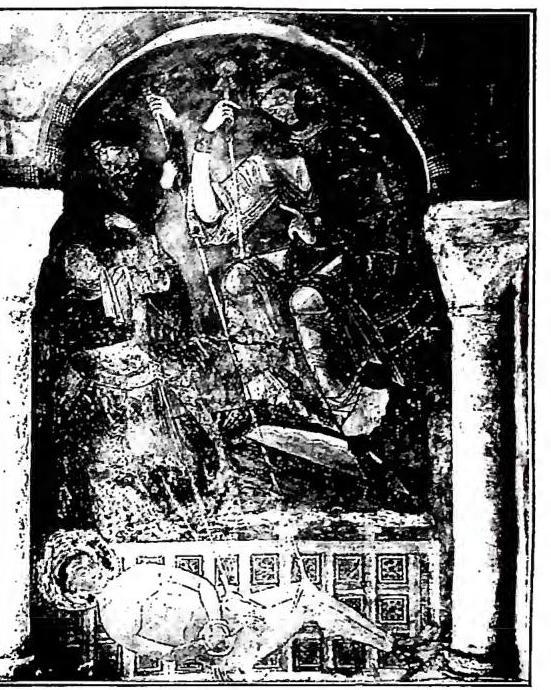
(fot. Bullez)
LORENZO, Saint, Martyr — Martyrdom of St. L. Fresco from the time of Abbot Hugh (1109) — Apse of the Cluniac abbey of Berzé-la-Ville.
In Milan, during the 5th century, a grand basilica (perhaps the “Portiana”) built in the 4th century was dedicated to St. L. In Constantinople, relics of St. L. arrived under Theodosius II (408–50), and the Empress Pulcheria (d. 453) had a church erected in his honor. It would be pointless to continue enumerating churches dedicated to the martyr, since from the 5th century onward and especially during the Middle Ages no diocese or city was without at least one; suffice it to say that in the diocese of Milan alone there were up to 43 (cf. F. Savio, Gli antichi vescovi d’Italia. La Lombardia, I, Milan–Florence 1913, p. 775).
The attributes of the deacon St. Lawrence were the cross, as a staurophorus, the book, and the gridiron, his instrument of martyrdom. He appears as a staurophorus already in one of the gold-glass vessels mentioned above. In the mausoleum of Galla Placidia in Ravenna, St. Lawrence is represented as cruciform, between the red-hot gridiron and the cupboard containing the sacred texts. A similar reference to the reading of the Gospel is found in the triumphal arch of the basilica dedicated to him in Rome, from the 6th century: in honorable proximity to Jesus Christ, he holds the cross and the book of Psalms with the words of V. III, 9: “Dispersit, dedit pauperibus.” He is also depicted with the cross in a 6th-century fresco in the catacomb of Albano.
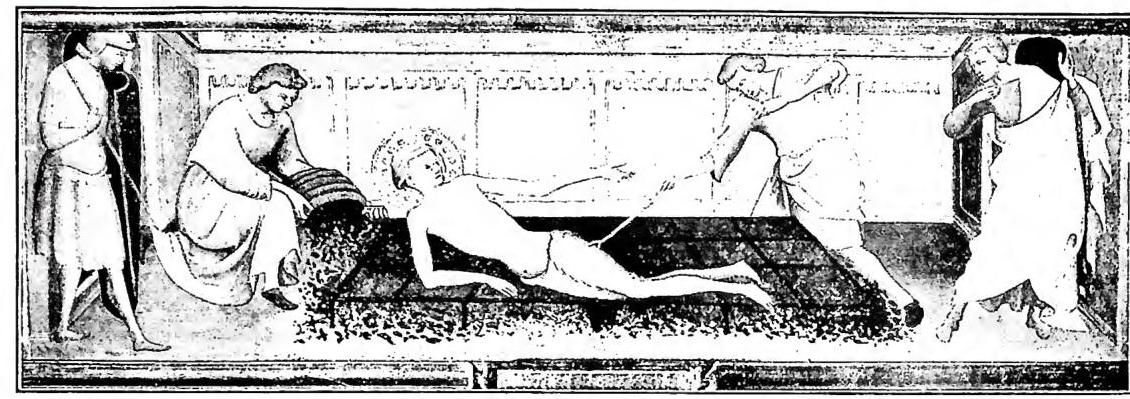
In the following centuries, the iconographic developments of the depiction of St. Lawrence are to be sought in the miniatures of Sacramentaries, among which those of Udine, Ivrea, Lucca, from the 9th and 11th centuries; notable is the miniature of the Sacramentary of Drogo, from the 9th century, where in a large “D” letter St. Lawrence is depicted in the act of distributing the goods of the Church to the poor, and his martyrdom. The gridiron has been transformed into an enormous machine, balanced on the flames by two sturdy uprights and operated at a distance by two executioners by means of long chains. Other executioners, under the orders of the judge witnessing the execution, hasten to feed the brazier with fresh wood.
Rome also possesses, at the beginning of the 13th century, during the papacy of Honorius (1216-27), in addition to a mosaic in the chapel of the “Sancta Sanctorum,” three cycles with episodes from the life of the Saint, painted: 1) in a side portico now transformed into a sacristy, 2) in the atrium, and 3) on the inner wall at the entrance of the basilica on the Via Tiburtina, partly very heavily restored and now almost vanished by 1943; but of which copies from 1639 survive in a Vatican Barberini codex (4403). Intact instead is the cycle painted by Masolino and assistants in the church of the Collegiata of Castiglione d’Olona near Milan, from the early decades of the 15th century; and shortly after the middle of the century, the one executed by Fra Angelico with the help of many assistants in the chapel of Nicholas V in the Vatican. In both, the main episodes consist of the handing over to St. Lawrence by Pope Sixtus II of the treasure of the Church, the almsgiving to the poor, the judgment before the Emperor, and the martyrdom, albeit with some variations. The cycle in the church of Berching, by the school of painting of Regensburg, comprises 8 episodes with the scene of the imprisonment of Pope Sixtus, his arrest, then his interrogation, flogging, torture, and martyrdom of the Saint. In the same church, the cycle is repeated on the shutters of the altarpiece of the high altar.
In modern art, the Saint is usually depicted in a dalmatic with the specific attribute of the martyr, the gridiron. Thus in a panel by Ghirlandaio in the Pinacoteca of Munich, in a painting by Titian for Philip V of Spain at the Escorial, in another by Andrea d’Assisi in the Pinacoteca of Perugia, in another by Alvise Vivarini in the Accademia of Venice, and in another by Pinturicchio in the cathedral of Spello. Beyond the Alps, the depiction of the Saint is repeated in various wooden statues preserved in museums and private collections in Frankfurt, Stuttgart, etc. Notable is the admirable painting by Matthias Grünewald in Frankfurt.
IV. IN FOLKLORE
The saint enjoys a vast and lively popular cult, both in Italy and abroad. In relation to the attributes of his martyrdom, he is invoked against fires and burns: in Sicily they even apply a popular print with the image of the saint to the burned area. He is therefore also the patron of firemen, charcoal burners, cooks, roasters, and pastry chefs. On the morning of his feast day, or before dawn or around midday, the people search, digging in suitable terrain (fields, gardens, woods, secluded roads), for the so-called “charcoals of St. L.,” to which various therapeutic virtues are attributed, especially against burns and lumbago, but also against witchcraft, the evil eye, and storms. Reduced to powder and mixed with wine, these charcoals are swallowed to cure quartan fever. They are placed under the pillows of children and made into small crosses. Since the date of his feast (10 Aug.) falls during the period of the shooting stars, the falling stars are called “tears of St. L.,” as it is believed that the heavens weep for the saint’s death or that they are the tears shed by the saint as he was roasted on the gridiron.In popular meteorology, it is believed that summer reaches its peak heat on St. L.’s day, but then quickly declines, hence the proverb: “St. Anthony brings the great cold — St. L. brings the great heat — one and the other last but a short time.” On that day, forecasts are also made for the weather in autumn: if it is fair, autumn will be fair too, and the year will be good for honey and wine; if it is bad, field mice will abound and cause serious damage.
Since the feast occurs at a time when the great field labors are over and the farmers have already harvested their crops, in many cities and towns a great festival and celebration is held on that day. In Udine, the largest annual fair is held, with shows, races, and a lottery; and it is believed that by St. L.’s day walnuts and hazelnuts ripen. Festivals and celebrations also take place in Cervia (Romagna), in Veglia (Istria), and in Champagne, where in Soulaine, near Bar-sur-Aube, the aubade is performed, corresponding to our “albate” or morning serenades. St. L. is the patron saint of the cities of Alba, Chiavenna, Fano, Genoa, Ancona, Viterbo, and many cities of Central and Northern Europe.
The saint’s life has also inspired popular poems and songs: two cantari in sestinas, one on his birth and childhood, the other on his passion and death, contained in the Ambrosian ms. c. 35 sup., were published by De Bartholomaeis (see bibliography). A narrative song in epic hendecasyllables still survives in Romagna and Tuscany. — See plate CVI.