
LEZIONARIO. — (Lectionarium, or -ius: from lectio, reading). This was the name given to the book containing passages from Sacred Scripture for liturgical use. It is a general term, capable of a broader or narrower meaning according to the purpose of the collection and the different periods of its history. In any case, the established usage of the term to indicate the readings taken from the Bible to be proclaimed at Mass is ancient. From the primitive form of a simple list of scriptural references (called capita—from which capitulare—or also indiculi), one gradually arrived at a complete collection of the readings (lessons, epistles, Gospels), transcribed in full according to the order of the feasts (11th–12th centuries).
Originally, lectio divina in the liturgical assemblies was carried out directly from the sacred text, without interruption (lectio continua), following the order of the canonical books (cf. A. M. Olivar, Codices per ordinem ex integro legant. Regula monasteriorum, c. 48, in Archivos, Bibliotecas y Museos, Madrid, 55 [1949], pp. 513–22), according to the amount of time available («prout tempus fert», says s. Giustino, Apol., I, cap. 67), or until the person presiding signalled that it should stop. Subsequently, through an obvious and natural development, people began to designate books or particular passages from them for specific periods or feasts of the ecclesiastical year, such as Lent, Passiontide, Easter, Pentecost, Advent, Christmas, etc. The choice was motivated by the desirability of having more appropriate texts read on each occasion. This system is already found, both in the East and in the West, in the sermons of the Fathers of the 4th–5th centuries: s. Ambrogio, s. Agostino, s. Leone Magno, s. Pier Crisologo, s. Massimo di Torino, s. Giovanni Crisostomo. The constant repetition of homiliae on the same scriptural passages presupposes that, whenever the same feast recurred, they had been read at Mass.
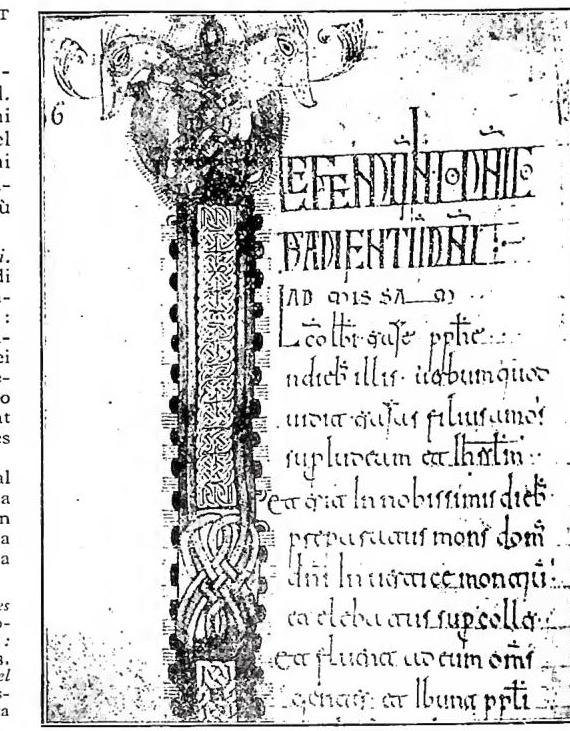
(from G. Marin, Liber comicus, Mercdiana 1893, tec. f. 1)
LEZIONARIO - Incipit of the Liber comicus - Paris, Bibliothèque nationale. Nouv. Acquis., lat. 2171, f. 36 (11th century).
VIII, that is, Lectio in Sexagesima: Et manifeste magnum est pietatis sacramentum... quae nunc est et futura (I Tim. 3,16-48). At other times the reference was more complete, with the indication of the chapter, verses, and incipit. Thus in the Epistolary of Schlettstadt (ca. 8th century): In Pascha, Act. 3,29-41: Viri fratres, liceat audenter dicere. This is the most frequent method. But there are l. that provide still more precise information, namely the indication of the book, incipit, and explicit, as in the L. of Würzburg (8th century): In Theophania, Lectio epistolae benti Pauli Apostoli ad Titum. Carissimi: apparuit, uq. spem vitae aeternae in Christo Jesu Domino nostro.
At a third stage, the selected passages, or the epistles and lessons from the Old Testament (epistolaria), and the Gospels (evangelaria), were copied out in full (as in the L. of Toledo and Luxeuil from the 7th century), either separately or both together in the same codex (lectionaria properly so called). It is in this «plenary» sense (the designation is Tomasi’s, with an evident reference to the missalia plenaria) that Agobard (d. in 840), it seems, defines the l. as «liber lectionum ex divina libris congrua ratione collectus» (De correct., Antiph., cap. 19: PL 104, 338). At this point the development of the l. was complete. The culmination of its formation coincided with its decline. The multiplicity of books gradually created for the performance of the actio sacra (at least three, if not four, for the Mass alone: antiphanarium, lectionarium [evangeliarum], and sacramentarium or liber sacramentorum), by making the structure of the liturgical institution more cumbersome, made the need for simplification more keenly felt. Thus arose the Missalia plenaria (11th century), which marked the disappearance of all their components, including the l.
According to the nature of the lessons it contained, the l. had various names: capitulare (or = ium), lectionarium (or = ius), comes or liber comicus, comitis (that is, a priestly vademecum, because at first it was not properly a liturgical book, but also served for private spiritual reading) are terms used indiscriminately for miscellaneous collections (prophetic lessons, epistles, and Gospels); epistolarium (or = ius) or epistolium, apostolus, and apostolicus (a clear allusion to the predominance of the Pauline letters) more precisely designate the collection of the prophetic lessons of the Old Testament and the epistles, compiled first by the lectores and later by the subdeacons; evangelarium (or = ius), breviarium (or = ius) evangeliorum, etc., were collections of Gospel pericopes.
The practice of reading the Gospel directly from the text of Holy Scripture (the bibliotheca of the Middle Ages), rather than from a collection of passages, persisted more tenaciously than in the case of the other two types of reading, as the numerous surviving codices attest. Even the Ordo Romanus I of the end of the 7th century states (n. 28): «Lectio legenda est prout continetur in capitulari» (PL 78, 950-51), whereas the epistle must have been read from an l. designated by the same Ordo (n. 3: ibid., 938) by the traditional name of apostolus. The practice, moreover, must have varied according to the different churches, the possibility of obtaining special books, their availability, and so forth. Even today, the churches best supplied and most orderly in the solemn Mass use the epistolary and the evangeliary, or an l. comprising both, for the singing of the lessons.
PRINCIPAL L. -
1. For the Epistles
The first attempts at systematic collections of Scripture for liturgical use appear in Gaul in the fifth century. In Rome, the first mention of an l. is found in the inventory of the church of Cornutum (a small parish in the territory of Tivoli) from 471. But it is doubtful whether this was a local l. or one derived from the Roman Church. In any case, nothing remains except the notice itself. Everything else is pure conjecture. The most important document preceding the seventh century is the L. of Capua, composed, apparently, by Vittore, bishop of that city (d. in 573), contained in the celebrated codex Fuldensis of the New Testament. The liturgical pericopes are marked in the text with a conventional sign; then the list is repeated in the margin for the individual epistles. As regards Rome, particular importance attaches to the information provided by Giovanni Diacono, who asserts that the l. itself was the basis of the reform of the Gelasian Sacramentary carried out by s. Gregorio (Vita S. Gregorii, 11, 17: PL 75, 94). Other important l. are the Epistolario di Corbie (ninth century) of the Biblioteca di Petersburg, dependent on the L. misto di Murbach (eighth century), and the Epistolario di Schlettstadt (eighth century), a typical representative of the Gallican rite, also containing the prophetic readings.2. For the Gospels
One of the oldest indices is that of the Evangeliario di s. Cutberto, also called Book of Lindisfarne, because it was transcribed in that city from a copy belonging to the Church of Naples, brought to England after the middle of the seventh century (edited by G. Morin, in Anecdota Maredtsolana, I, Maredsous 1893, pp. 426-35). The list of pericopes contains very few feasts of saints, a manifest indication that the codex preserves the arrangement preceding s. Gregorio Magno. Perhaps it is a Gelasian list with later additions made at Naples. The same capitulary reappears in the Vangelo di s. Burcardo (seventh century), which contains additions certainly of Roman origin. Another interesting index of pericopes is found in the Evangeliario di s. Genoveffa di Parigi, from the ninth century, now in the British Museum (Harley 2797).3. For the Epistles and the Gospels
The Roman system of lectionary arrangement has three notable representatives: the comes di Würzburg, “il più antico l. della Chiesa romana” (Morin), which reflects the state of the liturgy in Rome at the end of the sixth century; the comes Alcuini (seventh-eighth century); and the comes dell'abbazia di Murbach (eighth century). For Spain, the oldest document is the Liber comicus di Toledo (seventh century). Gaul has two important l.: the L. di Luxeuil (sixth-seventh-eighth centuries), recently edited by P. Salmon (Rome 1944), and the Missale Gothicum, contemporary with the preceding work (phototype edition with a critical introduction by C. Mohlberg, Augsburg 1929). The arrangement of the readings in the ancient Ambrosian liturgy is given by the Sacramentarium Bergomense of the tenth-eleventh century (edited by Cagin, Solesmes 1900).The l. are of particular importance in the history of the liturgy. First of all, because through the system of readings they show the development and gradual evolution of the liturgical year; then because from the selection of the readings one can determine precisely the primitive conception of a given feast or mystery, a conception sometimes altered or transformed in the course of the centuries. Finally, the l. are important for the history of the sacred books, because at times they are the principal or sole source of a variant reading.