
CORBIE. — A town situated near the confluence of the Encre and the Somme, 15 km from Amiens, in the department of the Somme, in Picardy (France). Clotaire III (657–61), together with his mother Bastide, founded an abbey there in honore sancti Petri et sancti Pauli principum apostolorum et sancti Stephani protomartiris, as is stated in the very charter of foundation, which also contains the privileges received immediately thereafter, such as immunity and exemption. It was placed under Luxeuil by Abbot Waldebert, and received its first volumes from Luxeuil. The monastery church was consecrated in 667 by Bishop Bertefredo. A charter of Chilperic II dated 29 April 716 refers to work on the monastic library. The abbey obtained privileges from Popes Benedict III (855–58) and
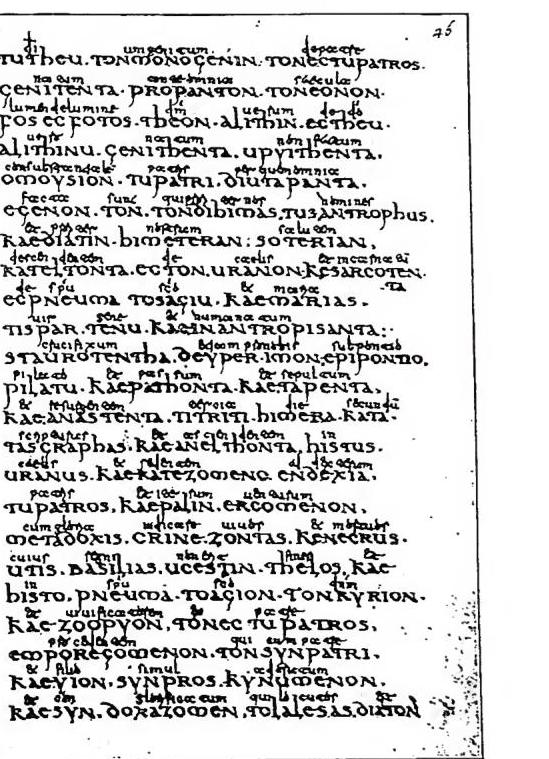
CORBIE — Type of writing of C. from the eighth century. — Fol. 46 of the Sacramentarium Gelatianum containing the Nicene Creed in Greek and Latin — Vatican Library, cod. Regin. 316.
Niccolò I (858–67). Its prestige increased during the Carolingian period; Desiderio, king of the Lombards, was held prisoner there and died there (774). The monastic school of C. achieved great renown under its ninth abbot, St. Adelardo, who sent a group of his monks to Westphalia, where the emperor Ludovico il Pio founded the Benedictine monastery of Corvey, or New C. (diocese of Paderborn).
In 1137 a fire destroyed the monastic buildings, which were nevertheless immediately and extensively rebuilt.
Filippo Augusto (1165–1223) granted C. a municipal charter. In 1550, as the abbey declined, commendatory abbots were appointed; it nevertheless flourished again from 1618, when it was incorporated into the new Benedictine Congregation of S. Mauro.
On 15 Aug. 1636 C. was occupied by the Spanish and then retaken by Luigi XIII on 14 Nov. of the same year. Luigi XIV (1638–1715) had the city’s fortifications demolished. The library was in danger of being confiscated, and the Congregation of S. Mauro therefore decided to transfer it to St-Germain-des-Prés; about 400 manuscripts were deposited in Paris, in the Saint-Germain collection (nos. 11504–14231). Around 1791 a secretary of the Russian embassy, Pietro Dubrovski, had about fifty Latin manuscripts removed from St-Germain-des-Prés, including twenty-five of the finest; all went to the imperial library of St Petersburg. In 1790 the abbey was suppressed; the following year four hundred volumes were sent to Amiens, to the municipal library, while 75 entered the National Library of Paris in 1803. After the suppression, part of the abbey buildings was demolished, and today only some enclosure walls, a monumental gate, a well, and remains of eighteenth-century buildings survive; the church of S. Stefano has become a parish church.
The history of the library of C. was summarized by L. Delisle (Recherches sur l'ancienne Bibliothèque de C., Paris 1861; idem, in Le Cabinet des mss. de la bibliothèque Nationale, II, there 1874, pp. 104–41, 427–40). In the eighth century the scriptorium Corbienne had Anglo-Saxon monks who used insular script, especially in the abbreviations (W. Lindsay, The old Script of C., its abbreviation symbols, in Revue des bibliothèques, 22 [1912], pp. 405–29).
Mabillon had already classified a characteristic type of writing from C. under the name “lombardica,” which Traube changed to “ancient script of C.”; two codices of this type, however, are dated to 810–20. Subsequently, other types, likewise from the eighth century, were brought to light. Of these the oldest, type b, is represented by a group of codices from the first half of the eighth century (E. A. Loew, Studia palaeographica, Munich 1910, p. 36; S. Tafel, Un type français de minuscule précarolingienne, in Revue Charlemagne, 2 [1912], pp. 105–15; A. Wilmart, L'index liturgique de St-Thierry, in Revue Bénédictine, 30 [1913], p. 439, n. 11; another type, called that of Abbot Leuticarius (751–68), displays characteristics of both the semioncial and the minuscule scripts (P. Liebaert, Some early script of the C. scriptorium, in Palaeographia Latina, 1 [1922], p. 62). The type called that of Abbot Mordrannus (772–80) presents rounded, regular letters like Carolingian minuscule; famous is the Bible now in the municipal library of Amiens (mss. 6, 7, 9, 11, 12), written at the direction of that abbot (cf. Ph. Lauer, La réforme carolingienne de l'écriture latine et l'école calligraphique de C., in Mémoires de l'Académie des inscriptions et belles lettres, 13 [1924], p. 19). The e-n type (eighth century) and the a-b type (first half of the ninth century) should also be mentioned. Lindsay sought to distinguish an a type, which, however, amounts to a variety of Merovingian script. It seems that Beneventan script exerted a certain influence on the writing of C. in the eighth century (for the writing of C. see also the entry CAROLINA, SCRITTURA: scritture précaroline).
More recent studies of the scriptorium of C. are those undertaken by O. Dobiache-Rojdestvenskaia (Un codex insulaire des VIIe-IXe siècles à C., in Bulletin de l'Académie des sciences de l'U.R.S.S. Classe des Humanités, Leningrad 1930, pp. 183–95; idem, Questions corbiennes, in W. Stach and H. Walter, Studien zur lat. Dichtung des M. A., Ehrengabe für Karl Strecker, Dresden 1931, pp. 18–28). The same author subsequently provided a systematic treatment of the manuscripts of the scriptorium Corbienne now in the library of Leningrad in her study: Histoire de l'atelier graphique de C. de 651 à 830 reflété dans les manuscrits de Leningrad (in Académie des sciences de l'U.R.S.S., 2nd series, fasc. XLIII [Leningrad 1934]).
L. W. Jones finally summarized the entire activity of the school of C. in 1947 (The scriptorium of C., in Speculum, 22 [1947], pp. 191–204).
The scriptorium continued to flourish in the ninth century, as demonstrated by the sacramentary of Rodrado from 853 (in that century one of the most famous pupils of C. was Pascasio Radberto, who died in 865), and continued its activity until the thirteenth century, as attested by the catalogues of its manuscripts.
The oldest catalogue, from the eleventh century and fragmentary, comprises 45 entries (Cod. Vat. Lat. Regiments, 520); the second, dating from before the end of the eleventh century, is found in ms. Phillips 1865 in the Royal Library of Berlin; the third, from the beginning of the thirteenth century, is the most complete. With the decline of the monastery, however, the library was repeatedly deprived of many of its manuscripts; during the sixteenth century some ended up in other libraries, such as Berlin, Leiden (Philippici 1669, 1735, 1776, 1865; and Lat. 30), Oxford (Canonici, script. eccl. 112), Paris (Bibliothèque Nationale; De Thou, Dupuy, and Notre-Dame collections in the Bibliothèque Nationale, now lat. 5730, 6796, 8051, 8777, 17655, 18311, 18315), and the Vatican (Cod. Vat. Lat. 340 and Vat. Regim. 133).
From the catalogues cited and the surviving manuscripts, one can gain an idea of the richness and importance of the Corbie library, which contained biblical manuscripts, calendars, martyrologies, sacramentaries, missals, antiphonaries, Gospel books, lectionaries, books of hours and breviaries, lives of saints, rituals, obituaries, liturgical literature, musical manuscripts, and so forth.