
CORNELIO, PAPA. - The Lib. Pont. (I, p. 150), in his biography calls him « natione Romanus »; G. B. De Rossi considered him a relative rather than a client
C. convened a Council in Rome in the autumn of 251, in which sixty bishops and a large number of priests and deacons participated (Eusebius, Hist. eccl., VI, 43, 2); in it, the decisions of the Synod of Carthage regarding the « lapsi » were confirmed, and Novatian and his partisans were excommunicated.
Eusebius records a part of the letter sent by C. to Bishop Fabian of Antioch to communicate the resolutions of the council; in it, the composition of the clergy of the Roman community is listed for the first time; it consisted of forty-six priests, seven deacons, and seven subdeacons, in addition to the minor clergy which comprised 42 acolytes and 52 exorcists, lectors, and doorkeepers (Eusebius, Hist. eccl., VI, 43, 11). The spontaneous offerings of the faithful made it possible to support 1500 widows and needy persons daily. In June of the year 252, Emperor Gallus suddenly unleashed the persecution, imposing exile on the bishops, as attested by Bishop Dionysius of Alexandria (Eusebius, Hist. eccl., VII, 1) and by St. Cyprian (Ep. 60, 2), from whom we learn that C. was arrested. But as soon as this news spread in the Roman community, many of the faithful rushed forward and wished to accompany him to the tribunal, joining in his confession, so that the Pope had « multos gloriae comites » and was « dux confessionis fratribus » (Cyprian, Ep. 60, 2).
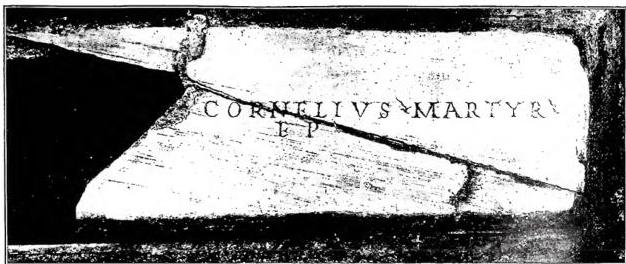
C. was condemned to exile in Civitavecchia, where in June of the following year, 253, « cum gloria dormitionem accepit » (Liberian Catalogue). His remains were translated to Rome, certainly after 258, and deposited in the part of the Cemetery of Callistus closest to the Appian Way, in a deep area inside a large quadrangular niche plastered on the inside, closed on the outside largely by a wall and for the rest by a marble slab upon which at first only his name and dignity were engraved: CORNELIUS EP(ISCOPUS), to which the glorious title of MARTYR was subsequently added on the right. This is the only Latin inscription of the popes of the early centuries.
St. Cyprian also calls C. « beatum martyrem » (Ep. 61, 3): he is the « sacerdos pacificus et iustus et martyrio quoque dignatione Domini honoratus » (Ep. 67, 6; 69, 3).
The anonymous African author of the treatise Ad Novatianum highlights the example he gave of a « boni pastoris ».
The Church of Rome celebrated not the date of his death and temporary deposition in Centumcellae, but that of his definitive deposition in Callistus; it coincided « eodem die, sed non eodem anno » (Jerome, De viris illustribus, 67) with the commemoration of the bishop of Carthage, St. Cyprian, celebrated in Rome already in the first half of the 4th century in Callistus (Depositio Martyrum). In the Hieronymian Martyrology, under the date of September 14, we read: « XVIII Kalendas octobres Romae via Appia in cimitero Calesti Corneli episcopi » (Bern codex).
The tomb of St. C. was later embellished by Pope Damasus (366-84) with a carmen in Philocalian letters, the text of which has not been handed down by the sylloges; G. B. De Rossi recovered about the right half of it when he discovered the Pope's tomb in 1854. Beneath the tomb itself was a second, very mutilated inscription, which De Rossi himself attributed to Pope Siricius (384-99). Later, the adjacent walls were decorated with paintings of SS. C., Cyprian, Sixtus II, and Optatus the bishop. Wilpert has dated them to the time of John III (561-74). On the painted walls and on the Pope's own sepulchral slab, a fragment of which De Rossi had recognized as early as 1849 in the lintel, pilgrims of the 7th-9th centuries wrote their names; lamps were burning before the tomb at that time. Among the inscriptions found near the crypt, mention should be made of a marble slab bearing the inscription of a ΜΑΣΙΜΟΥΣ Π. Ρ. (πρεσβότερος), who is perhaps the presbyter Maximus the Confessor, a contemporary of the Pope, and that of a certain Serpentius who purchased the tomb from the fossoressor Quintus « ad sanctum Cornelium ».