
PAPA. — From the Greek πάππας, πάπας (= father), an honorific title now reserved in the Catholic Church for the Supreme Pontiff.
SUMMARY:
I. Origin of the name
II. Election of the p
III. Names of the p
IV. The papal chronology
V. The number of the p
VI. Portraits of the p
VII. Coats of arms of the p
VIII. Burial of the p
IX. Acts of the p
X. Papal medals.I. ORIGIN OF THE NAME
Until almost the ninth century, but especially in the third to fifth centuries, the title of pope was given to bishops as an expression of affectionate veneration, as is also shown by the adjectives my, your, our, which often accompanied it (“non tu es papa noster?” Perpetua and Saturus exclaim to the bishop Ottatus of Carthage: Passio ss. Perpetuae et Felicitae, 13; “τοῦ μακαρίου πάπα ἡμῶν Ἡρανῶν” writes Dionysius of Alexandria [d. ca. 254]: Eusebius, Hist. eccl., VII, VII, 4; “Cypriano papas” the Roman deacons address in a letter: Ep., 30, ed. G. Hartel, CSEL, III, 2, Vienna 1871, p. 557). This title was sometimes also given to simple priests, as, for example, in Egypt in the fourth century (cf. P. Batifol, L'Eglise naissante et le catholicisme, Paris 1927, p. 353, n. 2); in any case, it is well known that in the East the priest is still called papas. In Egypt, however, the πάπας par excellence was always the patriarch of Alexandria.The title of pope for the bishop of Rome, apart from Tertullian’s “benedictus papa” in De pudicitia (XIII, 7), which probably refers to Callistus, is given directly for the first time in the inscription of the deacon Severus (596–304), discovered in S. Callisto, in which we read “iussu p(a)p(se) sui Marcellini” (reproduced at V. LUMINARE). With the end of the fourth century, the word pope, for the bishop of Rome, begins to be something more than a simple expression of affectionate veneration: it tends to become his specific title; significant in this regard is the address placed by S. Ambrose at the beginning of the letter of the Synod of 390: “Domino dilectissimo fratri Syricio papae” (Ep., 42: PL 16, 1124). The Synod of Toledo in 400 uses the word pope to indicate, sic et simpliciter, the bishop of Rome (Mansi, III, 1006–1007), and S. Vincent of Lérins, recalling various bishops, gives this title only to the pontiffs Celestine I and Sixtus III (cf. Commonitorium 32–33: PL 50, 683–84). The Roman Synod of 499 likewise uses the word pope absolutely (ed. Th. Mommsen, in MGH, Auct. antiquissimi, XII, p. 403). During the fifth century, however, there was still a perceived need to accompany the word pope with a qualifier, such as papa Urbis aeternae or Urbis Romae (letters of Honorius: Collectio Avellana, Epp., 27, 28, 37; ed. O. Guenther, CSEL, XXXV, Vienna 1895, pp. 73, 85), papa urbicus (Paulinus of Nola, Ep., 5, 14; CSEL, XXX, Vienna 1893, p. 33), etc. With the sixth century, the term pope also entered the formulary of the Chancery of Constantinople and became, apart from increasingly rare exceptions, the distinctive title of the bishop of Rome. In the Liber Pontificalis too, the word episcopus, used in the preceding biographies, gives way with the biography of Agapitus I
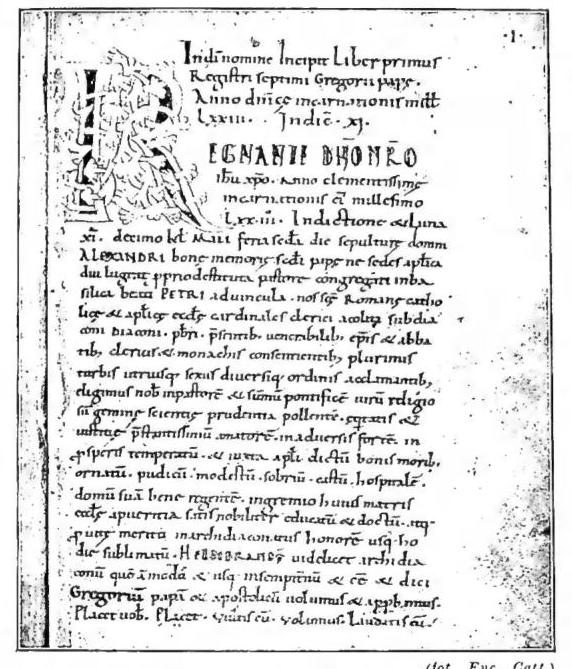
(photograph: Esc. Cutt.)
PAPA – Official record of the election of Ildebrando to the supreme pontificate (22 August 1073). Incipit of the register of Gregorio VII – Vatican Secret Archive, Reg. Vat. 2, f. 1°.
(535–36) the place of that of p. As for proposition 11 of the Dictatus papae of Gregorio VII (1075): « quod hoc unicum est nomen in mundo » (v. riproduzione a tav. LXXXII del vol. VI), it introduces no innovation regarding the meaning of the word p., but codifies a custom already several centuries old. The name papatus does not appear to be older than Leone Ostiense (12th century).
II. ELECTION OF THE P
The election of the bishop of Rome in the first centuries of Christian life did not differ from that of the other episcopal sees. Although some norms for ecclesiastical elections can be derived from chap. 44 of the First Ep. to the Corinthians of s. Clement of Rome, one must turn to the correspondence of s. Cyprian for direct information concerning the election of a p.; in letters 45–52, especially 55 (ed. G. Hartel, CSEL, III, 2, Vienna 1871, pp. 599–650), s. Cyprian discusses the election of s. Cornelius, which took place in particularly troubled circumstances because of the conflicts provoked by Novatian, in March 251: in the election of Cornelius, who had passed through all the grades of the hierarchy, the clergy and the people took part, and the bishops present conferred the episcopate upon him. From that time onward, the newly elected bishop of Rome communicated to the bishop of Carthage his elevation to the Roman see.With the fourth century, in conformity with the practice established after the Council of Nicaea for the selection of bishops, the election of the p. became chiefly a matter for the clergy, to which the people and the aristocracy gave their assent. The candidate had to have passed through all the grades of the hierarchy and was generally the archdeacon, the most distinguished figure in the Roman ecclesiastical administration. Normally the election took place three days after the death of the predecessor (a rule that had many exceptions, especially in the Middle Ages; the longest vacancy was that which preceded the election of Gregory X, 1271), and the consecration took place on the following Sunday. From Justinian I until Constantine IV Pogonatus (685: cf. Lib. Pont., I, p. 363), however, the elected candidate had to ask the Emperor (cf. formula 58 of the Lib. diurnus, ed. Th. Sickel, Vienna 1889, p. 47) for the tusio or praecetio for ordination and pay an adequate tax to the Imperial Chancery (cf. Lib. Pont., I, p. 354), as well as obtain the approval of the Exarch of Ravenna (cf. formula 60: ibid., ed. cit., p. 49
ff.). The last p. to request confirmation from the Exarch was Gregory III (731). In urgent cases the consecration could also take place « abscue iussione principis », as happened in the case of Pelagius (Lib. Pont., I, p. 309). The consecration of the bishop of Rome was already in the fourth century a privilege of the bishop of Ostia, as s. Augustine attests (cf. Breviculum collationis cum Donatistis, III, 16: PL 43, 641; cf. also Lib. Pont., I, p. 202), with the assistance of the bishops of Albano and Porto (cf. formula 57 of the Liber diurnus, ed. cit., p. 46). As soon as he had been elected and consecrated, the new p. sent to the patriarchs and bishops of the principal sees—a practice already attested by s. Cyprian in the case of Carthage—a synodical letter announcing his elevation to the throne of S. Peter.
The election of the p. has always possessed a religious and political character of particular importance; it should therefore cause no surprise that from antiquity onward it was often disfigured by violent human passions and base political interests. The civil authority more than once believed itself obliged to intervene, and not always for the good of the Apostolic See, either to safeguard public order or to impose its own candidates: the Emperor Constantius sent Liberius into exile and supported the election of the antipope Felix; at the death of Simplicius (483), the prefect of the praetorium, Cecina Basilus, in the name of Odoacer, presided over an assembly of senators and members of the clergy and had regulations approved to prevent the future p. from alienating Church property; Theodoric intervened in the double election of Symmachus and Laurentius and gave his approval for the ordinatio of Felix IV (the first intervention of this kind: Lib. Pont., I, pp. 106, 280, n. 5); Belisarius deposed Silverius and had Vigilius elected; the duke Totila of Nepi had the antipope Constantine elevated to the see of Peter (767); the Carolingians intervened through their legates; Otto I had John XII deposed and Leo VIII elected; the German emperors tyrannized over papal elections, causing more than one antipope to be created in the eleventh and twelfth centuries; the sovereigns of Spain, France, and Austria interfered in the choice of the p. from the sixteenth century until the Conclave of Pius X, using the insidious weapon of the « esclusiva », that is, veto (v.).
To remedy the grave abuses that periodically occurred in the election of the p., the pontiffs themselves took or invoked measures to regulate its proper conduct: in 420 Boniface I asked the Emperor Honorius to take precautions to prevent in the election of his successor the disturbances that had occurred in his own; Honorius accepted the request, but wisely refrained from promulgating a law on the matter and assured the P. that the government would recognize only a morally unanimous election (Collectio Avellana, Ep. 37, ed. cit., p. 83). The Roman Synod of 499 prohibited discussion of the succession of the p. while he was alive « et inconsulto », imposing severe penalties on offenders; it then declared that, if opinions differed (studia diversa) in the choice of the successor, « vincat sententia plurimorum » (ed. Th. Mommsen, in MGH, Aust. antiquissimi, XII, pp. 403–404; cf. also the constitutum of Boniface III: Lib. Pont., I, p. 316). The attempt of Felix IV, in 530, to choose his own successor disturbed the Roman Church at his death, with the election of Dioscorus by the majority and of Boniface II, chosen by the dying pope and confirmed only by a minority. The attempt, undertaken for the good of the S. See, was not continued, since Boniface II, who had likewise chosen his successor, was compelled to burn the deed of appointment before the tomb of s. Peter (Lib. Pont., I, p. 281). The Roman Synod of 769 barred access to the supreme pontificate to all who were not cardinal priests or deacons and reserved the election to « cunctis sacerdotibus atque proceribus Ecclesiae et cuncto clero » (ed. A. Werminghoff, in MGH, Concilia, II, p. 86; Lib. Pont., I, pp. 468, 480–81). The Constitutio Romana of 824, however, tacitly restored to the aristocracy and the people their role in the election of the p. Nevertheless, in order to prevent abuses, the consecration of the elected candidate had to take place in the presence of the Emperor’s « missi », or legates. The Roman Synod of 898 reaffirmed the necessity of the presence of these imperial legates and restricted the act of electing the p. to the bishops (cardinals) and clergy of Rome, although it had to take place in the presence of the Senate and the people (can. 10: Mansi,
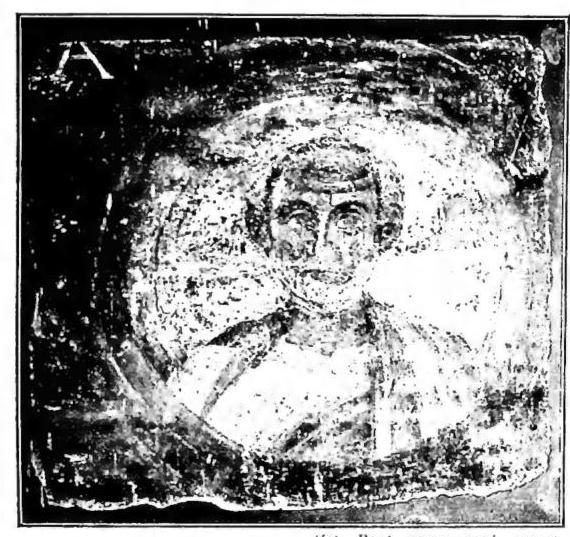
(phot. Pont. comm. arch. sacra)
PAPA - Uno dei frammenti meglio conservati della serie dei ritratti del p. in S. Paolo fuori le Mura del tempo di Leone I. Ritratto di p. Urbano.
XVIII, p. 225). Per arginare i gravi abusi che si verificavano ad ogni elezione, Niccolò II (1059) riservò le trattative per l'elezione ai cardinali vescovi i quali dovevano poi subito associarsi gli altri « clerici cardinales »; il resto del clero e il popolo veniva a sua volta convocato per assentire all'avvenuta elezione. Il candidato doveva appartenere al clero della Chiesa di Roma, e solo in caso di necessità si poteva ricorrere a persona ad esso estranea. Niccolò II prevede anche il caso che l'elezione per necessità si dovesse tenere fuori Roma (cf. l'ed. del decreto, nel testo genuino e nell'interpolato da Guiberto o dai suoi seguaci, a cura di J. B. Lo Grasso, Ecclesia et Status. Fontes selecti, Roma 1939, pp. 100-107).
Il decreto con cui Niccolò II riservò al collegio dei cardinali l'elezione del p. aprì un nuovo periodo nella storia di questo istituto che andò lentamente evolvendosi sino a raggiungere l'attuale preciso e severo ordinamento fissato nel Codice di diritto canonico e integrato di recente con la cost. Vacantis Apostolicae Sedis di Pio XII dell'8 dic. 1945. Le principali tappe di questo nuovo periodo sono: 1) il decreto del Concilio Lateranense III (marzo 1179: Mansi, XXII, 217-18) contenuto nella cost. di Alessandro III, Licet de vitanda (6. X. I. 6; G. J. Ebers [cit. in bibl.], p. 66) che richiedeva per la validità dell'elezione la maggioranza di due terzi dei voti e ciò per precludere la via a possibili scismi; 2) il can. 2 del II Concilio di Lione (1274: Mansi, XXIV, pp. 81-85) riprodotto nella cost. Ubi periculum di Gregorio X (luglio 1274: G. J. Ebers, p. 67) che fissava le norme per il conclave, che poi vennero modificate e integrate più volte; 3) la cost. Si summus rerum di Giulio II del 14 genn. 1505, pubblicata a Bologna nell'ott. 1510 e nuovamente sancita dal Concilio Lateranense V nella sessione quinta del 16 febbr. 1513 (Bullarium Romanum, ed. Taurinensis, V, pp. 536-37: Pastor, III, p. 701) per prevenire gli scandali simoniaci verificatisi nell'elezione di Alessandro VI; 4) la cost. Asterni Patris Filius di Gregorio XV del 15 nov. 1621 (ibid., XII, pp. 619-26), contenente nuove norme per l'elezione del p. allo scopo di ovviare ai gravi abusi delle elezioni precedenti, e per arginare l'intromissione ormai diventata intollerabile dei governi, in particolare della Spagna, che esercitava l'esclusiva sin da Carlo V. Lo scopo sperato non si raggiunse, anzi se fino a quel punto gli ambasciatori erano riusciti nel loro intento con intrighi, d'ora in poi vi riusciranno ponendo ufficialmente l'esclusiva (cf. Pastor, XIII, pp. 85-93) che solo Pio X avrà il coraggio di interdire con la cost. Commissum nobis, del 20 genn. 1904, pubblicata nel marzo del
1909 (Pii X P. M. Acta, III, Roma 1908 [1909], pp. 289-292 sgg.); 5) la cost. Sede vacante di Pio X (25 dic. 1904) integrata dal motu proprio di Pio XI, Cum proxime (1º marzo 1922) e dalla costit. citata di Pio XII (v. CONCLAVE).
Per farsi un'idea del come si svolgeva l'elezione in seno al conclave dal sec. XIV in poi si veda l'Ordo Romanus XIV, composto probabilmente da Gaetano Stefaneschi, m. nel 1341 (ed. J. Mabillon, Museum Italicum, II, Parigi 1689, p. 246 sgg.); l'Ordo Romanus XV, composto da Pietro Amelio, m. nel 1389 (ed. cit., II, p. 532); la descrizione che ne diede nel 1488 il cerimoniere pontificio Agostino Patrizi Piccolomini (cf. C. Marcello, Rituum ecclesiasticorum sive sacrarum caeremoniorum SS. Romanae Eccl. libri III, Venezia 1516, cc. I-VIII); la cost. di Gregorio XV, Decet Romanum pontificem, del 12 marzo 1621 (ed. G. J. Ebers, pp. 104-11), e la cost. di Clemente XII Apostolatus officium del 5 ott. 1732 (Bullarium Romanum, ed. Taurinensis, XXIII, p. 443 sgg.; G. J. Ebers, pp. 111-16). Per l'ordinatio, l'inthronizatio, la possessio e la coronatio, V. i testi raccolti dall'Ebers, pp. 169-214; cf. E. Eichmann, Weihe u. Krönung des Papstes im Mittelalter, Monaco 1951.
III. NAMES OF THE P
After the Prince of the Apostles, whose name Christ changed from Simon to Peter (Io. 1:42), the first of his successors to change his name was Giovanni II, who had previously been called Mercurius. Other examples of this kind occurred in the 10th century: Ottaviano dei Conti di Tuscolo became Giovanni XII (955); the antipope Francone, Bonifacio VII (974); Pietro Canepanova, bishop of Pavia, Giovanni XIV (983); Brunone dei duchi di Carintia, Gregorio V (996). From Silvestro II (999) onward, p. and antipopes changed their baptismal names at the time of election, with the exceptions of Adriano VI (Adriano Florensz) and Marcello II (Marcello Cervini); at first this occurred at the wish of the electors (cf., for example, Leone Ostiense, Chronicon Casinense, II, 86 [the election of Vittore, 1055, and of the antipope Benedetto X, 1058]: MGH, Scriptores, VII, pp. 686, 695; Lib. Pont., II, p. 357; the Ordo Romanus XII of Cencio Savelli [around 1192] still assigns the task of imposing the new name on the elected candidate to the « prior diaconorum »: ed. P. Fabre-L. Duchesne, Le Liber censuum, I, Paris 1889–1910, p. 311), then by personal choice of the elected candidate, following a request from the « prior diaconorum », as is already attested by the Ordo Romanus XIII (1275: ed. J. Mabillon, Museum Italicum, II, Paris 1689, p. 221; G. J. Ebers, p. 186).IV. THE PAPAL CHRONOTAXIS
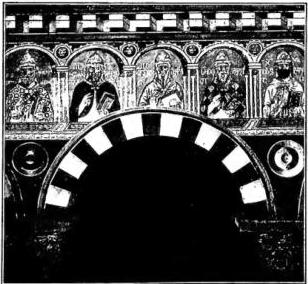
The first attempts to transmit the succession of the popes date back to the second half of the 2nd century and are due to two writers: Egesippus(phot. Gub. int. naz.)
PAPA — Series of portraits of the p. in S. Piero a Grado, near Pisa: portraits from the antipope Cristoforo to Leone VI; a fresco series probably painted by Deodato Orlandi (1300–12).
(Int. Emil)
PAPA - Series of busts of p. (15th century) in the interior of the cathedral of Siena: the last bust visible on the right is Sixtus II.
(between 155 and 166) and Irenaeus (177–78), who came to Rome to obtain directly from local sources the data they needed. The work of the former has survived only in fragments (cf. Eusebius, Hist. eccl., IV, 22, 3), whereas that of the latter is preserved in its entirety (cf. ibid., V, 6, V. also 24, 28; Adversus haereses, III, 3). The list of p. by Irenaeus, although without chronological data, is the most authoritative document available on the subject, and is the one adopted in our chronological table up to Eleutherius. Sporadic references to successions of p. are found here and there in the Fathers and ecclesiastical writers, but there is no need to dwell on them here, since chroniclers, historians, and anonymous compilers of catalogues of p. (v.) soon undertook to establish, often by more or less empirical methods, the chronological data of the p., either by relating them to emperors and consuls or by indicating the number of years, months, and days of the individual pontificates. The catalogues of p. were subjected to careful critical examination by Duchesne (Lib. Pont., I, pp. 1–xxv, and the article LIBER PONTIFICALIS, III, Sources); the best known among them is the one called the Liberian Catalogue, which constitutes one of the sources of the Liber Pontificalis. The catalogues of p. were often inserted in canonical collections, especially those originating in Italy and Gaul (cf., for example, cod. lat. 12097 of the Bibliothèque nationale in Paris, from the second half of the 6th century; the oldest example of its kind), and served to date the papal decretals collected therein.
With the exception of a few, these catalogues, which became extremely numerous in the early Middle Ages and in modern times, have no critical value, and the same must be said of countless medieval chronicles. Among the papal chronological tables that exercised the greatest influence on historical chronology down to the present day, mention should be made of those that can be derived: 1) from the Chronicon and the Eusebius of Caesarea (v.), which do not always agree on the number of years of the pontificate; 2) Liber Pontificalis (v.) and its continuations, which in their ancient section contain the errors of their sources; 3) from the Chronicon pontificum et imperatorum of Martino di Troppau, O. P. (d. 1278), whose third edition extends to Nicholas III (ed. L. Weiland, in MGH, Scriptores, XXII, pp. 327–473); 4) from the Liber de vita Christi ac omnium pontificum of Platina (critical ed. G. Gaida in RIS, III, I, Bologna 1913–32; the editio princeps, Venice 1479; the noteworthy edition edited by O. Panvinio, Leuven 1572; various editions in Italian); 5) from O. Panvinio, Epitome pontificum Romanorum a s. Petro usque ad Paulum III. Gestorum electionisque singulorum et Conclusium compendiaria narratio (Rome 1557; the Venetian edition of the same year was published without the author’s consent); 6) from the Annales of Baronio (Rome 1588; 22nd ed., Paris 1864–82, together with the innumerable abridged editions and various translations): the chronology of Baronio, which ends with 1198, was accepted by almost all historians until the last century; 7) from A. Ciacconio (Chacón), Vitae et gesta summorum pontificum a Christo Domino usque ad Clementem VIII (Rome 1601; published several times, revised by Oldoini, there 1672); 8) from the Conatus chronologico-historicus ad universam seriem Romanorum pontificum of Daniele Papebroch (Propylaeum ad Acta SS. Maii, Antwerp 1688), the first genuinely critical attempt: the author apologizes for having to contradict Baronio; 9) from the Mémoires of Tillemont (Paris 1693–1712, Venice 1732), which end at the beginning of the 6th century; 10) from the Chronologia Romanorum pontificum in pariete australi basilicae S. Pauli viae Ostiensis depicta saec. V seu aetate s. Leonis PP. Magni cum additione reliquorum summorum pontificum nostra ad haec usque tempora perducta... of G. Marangoni (Rome 1751), a chronological table that reproduces the errors of the source it describes; 11) from the Regesta pontificum of Jaffé up to 1198 and of Potthast up to 1304: at the beginning of each pontificate, the editors placed a careful chronological notice necessary for establishing the dates of the letters (the list of p. from Hadrian I, with the dates of their election, consecration, and coronation, drawn up by H. Grotefend, Taschenbuch der Zeitrechnung des deutschen Mittelalters u. der Neuzeit, 6th ed., Hanover 1928, pp. 117–24, serves the same purpose); 12) from the more recent histories of the Church by Hergenröther-Kirsch, Duchesne (cf. the critical chronological tables up to Pius II published in Lib. Pont., I, pp. cclx–xii; II, pp. lxxv–xiii), Funk, Fliche-Martin, etc.; and from those of the papacy: Pastor, Seppelt, Caspar, etc.; 13) from Eubel’s Hierarchia catholica, from 1198 onward.
Father Ehrle, librarian of the Vatican Library, published in Gerarchia cattolica for 1904 and 1905 a papal chronological table according to the Liber Pontificalis and its sources, edited by Duchesne, in order to offer ecclesiastics a reliable and readily consultable guide. Ehrle’s work was not well received by most, and was not reproduced again because of intemperate controversies provoked by persons with little historical learning, who preferred that the series of p. of St. Paul should continue to be followed with all its errors. The series of p. according to the medallions of St. Paul had in fact been reproduced since 1806 in the Notizie of Cracas, since 1862 in the Annuario pontificio, since 1871 in Gerarchia cattolica, and again from 1913 to 1946 in the Annuario pontificio. In 1947 the editors of the Annuario pontificio replaced the old and anachronistic chronology of St. Paul with a genuinely critical one, prepared by the Prefect of the Vatican Secret Archives, Mons. A. Mercati, who duly updated Ehrle’s series of p.
Since the Duchesne–Ehrle–Mercati papal chronology is thus far the best, it has been thought appropriate to reproduce it with some modifications, especially in the section concerning the antipopes (v.). It should be noted that the dates assigned from Linus to Pius I are only approximate; those from Anicetus to Callistus are more secure, but not precise to the exact year. The authentic antipopes have their names printed in italics; dates preceded by an asterisk mean that the beginning of the pontificate was illegitimate; names in italics preceded by an asterisk indicate doubtful antipopes; in roman type are those improperly called antipopes, or p. who are not such, like Stephen II. When there are two dates at the beginning of a pontificate, the first refers to the electio, the second to the ordinatio or consecratio (where applicable) and to the coronatio; when three dates are indicated, the third refers to the coronatio when it is distinct from the consecratio.
The year of the pontificate was reckoned from the coronatio. Before that date, the status of the elected pope was emphasized in papal documents both in the datatio and in the intitulatio (e.g., «Benedictus presbiter et in Dei nomine electus Sanctae Sedia apostolicae» [Benedict II]: cf. C. Silva Tarouca, Nuovi studi sulle antiche lettere dei p., I, Rome 1932, p. 55). The formula electus is also prescribed by the papal ceremonial of Patristi Piccolomini (cf. C. Marcello, op. cit., c. VIII: «Innocentius electus servus servorum Dei» [Innocent VIII]).
PAPAL CHRONOLOGICAL TABLE.
S. PIETRO, of Bethsaida in Galilee, Prince of the Apostles, died a martyr in Rome between 64 and 67.
S. LINO, of Tuscia, 67–76 [67–79].
S. ANACLETO or CLETO, Roman, 76–88 [79–91].
S. CLEMENTE, Roman, 88–97 [92–101].
S. EVARISTO, Greek, 97–105 [101–105].
S. ALESSANDRO I, Roman, 105–115 [109–110].
S. SISTO I, Roman, 115–125.
S. TELESFORO, Greek, 125–136.
S. IGINO, Greek, 136–140 [138–142].
S. PIO I, of Aquileia, 140–155.
S. ANICETO, Syrian, 155–166.
S. SOTERO, of Campania, 166–175.
S. ELEUTERIO, of Nicopolis in Epirus, 175–189.
S. VITTORE I, African, 189–199.
S. ZEFIRINO, Roman, 199–217.
S. CALLISTO I, Roman, 217–14 October 222.
S. Ippolito, Roman, 217–235.
St. URBANO I, Roman, 222–230.
St. PONZIANO, Roman, 21 July 230 – 28 September 235.
St. ANTERO, Greek, 21 November 235 – 3 January 236.
St. FABIANO, Roman, 10 January 236 – 20 January 250.
St. CORNELIO, Roman, ... March 251 – ... June 253.
Novaziano, Roman, 251, d. ca. 258.
St. LUCIO I, Roman, 25 June 253 – 5 March 254.
St. STEFANO I, Roman, 12 May 254 – 2 August 257.
St. DIONISIO, of unknown origin, 22 July 259 – 26 December 268.
St. FELICE I, Roman, 5 January 269 – 30 December 274.
St. CAIO, Dalmatian, 17 December 283 – 22 April 296.
St. MARCELLINO, Roman, 30 June 296 – 25 October 304.
St. MARCELLO I, Roman, 27 May (or 26 June) 308 – 16 January 309.
St. MILZIADE, African, 2 July 311 – 11 January 314.
St. SILVESTRO I, Roman, 31 January 314 – 31 December 335.
St. GIULIO I, Roman, 6 February 337 – 12 April 352.
LIBERIO, Roman, 17 May 352 – 24 September 366.
Felice II, Roman, ...355–22 November 365.
Uretino, Roman deacon, 366–367, d. after 381.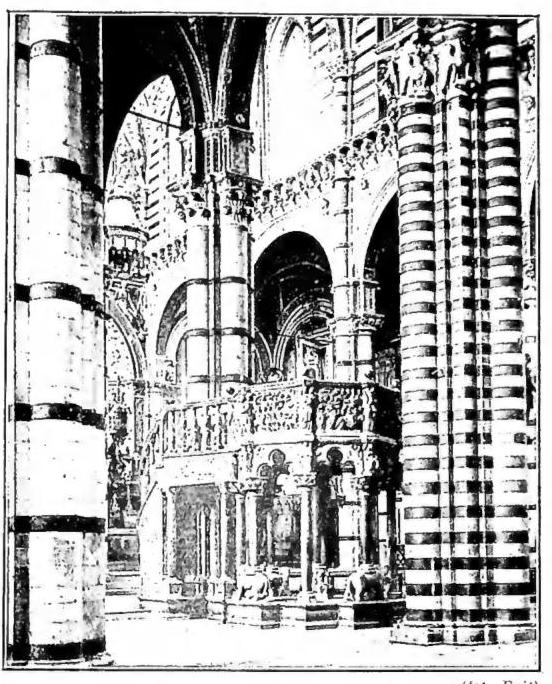
St. ANASTASIO I, Roman, 27 November 399 – 19 December 401.
St. INNOCENZO I, of Albano, 22 December 401 – 12 March 417.
St. BONIFACIO I, Roman, 28, 29 December 418 – 4 September 422.
Eulalio, Roman archdeacon, 27, 29 December 418 – 29 March 419.
St. CELESTINO I, of Campania, 10 September 422 – 27 July 432.
St. SISTO III, Roman, 31 July 432 – 19 August 440.
St. LEONE I, Magno, of Tuscia, 29 September 440–10 November 461.
St. ILARO, Sardinian, 19 November 461 – 29 February 468.
St. SIMPLICIO, of Tivoli, 3 March 468 – 10 March 483.
St. FELICE III (II), Roman, 13 March 483 – 1 March 492.
St. GELASIO I, African, 1 March 492 – 21 November 496.
ANASTASIO II, Roman, 24 November 496 – 19 November 498.
St. SIMMACO, Sardinian, 22 November 498 – 19 July 514.
Lorenzo, Roman archpriest, 498, 501–507.
St. ORMISDA, of Frosinone, 20 July 514 – 6 August 523.
St. GIOVANNI I, of Tuscia, martyr, 13 August 523 – 18 May 526.
St. FELICE IV (III), of Samnium, 12 September 526 – 22 September 530.
[DIOSCORE, of Alexandria, 22 September 530 – 14 October 530].
BONIFACIO II, Roman, *22 September 530 – 17 October 532.
GIOVANNI II, Roman, 2 January 533 – 8 May 535.
St. AGAPITO I, Roman, 13 May 535 – 22 April 536.
St. SILVERIO, of Campania, martyr, 1 (or 8) June 536 – 11 November 537.
VIGILIO, Roman, *29 March 537 – 7 June 555.
PELAGIO I, Roman, 16 April 556 – 4 March 561.
GIOVANNI III, Roman, 17 July 561 – 13 July 574.
BENEDETTO I, Roman, 2 June 575 – 30 July 579.
PELAGIO II, Roman, 26 November 579 – 7 February 590.
St. GREGORIO I, Magno, Roman, 3 September 590–12 March 604.
SABINIANO, of Blera (Tuscia), 13 September 604 – 22 February 606.
BONIFACIO III, Roman, 19 February 607 – 12 November 607.
St. BONIFACIO IV, Marsican, 25 August 608–8 May 615.
St. ADEODATO I, Roman, 19 December 615 – 8 November 618.
BONIFACIO V, of Naples, 23 December 619 – 25 October 625.
ONORIO I, of Campania, 27 October 625 – 12 October 638.
SEVERINO, Roman, 28 May 640 – 2 August 640.
GIOVANNI IV, Dalmatian, 24 December 640 – 12 October 642.
TEODORO I, Greek, 24 November 642 – 14 May 649.
St. MARTINO I, of Todi, martyr, ... July 649 – 16 September 655.
St. EUGENIO I, Roman, *10 August 654 – 2 June 657.
St. VITALIANO, of Segni, 30 July 657 – 27 January 672.
ADEODATO II, Roman, 11 April 672 – 17 June 676.
DONO, Roman, 2 November 676 – 11 April 678.
St. AGATONE, Sicilian, 27 June 678 – 10 January 681.
St. LEONE II, Sicilian, 17 August 682 – 3 July 683.
St. BENEDETTO II, Roman, 26 June 684 – 8 May 685.
GIOVANNI V, Syrian, 23 July 685 – 2 August 686.
Pietro and Teodoro, Roman archpriest and priest, 2 August –
21 October 686.
CONONE, of unknown origin, 21 October 686 – 21 September 687.
Teodoro, having become archpriest, 21 September – 15 December 687.
Pasquale, Roman archdeacon, 21 September 687 – 692.
St. SERGIO I, Syrian, 15 December 687 – 8 September 701.
GIOVANNI VI, Greek, 30 October 701 – 11 January 705.
GIOVANNI VII, Greek, 1 March 705 – 18 October 707.
SISINNIO, Syrian, 15 January 708 – 4 February 708.
COSTANTINO, Syrian, 25 March 708 – 9 April 715.
St. GREGORIO II, Roman, 19 May 715 – 11 February 731.
St. GREGORIO III, Syrian, 11 February, 18 March 731 – 29 November 741.
St. ZACCARIA, Greek, 10 December 741 – 15 March 752.
Stefano II, Roman, elected and died between 16–25 March 752.
STEFANO II (III), Roman, 26 March 752 – 26 April 757.
Teofilatto, Roman archdeacon, late April–May 757.
St. PAOLO I, Roman, late April, 29 May 757 – 28 June 767.
Costantino, of Nepi, 28 June, 5 July 767 – 1 August 768.
Filippo, 31 July 768.
STEFANO III (IV), Sicilian, 1, 7 August 768 – 24 January 772.
ADRIANO I, Roman, 1, 6 February 772 – 25 December 795.
St. LEONE III, Roman, 26, 27 December 795 – 12 June 816.
STEFANO IV (V), Roman, 22 June 816 – 24 January 817.
St. PASQUALE I, Roman, 25 January 817 – 11 February 824.
[...], Roman priest, February 824 (Zinzino?).
EUGENIO II, Roman, ... February–May 824 – August 827.
VALENTINO, Roman, ... August 827 – ... September 827.
GREGORIO IV, Roman, ... 827 – ... January 844.
Giovanni, Roman archdeacon ... January 844.
SERGIO II, Roman, ... January 844 – 27 January 847.
St. LEONE IV, Roman, ... January, 10 April 847 – 17 July 855.
BENEDETTO III, Roman, ... July 29 September 855 – 17 April 858.
Anastasio, the Librarian, Roman priest, August ... September 855.
St. NICCOLÒ I, il Grande, Roman, 24 April 858 – 13 November 867.
ADRIANO II, Roman, 14 December 867 – 14 December 872.
GIOVANNI VIII, Roman, 14 December 872 – 16 December 882.
MARINO I, of Gallese, 16 December 882 – 15 May 884.
St. ADRIANO III, Roman, 17 May 884 – ... September 885.
STEFANO V (VI), Roman, ... September 885 – 14 September 891.
FORMOSO, bishop of Porto, 19 September 891 – 4 April 896.
BONIFACIO VI, Roman, ... April 896 – ... April 896.
STEFANO VI (VII), Roman, ... May 896 – ... August 897.
ROMANO, of Gallese, ... August 897 – ... November 897.
TEODORO II, Roman, ... December 897 – ... December 897.
GIOVANNI IX, of Tivoli, ... January 898 – ... January 900.
BENEDETTO IV, Roman, ... January–February 900 – ... July 903.
LEONE V, of Ardea, ... July 903 – ... January 904.
Cristoforo, Roman, ... September 903 – ... January 904.
SERGIO III, Roman, ... January 898, *29 January 904 – 14 April 911.
ANASTASIO III, Roman, ... April 911 – ... June 913.
LANDONE, of Sabina, ... July 913 – ... February 914.
GIOVANNI X, of Tossignano (Imola), ... March 914 – ...
May 928.
LEONE VI, Roman, ... May 928 – ... December 928.
STEFANO VII (VIII), Roman, ... December 928 – ... February 931.
GIOVANNI XI, Roman, ... February–March 931 – ... December 935.
LEONE VII, Roman, 3 January 936 – 13 July 939.
STEFANO VIII (IX), Roman, 14 July 939 – ... October 942.
MARINO II, Roman, 30 October 942 – ... May 946.
AGAPITO II, Roman, 10 May 946 – ... December 955.
GIOVANNI XII, Ottaviano, of the counts of Tusculum, 16 December
955 – 14 May 964.
Leone VIII, Roman, 4–6 December 963 – 1 March 965.
BENEDETTO V, Roman, 22 May 964 – 4 July 965 or 966.
GIOVANNI XIII, Roman, 1 October 965 – 6 September 972.
BENEDETTO VI, Roman, 19 January 973 – ... June 974.
Bonifacio VII, Roman, Francone, ... June – ... July 974; then August 984 – ... July 985.
BENEDETTO VII, Roman, ... October 974 – 10 July 983.
GIOVANNI XIV, of Pavia, Pietro, ... December 983 – 20 August 984.
GIOVANNI XV, Roman, ... August 985 – ... March 996.
GREGORIO V, Saxon, Brunone of the dukes of Carinthia,
3 May 996 – 18 February 999.
Giovanni XVI, of Rossano; Giovanni Filagato, ... April 997 – ... February 998.
SILVESTRO II, of Auvergne, Gerberto, 2 April 999 – 12 May 1003.
GIOVANNI XVII, Roman, Siccone, ... June 1003 – ... December 1003.
GIOVANNI XVIII, Roman, Fasano, ... January 1004 – ... July 1009.
SERGIO IV, Roman, Pietro, 31 July 1009 – 12 May 1012.
BENEDETTO VIII, Teofilatto of the counts of Tusculum, 18 May 1012 – 9 April 1024.
Gregorio, 1012.
GIOVANNI XIX, Romano dei conti di Tuscolo, ... April–May 1024 – ... 1032.
BENEDETTO IX, Teofilatto dei conti di Tuscolo, ... 1032 – 1 May 1045 (resignation).
Silvestro III, Romano, Giovanni, 20 January 1045 – 10 March 1045.
GREGORIO VI, Romano, Giovanni Graziano, *5 May 1045 – 20 December 1046.
CLEMENTE II, of Saxony, Suitgero dei signori di Morsleben e Hornburg, *24, 25 December 1046 – 9 October 1047.
*Benedetto IX (reappears after his resignation), 8 November 1047 – 17 July 1048.
DAMASUS II, of Bavaria, Poppo, 17 July 1048 – 9 August 1048.
S. LEO IX, Lorrainer, Bruno of the counts of Egisheim-Dagsburg, 12 February 1049 – 19 April 1054.
VICTOR II, German, Gebhard of the counts of Dollnstein-Hirschberg, 16 April 1055 – 28 July 1057.
STEPHEN IX (X), Lorrainer, Frederick of the dukes of Lorraine, 3 August 1057 – 29 March 1058.
Benedict X, Roman, Giovanni, 5 April 1058 – 24 January 1059 (deposed).
NICHOLAS II, of Burgundy, Gerard, 24 January 1059 – 27 July 1061.
ALEXANDER II, Anselm of Baggio (Milan), 1 October 1061 – 21 April 1073.
Honorius II, of Verona, Cadalo, 28 October 1061 – ... 1072.
S. GREGORY VII, of Tuscany, Hildebrand, 22 April, 30 June 1073 – 25 May 1085.
Clement III, of Parma, Guibert, 25 June 1080, 24 March 1084 – 8 September 1100.
B. VICTOR III, of Benevento, Dauferius (Desiderius), 24 May 1086 – 16 September 1087.
B. URBAN II, French, Odo of Lagery, 12 March 1088 – 29 July 1099.
PASCHAL II, of Pieda in Romagna, Ranier, 13, 14 August 1099 – 21 January 1118.
Theodoric, bishop of S. Rufina ... 1100, d. in 1102. Albert, bishop of Sabina, ... 1102.
Sylvester IV, Roman, Maginulf, 18 November 1105 – 12 April 1111.
GELASIUS II, of Gaeta, Giovanni Caetani, 24 January, 10 March 1118 – 28 January 1119.
Gregory VIII, French, Maurice called Burdinus, 8 March 1118 – April 1121, d. ca. 1136.
CALLISTUS II, Guy of Burgundy, 2, 9 February 1119 – 13 December 1124.
[CELESTINE II, Roman, Thebald Buccapeus, 15-16 December 1124; abdicated immediately].
HONORIUS II, of Fiagnano (Imola), Lambert, 15, 21 December 1124 – 13 February 1130.
INNOCENT II, Roman, Gregory Papareschi, 14, 23 February 1130 – 24 September 1143.
Anacletus II, Roman, Pietro Petri Leonis, 14, 23 February 1130 – 25 January 1138.
Victor IV, Gregory, 15 March 1138 – 29 May 1138.
CELESTINE II, of Città di Castello, Guido, 26 September, 3 October 1143 – 8 March 1144.
LUCIUS II, Bolognese, Gerard Caccianemici, 12 March 1144 – 15 February 1145.
B. EUGENE III, of Pisa, Bernard possibly of the Paganelli of Montemagno, 15, 18 February 1145 – 8 July 1153.
ANASTASIUS IV, Roman, Conrad, 12 July 1153 – 3 December 1154.
ADRIAN IV, English, Nicholas Breakspear, 4, 5 December 1154 – 1 September 1159.
ALEXANDER III, of Siena, Roland Bandinelli, 7, 20 September 1159 – 30 August 1181.
Victor IV (V), Octavian of Montecelio (Tivoli), 7 September, 4 October 1159 – 20 April 1164.
Paschal III, Guido of Crema, 22, 26 April 1164 – 20 September 1168.
Callistus III, Giovanni abbot of Strumi (Arezzo), ... September 1168 – 29 August 1178.
Innocent III, of Sezze, Lando, 29 September 1179 – ... January 1180.
LUCIUS III, Lucchese, Ubaldo Allucingoli, 1, 6 September 1181 – 25 September 1185.
URBAN III, Milanese, Uberto Crivelli, 25 November, 1 December 1185 – 20 October 1187.
GREGORY VIII, of Benevento, Alberto de Morra, 21, 25 October 1187 – 17 December 1187.
CLEMENT III, Roman, Paolo Scolari, 19, 20 December 1187 – March 1191.
CELESTINE III, Roman, Giacinto Bobone, 30 March, 14 April 1191 – 8 January 1198.
INNOCENT III, of Anagni, Lotario of the counts of Segni, 8 January, 22 February 1198 – 16 July 1216.
HONORIUS III, Roman, Cencio Savelli, 13, 24 July 1216 – 18 March 1227.
GREGORY IX, of Anagni, Ugolino of the counts of Segni, 19, 21 March 1227 – 22 August 1241.
CELESTINE IV, Milanese, Goffredo Castiglioni, 25, 28 October 1241 – 10 November 1241.
INNOCENT IV, Genoese, Sinibaldo Fieschi, 25, 28 June 1243 – 7 December 1254.
ALEXANDER IV, of Anagni, Rainald of the counts of Segni, 12, 20 December 1254 – 25 May 1261.
URBAN IV, of Troyes, Jacques Pantaléon, 29 August, 4 September 1261 – 2 October 1264.
CLEMENT IV, French, Guy Foulques, 5, 15 February 1265 – 29 November 1268.
B. GREGORY X, of Piacenza, Tedaldo Visconti, 1 September 1271, 27 March 1272 – 10 January 1276.
B. INNOCENT V, of Savoy, Peter of Tarentaise, 21 January, 22 February 1276 – 22 June 1276.
ADRIAN V, Genoese, Ottobono Fieschi, 11 July 1276 – 18 August 1276.
JOHN XXI, Portuguese, Peter Juliani or Peter Hispanus, 8, 20 September 1276 – 20 May 1277.
NICHOLAS III, Roman, Giovanni Gaetano Orsini, 25 November, 26 December 1277 – 22 August 1280.
MARTIN IV, French, Simon de Brion, 22 February, 23 March 1281 – 28 March 1285.
HONORIUS IV, Roman, Giacomo Savelli, 2 April, 20 May 1285 – 3 April 1287.
NICHOLAS IV, of Ascoli, Girolamo Masci, 22 February 1288 – 4 April 1292.
S. CELESTINE V, of Isernia, Pietro del Murrone, 5 July, 29 August 1294 – 13 December 1294, d. 19 May 1296.
BONIFACE VIII, of Anagni, Benedetto Caetani, 24 December 1294, 23 January 1295 – 11 October 1303.
B. BENEDICT XI, of Treviso, Niccolò Boccasini, 22, 27 October 1303 – 7 July 1304.
CLEMENT V, French, Bertrand de Got, 5 June, 14 November 1305 – 20 April 1314 (first Avignon pope).
JOHN XXII, of Cahors, Jacques Duèse, 7 August, 5 September 1316 – 4 December 1334.
Nicholas V, of Corvaro (Rieti), Pietro Rainallucci, 12, 22 May 1328 – 25 August 1330, d. 16 October 1333.
BENEDICT XII, French, Jacques Fournier, 20 December 1334, 8 January 1335 – 25 April 1342.
CLEMENT VI, French, Pierre Roger, 7, 19 May 1342 – 6 December 1352.
INNOCENT VI, French, Étienne Aubert, 18, 30 December 1352 – 12 September 1362.
B. URBAN V, French, Guillaume de Grimoard, 28 September, 6 November 1362 – 19 December 1370.
GREGORY XI, French, Pierre Roger de Beaufort, 30 December 1370, 5 January 1371 – 26 March 1378 (returns to Rome).
URBAN VI, of Naples, Bartolomeo Prignano, 8, 18 April 1378 – 15 October 1389.
BONIFACE IX, of Naples, Pietro Tomacelli, 2, 9 November 1389 – 1 October 1404.
INNOCENT VII, of Sulmona, Cosma Migliorati, 17 October, 11 November 1404 – 6 November 1406.
GREGORY XII, Venetian, Angelo Correr, 30 November, 19 December 1406 – 4 July 1415 (resigns), d. 18 October 1417.
Avignon Obedience
Clement VII, Robert of the counts of Geneva, 20 September, 31 October 1378 – 16 September 1394.
Benedict XIII, Aragonese, Pedro de Luna, 28 September, 11 October 1394 – 23 May 1423.
Clement VIII, of Valencia, Gil Sánchez Muñoz, 10 June 1423 – 26 July 1429.
Benedict XIV, of Rodez, Bernard Garnier, 12 November 1425-30.
Pisan Obedience
Alexander V, of the island of Crete, Pietro Filargo, 26 June, 7 July 1409 – 3 May 1410.
John XXIII, of Naples, Baldassare Cossa, 17, 25 May 1410 – 29 May 1415 (deposed).
MARTIN V, Roman, Oddone Colonna, 11, 21 November 1417 – 20 February 1431.
EUGENE IV, Venetian, Gabriele Condulmer, 3, 11 March 1431 – 23 February 1447.
Felix V, of Savoy, Amadeus duke of Savoy, 5 November 1439, 24 July 1440 – 7 April 1449.
NICHOLAS V, of Sarzana, Tommaso Parentucelli, 6, 19 March 1447 – 24 March 1455.
CALLISTUS III, of Játiva (Valencia), Alfonso de Borja, 8, 20 April 1455 – 6 August 1458.
PIUS II, of Siena, Enea Silvio Piccolomini, 19 August, 3 September 1458 – 15 August 1464.
PAUL II, Venetian, Pietro Barbo, 30 August, 16 September 1464 – 26 July 1471.
SIXTUS IV, of Savona, Francesco della Rovere, 9, 25 August 1471 – 12 August 1484.
INNOCENT VIII, Genoese, G. B. Cibo, 29 August, 12 September 1484 – 25 July 1492.
ALEXANDER VI, of Játiva (Valencia), Rodrigo de Borja, 11, 26 August 1492 – 18 August 1503.
PIUS III, of Siena, Francesco Todeschini-Piccolomini, 22 September, 1, 8 October 1503 – 18 October 1503.
JULIUS II, of Savona, Giuliano della Rovere, 31 October, 26 November 1503 – 21 February 1513.
LEO X, Florentine, Giovanni de' Medici, 9, 17, 19 March 1513 – 1 December 1521.
ADRIAN VI, of Utrecht, Adriaan Florensz, 9 January, 31 August 1522 – 14 September 1523.
CLEMENT VII, Florentine, Giulio de' Medici, 19, 26 November 1523 – 25 September 1534.
PAUL III, Roman, Alessandro Farnese, 13 October, 3 November 1534 – 10 November 1549.
JULIUS III, Roman, Giovanni Maria Ciocchi del Monte, 7, 22 February 1550 – 23 March 1555.
MARCELLUS II, of Montepulciano, Marcello Cervini, 9, 10 April 1555 – 1 May 1555.
PAUL IV, of Naples, Gian Pietro Carafa, 23, 26 May 1555 – 18 August 1559.
PIUS IV, Milanese, Giovan Angelo de' Medici, 25 December 1559, 6 January 1560 – 9 December 1565.
St. PIUS V, of Bosco (Alessandria), Antonio (Michele) Ghislieri, 7, 17 Jan. 1566 – 1 May 1572.
GREGORY XIII, Bolognese, Ugo Boncompagni, 13, 25 May 1572 – 10 Apr. 1585.
SIXTUS V, of Grottammare (Ripatransone), Felice Peretti, 24 Apr., 1 May 1585 – 27 Aug. 1590.
URBAN VII, Roman, Giov. Batt. Castagna, 15 Sept. 1590 – 27 Sept. 1590.
GREGORY XIV, of Cremona, Niccolò Sfondrati, 5, 8 Dec. 1590 – 16 Oct. 1591.
INNOCENT IX, Bolognese, Giov. Antonio Facchinetti, 29 Oct., 3 Nov. 1591 – 30 Dec. 1591.
CLEMENT VIII, Florentine, Ippolito Aldobrandini, 30 Jan., 9 Feb. 1592 – 3 Mar. 1605.
LEO XI, Florentine, Alessandro de' Medici, 1, 10 Apr. 1605 – 27 Apr. 1605.
PAUL V, Roman, Camillo Borghese, 16, 29 May 1605 – 28 Jan. 1621.
GREGORY XV, Bolognese, Alessandro Ludovisi, 9, 14 Feb. 1621 – 8 July 1623.
URBAN VIII, Florentine, Maffeo Barberini, 6 Aug., 29 Sept. 1623 – 29 July 1644.
INNOCENT X, Roman, Giov. Batt. Pamphili, 15 Sept., 4 Oct. 1644 – 7 Jan. 1655.
ALEXANDER VII, of Siena, Fabio Chigi, 7, 18 Apr. 1655 – 22 May 1667.
CLEMENT IX, of Pistoia, Giulio Rospigliosi, 20, 26 June 1667 – 9 Dec. 1669.
CLEMENT X, Roman, Emilio Altieri, 29 Apr., 11 May 1670 – 22 July 1676.
INNOCENT XI, of Como, Benedetto Odescalchi, 21 Sept., 4 Oct. 1676 – 12 Aug. 1689.
ALEXANDER VIII, Venetian, Pietro Ottoboni, 6, 16 Oct. 1689 – 1 Feb. 1691.
INNOCENT XII, of Naples, Antonio Pignatelli, 12, 15 July 1691 – 27 Sept. 1700.
CLEMENT XI, of Urbino, Giov. Francesco Albani, 23, 30 Nov., 8 Dec. 1700 – 19 Mar. 1721.
INNOCENT XIII, Roman, Michelangiolo dei Conti, 8, 18 May 1721 – 7 Mar. 1724.
BENEDICT XIII, Roman, Pietro Francesco (Vincenzo Maria) Orsini, 29 May, 4 June 1724 – 21 Feb. 1730.
CLEMENT XII, Florentine, Lorenzo Corsini, 12, 16 July 1730 – 6 Feb. 1740.
BENEDICT XIV, Bolognese, Prospero Lambertini, 17, 22 Aug. 1740 – 3 May 1758.
CLEMENT XIII, Venetian, Carlo Rezzonico, 6, 16 July 1758 – 2 Feb. 1769.
CLEMENT XIV, of S. Arcangelo (Rimini), G. Vincenzo Antonio (Lorenzo) Ganganelli, 19, 28 May, 4 June 1769 – 22 Sept. 1774.