
« SUB TUUM PRAESIDIUM ». — It is the oldest prayer to the Most Blessed Virgin known.
I. THE ORIGINAL TEXT
It is preserved on a sheet of papyrus (18 × 9.4 cm) discovered at an unknown location in Egypt and acquired in 1917 by the John Rylands Library of Manchester (Pap. Ryl., 470); published in 1938 by C. H. Roberts, The Catalogue of the Greek and Latin Papyri in the John Rylands Library, III: Theological and Literary Texts, Manchester 1938, pp. 46–47 (cf. A. Calderini, in Aegyptus, 18 [1938], p. 349). Roberts, on theological grounds (the cult of the Virgin), dates it to the fourth century; but E. Lobel, his colleague and co-editor of the Oxyrhynchus papyri (vol. XIX, London 1948), considering objectively the purely palaeographical evidence, declares himself (as Roberts himself reports) “reluctant to place it later than the third century.” The writing, in tall and upright uncial letters, narrow and at the same time spacious, with ornamental elements, has a decorative appearance, partly characteristic of inscriptions, leading H. J.(after C. H. Roberts, Catalogue of the Greek and Latin Papers, III. Theological and Literary Texts, Manchester 1938, no. 279)
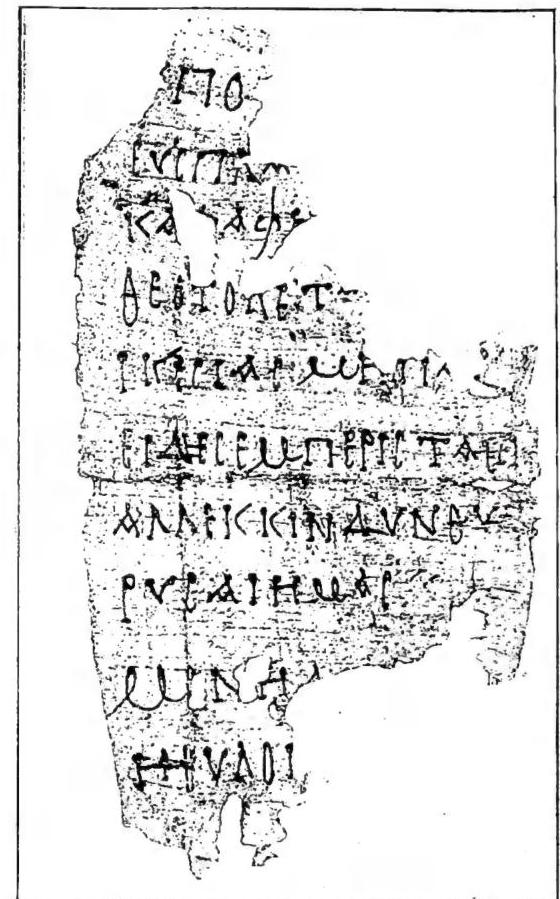
Bell, with whom Roberts agrees, to think that the papyrus was a specimen intended as a “model for an engraver.”
II. COMPOSITION
Since the right-hand side of the papyrus is badly damaged, Roberts failed to discern the specific nature of the prayer; it is to the credit of Fr. Feuillen Mercenier, of the monastery of Chevetogne, that he recognized in it the S. t. p., thereby proposing a complete reconstruction of the text on the basis of the corresponding liturgical formulas still in use today in the Coptic and Byzantine rites (Le Muséon, 52 [1939], p. 233). Like all ancient liturgical prayers, the S. t. p., despite the simplicity and spontaneity of its sentiment, draws its inspiration from biblical texts, borrowing characteristic expressions from the Greek of the Septuagint. Its opening evokes the image of the “shadow of the wings,” familiar to the Semites and Egyptians as an expressive symbol of divine protection: ὑπὸ τὴν σκέπην τῆς... (Is. 49:2; 51:16; cf. Ps. 16:8 and the commentary of F. Vigouroux, ad loc., with monumental illustrations). It is noteworthy that the Coptic formula has preserved, without translating it, the sacred term σκέπη (praesidium), and that the concept of the shadow alarum is found in certain versions, such as the Syriac, Syro-Chaldean, and Armenian.Throughout the composition, moreover, one finds the same spiritual situation present in the individual psalms (e.g., 16, 27, 30, 38, 60), which implore the immediate help of the Lord, refuge and deliverer (καταφυγή and βύστης) of the faithful person who turns to him in order to escape the imminent danger (Ps. 17:3; 60:5; 70:4; 90:1 ff.; 114:2-5; 142:9 = καταφεύγομεν and βύσαι ἡμᾶς [ἐκ κινδύνου] of the S. t. p.). In this regard, the comparison with the very ancient prayer of the papyrus of Dér-Balizeh is significant (fol. 1ª, lines 8-12: PO 18, 425 and 428; ed. Roberts-Capelle, An early Euchol., Louvain 1949, p. 14), whose expression ἀλλὰ βύσαι ἡμᾶς ἀπὸ παντὸς κινδύνου recalls the periculis cunctis of the Roman S. t. p.
III. IMPORTANCE OF THE PRAYER
a) Historical value. - The tone of the prayer seems to indicate a time of persecution (Valerian, Decius), from which liberation is ardently desired (βύσαι ἡμᾶς, orue nos; the λυτρώσαι of the Greek liturgy no longer has this meaning, but a theological one).b) Theological value. - In such distress (περίστασις), the Christian seeks refuge beneath the mantle of the Virgin, in the shadow of her εὐσπλαγχνία, which is not the ἔλεος of the Psalms, an attribute of God, but the great mercy and solicitude of the maternal heart (cf. Eccl. 30:7, and eisera misericordiae, σπλάγχνα ἐλέους, of Lc. 1:78). And the prayer is addressed directly to her, as helper and savior, since she is the Mother of God, Θεοτόκος. The discovery of this word in a euchological text demonstrates that, in Egypt, it was not merely a term of the schools, but a liturgical one. Thus one can understand what the historian Socrates reports: that Origen, in the now-lost Book I of his commentary on Rom., “explained (ἐρμηνεύω) in what sense [Mary] is called Θεοτόκος” (Hist. eccl., VII, 32: PG 67, 812 B). Considering, moreover, that before the Council of Ephesus (431) this dogmatic term is found in authors connected with the School of Alexandria (cf. Hefele-Leclercq, II, p. 244, note; Fliche-Martin-Frutz, IV, p. 167, n. 17; Manteau-Bonamy [V. BIBLICA.], pp. 10-12), one perceives in this an influence of the Alexandrian liturgy, and the vehemence of the anti-Nestorian struggle becomes more comprehensible: Cyril fought not for a term of the schools, but for an expression of the faith of the people, consecrated by liturgical usage (cf. Denz-U, 139). Until now, no positive document proving the cult of invocation of the Virgin in the pre-Nicene period was known (cf. E. Neubert, Marie dans l'Eglise anténic., Paris 1908, pp. 268 and 275; E. Dublanchy, Marie, in D'ThC, IX, col. 2443): Pap. Ryl. 470 fills the documentary gap, eliminating all discussion. Through its clear affirmation of Mary’s divine Maternity, the S. t. p. also contains a manifest allusion to her immaculate purity, proclaiming the Holy Virgin as “the only pure one,” “the only chaste and blessed one”: ἡ μονὴ ἁγνῆ, καὶ ἡ εὐλογημένη.
c) Liturgical value. - The text of the papyrus, reconstructed by Mercenier, represents the primitive recension and explains the two later recensions: the Eastern (Byzantine-Ambrosian) and the Western (Alexandrian-Roman). The Roman formula, in fact, appears to belong to the same family as the Coptic text, whereas the Ambrosian one depends on the Byzantine text.
IV. DIFFUSION AND LITURGICAL USE
From its land of origin, Egypt, the S. t. p. spread through the two principal rites: Byzantine and Roman. The Coptic liturgy has preserved, almost in its entirety, the original formula offered by the Greek papyrus, and still today, at least among Catholics, uses it at Vespers. The Byzantine and Roman liturgies must have received the S. t. p. from Egypt before the Christological controversies of the fifth century.a) Roman liturgy. - In the Latin West the S. t. p. has had various recensions, testifying to different Greek originals. The Roman formula is found in the Antiphonary of Compiègne (ninth-tenth century) among the antiphonae in Evangelio (a series of antiphons intercalated among the various verses of the Benedictus) for the feast of the Assumption (PL 78, 799). It is currently used at Compline in the Little Office of the B. Virgin (antiphon for the Nunc dimittis). It is used in part in the offices of the Maternity of Mary (11 Oct.: fifth responsory) and of the B. V. Mediatrix of All Graces (31 May: short responsory at the Little Hours). It is also frequently used in various exercises of devotion; in France, also in the Saluts of the Most Blessed Sacrament. A. Wilmart published a medieval office in honour of the Seven Sorrows of the Most Blessed Virgin, attributed to Innocent IV, in which the S. t. p. is the opening prayer for each individual part (Auteurs spirituels, Paris 1932, pp. 518, 523-26). In the Dominican liturgy it is sung at Compline for various feasts of Our Lady. The Salesians have it as a special devotion in honour of Mary Help of Christians; among
| ΠΟ . . . . . . . . . . . . . . . . . . . . . . . . . . . . . . . . . . . . . . . . . . . . . . . . . . . . . . . . . . . . . . . . . . . . . . . . . . . . . . . . . . . . . . . . . . . . . . . . . . . . | Υπό τήν σήν | Sub tuum | |
| ΕΥΣΙΑ . . . . . . . . . . . . . . . . . . . . . . . . . . . . . . . . . . . . . . . . . . . . . . . . . . . . . . . . . . . . . . . . . . . . . . . . . . . . . . . . . . . . . . . . . . . . . . . . . . . | εὐσπλαγχνίαν | praesidium | |
| ΚΑΤΑΦΕ . . . . . . . . . . . . . . . . . . . . . . . . . . . . . . . . . . . . . . . . . . . . . . . . . . . . . . . . . . . . . . . . . . . . . . . . . . . . . . . . . . . . . . . . . . . . . . . . . . . | καταφάγνων | confugimus, sancta | |
| ΘΕΟΤΟΚΕΤ . . . . . . . . . . . . . . . . . . . . . . . . . . . . . . . . . . . . . . . . . . . . . . . . . . . . . . . . . . . . . . . . . . . . . . . . . . . . . . . . . . . . . . . . . . . . . . . . . . . | Θεοτόκεν τός ἡμῶν | Dei Gentia: nostras | |
| ΙΚΕΣΙΑΣΜΗΙΑ . . . . . . . . . . . . . . . . . . . . . . . . . . . . . . . . . . . . . . . . . . . . . . . . . . . . . . . . . . . . . . . . . . . . . . . . . . . . . . . . . . . . . . . . . . . . . . . . . . . | Ιεμείαν μή νην. | deprecationes ne de- | |
| ΕΙΔΗΚΕΜΠΕΡΙΣΤΑΚ | ἀνδρ ἐν περσέτῳ | pictus in necessitatibus | |
| ΑΑΑΕΚΚΙΝΑΤΝΟΥ . . . . . . . . . . . . . . . . . . . . . . . . . . . . . . . . . . . . . . . . . . . . . . . . . . . . . . . . . . . . . . . . . . . . . . . . . . . . . . . . . . . . . . . . . . . . . . . . . . . | ἀλλ' ἐν περσέτῳ | nod a periculo euntio | |
| ΡΥΣΑΙΗΜΑΚ . . . . . . . . . . . . . . . . . . . . . . . . . . . . . . . . . . . . . . . . . . . . . . . . . . . . . . . . . . . . . . . . . . . . . . . . . . . . . . . . . . . . . . . . . . . . . . . . . . . | ἀνδρ ινεμν | libra nos semper, | |
| ΜΟΝΗ . . . . . . . . . . . . . . . . . . . . . . . . . . . . . . . . . . . . . . . . . . . . . . . . . . . . . . . . . . . . . . . . . . . . . . . . . . . . . . . . . . . . . . . . . . . . . . . . . . . | μόνη ὀργή | Virgo gloriosa | |
| ΗΕΥΛΟΓ . . . . . . . . . . . . . . . . . . . . . . . . . . . . . . . . . . . . . . . . . . . . . . . . . . . . . . . . . . . . . . . . . . . . . . . . . . . . . . . . . . . . . . . . . . . . . . . . . . . | μόνη εὐλογημένη | et benedictia. | |
| 4 | Sub tuum | Sub praesidium | |
| misericordium | misericordium tearius | misericordium tearius | |
| confugimus | confugimus, 2 | confugimus, 2 | |
| Dei Gentia: nostram | Dei Gentia: nostram | Dei Gentia: nostram | |
| deprecationem ne in- | deprecationem ne in- | deprecationes ne in- | |
| duces in tentationem | picius in necessitatibus | picius in necessitatibus | |
| sed de periculo | sed a periculo | sed a periculo | |
| libera nos, | astra nos, | astra nos, | |
| sola casta | 8 (to) quae sola (to) | 8 (to) quae sola (to) | |
| et benedictia. | benedictia. | benedictia. |
(from F. Mercenier, L'Antienne Mariale grecque la plus ancienne, in Le Mustois 38 [1939], p. 231)
« SUB TUUM PRAESIDIUM » - Text of the papyrus of the Rylands Library, no. 470, col. 1, compared by Fr F. Mercenier with the texts: Byzantine, col. 2 (Ὠρολόγιον τὸ μὲν), ed. Rome 1938, p. 232); Roman, col. 3; Ambrosian, col. 4 (Missale ambrosianum, Milan 1831, pp. 381-92); and the Latin version of the Coptic text, col. 5.
the Jesuits it forms part of the only daily exercise of devotion which they practise in common. Noteworthy are the opening, simplified by the omission of the word misericordia (εὐσπλαγχνία), and the ending: Libera nos semper, Virgo gloriosa et benedictia. The semper is joined, also in the Gregorian melody, to « libera nos », whereas critically it should be joined to Virgo, in accordance with the characteristic Greek epithet Ἀειπάρθενος: a term, however, not found in the original formula, nor in that of the Byzantine liturgy, which instead has the corresponding μόνη ἀγνή. The word gloriosa is likewise a Roman variant: it is not known whether it is ancient; Fr Mercenier allows that it may be original (σεμνή); it is absent from the Antiphonary of Compiègne and from the Dominican liturgy. The Gregorian melody, in the seventh mode, in its almost syllabic simplicity, expresses a feeling of trusting and filial abandonment and, in its insistent motif, the urgency of immediate help. Before the Gregorian restoration, another melody in the second mode was also in use in Italy (cf. J. Pothier, Antienne « S. t. », in Rev. du chant grég., 2 [1893-94], pp. 3-4).
b) Ambrosian liturgy. - The Milanese text (Sub tuam misericordiam) derives from the Byzantine one (Ὑπὸ τὴν σὴν εὐσπλαγχνίαν); but it seems later than s. Ambrogio, also because of the erroneous translation « ne inducas in tentationem » (instead of: ne despicias in necessitate), which cannot be attributed to the Saint, who knew Greek well; this variant, however, may not belong to the original translation, and may be a late contamination from the Lord’s Prayer. In the Middle Ages the prayer was used (according to cod. T 103 Sup. of the Biblioteca Ambrosiana) on the sixth Sunday of Advent, among the litany antiphons or psalendae (cf. Cagin [V. op. cit. in bibl.]). Today it survives only as an antiphon post Evangelium in certain Masses of Our Lady (5 Aug. and 16 July [the same Mass]; S. Maria in Sabbato [ferial Mass] and solemn votive Mass). It is also sung by the people to a melody proper to the rite.
c) Byzantine liturgy. - In comparison with the original text given by Pap. Ryl., 470, that of the Byzantine liturgy constitutes a more elaborate form, with variants due above all to the requirements of rhythm.
In the Byzantine liturgy (and consequently in the various languages proper to the rite), the prayer is employed as a θεοτόκον (troparion in honour of the “Mother of God”) at the end of weekday Vespers (Ὠρολόγιον, Rome 1876, p. 104; 2nd ed. ibid. 1937, p. 232), always associated with the Ave Maria which precedes it as the first troparion (θεοτόκε παρθένε χαίρε).
d) Altri riti orientali. - Le Chiese armena, siro-antiochena, siro-caldea e malabarica, maronita, etiopica, anche se non posseggono il S. t. p. nella loro liturgia, lo hanno nei loro libri di devozione (a quanto sembra, per influsso di Roma). I Maroniti ne fanno, con le Litanie lauretane, un uso frequentissimo (in arabo, adibito in tutte le funzioni estraliturgiche). Per i cattolici dell'Etiopia fu tradotto dal latino dai missionari, e si recita insieme alla Salve Regina. La formola siro-antiochena, la quale sembra molto antica, ha diverse varianti, di sapore biblico, che ne costituiscono una profonda rielaborazione (cf. P. Hinds, Disciplina Antiochena antica: Siri, IV [Fonti per la Cod. can. Orient., 2ª serie, fasc. 28], Città del Vaticano 1943, p. 307, nota 1).