
OSSIRINCO, PAPIRI di. — Ancient Egyptian city, today el-Bahnasà, where one of the most substantial collections of Greek papyri was discovered, assembled through the work of the Egypt exploration fund (now Society), under the direction of Professors P. Bernard Grenfell and Arthur S. Hunt, both of Queens' College, Oxford, and subsequently continued by their collaborators and successors down to Roberts, Lobel, and Wegener.
Its publication began in 1898 with a first volume edited by Grenfell and Hunt, containing an edition of 6 Christian papyri, of which the first contained the Sayings of Jesus, the second a passage from Matthew, the third a passage
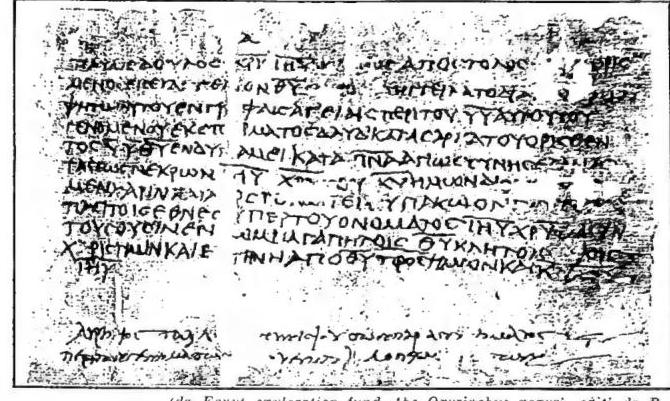
of Mark, the fourth a theological fragment, the fifth an unidentified Christian fragment, and the sixth a passage from the Acts of Paul and Thecla. The first was especially important: dating from the 2nd–3rd century, it contained an early fragment of the so-called Loghia Iesu, that is, brief sayings attributed to him, collected progressively by various writers who also drew on apocryphal works and transmitted their texts in an unsystematic manner; in vol. IV of the same collection (1904), another fragment of the same work appeared under no. 654.
Taken as a whole, the entire collection of the p. of O., up to the last volume published to date (XVIII, 1941), contains approximately one hundred papyri of interest to Christianity, that is, approximately one twentieth of the entire published portion; others still remain to be read in the part awaiting the attention of the editors. Particularly noteworthy in the collection are three parchments: two (XIII, 1594 and VIII, 1076) concerning the text of Tobit (v.), and one (VII, 1010) Ezra (v.); an important papyrus with a fragment of the 4th-century Gospel (II, 208; XV, 1781), a highly significant text of Acts (XIII, 1579), one no less important of Hebrews (IV, 657), a fragment of an apocryphal Gospel (X, 1224; cf. 655), of the Acts of John (VI, 850), a Christian hymn with musical notation (XV, 1786), the Liturgical Calendar of 535–36 (XI, 1357), and a parchment with fragments of the Didache (XV, 1782).