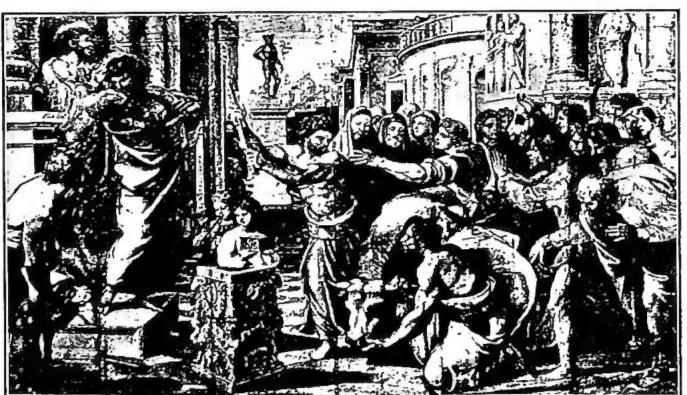
PAUL, APOSTLE, Saint. — Apostle who spread Christianity among the Gentiles, born in Tarsus (q.v.) in Cilicia in the first decade of the common era and martyred in Rome under Nero, most probably in AD 67.
SUMMARY:
I. Life
II. Epistles
III. Doctrine
IV. “Pauline theology.” —V. Liturgical feasts
VI. Archaeology
VII. Christian iconography
VIII. Apocalypse of Paul
IX. Acts of Paul
X. Preaching of Paul.I. LIFE
1. Youth
By birth Paul inherited Roman citizenship (Acts 16:37; 22:25–28) and a deep attachment to the Mosaic Law. He boasts of being “a Hebrew of Hebrews; as to the law, a Pharisee” (Phil 3:5), and elsewhere calls himself “a Pharisee, the son of Pharisees” (Acts 23:6), recalling his almost fanatical zeal “for the traditions of my fathers” (Gal 1:14). It is possible that in the intellectual center of Tarsus Paul attended Greek schools, yet the traces of Hellenistic education are tenuous and debatable (cf. Acts 17:28; 1 Cor 15:33; Tit 1:12), whereas his rabbinic formation is undeniable; to perfect it he went as a youth (c. 14–20 AD?) to Jerusalem. There he studied “at the feet of Gamaliel” (Acts 22:3), a teacher well known in Jewish traditions and of calm, balanced spirit (cf. ibid. 5:34 ff.).The fruit of his attachment to the Mosaic religion was his participation in the first persecution against the nascent Church. Paul appears for the first time at the stoning of Stephen (v.). It is difficult to specify the part he played. The text merely states that during the gruesome act the stoners, to be more free, laid aside their garments “at the feet of a young man named Saul” (by this name he is always remembered until his first missionary journey). It is certain, however, that immediately afterward this “young man” took a very active part in the persecution (Acts 26:9–11).
2. Conversion
While Paul was carrying out this anti-Christian activity with unwavering resolve (cf. 1 Tim 1:13), an unforeseen event occurred that revolutionized his entire life. Near Damascus, whither he was traveling as an envoy of the Sanhedrin against the Christians, the risen Jesus appeared to him. The supernatural phenomenon was attested by his companions, who fell to the ground stunned (Acts 9:3–7; 22:7–10; 26:14–18); it produced, as a physical effect, a few days’ blindness in the protagonist and, as a moral-psychological consequence, his complete transformation from persecutor to convinced follower of Jesus. This is the most salient point of Paul’s life and therefore the preferred object of historical-religious studies.(photo: Vatican Library)
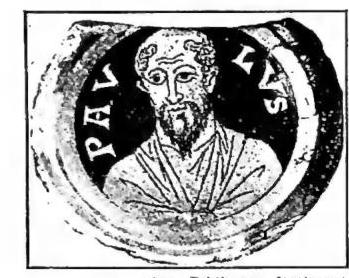
PAUL, APOSTLE, St. - Gold-glass (4th century) - Vatican Library, Sacred Museum.
For rationalists this event constitutes a formidable obstacle; many theories have been advanced, usually exaggerating or inventing physical, physiological, historical-psychological, or purely psychic-religious elements, yet no hypothesis has been able to claim to have solved the enigma. With a sense of melancholy it has been concluded that “no analysis, whether psychological or dialectical, is capable of probing the inner mystery of the act by which God revealed His Son to Paul” (F. C. Baur, Das Christentum und die Kirche der drei ersten Jahrhunderte, 2nd ed., Tübingen 1880, p. 45). In this event “history can only show the sudden change” (C. Weizsäcker, Das apostolische Zeitalter der christlichen Kirche, 3rd ed., ibid. 1902, p. 75).
3. At Damascus and in the desert
Recovering from the deep impression and having received baptism at the hands of Ananias (v.), Paul immediately became a Christian missionary; yet his first result was disappointment (Acts 9:20–21). Then he decided to withdraw into the desert to meditate and deepen the truths perceived by supernatural intuition at the moment of his conversion. For nearly three years he lived “in the desert” (Gal 1:17–18), namely in Arabia Petraea not far from Damascus. After this retreat Paul made another missionary attempt, again without success, at Damascus (Acts 9:23); then he went to Jerusalem to meet the Apostles, especially Peter (Gal 1:18; Acts 9:26 ff.). The reception was rather cool toward the erstwhile terrible persecutor. Barnabas (v.) helped to dispel this distrust, yet even in Jerusalem no prospects opened for the zeal of the convert. There were even attempts at conspiracy by Hellenistic Jews. “When this was known, the brethren brought him down to Caesarea and sent him off to Tarsus” (Acts 9:30), where he remained about four years until Barnabas came to fetch him to take him as a missionary to Antioch (Acts 11:25).4. First missionary journey
In the city on the Orontes Paul remained four or five years, playing a secondary role in the shadow of his friend Barnabas, who took him with him to Jerusalem to bring alms collected in view of the famine (Acts 11:30) foretold by the prophet Agabus (v.). Returning from Jerusalem, Paul in 45–46 was designated for a far-reaching apostolic mission. A prophet designated him together with Barnabas; the leaders laid hands on them and commended them to the grace of God for the ministry assigned to them. Joining them was the young Mark, cousin of Barnabas. The first stop was the island of Cyprus, Barnabas’s homeland. The three landed at Salamis and, crossing the whole island, reached Paphos (v.), seat of the governor. This office was held by the proconsul Sergius Paulus, who became a Christian, especially after Paul’s victory over the magician Bar-Jesus (v.), who was struck blind at the Apostle’s rebuke (Acts 13:1–12). From this moment Paul takes the lead and is henceforth always named by his famous name, not assumed in memory of the converted proconsul but probably received at birth along with that of Saul.From Paphos the missionaries sailed to Pamphylia in Asia Minor. After a brief stop at Perga (v.), they reached Antioch at the borders between Phrygia and Pisidia, hence called “Antioch of Pisidia.” There, on a Sabbath, in the synagogue Paul spoke to the assembled Jews and proselytes (Acts 13:16–41), an admirable example of primitive catechesis and a summary of Pauline theology. The effect was encouraging; Paul was officially invited to speak again the following Sabbath. Yet then the hostility of the Jews began, who, making special use of some proselytes, forced the missionaries to leave the city (ibid. 13:50). They turned eastward and reached Iconium in Lycaonia, where they carried on a brief apostolate until driven out by Jewish opposition. At Iconium many of the events described in the apocryphal Acts of Paul (v.) took place. At Lystra (v.) Paul achieved greater success with the miraculous healing of a cripple; but soon he had to flee to Derbe, where he carried on a quiet and fruitful activity, though little is known of it (Acts 14:21). From Derbe the missionaries began their return journey, confirming the converts and establishing a certain ecclesiastical hierarchy in the communities. At Perga they embarked for Syrian Antioch, thus ending the first missionary journey, most probably in 49 AD.
5. Council of Jerusalem
Undoubtedly the most delicate question that beset the nascent Church was its relationship with Judaism. The problem, unknown in Palestine where the converts were happy to retain their Mosaic practices, manifested all its difficulties in Antioch, where clear-sighted figures like Barnabas and Paul had not required the Gentile Christians to submit to strictly Jewish precepts. The arrival of certain emissaries from the Church of Jerusalem with the precise idea of imposing such norms produced no little turmoil among the faithful. Chief among these requirements was the necessity of circumcision (Acts 15:1), a rite that repelled the vast majority of the Gentiles.For the problem posed by the Judaizing party, PAUL and Barnabas were sent to Jerusalem to confer with the Apostles. They took with them Titus (v.), an uncircumcised Christian. At Jerusalem the two missionaries were welcomed with signs of esteem and mutual brotherhood; yet some zealous spirits insisted on Titus’s circumcision, according to the most probable interpretation of the difficult passage in Gal. 2:3. Paul not only refused this demand but so cogently argued that the Mosaic Law no longer obliged that his view in practice carried the day in the assembly. Peter championed his cause, and James, “the brother of the Lord,” who was highly revered by Jewish Christians, also adhered to it, though requiring only certain practical concessions from Gentile Christians—abstinence from blood, from fornication, and from meat offered to idols.
This decision was reached in A.D. 49 or 50 and was of immense importance for the nascent Church. It was Paul’s triumph, which he joyfully brought back to Antioch, insisting that the faithful be informed of the abrogation of the Mosaic Law. When, shortly afterward, Peter in Antioch adopted a vacillating attitude, avoiding contact with Gentile Christians so as not to irritate the touchy Judaizers, Paul did not hesitate to rebuke him publicly for his dangerous conduct (Gal. 2:11–14).
6. Second Missionary Journey
Once this question was settled, Paul set out on a second journey, which proved much longer than the first. Barnabas proposed taking along Mark, his cousin, who had abandoned them at Perga in Pamphylia during the first journey (Acts 13:13). Paul firmly opposed this, even breaking company with Barnabas, who went off with Mark to Cyprus (ibid., 15:39). Barnabas’s place was taken by Silas (v.) or Silvanus, who possessed excellent qualities and the added privilege of Roman citizenship (cf. ibid., 16:37). The journey’s first goal was the Christian communities of Derbe, Lystra, and Iconium. In the second of these cities Paul found a new collaborator who would become his disciple and favorite companion, the young Timothy (v.). From Pisidian Antioch the three traveled north through Phrygia and “the region of Galatia” (ibid., 16:6), interpreted by some as practically equivalent to Lycaonia and Pisidia, while others, more soundly, see it Galatia (v.). The missionaries probably reached Pessinus and Dorylaeum; then Paul proposed heading west to the important cities of the province of Asia, but the Holy Spirit forbade this plan. An attempt in the opposite direction, toward Bithynia in the northeast, met with the same result (ibid., 16:6–7). Finally the three turned northwest until, at Alexandria Troas, Paul received a clear revelation that his mission was to be in Greece. The first city evangelized on the European continent was the important Roman colony of Philippi (ibid., 16:12–15). As at Lystra, so at Philippi a miracle worked by Paul provided occasion for persistent opposition to the missionaries. Some, whose comfortable livelihood had been disrupted when Paul freed a slave-girl from a demonic obsession, accused him of disturbing public order. Paul and Silas were flogged and imprisoned; but the next day the magistrates, alarmed at having inflicted such punishment on Roman citizens, released them (ibid., 16:16–39).Leaving Philippi, whose small Christian community was entrusted to Luke (v.), who had joined the three at Troas, Paul went to Thessalonica (modern Salonika) on the Thermaic Gulf. Among the converts in this city we may mention Jason, who at his own expense housed the missionaries (ibid., 17:5, 9), and Aristarchus and Secundus, who later became Paul’s companions (ibid., 20:4). To escape Jewish hostility Paul moved on to Berea, where he carried on a calm and fruitful ministry until troublemakers arrived from nearby Thessalonica. Then Paul went to Athens (ibid., 17:16–34), where he delivered an interesting discourse on the Areopagus (ibid., 17:22–31); but the result was rather meager. The philosophers mocked Paul as a deluded dreamer, while ordinary people, it seems, paid no heed. A few, however, did convert; among them are mentioned Dionysius, a member of the Areopagus, and Damaris.
Far more fruitful, though attended by grave sufferings and trials for the Apostle, was the long ministry in the capital of Achaia, Corinth. Here Paul converted, among others, Crispus, the synagogue leader (ibid., 18:8). This provoked the resentment of the Jews, who brought the Apostle before the Gallio (v.), brother of the philosopher-poet Seneca. The magistrate took no action against the accused, who was thus able to continue his apostolate “for many days,” perhaps until the autumn of 53, when he set out eastward to revisit the mother Church in Jerusalem and the other Christian communities of Asia.
7. Third Missionary Journey
Paul left Corinth under a “vow” (ibid., 18:18), that is, almost certainly as a Nazirite (v. NAZIREATE). He went to Jerusalem (Acts 18:22; ἀναβὰς καὶ ἀσπάσαμενος τὴν Ἐκκλησίαν); then he went to Antioch, whence in the spring of 54 he began his third missionary journey. After a brief visit to the communities of the province of Galatia, evangelized during the first and second journeys, he made an extraordinarily long stop (about three years, cf. ibid., 20:31) at Ephesus. In that city a rudimentary form of Christianity had already been spread by the Alexandrian Apollos (v.). Paul completed the instruction of the few adherents and, assisted by numerous coworkers, carried on an intense ministry even in the neighboring cities (ibid., 18:24–19:40). The effectiveness of his preaching is seen in the agitation of the silversmith Demetrius, whose trade in statuettes of the goddess Artemis was threatened (ibid., 19:24). At Ephesus Paul likewise suffered greatly and would say metaphorically that he had fought with beasts (1 Cor. 15:32); a real imprisonment (v.) is more than probable, reflected perhaps in the Letter to the Philippians. A brief visit to Corinth is also plausible, though debated, where the Apostle would have met with a hostile reception from an enemy (cf. 2 Cor. 2:1–5). Finally, after visiting the communities of Macedonia, Paul went to Corinth, where he spent the three winter months (57–58). His stay in the capital of Achaia was cut short by plots laid by some Jews (Acts 20:3). To escape an ambush, Paul changed his itinerary on the way to Jerusalem, where he intended to bring the collection he had diligently gathered for the poor of that city (cf. 2 Cor. 8–9; Rom. 14:31). Passing again through the churches of Macedonia and the Asian coast, he arrived in Jerusalem for Pentecost in 58.8. Paul’s Imprisonment
In the Holy City, where he was joyfully welcomed by the leaders, Paul was urged to give outward observance to Mosaic prescriptions to quiet the grumbling of the Judaizers. He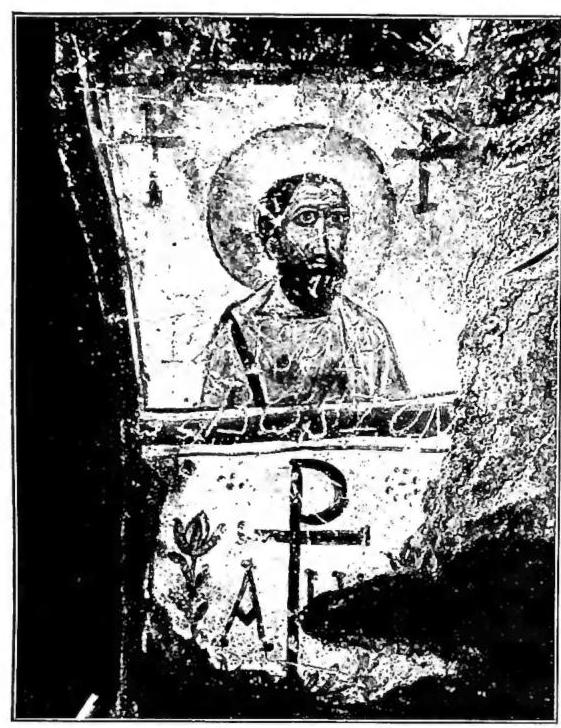
In the autumn of 60, Paul set out for Rome under escort. Off the coast of Malta the ship was wrecked, yet all the passengers and crew were saved, not without a particular intervention of divine Providence. On the island there was a forced stopover of three months, during which Paul won great popularity through his miraculous healings. Only in the spring of 61 did he enter the Urbe, welcomed with great veneration by the Christians. There, though remaining for two years in the condition of a prisoner, he enjoyed a fairly wide freedom, which he used for fruitful Christian propaganda (ibid., 28:31).
9. The Martyrdom
From the letters of his imprisonment (Ephesians, Colossians, Philemon, and perhaps Philippians) and from the Pastoral Epistles (1 and 2 Timothy and Titus), it is clear thatPaul regained his full freedom and continued his intense apostolic activity. With every probability he went to Spain (cf. Rom. 15:24, 28; Clement of Rome, Ad Cor. 5:7; Muratorian Fragment). Then he returned to Italy and the East, stopping at Ephesus (1 Tim. 1:3), Miletus (2 Tim. 4:20), Crete (Tit. 1:5), Macedonia (1 Tim. 1:3), and Epirus (at Nicopolis, cf. Tit. 3:12), where he was probably arrested again. Brought to Rome in 67, according to the traditional date, he ended his eventful life, beheaded at the Aquae Salviae, in the place now called “Tre Fontane,” according to apocryphal Acts.
Paul, the most eminent figure of the apostolic age, was a man of action of the most dynamic kind, an indefatigable missionary and a fighter; but above all he was a mystic and an apostle whose heart was filled with love and zeal for “Christ.”
II. EPISTOLARY WORK
Apart from the various discourses summarized in the Acts, tradition has preserved for us fourteen letters of Paul (it is not excluded that some of his writings have been lost [cf. 1 Cor 5:9; Col 4:16]). According to the usual order—not chronological or logical but dictated by extrinsic criteria—the Pauline letters are: Romans, Corinthians, Galatians, Ephesians, Philippians, Colossians, Thessalonians, Timothy, Titus, Philemon, Hebrews (see the respective entries). The most probable chronological order is as follows: Thessalonians (AD 51), Galatians (54), Philippians (?) during the Ephesian sojourn (54–55), Corinthians (55, 57), Romans (57–58), Philemon, Colossians, Ephesians and, according to the most common opinion, Philippians at the time of the Roman imprisonment (61–62), Hebrews (64), 1 Timothy (65–66), Titus (66), 2 Timothy (66).These various writings often differ in subject, style, and length. Although they all share the title of “letter,” they vary greatly in tone and literary genre. Some, like the note to Philemon, are strictly personal and confidential, while others (such as Romans, Ephesians, Hebrews) differ little from a doctrinal “epistle.”
Literarily, these writings of Paul are distinguished by a very particular elegance. The language, which is fairly pure, belongs to the koine or “common” dialect; Semitisms are rare when compared with those in other New Testament works, yet there are even bold anacolutha that make the reading difficult and arduous at first. The charm of the Pauline letters does not stem from any contrived artistry, but from the depth of thought and the vehemence of Paul’s affections for Christ, for his neophytes, and for the entire Christian Church.
III. DOCTRINE
It is difficult to summarize in a few lines the teaching of P., which constitutes the granite foundation for many points of Christian theology. Although he has most felicitous trinitarian expressions (cf. Rom 8, 9–11. 14–17; 15, 15–16; 1 Cor 6, 11; 12, 4–6; 2 Cor 2, 21; 13, 13; Gal 4, 6; Eph 1, 3–14; Tit 3, 4–6), P. presents a doctrine that is eminently Christocentric. In the revelation at Damascus the risen Christ had identified Himself with His followers: “Saul, Saul, why do you persecute me?” (Acts 9, 4). From this concept P. derived, as most important elements of his catechesis, the idea of the Resurrection, the ultimate consequence of the redemptive work, and that of the Mystical Body: Christ, the head of the Church, who vivifies and sustains the entire marvelous edifice constituted by the various faithful. Another cornerstone of Pauline doctrine is the universality of Redemption, which, without annulling the privileges of the Jewish people, is offered indistinctly to all nations. This is the great mystery hidden, dimly illuminated by the ancient prophets, but inconceivable to the vast majority of contemporary Jews; P. glories in being destined to proclaim it (Eph 3, 8–9).10. Christology
For P., the novelty of Christianity consists in the revelation of the Word as “the mystery of God, the Christ, in whom are hidden all the treasures of wisdom and knowledge” (Col 2, 2–3). To the fragmentary revelation of the ancient prophets, God has substituted the perfect revelation through His Son, “through whom also He made the worlds, who being the radiance of His glory and the exact imprint of His nature and upholding all things by the word of His power, when He had made purification of sins, sat down at the right hand of the Majesty on high, having become as much better than the angels, as He has inherited a more excellent name than they” (Heb 1, 2–4): here twice over are summarized the principal prerogatives of the Son of God in His eternal pre-existence, historical existence, and glorified survival. The Son of God, principle of union and coordination of all created things (cf. Col 1, 16), recapitulates (ἀνακεφαλαιόω) and concentrates in Himself, as principle of elevation to a supernatural order, all things (Eph 1, 10).By this prerogative Christ is the antithesis of Adam. Both, though in different forms and functions, were constituted heads of humanity. The second, through his sin, brought about estrangement from God and a series of punishments and sorrows, above all death. The first repairs in an abundant manner the evil caused by the second, bringing the life of Grace and vanquishing sin (cf. Rom 5, 12–21). This presupposes man’s capacity to receive the communication of divine life, that is, Grace, the universal salvific will of God (cf. ibid. 3, 21–31; 8, 15; Eph 1, 3–14), together with the absolute necessity of a redemption for fallen humanity (cf. Rom 1, 18–3, 18). By virtue of Redemption, the kingdom of sin is succeeded by that of Grace, the tyranny of the Mosaic Law—manifested as an unconscious instrument of sin through its multiplicity of precepts without intrinsic aid for their observance—by the freedom of the children of God, the dominion of the flesh and concupiscence by the possibility of living “according to the spirit” with the capacity to produce fruits of justice; to the kingdom of death succeeds that of life and Resurrection (cf. 1 Cor 15, 12 ff.). In short, to the forms of a rudimentary religion (στοιχεῖα τοῦ κόσμου, cf. Gal 4, 3) and to the imperfect “economy” of the Old Testament, according to the terminology dear to the Greek Fathers, is substituted a new “economy,” based on the salvific work of Christ, on the dominion of Grace, and on the ineffable reality of the Mystical Body. The soul of all these marvelous events is Christ, the one and eternal priest who regulates the relations between God and humanity (cf. Heb 2, 17; 4, 14; 5, 5 etc.): He is the sole mediator (1 Tim 2, 5).
11. The Holy Spirit and the Mystical Body
Christ is the center of all creation and the head of the Mystical Body, but the Holy Spirit is its vivifying soul (cf. 1 Cor 6, 19; Rom 8, 2, 11; 2 Tim 1, 14). It is the source of charisms, which were of such great importance in the early Church (cf. 1 Cor 12, 4). The revelation of divine mysteries is the work of the Spirit (ibid. 2, 10). The impulses of Grace come from the same Spirit. The Christian, therefore, must “walk in the Spirit” or “be moved by it” (Rom 8, 4, 14), which generates the complex of all the virtues (Gal 5, 22). The faithful must consider himself as the temple of the Holy Spirit (1 Cor 6, 19). To this is attributed sanctification, because through it “the love of God is poured out” into the hearts of believers (Rom 5, 5).This task, however, is also exercised by the glorified Christ as head of the Mystical Body. For this reason it would be easy to point out Pauline texts that attribute the same prerogative now to one and now to the other divine Person, who operates in conformity with the predestination of God the Father (Rom 8, 29–30). Moreover, even in ordinary language the various vital phenomena are easily referred to the head or the soul of an organism. In the theological field the truth is clearer inasmuch as Christ is able to pour forth the fullness of the Spirit (1 Cor 15, 45); sanctification is attributed to the Holy Spirit sent by the Son.
To the concept of the Mystical Body is connected that of the intimate solidarity among the faithful as members of the same organism, and therefore that of the Communion of Saints (cf. 1 Cor 10, 17; Eph 4, 4–6).
12. The Sacraments
Among the means of Grace P. recalls in a special way Baptism, which marks the birth of the Christian. More than on the necessity of the rite (cf. Acts 19, 5), P. insists on its symbolism; it represents outwardly also the death to the world and the incorporation of the new creature into the Mystical Christ (cf. Rom 6, 3; Gal 3, 27; Eph 3, 6). The Apostle dwells at length on the Eucharist (1 Cor 11, 20–32). He speaks of Holy Orders, emphasizing its capacity to confer Grace (Acts 20, 28; 1 Tim 4, 14; 2 Tim 1, 6). Finally, he insists on noting the symbolic character of Christian Marriage, which represents the intimate union between Christ and His Church (cf. Eph 5, 32); and he descends to practical cases to regulate the use of Marriage, declaring its lawfulness but subordinating it to the more esteemed state of virginity (1 Cor 7, 2–40).13. Ethics
The moral theology finds a more modest harvest in the writings of P., who, while in the letters to the Romans and to the Galatians solemnly declares the end of the Mosaic Law in its entirety, is less explicit in manifesting what constitutes “the law of Christ” (Gal 6, 2; 1 Cor 9, 21) or of Grace (cf. Rom 6, 15). Nevertheless, he upholds the obligatoriness of the natural law and the dictate of conscience (ibid. 2, 14–15). Finally, in the letters there are not rare long lists of moral recommendations (cf. 1 Thess 5, 14, 19–22; Rom 12, 8–15). In general, however, P. insists much more on the positive side of ascetics and mysticism than on the negative side of sin to be avoided. The commitment of the Christian is to form “a new creature” perfect and to live “in Christ.” This can be realized only through the acquisition of the various moral virtues under the vivifying and unifying action of “charity” (cf. 1 Cor 13, 1–13), which is “the bond of perfection” (Col 3, 14).The Christocentric idea dominates even the ethics of St Paul, who often speaks of “death” and “moral resurrection” (Rom 6:4, 6:11; Col 2:20–3:8), of the need to “strip off” the old self (= Adam) and “clothe oneself” with the new (= Christ; cf. Rom 13:14; Eph 4:20–24; Col 3:9–11). Just as in his Christology he dwells on liberation from the tyranny of the flesh, so in the moral sphere he insistently demands renunciation of the flesh in order to follow the impulses of the Spirit, who dwells in the hearts of the faithful (cf. Gal 5:16–26; Rom 8:4–10).
14. Eschatology
For this topic the two letters to the Thessalonians and certain passages in those to the Corinthians (1 Cor 15:12–55; 2 Cor 5:3) and to the Romans (13:11 ff.) are fundamental. While in some texts Paul seems to envisage an imminent end of the world with the consequent beginning of a blessed life with Christ (cf. 2 Cor 5:3–4; Phil 1:6, 10; 3:20; 4:5), in others (Rom 11:25) he makes the prior worldwide preaching of the Gospel and the conversion of the Jews necessary prerequisites for the complex events of the parousia (the revelation of the Antichrist and the second coming of Christ).When speaking of the afterlife, Paul emphasizes the final resurrection, whose meritorious and formal cause is Christ’s own resurrection as head of the Mystical Body (Rom 4:25; 1 Cor 15:12–58). This is followed by the Last Judgment (cf. 2 Cor 5:10; Rom 2:16; 2 Tim 4:1). The fate of sinners is only briefly touched upon (cf. 2 Thess 1:5 ff.), whereas Paul dwells at length on the happiness of the just. The central figure in these final events will again be Christ, who, once his work is completed, “will hand over the kingdom to God the Father” (1 Cor 15:24–28).
IV. “Pauline Christianity.” — This term is often used to denote the entire theological teaching of Paul, which is alleged to have vitalized or, more precisely, altered the teaching of Jesus by introducing foreign elements drawn from Judaism or Hellenism, according to the preferences of various authors. The question is complicated by the fact that “criticism” of Paul’s personality is influenced by positions often antagonistic on the authenticity and reliability of the sources, on the relationship between Paul and Jesus, on primitive Christianity, and on other elements connected with the history of religions.
The importance of Paul, not as an apostle but as the creator of a Christian theology or even as the founder of Christianity, has been so exaggerated that there arose a need to return to the simplicity of the Gospel. “Away from Paul” (Los vom Paulus) or “Back to Christ” is the watchword that still guides certain scholars of Christianity. In reality, such a call is explicable only after the violent separation of Paul from Jesus, of whom he always considered himself a devoted follower and imitator (cf. 1 Cor 11:1).
After the timid attempts of L. Usteri (1824) and a few other writers, “Pauline Christianity” became a favorite theme from the time of the Tübingen school. Its founder, F. C. Baur, following Hegel’s philosophical conception, described Paul’s teaching—allegedly derived from Hellenism—as the antithesis to the Judaizing thesis (= Petrinism). Among his more or less direct followers it is enough to mention A. Hilgenfeld, O. Pfleiderer, C. Holsten, H. J. Holtzmann, C. Weizsäcker, and F. Ferrari. The basis of their reconstruction, at least originally, was the recognition of the authenticity of only four letters (Romans, 1 and 2 Corinthians, Galatians).
For the vociferous Dutch school (A. Pierson, W. C. van Manen, S. A. Naber, D. Völter, etc.), which denied the authenticity of all the epistles, “Pauline Christianity” would be a late (2nd-century) doctrine of a progressive Christian group that sought to place its own ideas under Paul’s aegis.
Such an extreme position provoked a vigorous reaction in all quarters. Among the effects of this reaction may be noted a greater respect for tradition regarding the authenticity of the Pauline writings, a certain skepticism about the claim to reduce Paul’s teaching to a single master-idea, a revived interest in Paul’s life as well as in his doctrines, and the almost complete abandonment of the simplistic method of explaining “Pauline Christianity” as a derivation from Hellenism. Hence scholars investigated more rigorously Paul’s relations with the Old Testament, with contemporary Jewish literature, with the teaching of Jesus, and with that of the other apostles. From such inquiry it has emerged that the earlier Protestant exegesis, which generally posited as the foundation of “Pauline Christianity” the idea of the “righteousness of God” drawn from the Epistle to the Romans, is untenable. In general, attention is now focused on the importance of Redemption or soteriology. The quintessence of Paul’s thought would be the redemptive work of Christ.