
RATISBONA (REGENSBURG), DIOCESE of. – City and diocese of Germany, suffragan of Munich and Freising.
It has an area of 12,193 sq. km., with a population of 1,471,938 inhabitants, of whom 1,224,190 are Catholics; it has 541 parishes served by 1,504 diocesan priests and 263 religious priests; it has one seminary, 42 male and 402 female religious communities (Ann. Pont., 1952, p. 335).
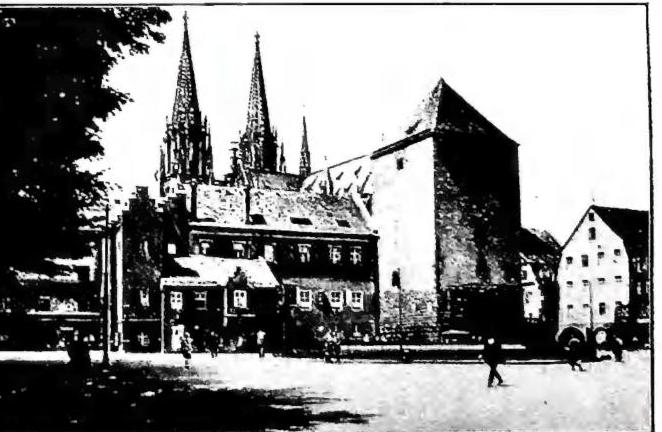
(from Enc. Ital., XXVIII, inv. 16° at the bottom)
RATISBONA, DIOCESE of – View of St. Ulrich (1230), now a museum, with the Cathedral.
canons (1503), two-thirds had to belong to noble families; the remainder were chosen from among men of letters. The first synodal statutes date from 1330 and 1377, and the first printed ones from 1512. After 1583, synods were no longer held. They were replaced by the so-called Diocesan Constitutions, first issued in 1588. The oldest missal of R. dates from 1485. In 1611 Wolfgang V. Hausen replaced it in R. with the «Missale Romanum», adding a diocesan «Proprium». The first Breviary was printed at R. in 1480. In the late Middle Ages, the education of the clergy did not follow consistently uniform guidelines; in the 16th century it was entrusted to the Jesuits. The seminary was established only by Anton Ignaz V. Fugger and Max von Torring (1789). During the Lutheran Reformation, the Ansbach region became Protestant in 1529, R. itself in 1542, and the Oberpfalz and Waldsassen region in 1556, but they returned to Catholicism in 1624.
Of the 67 bishops, particular mention should be made of Gaubaldo (739–61), under whom St. Emmeram was canonized; Sinberto (768–91), a friend of Charlemagne, who died during the campaign against the Avars; and Baturich (817–47), under whom 15 Bohemian princes received Baptism. During the Investiture Controversy, Otto V. Riedenburg (1061–89) was a friend of Henry IV. St. Albert the Great (1260–62) resigned after two years of government. Leo of Tundorf (1262–77) began the construction of the Cathedral. The effective work of reform against Lutheranism was carried out by Philip of Bavaria (1579–98), created a cardinal in 1597, and by the auxiliary bishop Jakob Miller. Albert V. Torring (1613–49) witnessed the return of Catholicism throughout the territory of the Oberpfalz and Pfalz-Neuburg. A typical prince-bishop of the period was K. Th. von Dahlberg (1803–17). On 8 Sept. 1821, on the basis of the Bavarian Concordat of 1817 and the Circumscription Bull of 1818, the Landesbistum was erected, with the Metropolitan See of Munich. Among the more recent bishops, the principal figures are Michael V. Sailer (1829–32), author of notable ascetical writings, Anton Henle (1906–17), and, from 1917, Michael Buchberger.
Bruno Wuestenberg
ARCHAEOLOGY. — In 1839, the Christian funerary inscription of a «Sarmanna quiescenti in pace martyribus sociata» was found in R. (CIL, III, 5972; A. Ebner, Die ältesten Denkmale des Christentums in Regensburg, in Römische Quartalschrift, 6 [1892], pp. 154–79, and pl. 9); it is preserved in R.’s «Museum des historischen Vereins». The beautiful expression is related to those found in two Christian inscriptions from Trier: «qui meruit Sanctorum sociari sepulcris» and «meruit Sanctorum esse consortem» (F. X. Kraus, Die christlichen Luschriften der Rheinlande, I, Freiburg im Br. 1892, pp. 89 and 135). Enrico Josi