
RATIO STUDIORUM. — This is the scholastic and pedagogical code of the Society of Jesus, composed in the 16th century and still partly in force, for governing the Order’s teaching activity from the higher faculties of theology and philosophy down to the first humanities classes.
I. ORIGIN AND HISTORY
S. Ignazio initially excluded teaching from the activity of the Order, but wished the young candidates to undertake, before their ecclesiastical studies, thorough literary studies in Latin and Greek. This became the rule both for the colleges reserved for students of the Society and, from 1546 (Gandia) and 1548 (Messina), for the colleges open to all in the cities that competed to offer them. S. Ignazio wished to provide these with an organization and a prototype. The latter was established in the Collegio Romano (1551 for the humanities, 1553 for philosophy and theology); the former, after a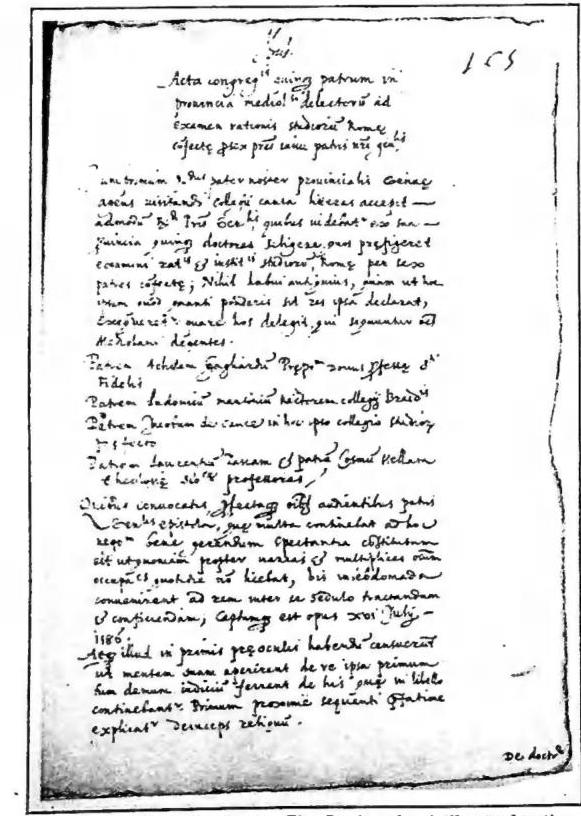
RATIO STUDIORUM – Minutes of the commission of the five Fathers of the Province of Milan, appointed to examine the R. S. proposed by the Roman Commission (16 July 1586).
The primitive plan for a complete organization, of which the Constitutiones collegiorum of the secretary G. A. de Polanco are evidence (Mon. Hist. S. J. Mon. Paedagogica, Madrid 1901), could not be implemented for lack of experience; its guiding principles were collected in Part 4 of the Constitutions (first draft 1550, definitive version 1555). Methodologically, these principles may be reduced to the adoption of the Parisian method (division into classes, curricula, exercises, guidance by the teacher) and of humanistic ideals, adapted to the requirements of the times, for literary studies, and of the scholastic method, with suitable updating, for ecclesiastical sciences. From the pedagogical standpoint, it sought to achieve a harmonious development of intellectual and moral education, drawing upon the human and spiritual resources of religion; while, in the ideal order (plans for a university), theology remained the queen of the sciences, as the supreme faculty toward which the lower faculties were directed and from which the collateral ones received their norms. Gir. Nadal dealt with these matters at Messina and in various colleges of Europe, Giac. Ledesma at the Collegio Romano, through various projects, and delegates of the generals through particular ordinances in the provinces. After certain directives issued by Borgia (1569), Claudio Acquaviva, commissioned by his electors, prepared from 1581 onward a plan for organizing studies. Two commissions prepared, for 1586, the first R. s. in two parts: one concerning the norms to be followed in theology with regard to disputable questions, the second consisting of concrete proposals for the organization and curricula of the classes. Sent to the provinces for examination, a second, more extensive and more theoretical R. was compiled in 1591 on the basis of their observations; it was also accompanied by models of lessons for the humanities schools. This was applied for three years, and the results and suggestions requested by experience were transmitted to Rome. After further examinations, a new, shorter text was prepared in the form of rules; printed in 1599, it was promulgated with the force of law for all the colleges of the Order. It was the result of fifty years of teaching throughout Europe, with the collaboration of the Order’s most distinguished men, including Bellarmino, Suárez, Azor, Benci, Tursellini, and Tucci.
It remained in force until the suppression (1773), with some partial adaptations, while coming under attack from Enlightenment philosophy and the new educational trends of the eighteenth century. After the restoration of the Order in 1814 and the resumption of teaching activity, the R. was modified by the superior general G. F. Roothaan, who promulgated it in 1832. It applied chiefly to ecclesiastical studies, whereas for literary studies it was necessary to adopt the methods and curricula imposed by the governments of the various nations, while remaining faithful, as far as possible, to the ancient animating principles. The subsequent generals introduced further modifications, while today a new R. is under study on the basis of the pontifical constitution Deva scientiarum Dominus.
II. COMPOSITION OF THE R
The R. of 1599, not being a theoretical treatise, was presented in the form of rules for those who were to be concerned with teaching. According to the centralized method of government, teaching in the individual provinces is subject to the Provincial. Its rules concern overall governance, the training of professors, supervision of doctrine, methods, teaching aids, holidays, etc. In the various colleges, the Rector is responsible for the schools (Rule of the Rector) and is assisted by a Prefect of Studies (Rule of the Prefect of Studies) in the practical administration of the schools. There are general rules common to all professors in the higher faculties, and in particular to professors of Sacred Scripture, Hebrew, scholastic theology, cases of conscience (moral theology), philosophy, moral philosophy, and mathematics. Literary studies are under the authority of their own prefect of lower studies, with special regulations for written examinations and prizes. The professors have common rules, while special rules are then given to the professors of rhetoric, humanities, and the three grammar classes. These are followed by rules for the beadles, external pupils, and the various academies. For each group of these rules, an opening paragraph sets out its spiritual, pedagogical, and didactic aims, followed by particular prescriptions concerning curricula, methods, etc.III. PEDAGOGICAL PRINCIPLES
Acquaviva did not intend to undertake theoretical work, nor to be an innovator. In fact, the Jesuits had theoretical principles and introduced innovations in the field
of teaching and education. In the literary sphere, they adopted the humanistic ideal, incorporating whatever positive elements the new approaches had produced in Italy and abroad. They adhered to the Parisian method of classes with fixed curricula and established goals to be attained, but in humanities and rhetoric they left the professor personal initiative, moderating the excesses of the Italian method. The R. sought to organize literary instruction by assigning three years to grammar, one to humanities, and one to rhetoric; distributing philosophy over three years, with studies in mathematics and physics; and theology over four, accompanying scholastic theology with the Bible, Hebrew, and cases of conscience. It sought to give instruction a unified direction and subordinated Greek, the vernacular language, history, and geography to Latin, as contributions to a better understanding of the authors; it sought to engage all the faculties of man, making particular use, for adolescents, of the competitive sense of emulation and of prizes, and developed the art of speaking through public recitations in prose and verse and theatrical performances, which rose to the highest importance; it sought to cultivate the best students through academies and by initiating them into personal study and composition, aimed at the formation of character and at a convinced Christian life through the Marian Congregations, which soon became the soul of the colleges. The professor, generally the sole teacher in each class, became the driving force of intellectual and moral life. Through the prelection, delivered in Latin, he introduced the students to the knowledge of grammar and then of the authors, among whom Cicero was pre-eminent as the complete expression of the oratorical ideal; through daily and weekly practical exercises he tested their progress; through compositions he encouraged personal work based on the canon of imitation of the classics, while demonstrations of achievement were provided by public disputations, declamations, and academies. The results were seen in the continual demand for colleges and in the pre-eminent position of the Jesuits in teaching until the French Revolution. Accusations and campaigns were directed against the narrowness of the instruction in comparison with the expansion of studies and general culture, and against the pedagogy, especially on account of emulation, prizes, and punishments. The fact remains that the R., limited like everything human, had to adapt itself to new needs rather than remain fixed upon the sixteenth-century ideal; it is not based exclusively on emulation or self-interest and was very lenient in its punishments. In contrast with an encyclopedic school, it offers an example of sound in-depth study and serious preparation for life, and is based on a knowledge of man that leads it to promote a humanistic type that remains ever current.
BBL.: edd.: R. atque institutio s., Rome 1586, there 1591, Naples 1599; G. M. Pachtler, R. S. et Institut. scholast. per Germanium olim vigentes, 4 vols., Berlin 1887–94 (the best ed., with the three R. and other documents); Monum. Paedagogica S. J., Madrid 1901; M. Barbera, La R. s. e la IV Parte delle Costituz. della C.d.G., Padua 1942, Opere; A. Schimberg, L'éducation morale dans les Collèges de la C.d.J. en France sous l'Ancien Régime, Paris 1913; G. B. Herman, La pédagogie des Jésuites au XVIe siècle, Louvain 1914; E. Boeminghaus, Geist der Gesellschaft Jesu und ihr pädagogisches Werk, Feldkirch 1931; A. Farrell, The Jesuit Code of liberal Education, Development and scope of the R. S., Milwaukee 1938; P. de Leturia, De Constitutionibus Collegiorum S. J., J. A. de Polanco ac de eorum influus in Constit. S. J., in Arch. Hist. S. J., 7 (1938), pp. 1–30; id., Come la Compagnia di G. divenne Ordine insegnante, in Gregorianum, 12 (1940), pp. 350–82; J. Schröter, Die Erziehung in den Jesuiteninternaten des 16. Jahrh., Freiburg in Br. 1940; A. Ferrua, Gli studi del latino e la Compagnia di Gesù, in Il 4e centen. della costituzione della C. di Gesù, Milan 1941, pp. 47–63; P. Bailly, Collige, in Delatres, Les établissements des Jésuites en France, I. Bruges 1949, cols. 1394–1503. Angelo Martini