
SUÁREZ, FRANCISCO. - Jesuit theologian and philosopher, called the Doctor Eximius, born at Granada on 5 Jan. 1548, died at Lisbon on 25 Sept. 1617.
I. LIFE
Descended from the noble families of the S. and Vasquez de Utiel, at the age of 14 he was sent to Salamanca to study canon law. Moved by the sermons of Fr. Juan Ramírez, he entered the Society of Jesus on 16 June 1564. In the same year he began the course in philosophy under the guidance of Fr. Andrés Martínez and, after months of great but fruitless appli-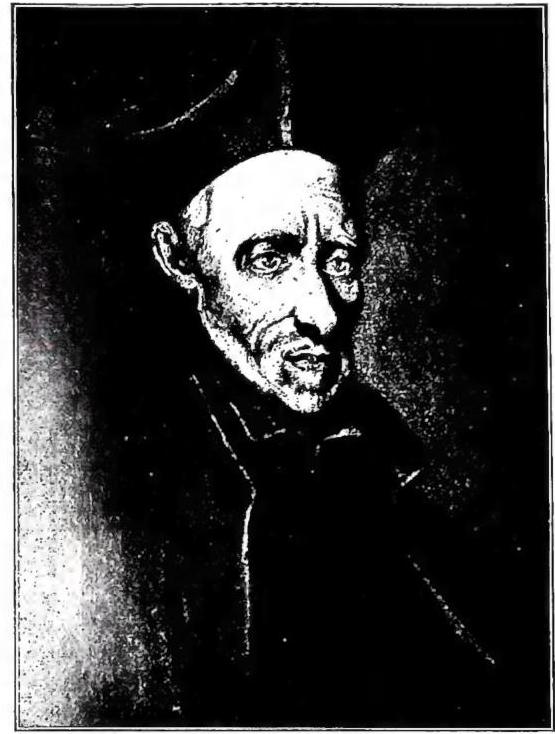
SUÁREZ, FRANCISCO – Portrait, painted by Tomás Muñoz Lucena (20th century) – Washington, Carnegie Collection.
After months of intense but fruitless application, he suddenly gave proof of uncommon ability. In 1570 he completed the course in theology at the same University of Salamanca with a public disputation concerning the superiority of the Grace of Mary over that of the saints. Ordained a priest in 1572, he first taught philosophy at Salamanca and Segovia (1570–74), then theology at Valladolid, Segovia, and Avila (1574–80).
Called in 1580 to teach theology at the Roman College (where in 1583 he made his solemn profession), he had to return to Spain (1585) because of poor health. He continued teaching theology at Alcalá until 1593. In 1590 he published the De Incarnatione, and shortly thereafter asked to be relieved of teaching in order to devote himself, at Salamanca, to the definitive preparation of his works. At that time the disputes over efficacious Grace began in Spain (v. BAÑEZ; MOLINA); Suárez found himself close to Molina on the essential points, and therefore, when Clement VIII took over the decision in the controversy, the most important part of the submission sent by the Jesuits was his work, published in the Varia opuscula theologica (Salamanca 1599). In 1597, the repeated requests of the University of Coimbra, supported by Philip II, induced him to accept the chair for the first year of theology. Having obtained his degree at Evora on 4 June, he alternated his writing with the chair he held until two years before his death (1615), although he was occasionally replaced in it by Fr. Cristobal Gil. During those years he was consulted by Spain, Portugal, and Rome. An opinion in his treatise De Paenitentia concerning confession at a distance and absolution in the absence of the penitent, condemned by the Holy Office, compelled him to go to Rome (1603–1605) to defend himself, though without succeeding in his purpose. During this second stay in Rome, he took part, secretly but not ineffectively, in the final episodes of the de auxiliis controversy, through his pamphlet De vera intelligentia auxilii efficaci.
Having returned to Coimbra, he wrote the De immunitate ecclesiastica, against the Signoria of Venice, which opposed the rights of the Church; this work earned him from Paul V the brief of 2 October 1607, in which he is described as an “eminent and pious theologian.” At that time he published the first two volumes of the great treatise De virtute religionis, whose final part is a masterly commentary on the rules of the Society of Jesus. In the last years of his teaching, at the express invitation of the Pope, he intervened with the Defensio fidei in the controversy provoked by the King of England, James I. In 1615 he withdrew to Lisbon, to the novitiate of the Society, but in May 1617 he had to intervene in the dispute known as the “Lisbon interdict,” between the Collector of the Nunciature and the civil magistrates.
The testimonies to Suárez’s virtues are numerous and immediate; among them are those of his superiors and of numerous religious, some of considerable authority, such as Luigi de la Puente and Alonso Rodriguez. In the documents sent to him at the end of his life by Pope Paul V and Cardinal Borghese, his secretary, mention is made of his “excellent virtues and merits”; St. Giovanni Eudes became the spokesman for this reputation, calling him a most devout theologian. His mystical gifts and extraordinary communications with God appear to be well attested (the sworn testimony of Jeronimo de Silva). His profound piety is reflected throughout his theological work. Clear testimony to it is provided by his volume De mysteriis vitae Christi, in which the first 23 disputations constitute his Mariology, and by the four extensive volumes devoted to the virtue of religion.
II. WORKS
S., in the judgment of Grabmann (History of Catholic Theology, Italian trans., Milan 1939, p. 241), is the most prolific of modern theologians. The treatises published by him or left almost entirely ready for printing constitute, in the edition of the Opera omnia (Venice 1747 ff.; Paris 1856), a collection of 23 folio volumes. Quite a few writings still remain, awaiting preparation for a future critical edition.S.’s production, begun at the age of 42, is the fruit of his teaching. His first works appeared at Alcalá: Commentariorum ac disputationum in tertiam partem divi Thomae tomus... De Verbo Incarnato (Alcalá 1590); De mysteriis vitae Christi (there 1592); De Sacramentis (Salamanca 1595); De paenitentia (Coimbra 1602), to which he added De censuris as a supplement (there 1603). After reproducing and briefly explaining the text of St. Thomas, these works develop into extensive discussions divided into sections. Among these commentaries there appeared in 1594 the Quaestio theologica; Utrum opera mortificata per peccata per paenitentiam revisicant, relectio, reproduced in the Varia opuscula; and then, in Salamanca in 1597, the two celebrated volumes of Disputationum metaphysicarum, written as a propaedeutic to theology. The volume Varia opuscula theologica (Madrid 1599) comprises six short treatises: the first three, De concursu et efficaci auxilio Dei ad actus liberi arbitrii necessario, De scientia quam Deus habet de futuris contingentiibus, Brevis resolutio quaestionis de concursu, form part of the documentation sent to Rome by the Spanish Jesuits during the de auxiliis controversy; these are followed by two reports: De libertate voluntatis divinae in actionibus suis, De meritis mortificatis, already cited, and the Disputatio de iustitia qua Deus reddit praemia meritis et poenas pro peccatis, a polemical work against Vázquez. In 1606 he published in Lisbon De Deo Uno et Trino (Lisbon 1606), written during the journey to Rome, not in the form of a commentary on St. Thomas but as an independent work; De virtute et statu religionis (2 vols., Coimbra 1608–1609); and Tractatus de legibus ac de Deo legislatore (there 1612), which gave him a reputation as a jurist. The last great work published by him personally was Defensio fidei catholicae et apostolicae adversus anglicanae sectae errores (there 1613).
At the time of his death (1617), he already had several volumes ready, which were soon published by the Portuguese Jesuit Fr. Baltasar Alvarez: Tractatus de Gratia Dei seu de Deo Salvatore, iustificatore et liberi arbitrii adiutore per Gratiam suam (there 1619). The second volume, which dealt de auxiliis, could not be published at that time, but was instead published at Lyon in 1651, against the will of the superiors of the Society; there, in 1655, the important De vera intelligentia auxilii efficacis also appeared, written in Rome toward the end of the controversy, as well as De angelis (Lyon 1620); De triplici virtute theologica (Coimbra 1621); De opere sex dierum together with De anima (Lyon 1621), left by the author at chapter 12 of book I; Fr. Alvarez completed it with notes from the original treatise. Volumes III and IV of De religione appeared at Lyon (there 1624–26); Tractatus quinque in primam secundae divi Thomae (there 1628), a collection made by the author of notes on subjects of general morality: De ultimo fine hominis, De voluntario et involuntario, De bonitate et malitia humanorum actuum, De passionibus et habitibus, De vitilis et peccatis.
The first editions, almost all published in Spain and Portugal, were soon followed—sometimes in the same year—by other editions, especially at Lyon, Mainz, and Venice; the editions of numerous works multiplied until the middle of the seventeenth century. After the Opera omnia (23 vols., Venice 1740–51; 28 vols., Paris 1856–61), Mons. Malou published R. P. Francisci Suárez, opuscola sex inedita (Brussels 1859): two works on confession at a distance; the third containing a letter to Clement VIII against Bañez’s accusations; the fifth, book II of De immunitate ecclesiastica against the Venetians. The other parts of the treatise have not yet been found; the final short work reports S.’s opinion on the so-called «gesuitine». In 1866 Bourassé’s Summa aurea included (vol. VIII, pp. 457–82) a treatise by S. on the Immaculate Conception. In 1948, the fourth centenary of S.’s birth, the University of Coimbra printed two volumes entitled Doctor Eximius Conselhos e pareceres: these are dissertations on questions of morality and law on which S. had been consulted.
He also wrote commentaries on Aristotle: on the Peri-hermeneias, the Analytica, the Topica, the De generatione et corruptione, etc., some of which may have been lost. His correspondence and other occasional writings amount, in Rivière’s bibliographical repertory, V. op. cit. in bibl., to more than 300 cards, a number subsequently increased. The correspondence is ready for publication. A work on 15 propositions of St. Augustine concerning efficacious Grace was published in 1948 (Estudios eclesiásticos, pp. 495–505) by Fr. J. A. de Aldama. A new edition of S. is about to gather together all these literary remains.
III. SCIENTIFIC PERSONALITY
A theologian who best represents the doctrinal orientation of the Society of Jesus, heir to the tradition of Paris and Salamanca, he participated in the movement of return to the sources. His patristic erudition is imposing, not only on account of his citations, but also because of his profound critical sense. He knew the earlier theology better than any other writer of his time, and this is one of his acknowledged characteristics (in S. tota auditur Schola).The reworking of the elements offered by the philosophical and theological tradition is profound and personal. The recovery of all preceding thought is not an end in itself, but a means toward more constructive work, toward the formulation of a sound judgment on individual problems. If in these respects S.’s work proves eminently analytical, it must be added that it does not lack synthetic force. S. did not claim to elaborate a personal systematic construction. Rather, he was a great organizer of treatises: Mariology, as it is conceived today, was one of his inspired creations; the same must be said of the treatises De Gratia, De legibus, and De religione; moreover, he organized metaphysics into a broad synthesis centered on the idea of being.
Although S. was not original in the doctrine as a whole, nor in his method, he was original on particular points, especially in the problems most debated among the scholastics. His teaching seemed to present novelties, perhaps far more than can currently be appreciated, and he was accused on this account.
S.’s well-known eclecticism derives from his attitude toward the three systematic orientations, of differing value but still current in the scholasticism of the sixteenth century: Thomism, Scotism, and nominalism; as they appeared historically, he granted none of them any preference. This is the sole foundation for the qualification “eclectic” applied to his teaching. But S. subjected the arguments and systems of the various authors to vigilant criticism, demolishing them «sine ira et studio» wherever, in the light of Revelation or reason, they seemed to lack consistency; thus it happened that his conclusions sometimes coincided with one system or the other.
S. made extensive use of the works of St Tommaso (898 citations in the Metafisica alone); his adherence to the master’s doctrine was not servile, but sincere: he always followed him whenever, in his judgment, no overriding contrary reason presented itself. Of the more than 6,000 conclusions contained in S.’s works, only about twenty disagree with the thought of the Angelic Doctor. His substantial Thomism is acknowledged by Cardinal Gonzalez and by Grabmann.
IV. DOCTRINE
The S.’s contributions are numerous. To him are due the systematic character and precision attained in the qualification of theological doctrines. Worth noting are the Suárezian development of the supernatural character of the entire order of Grace, of positive dispositions toward Grace, and of the doctrine of merit (based on God’s commutative and distributive justice: Opusc., VI: De merito, chap. 33); the delimitation of the effects of original sin to the «gratuitous» or original justice, forcefully emphasized, as well as the universality of God’s salvific will and the defense of the true character of freedom as active indifference. The S.’s own opinions in various theological treatises (cf. P. Dumont, S., in DThC, XIV, cols. 2652-89) concern: the character of the divine relations (De Trinitate, bk. III), the constitutive element of the hypostatic union (De Incarnatione, disp. 8), the motive of the Incarnation (ibid., disp. 5), the essence of beatitude and of the intuitive vision of God (De Deo, bk. II), the nature of Providence, the supernatural character of the formal object of the «salutary acts», the disposition to justification (De Gratia habituoli, II, VII-VIII), the explanation of the maxim «facienti quod in se est Deus non denegat Gratiam», the opposition between Grace and sin (ibid.), active obediential potency (De Incarnatione, disp. 31, sect. 5-6), Sacraments (v.), the essence of transubstantiation (v. EUCARISTIA), together with the mode of the Eucharistic presence (cf. R. Masi, La teoria inarexiana della presenza eucaristica, Rome 1942), the intimate nature sacrifice of the Mass (v.), the sufficiency of repentance and the voluntariness of original sin (De opere sex dierum, bk. III). In the discussion of efficacious Grace, the S., who at first did not accept middle knowledge, soon became its most convinced defender. In the subsequent discussion of predefinition and predestination, together with Bellarmino he defended the system improperly called «congruism» (v.), in opposition to pure «Molinism» (v.).The S.’s philosophy is the fruit of personal reworking; on the one hand, the epistemological, cosmological, anthropological, and metaphysical doctrines (which constitute the common foundation of scholasticism) were deepened and expressed by him in clear formulas; on the other, in his further investigation of philosophical problems, he arrived at partially new solutions: the realistic application of the act-potency theory to being, formal distinction ex natura rei, conceptualist nominalism. He also made the idea of being (one, transcendent, and analogous) the basis of the system; this idea demands the fullness of Being by essence, from which every other being derives in complete dependence (cf. F. Cayré, Patrologia e storia della teologia, Italian trans., II, Rome 1938, pp. 845-49).
Although the S.’s moral theology is not complete (he did not treat the particular problems of justice and contracts, nor of Matrimony), it introduced precisions into the common doctrine; s. Alfonso regarded the S. as one of the safest authors. The special points on which he took a position are: the constitutive element of morality, the notion of penal law, positive imperfection as distinct from venial sin, and probabilism. The S. is recognized as one of the most eminent jurists, the theorist of law in general and of political law in particular. He deepened the philosophy of society and the concept of law, with his habitual breadth, and together with Bellarmino is regarded as the outstanding representative of the traditional doctrine concerning the immediate origin of civil society and authority through the free consent of the citizens, presupposing their natural necessity and therefore its special foundation in God. Important is the S.’s contribution to the formulation of the theory of the indirect power of the Church over the State; as a canonist he excels in the De censuris and in the De immunititate ecclesiastica, as well as in many passages of the Defensio fidei and other treatises. International law found in the S. (after Francesco de Vitoria [v.]) one of its most distinguished exponents. Substantial were the Suárezian contributions to the concept of delimiting the law of nations, as a middle way between natural law and particular civil law, and to the idea of the natural community of nations (which replaced the more abstract idea of the world held by de Vitoria). The problem of just war was considered by the S., with the ancient theologians, in closer relation to charity than to justice, which must undoubtedly be presupposed with certainty, without it being possible to apply probabilism properly so called to the determination of the cause of war. In the systematic exposition of moral-juridical doctrines, the S. emphasized the voluntary element without, however, dissociating it from the intellectual (cf. R. Bouillard, S., in DThC, XIV, cols. 2691-2728).
V. INFLUSSO DEL S
Come frutto del suo immenso lavoro il S. ottenne grande autorità nella scienza sacra. Fin dai suoi tempi le lezioni di S. erano avidamente ricercate dagli studenti degli altri centri, e le sue opere ebbero successi editoriali, che oggi difficilmente si possono valutare; quasi tutte ebbero, in meno di mezzo secolo, sette e anche dieci edizioni e la Metafisica, fuori di Spagna, fino a 17 edizioni. L'autorità del S. fu riconosciuta dal Concilio Vaticano, con le frasi di elogio con cui era citato dai Padri e con i frequenti riferimenti al suo pensiero negli schemi e note dei teologi.Dalla qualifica « teologo esimio e pio » data da Paolo V a S. (breve del 2 ott. 1607) deriva il titolo di Dottore « Esimio », con cui presto lo designarono i posteri, avvalorato da Alessandro VII, che lo chiamò il « principe dei teologi moderni », raccolto da Benedetto XIV nell'opera De Synodis e confermato da Pio XII, che ha citato il S. nella Costituzione Apostolica che definisce l'Assunzione di Maria.
BIBLI: 1. Elenchi bibliografici: S. A. Pérez Goyena, Fuentes para el estudio de S., in Razón y Fe, 42 (1917), pp. 442-57; E. Rivière, S. et son oeuvre, Tolosa 1918; E. Elorduy, S., su vida y su obra, in Rev. nacion. de educación, 3 (1943), pp. 16-28; P. Mujica, Bibliogr. suareziana, Granada 1948; F. Solà, Repertorio bibliogr. de las ed. de S., Barcellona 1948; J. Iturrioz, Bibliogr. suareziana, in Pensamiento, 4 (1948), pp. 603-38 e in Razón y Fe, 143 (1948), pp. 479-99; Bibliogr. suareziana dal 1917 al 1947, recensioni critiche in Estudios eclesial, 22 (1948), pp. 603-71; Atti del IV centen. della nascita di F. S., pubbl. dalla Direc. gen. di propaganda dello Stato spagnolo (2 voll., Madrid 1949-50); Congr. internaz. di filosofia, Barcellona 1-10 ott. 1948, in occasione del centen. dei filosofi spagnoli F. S. e G. Balmes, 3 voll., Madrid 1949. - 2. Vita e opere: la biografia definitiva è quella di R. de Scoraille, François S. de la Comp. de Jésus, d'après ses lettres, ses autres écrits inédits et un grand nombre de documents nouveaux, 2 voll., Parigi 1911-1912. Complementi posteriori: P. Monet, s. V. in DThC, XIV, coll. 2638-49; B. Leorca, S. e l'Inquis. spagnola del 1594, in Gregorianum, 17 (1936), pp. 3-52; id., L'inquis. spagnola ed il libro postumo del p. F. S. De vera intelligencia auxilii efficaci, in Arch. Hist. S. J., 7 (1937), pp. 240-56; F. Rodrigues, O Doutor Esimio na Universidade de Coimbra, in Broteria, 24 (1937), pp. 437-51; L. Lopetegui, La Secretaria de Estado de Paulo V y la composición del « Defensio fidei » de S., in Gregorianum, 27 (1946), pp. 584-96; E. Elorduy, Censuras de Enriquez contra S., in Arch. teol. granatino, 13 (1950), pp. 173-252. Per le opere del S. sono stati citati i principali lavori nel testo: inoltre C. Confalonieri, Spicilegio Vatic. di docum. inediti e rari, Roma 1890; V. Beltran da Heredia, Las manuscr. de los teólogos de la escuela salmantina, in Ciencia tomista, 42 (1930), pp. 327-349; A. Zulueta, Manuscritos de F. S. en Portugal, in Rev. portuguesa de filosofia, 3 (1947), pp. 390-99. - 3. Teologia: J. Mar-
tinez Gomez, S. y la sobrenaturalidad del mérito, in Arch. teol. gran., 2 (1939), pp. 71-127; A. Reddington, The act of faith in the theology of S., Roma 1939; L. Gomez Hellin, La libertad divina según los primeros teólogos jesuitas, in Arch. teol. gran., 6 (1943), pp. 217-67; J. Hellin, El principio de identidad comparada según S., in Pensamiento, 6 (1950), pp. 435-63; 7 (1951), pp. 169-92. - 4. Filosofi: M. Grabmann, Die disputationen metaphysicae des F. S. in ihrer method. Eigenart und Fortwirkung, in Gedenblätter (1917), ampliato nel Mittelalterl. Geistesleben, Münster 1926; J. Zaragusta, La filosofia de S. y el pensamiento actual, Granada 1941; H. Gutier, The Metaphysics of F. S., Nuova York 1941; C. Gacon, La seconda scolastica, II, Milano 1946; R. Masi, Il movimento assoluto e la posizione assoluta sec. S., Roma 1947; id., Interno ad una critica alla presenza assoluta di F. S., in Divus Thomas, 54 (Piacenza 1951), pp. 385-500; J. Alejandro, La gnoseologia del Doctor Esimio y la acusación nominalista, Comillas 1948. - 5. Morale e diritto: F. Plappert, S. als Völkerrechtlicher, Würzburg 1914; A. Medina Olmos, La obra jurística de S., Granada 1917; J. Brown Scott, S. and the international Community, Washington 1933; J. de Blic, Le volontarisme juridique chez S., in Rev. de philosophie, 30 (1950), pp. 213-30; C. Barcia Trelles, F. S., Les théologiens espagnols du XVIe siècle et l'école moderne du droit internat., Parigi 1933; R. Bouillard, S. La théol. pratique, in DThC, XIV, coll. 2691-2728; A. Esteban, Concepción suareziana de la Ley, Siviglia 1944; E. Elorduy, Teoria suareziana sobre la justicia de Dios, Granada 1942; id., La moral suareziana, Salamanca 1944. - 6. Infuso: T. M. Bartolomei, Relaz. dottrinale tra la bella Munificentissimus Deus e il pensiero del S. sull'Assunzione corporea di M. V., in Divus Thomas, 54 (Piacenza 1951), pp. 334-358.