
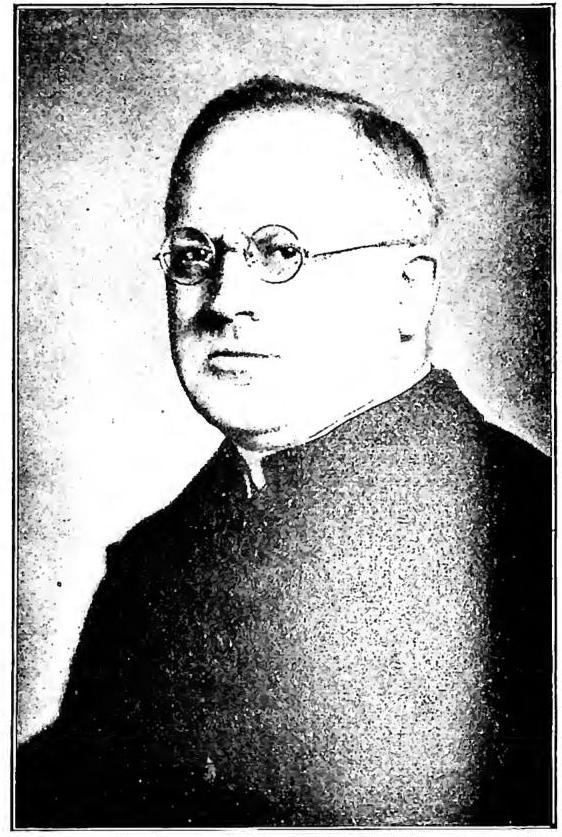
GRABMANN, MARTIN. — Historian of theology, born at Winterzhofen (Bavaria) on 5 January 1875, died on 9 January 1949 at Eichstätt, where he had definitively retired in 1943. Ordained a priest in 1898, resident at S. Maria dell’Anima in Rome (1900–1902), and doctor of philosophy and theology, he devoted several years to the sacred ministry. He taught dogmatic theology at the diocesan Lyceum of Eichstätt (1906–13), Christian philosophy at the University of Vienna (1913–18), and dogmatic theology at the University of Munich (1918–39), until the Nazi government suppressed the Faculty of Theology. In his lectures, his preferred authors were s. Tommaso d'Aquino and Scheeben, whom he called “the greatest dogmatic theologian of the nineteenth century.”
G.’s scholarly activity is evident above all from the extraordinary number of his publications, principally concerning medieval theology and philosophy. About a hundred should now be added to the 215 items in the bibliography appended to the miscellany of 77 articles Aus der Geisteswelt des Mittelalters (= Beiträge zur Gesch. d. Philos. u. Theol. d. Mittelalters, Supplementband III, Münster), presented to the sixty-year-old G. in 1935. For the history of theology from the age of the Fathers onward, three works are fundamental: Die Geschichte der scholastischen Methode... (2 vols., Freiburg im Br. 1909 and 1911), carried through to the beginning of the thirteenth century; Die theologische Erkenntnis u. Einleitungslehre des Thomas von Aquin auf Grund seiner Schrift in Boethium de Trinitate (Freiburg 1948), a supplement to the Geschichte, pending a second volume on Aquinas’s Philosophische Wissenschaftslehre; Die Geschichte der katholischen Theologie seit dem Ausgang der Väterzeit (Freiburg im Br. 1933; Italian version Storia della teologia cattolica dalla fine dell'epoca patristica ai tempi nostri, 2nd ed., Milan 1939).
Among the numerous publications on s. Tommaso, the following deserve particular mention: Thomas von Aquin, seine Persönlichkeit u. Gedankenwelt (Munich 1946, 8th ed., Italian version Milan 1920); Das Seelenleben d. hl. Th. V. IRAQ. (Munich 1924); Die Werke d. hl. Th. V. IRAQ. (Münster 1931; 3rd ed. there 1949), Einführung in die Summa theologiae d. hl. Th. V. IRAQ. (2nd ed. Freiburg im Br. 1928; Italian version Milan 1929), Die Lehre d. hl. Th. V. IRAQ. von der Kirche als Gotteswerk
(Ratisbona 1903), Die Idee des Lebens in der Theologie d. hl. Th. V. IRAQ. (Paderborn 1922), Die Kulturphilosophie d. hl. Th. V. IRAQ. (Augusta 1925; Italian translation Bologna 1931).
Important for the study of Aristotelianism in the thirteenth century are Forschungen über die lateinischen Aristotelesübersetzungen des XIII. Jahrhunderts (Münster 1916), I divieti di Aristotele sotto Innocenzo III e Gregorio IX (Roma 1941), Guglielmo di Moerbeke O. P., the translator of Aristotle’s works (ivi 1946). The influence of Aristotelian logic in the Faculty of Arts is treated especially in Die Sophismaliteratur des 12. u. 13. Jahrhunderts mit Textausgabe eines Sophisma des Boetius von Dacien (Münster 1940). There are numerous studies on the “artists,” especially in the Sitzungsberichte der Bayerischen Akademie der Wissenschaften (philos.-hist. Abteilung). The influence of Aristotelian philosophy on the political-ecclesiastical writings of the Middle Ages is examined, from one author to another, in the study Der Einfluss der aristotelischen Philosophie auf die mittelalterlichen Theorien über das Verhältnis von Kirche u. Staat (Monaco 1934).
Mention should also be made, in addition to notes and obituaries of scholars, of G.’s collaboration on the Lexikon f. Theologie u. Kirche (1930–38), his direction, assumed after the death of Cl. Baeumker (1925), of the collection Beiträge zur Geschichte der Philosophie u. Theologie des Mittelalters,
of the Philosophisches Jahrbuch (from 1927 onward, with Hartmann as publisher), and of the Series scholastica, founded in 1929 with Fr. Pelster, in the collection Opuscula et textus historiam Ecclesiae eiusque vitam atque doctrinam illustrantia.
In his publications G. does not treat authors and works as isolated entities, to be considered in themselves, but places them within the sequence of their genre, examining also, as the case may be, the influences they underwent or exerted. The singular merit of his publications (studies or texts) lies in his recourse to the sources and to an infinite number of manuscripts, as well as in his extraordinarily rich bibliographical knowledge. He thus corrected many false attributions and brought to light numerous authors and writings, of which he often reproduces excerpts or entire texts. Only his discoveries concerning Albertus Magnus, Guglielmo di Shyreswood, Pietro di Spagna (Giovanni XXI), Sigieri di Brabante, Boezio di Dacia, Eckhart, Taddeo da Parma, and Enrico di Bruxelles are mentioned.
G. was an apostolic protonotary, a member of the Academies of Monaco, Berlin, and Vienna, of the Academy of St. Thomas in Rome, doctor honoris causa of the Universities of Lovanio, Innsbruck, Milano, and Budapest, and a member of the Central Directorate of the Monumenta Germaniae Historica. Pious, modest, and affable, G. made, like no one else in this century, an extraordinarily important contribution to the scholarly knowledge of the philosophical and theological Middle Ages.