
SAINT THOMAS AQUINAS. - He is the greatest representative of Scholasticism (q.v.) and the official Doctor of the Catholic Church.
OUTLINE:
I. Life
II. Works
III. The formation of Thomism
IV. Doctrinal principles
V. Thomism
VI. Art.I. LIFE
He was born, it now seems certain, in the castle of Roccasecca, in the Kingdom of Naples, to Landolfo d’Aquino, lord of Roccasecca, and Teodora of Chieti but of Lombard origin. Since the date of his death is certain (7 March 1274) and the official biographer G. di Tocco states that the Saint had just completed his forty-ninth year, the date of his birth falls in the last months of 1225 or the first of 1226.Of his early childhood, the episode of the lightning bolt that struck and killed a little sister in the castle of Roccasecca while leaving the young T. unharmed, who was standing beside her, is especially remembered. In 1230, at the age of five, T. was placed by his parents among the “pueri oblati” of Montecassino to be educated there with the intention of steering him toward monastic life, secretly hoping that he might rise to the highest office and thereby enhance the family’s power. Instead, certainly by his own mature decision and, according to G. di Tocco, with the advice of the abbot himself (Vita s. Th. Aq., chap. 65; in Fontes Vitae s. Th., fasc. II, ed. D. Prümmer, St-Maximin, Var. 1924, p. 138), and also because of the devastation Montecassino had suffered in 1239 at the hands of Frederick II, T. returned home and proceeded to continue his studies at the University of Naples, where he first encountered Aristotelian philosophy directly under the masters Martino di Dacia for logic and Pietro d’Irlanda for natural philosophy (so G. di Tocco, loc. cit.; though the other biographers, P. Calò and Bernardo Gui, are more succinct and do not mention them). It was at the University of Naples that the Dominican vocation was born through the preaching of Fr. Giovanni di S. Giuliano; against the opposition of his family, which spared no physical or moral violence, T. displayed heroic firmness that won his sister Marotta to the religious life. It seems that the Saint received the religious habit from the hands of the Master General Giovanni Teutonico between 1243 and the end of 1244. Having finally secured his freedom by fleeing, he was sent to complete his higher studies. Some (Mandonnet, Grabmann, Glorieux, Castagnoli), following the emphasis of Tocco (op. cit., chap. 7; ed. cit., p. 72), maintain that his first destination was the University of Paris from 1245 to 1248, a supposition also supported by the famous letter of the Masters of Arts of Paris (of 2 May 1274) where the “omnium studiorum nobilissima Parisiensis civitas” is presented as the place that “ipsum prius educavit, nutrivit et fovit” (cf. Chartul. Univ. Paris., ed. Denifle-Chatelain, I, Paris 1889, no. 447, p. 505). In 1248, after Alberto Magno had founded the Studium Generale in Cologne, T. attended the theological courses for immediate preparation for the priesthood; at the school of Albert the Great, St. T. came into contact not only with the entire corpus aristotelicum but also with the Arabic and Greek commentators then available, especially through the corpus dionysianum, and was able to reveal to his master his true capacity. At the insistence of Albert, who solicited the good offices of Cardinal Hugh of St. Caro, the General of the Order in 1252 summoned T. to Paris to take up the vacant position of bachelor in theology in the Dominican chair. After bitter disputes, fomented by the secular masters, who were forced to yield through the direct intervention of Pope Alexander IV (cf. Letter to the Chancellor of the University of Paris of 3 March 1256, in Chart. Univ. Paris., I, no. 270, p. 307; cf. nos. 293, p. 339, and 317, p. 366), T. obtained the licentia docendi within the month of June of the same year, but was not admitted to the College of Professors (along with St. Bonaventure) until 15 August of the following year (1257), thus beginning his teaching as magister regens in the following month of October.
From this point onward, T.’s entire life was absorbed by scholarly activity, which alternated between the University of Paris and Italy. His first Parisian magisterium (1256–59) was disrupted by the attack of the secular masters, led by William of St. Amour, to prevent the mendicant orders from entering the University: his adversaries also invoked the question of the Evangelium aeternum, but without success. At the end of the academic year 1259, St. T. set out for Italy after having participated, at Pentecost (June 1259), in the General Chapter of Valenciennes, collaborating with St. Albert the Great and Peter of Tarentaise (later Pope Innocent V) in drafting the Ratio studiorum of the Order (cf. Chart. Univ. Paris., I, no. 385, p. 385 ff.). This first Italian sojourn (1259–68), lasting nearly ten years, was the most continuous and tranquil period of the Saint’s life, during which he displayed prodigious scholarly activity. He taught at the Studium Curiae, summoned there by Urban IV to Viterbo and then to Orvieto; in the years 1265–67 he was in the Roman convent of S. Sabina with the task of reorganizing the Order’s Studium Generale; in 1267–68 he was probably again at Viterbo in the presence of Clement IV. At the papal court he formed a friendship with his Flemish confrere William of Moerbeke, who proved invaluable to him both by revising old translations and by producing new ones from the Greek of Aristotle and the principal Greek commentators on Aristotle, as well as Neoplatonic texts, in particular the Theologica Platonica of Proclus in 1268, the commentaries on the Categories of Simplicius in 1266 and on the De Coelo et Mundo of the same in 1271, on the Peri Hermeneias of Ammonius in 1268, on the De Anima of Themistius in 1268, and on the De Anima of John Philoponus also in 1268. Earlier still is the translation of the commentary on the Meteorologica of Alexander of Aphrodisias, made at Nicaea in 1260. Toward the end of 1268, perhaps by order of the Pope himself, St. T. was on his way to Paris, where in January 1269 he began teaching, continuing through the academic year 1270–71. This second Parisian magisterium was the most turbulent period in the Saint’s life and one of the fiercest struggles on all fronts: first, the outbreak of Averroism in the Faculty of Arts; then the open opposition to his Aristotelianism by the dominant Augustinian school in the Faculty of Theology (and seemingly under the direct inspiration of St. Bonaventure: cf. J. D’Albi, S. Bonaventure et les luttes doctr. de 1267–77, Paris 1923), culminating in the stormy disputation of 1270 that embraced the principal theses of Thomism (and in particular the “unicity of the substantial form”) in the presence of Stephen Tempier, Bishop of Paris, in which T. “fuit quasi solus huius sententiae”; finally, the renewed struggle by the secular masters Gerard of Abbeville and Nicholas of Lisieux against the mendicant orders, which provoked from the Saint the two admirable writings De perfectione vitae spiritualis and Contra retrahentes a religione ingressu. In the spring of 1272, T. received from his superiors the assignment to reorganize (at the invitation of Charles of Anjou) the teaching of theology at the University of Naples: in addition to the teaching he undertook for the entire academic year 1272–73 and the first part of 1273–74 up to January, St. T. devoted himself with intensity to
SAINT THOMAS AQUINAS Scholasticism (v.) and the
preceding text ends: …in the spring of 1272 T. was entrusted by his superiors with the task of reorganizing (at the invitation of Charles of Anjou) the teaching of theology at the University of Naples: in addition to the teaching that covered the entire academic year 1272–73 and the first part of 1273–74 up to January, St Thomas devoted himself intensively to the third part of the Summa Theologica, to the composition of short treatises and commentaries on Aristotle, and to Lenten preaching to the people in the vernacular. In January 1274 he was invited by Gregory X to the Council of Lyons; setting out on the journey with the company of his faithful secretary Reginald of Piperno, he was struck along the way by an unusual malady that, unresponsive to the loving care of his niece Francesca, the countess of Ceccano, who received him at the castle of Maenza, carried him off on 7 March 1274 in the Cistercian abbey of Fossanova, where, foreseeing his end, he had asked for hospitality. He was canonized by John XXIII at Avignon on 18 July 1323, and in 1567 the Dominican St Pius V declared him “Angelic Doctor,” a title of honor alongside his official title of Doctor communis. Already his master St Albert the Great, who had hastened to Paris to defend him from the condemnation of 1277, had proclaimed him “the splendor and flower of the whole world” (Fontes vitae s. Th. Aq., fasc. IV, p. 382).
II. WORKS
St. Thomas’s scientific activity has a twofold origin: first, the duty of teaching, which obliged him to interpret official texts such as Holy Scripture, Peter Lombard’s Sentences, the works of Aristotle, Boethius, Pseudo-Dionysius, etc., and to compose disputed questions and seasonal academic conferences (Quodlibeta); second, occasional writings, prompted by fraternal charity and the courtesy of responding to requests from the Pope and superiors, as well as to questions put to him. In this second class of “occasional writings,” besides the short treatises, may be included his two most original works: the Summa contra Gentiles and the Summa Theologiae. The former appears to have been composed at the request of the Order’s Master General, St. Raymond of Peñafort; the latter—his unfinished masterpiece—was written for the benefit of young students of the Order to guide them through the chaos into which theological teaching often strayed, bound as it was to the commentaries on Peter Lombard’s Sentences (cf. the Prologue).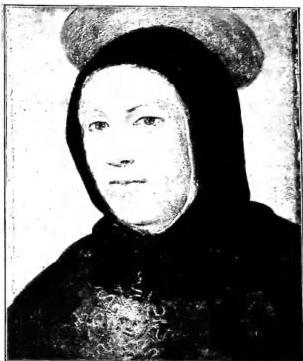
a) Commentaries on Holy Scripture. — 1. Expos. in Job (Tolomeo of Lucca, 1261–64; Mandonnet, 1269–72). 2. In Psalmos Davidis lectura (1271–73). 3. Expos. in Cantica canticorum (lost). 4. Expos. in Isaiam prophetam (Mandonnet, 1256–59; Destrez, 1269–74). 5. Expos. in Jeremiam prophetam (Mandonnet, 1267–68). 6. Expos. in Threnos Jeremiae prophetae (Mandonnet, 1264–69). 7. Catena aurea super quattuor Evang. (1261–64 for St. Matthew; after 1264 for the others). 8. Expos. (lectura) in Ev. s. Matthaei (1256–59). 9. Expos. in Ev. s. Joannis (1269–72). 10. Expos. in s. Pauli apost. epist. (for 1 Cor 11 to the end: 1259–65; for Rom–1 Cor 1–10: 1272–73).
b) Commentaries on Aristotle. — 1. In libros Perihermeneias expos. (up to Bk. II, lect. 2: 1268–72). 2. In libros posteriorum Analyticorum expos. (1268–72). 3. In octo libros Physicorum expos. (after 1268). 4. In libros De Caelo et Mundo expos. (up to Bk. III, lect. 8: 1272). 5. In libros De Generatione et Corruptione expos. (up to Bk. I, lect. 17: 1272–73). 6. In libros Meteorologicorum expos. (up to Bk. II, lect. 10: 1269–72). 7. In libros De Anima lectura (Bk. I; c. 1279, Verbeke) expos. (Bks. II–III: 1267–72). 8. In libros De sensu et sensato expos. (1267–72). 9. In librum De memoria et reminiscentia expos. (1267–72). 10. In duodecim libros Metaphysicorum expos. (1266–72). 11. In decem libros Ethicorum expos. (1260–69). 12. In libros Politicorum expos. (up to Bk. III, lect. 6: 1269–72). 13. In librum de causis expos. (1269–73).
c) Systematic works. — 1. Commentum in quattuor libros Sententiarum magistri Petri Lombardi (1254–56; a second, later commentary is lost). 2. Sum. c. Gent. (1261–64). 3. Sum. Theol. (up to Part III, q. 90. Followed by the Supplementum, compiled by Reginald of Piperno from the Commentary on Bk. IV of the Sentences): Part I, 1266–68; Part II: 1ᵃ–2ᵃᵉ, 1269–70, 2ᵃᵉ–2ᵃᵉ, 1271–72; Part III, 1272–73. 4. Quaestiones disputatae: De veritate: Paris arts. 1–84 (1256–57); arts. 85–168 (1257–58); arts. 169–253 (1258–59); De potentia: Rome, arts. 1–55 (1265–67); Viterbo, arts. 56–83 (1267–68); De spiritualibus creaturis, Viterbo (1268). In Paris: De anima (1269); De virtutibus in communi (1269–70); De malo (1269–72); De caritate (1269–72); De spe (1269–72); De correctione fraterna (1269–72); De unione Verbi incarnati (1270–72). 5. Quaestiones Quodlibetales (held during Christmas and Easter vacations): Quodl. VII–IX (1256–59); Quodl. I–VI and XII. Fr. Mandonnet suggests the following distribution: Quodl. VII (Christmas 1256); Quodl. VIII (Christmas 1258); Quodl. IX (Easter 1258); Quodl. XI (Easter 1259); Quodl. I (also Easter 1259); Quodl. II (Christmas 1269); Quodl. III (Easter 1270); Quodl. IV (Easter 1271); Quodl. V (Christmas 1271); Quodl. VI (Easter 1271). The doubts raised by P. Glorieux regarding the authenticity of Quodl. IX have been dismissed as unfounded by J. Isaac in Arch. d'hist. doctr. et litt. du m. d., 22–23 (1947–48), pp. 187 ff.
d) Authentic short treatises. — 1. Contra errores Graecorum ad Urbanum IV Pont. Max. (1261–64). 2. Compendium theologiae ad fratrem Reginaldum socium suum cariss. (1272–73; unfinished, up to De virtute spei, ch. 256). 3. De rationibus fidei contra Saracenos, Graecos et Armenos ad Cantorem Antiochenum (1261–64). 4. De duobus praeceptis caritatis et decem legis praeceptis (reportatio) (1273). 5. Devotiss. expos. super Symbolum Apostol. (1273). 6. Expos. devotiss. orationis dominicae (1273). 7. Devotiss. expos. super salutationem angel. (1273). 8. De artic. fidei et Ecclesiae Sacramentis ad archiep. Panormitanum (1261–68). 9. Responsio ad fr. Joannem Vercellensem, gener. magistr. Ord. Praed., de artic. XLII (1271). 10. Responsio ad lect. Venetum de artic. XXXVI (1269–71). 11. Responsio ad lect. Bisuntinum de artic. VI (1271). 12. De differentia verbi divini et humani. 13. De natura verbi intellectus. 14. De substantiis separatis seu de angelorum natura ad fratrem Reginaldum socium suum cariss. (unfinished; 1272–73). 15. De unitate intellectus contra averroistas (1270). 16. Contra pestiferam doctrinam retrahentium homines a religionis ingressu (1270). 17. De perfectione vitae spiritualis (1269–70). 18. Contra impugnantes Dei cultum et religionem (1256–57). 19. De regimine principum ad regem Cypri (up to Bk. II, ch. 4: 1265–66). 20. De regimine Judaeorum ad ducissam Brabantiae (1270). 21. De forma absolutionis ad gener. magist. Ord. (1269–72). 22. Expos. primae decretalis ad archidiac. Tudertinum (1259–68). 23. Expos. super secundam decretalem ad eundem (1259–68). 24. De sortibus ad dominum Jacobum de Burgo (1269–72). 25. De indictis astrorum ad fratrem Reginaldum socium suum cariss. (1269–72). 26. De aeternitate mundi contra murmurantes (1270). 27. De principio individuationis. 28. De ente et essentia (1254–56). 29. De principiis naturae ad fratrem Silvestrum (1255). 30. De natura materiae et dimensionibus interminatis (1252–56). 31. De mixtione elementorum ad magist. Philippum (1273, Walz). 32. De occultis operibus naturae ad quemdam militem (1272). 33. *De
e) Various works. — Sermons (the number is uncertain. A new collection of 11 sermons was discovered in Spanish libraries by Fr. T. Käppeli, V. Arch. Fr. Praed., 13 [1943], pp. 59-94). Prayers (the number is uncertain). Two Principia (or masterly lectures): one as “Baccalaureus biblicus” in 1252 on the theme “Hic est liber mandatorum Dei,” and the other as “Magister regens” in 1256 on the theme “Rigans montes de superioribus suis” (ed. F. Salvatore, Due sermoni inediti di s. T. d’A., Rome 1912).
2) Observations. — a) Spurious opuscules. — Grabmann (op. cit., p. 395 ff.) lists 33 titles of opuscules attributed to St Thomas that are certainly spurious. Some are compilations drawn from authentic works (e.g., De nat. loci; De nat. luminis; De tempore for chs. 1-4; De quo est et quod est, etc.). An Italian sonnet attributed by codex 9 A 27 of the Estense Library in Modena to St Thomas, and accepted as authentic by Fr. Mandonnet, has aroused serious doubts; Grabmann (op. cit., p. 413) suggests it may belong to St Thomas’s brother, Rinaldo d’Aquino, who left a collection of poems. Grabmann (op. cit., p. 141 ff.), relying on the criticism of Fr. A. Dondaine, also rejects the Quaest. de nat. beatit., discovered in codex Vat. lat. 784 and dated by Fr. Mandonnet to 1266. G. F. Rossi has begun a fundamental inquiry, based on a comparative study of manuscript tradition, into the authenticity of the opuscules: Gli opuscoli di s. T.: criteri per conoscere l’autenticità, in Divus Thomas Piac., 56 (1953), pp. 211-36.
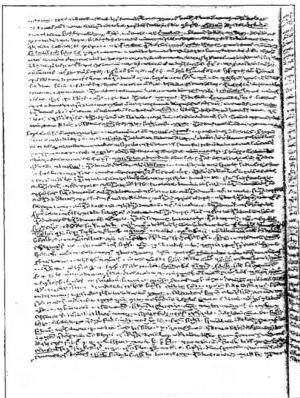
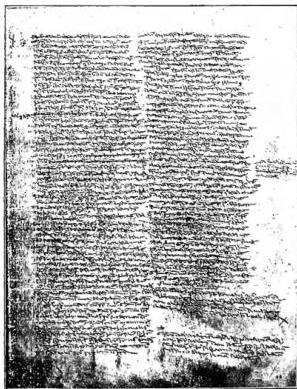
b) Autographs. — The Library of Montecassino (codex 82) holds the text of the Saint’s last writing, the Responsio ad Bernardum, abbatem Cassin., written in the margin of a manuscript of St Gregory the Great’s Moralia; Tosti and Uccelli have declared it an autograph (cf. P. Mandonnet, op. cit., 1st ed., p. 107; he concurs in the attribution). The Vatican Apostolic Library possesses two codices—donated by the diocese of Bergamo to Pius IX in 1874—which are recognized without doubt as being in the hand of St Thomas. Codex Vat. lat. 9850 contains a large part of the following three works: Summa contra Gentiles (about half the work, ff. 2r-50v); Commentary on Boethius’s De Trinitate (entire, ff. 90r-104v); Postillae on Isaiah (cc. 34-50, ff. 105r-14v). The Leonine edition (vols. XIII-XV) of the Summa contra Gentiles is based on the portion preserved in this autograph. Codex Vat. lat. 9851 contains the commentary on Book III of the Sentences (fundamental study: G. F. Rossi, L’autografo di s. T. del Commento al III libro delle Sentenze, 2nd ed., Piacenza 1933). The Vatican autographs are written in the so-called littera inintelligibilis (codex 9851 from f. 11 onward), which has finally found a sure interpreter in Fr. P. Mackey of the Leonine Commission (cf. vol. XIII, p. IV, the plate reproducing the littera inintelligibilis of f. 34, Summa contra Gentiles II, 25-26, with diplomatic transcription). Of some other alleged autographs, apart from a few fragments found in reliquaries, there is no secure evidence (cf. M. Grabmann, Die Werke..., p. 436 ff.). Even if it cannot be recognized as an autograph, as Fr. Käppeli has shown, the codex VIII. F. 16 of the National Library of Naples deserves mention; it contains the commentary on Aristotle’s Metaphysics, which seems to have been corrected by St Thomas’s hand or certainly under his direction. Another, even more famous, codex in the National Library of Naples, containing St Albert the Great’s commentary on the entire Corpus Dionysianum, was long believed by local tradition and by Uccelli to be a reportatio and thus an autograph of St Thomas dating from his stay in Cologne; but there is no decisive argument for this (cf. P. Mandonnet, op. cit., 1st ed., pp. 133 ff.; G. Meersseman, Introductio in opera Alberti Magni, Bruges 1931, p. 102; M. Grabmann, Die Werke..., pp. 341 ff., 436 ff.).
c) Lost works. — In their letter, the masters of the Faculty of Arts at Paris ask to receive those works which the Saint, on leaving Paris in 1272, had promised (specialiter promissione) to send them once certain philosophical writings he had begun there were finished; they hoped he had completed them in Italy. The works specified are: the commentary of Simplicius on the De coelo et mundo, the Expositio Timaei Platonis, and the Liber de aquarum conductibus et ingenii erigendis. The first of these certainly inspired the commentary on the De coelo et mundo left unfinished by St Thomas and dated to his final Neapolitan sojourn. Recent studies by Birkenmajer and Grabmann have shown that William of Moerbeke had completed translations of the three indicated works; a substantial fragment in three pieces of Moerbeke’s translation of Proclus’s commentary on the Timaeus has been identified in the encyclopedic work of E. Bate of Mechlin, Speculum divinorum et quorundam naturalium, bk. XI, ch. 24; bk. XXII, chs. 10 and 25 (cf. A. Birkenmajer, Neues zu dem Briefe der Pariser Artistenfakultät über den Tod des hl. Th. V. A., in Xenia Thomistica, III, Rome 1925, esp. p. 65 ff.). Among the commentaries on Holy Scripture, those on St Mark, St Luke, and St John, and the reportatio on St Matthew appear to have been lost, according to the official catalogue compiled by the notary Bartolomeo di Capua, who knew St Thomas personally in his youth. Also lost are the commentary on the Song of Songs and a second redaction of the commentary on Book I of the Sentences—works apparently contemporary with the first part of the Summa Theologiae (cf. P. Mandonnet, op. cit., pp. 34, 53, 57). Traces of commentaries by St Thomas on the other two works have not been found, and it is highly probable they remained at the project stage. In this matter, it may be observed that despite notable advances in historical criticism of St Thomas’s output, especially regarding opuscules, it is not impossible that further works may yet be discovered or identified. For example, Paris, Bibliothèque nationale, ms. lat. 14546—of great authority as it seems to date from c. 1280—contains among other undoubtedly authentic opuscules the treatise De concordia dictorum sancti Thomae (cf. G. F. Rossi, Il codice lat. 14546 della Biblioteca nazionale di Parigi con gli opuscoli di s. T., in Divus Thomas Placentinus, 54 [1951], pp. 301 ff.).
Incomplete commentaries: the commentary on the Perihermenias reaches only as far as the 3rd lecture of Book II; what follows in the editions is by Cardinal Cajetan. The commentary on the Metaphysics ends with Book XII; the commentary on the Politics reaches Lecture 6 of Book III, that on De Coelo et Mundo reaches Lecture 8 of Book III, that on Meteorology up to Lecture 8 of Book II (these were completed by the secular master Peter of Auvergne) and that on De Generatione et Corruptione up to Lecture 17 of Book I (the rest is the work of the Dominican T. De Sutton). Even the De Regimine Principum breaks off at Chapter 4 of Book II; the remainder appears to be the work of Tolomeo of Lucca.
III. THE FORMATION OF THOMISM
1. The problem of sources in Thomist thought is of capital importance and constitutes the key to understanding its formation. It is a matter of identifying, first of all, the texts and possibly the translations (from Greek and Arabic) that St Thomas actually had at his disposal; then it is necessary to determine the precise doctrinal context according to which these sources influenced the development of Thomist thought; finally, one should indicate the other interpretations that these same sources received in the medieval cultural environment, in order to arrive at an exact assessment of the Saint’s doctrinal work.As regards the first point, it can be said that the revolutionary novelty of the thirteenth-century library was the translation of Aristotle’s works on natural philosophy and metaphysics, ethics, and politics. The fact that St Thomas, barely an adolescent, attended at the University of Naples the direct teaching of logic and natural philosophy under masters Martino and Pietro d’Irlanda can be considered a decisive moment in his future orientation in favour of Aristotelianism, breaking with the Platonism of the Augustinian tradition. The Angelic Doctor could have known Plato’s Timaeus directly in the commentary-version by Calcidius (which inspired the humanist Platonism of the School of Chartres) and perhaps also the Phaedo and the Meno; Platonic doctrine was also diffused through the works of Cicero and especially in Macrobius’s commentary on the Somnium Scipionis. The principal source of medieval Platonism, however, was St Augustine (cf. De Trin., bk. VII; De Civ. Dei, bks. VIII–X), and this must guide our understanding of the precise sense of the Platonic–Aristotelian antithesis that dominated the Middle Ages and stood at the centre of St Thomas’s activity and of the controversies aroused by his work. For it is well known that St Augustine did not read any work of Plato directly and knew Platonism only through the later elaboration of Plotinus, whose Enneads had been translated by the rhetorician Marius Victorinus, to whom we can attribute the introduction of Neoplatonic terms and problems into Western Christian theology (cf. E. Benz, Marius Victorinus und die Entwicklung der abendländischen Willensmetaphysik, in Forschungen zur Kirchen- und Geistesgeschichte, I, Stuttgart 1932, esp. pp. 39 ff., 343 ff.). In this historical context, the common thesis expounded by Baeumker—that Platonism was dominant in the twelfth century, receded in the thirteenth, and regained vigour in Humanism (Cl. Baeumker, Der Platonismus im Mittelalter, in Studien und Charakteristiken, Baeumkers Beiträge..., 25 [1928], p. 58 ff.)—states a simple historical fact but does not specify its extent or its actual cultural significance. If it can be acknowledged that the doctrinal struggles of the Middle Ages indeed revolved around the Platonic–Aristotelian alternative, it must be admitted that authentic Plato (the Plato of rigid dualism, of the χῶμα, of the γομισμός between appearance and reality, between the sensible world and the ideas) is absent. The alternative is rather reduced to a contest between Plotinus (or Neoplatonism in general) and Aristotle, where the gap between Plotinus—who conceives of necessary emanation and remains a monist of transcendence—and Plato—the dualist who constructs the myths of the Demiurge and the soul—is perhaps greater than that between Plotinus and Aristotle, the monist of immanence who recognises neither myths nor any transcendence (cf. E. Hoffmann, Platonismus und Mittelalter, in Vorträge der Wartburg-Stiftung 1923–24, Berlin 1926, esp. p. 71 ff.). In the controversies of the thirteenth century, therefore, Plato is out of the question, and this explains why a critical mind like St Thomas’s should have intended, as is evident from the Letter of the Faculty of Arts of 10 May 1274, to provide a direct commentary or study of Plato’s Timaeus: such a commentary would certainly have furnished the key to understanding the inspirational principles of Thomist metaphysics in its final phase, concerning which, as will be said, the Thomist school has not yet fully shed light. It is therefore understandable that the Angelic Doctor had at his disposal only scant elements, insufficient for an attempt at interpreting Plato, unlike what he was able to do for Aristotle. The principal source for the knowledge of Plato, as for all pre-Aristotelian philosophy, was Aristotle himself in the introductions to his treatises (cf. bk. I of the Eth. Nic., Metaph., De An., De Gen. et Corr.), where theories are now simplified and in some way bent to highlight the polemical opposition.
The second capital fact regarding the sources of Thomist thought, in relation to the Platonic–Aristotelian alternative, is the complex superstructure of Neoplatonising influences that intervened in the debate. First among these is St Augustine himself, with the weight of his authority as the undisputed master of medieval theology, which St Thomas accepted no less than his contemporaries, especially in matters concerning Trinitarian theology, sin, and grace. More delicate is the relationship between the two Doctors in purely philosophical questions, where Thomist Aristotelianism could not accept compromise:
However, he accepts the fundamental doctrines of causal transcendentalism and divine exemplarism, where the inevitable contrast with the foundational tenets of Aristotelian thought is skillfully overcome through that “synthetic” interpretation to which we shall refer (on the Thomistic synthesis of Augustine and Aristotle, V. GRABMANN, MARTIN, Des hl. August. quaest. de Ideis in ihrer inhaltl. Bedeutung u. mittelalter. Weiterwirkung, in Mittelalter. Geistesleben, parte 2a, Monaco 1936, p. 32). Recent controversies regarding the agreement between St. Augustine the Neoplatonist and St. Thomas the Aristotelian have yielded no appreciable results, nor can they, because the doctrinal function of the two Doctors belongs to two distinct cultural epochs, the ancient and the medieval, which are not commensurable for the comparison that is sought; and St. Thomas himself provides sufficient criteria for this (cf. In I Sent., 13, q. I, a. 3 ad 1; Sum. Theol., 1a, q. 15 De ideis; ibid., q. 77, a. 3 ad 3; ibid., q. 84, a. 5; ibid., q. 85, a. 2, etc.). Nevertheless, St. Thomas is fully aware of St. Augustine’s Platonism and emphasizes the latter’s purifying work regarding heterodox doctrines inadmissible to Christian faith, such as the existence of “separate ideas” (Sum. Theol., 1a, q. 84, a. 5): the metaphysics of participation expounded by both Doctors expresses, so to speak, the transcendental structure of finite being in its dependence on God (cf. De spir. cr., a. 10 ad 8: “Non multum refert dicere quod ipsa intelligibilia participantur a Deo vel quod lumen faciens intelligibilia participantur a Deo.” The first is St. Augustine’s solution, the second is St. Thomas’s, who assimilates the Aristotelian doctrine of the active intellect (on the character of St. Thomas’s dependence on St. Augustine, V. Hertling, Augustinusitate bei Th. V. A., in Sitzungsb. d. philosoph.-hist. Klasse der königl. Bayer. Akad. d. Wissenschaft., Monaco 1914, pp. 535-602; repr. in Hist. Beitr. z. Philos., Kempten-Monaco 1914, pp. 97-151).
A striking yet significant example of the synthetic character of Thomistic exegesis is the prologue to the responsio of article 1 of the Q. de spir. creat., where St. Thomas precedes the authority of St. Augustine to that of Aristotle for the metaphysical concept of prime matter as “pure potency” (“...ut patet per Augustinum XII Confess. et I Super Gen. ad litt. et per Philosophum in VII Metaph.”, ed. L. W. Keeler, p. 10, 2-5). More original is the relationship of St. Thomas to the other source of theological Neoplatonism, namely the Pseudo-Dionysius (v.), whose influence equals and in some problems surpasses that of St. Augustine himself. St. Thomas commented on only the De divinis nominibus of the Corpus Dionysianum, adhering—as he did in his commentaries on Aristotle and Scripture—to the literal method: noteworthy is the Saint’s effort to find, among the various translations, the most intelligible reading, which is usually that of the Sarrazin translation (cf. G. Théry, L’entrée du Ps. Denis en Occident, in Mélanges Mandonnet, Paris 1930, vol. I, p. 23 ff.).
The influence of the Pseudo-Dionysius runs deep and touches upon the most difficult problems of metaphysics, such as the doctrine of the transcendentals and of analogy, the knowledge of God (affirmative and negative theology), and the problem of evil; moreover, according to St. Thomas, Dionysius more than anyone else stripped away the errors of Platonic philosophy and integrated its profound core into Christian theology (cf. the declarations of St. Thomas in the Prologue to the Commentary on De div. nom. and especially in De subst. separ., ch. 17). It is especially within the atmosphere of Dionysian texts, dense with profound mystical resonances and continual appeals to transcendence, that St. Thomas achieved that reconciliation between Platonism and Christian truth which enabled him to incorporate the methodological principle (not the method!) of Platonism into a metaphysics elaborated and expressed with Aristotelian principles. That this was his precise intention is shown above all by the 1,700 explicit citations of the Pseudo-Dionysius that recur in his works (cf. Durantel, S. T. et le Pseudo-Denis, Paris 1919), so much so that his authority is invoked to settle, for example, the theology of the De Causis: “Hanc autem positionem corrigit Dionysius quantum ad hoc quod ponebant (Platonici) diversas formas separatas quas dicebant deos, et aliud per se bonitas, et aliud per se esse, et aliud per se vita et sic de aliis. Oportet autem dicere quod omnia ista sunt essentialiter ipsa prima omnium causa”... (In I. De Causis, lect. 3a; ed. cit., p. 722 a).
Another sign of the exceptional theoretical value that Dionysian speculation holds in Thomism lies in the concern to repudiate heterodox interpretations tending toward the formal pantheism of the School of Chartres, which leads him to pose in good time the question: “Utrum Deus sit esse omnium rerum” (In I Sent., dist. 8, q. 1, a. 2); in Sum. c. Gent., I, 26: Quod Deus non est esse formale omnium. The Saint protests against the “intellectus perversus” that some have made of the Dionysian expression “Deus est esse existentibus” (De div. nom., § 4; PG 3, 818), doing open violence to the context (Cusanus expressly refers to this energetic correction by St. Thomas in Apol. doctor ignorant., Paris s.d., but 1514, f. XXXVIII a).
Finally, it is Dionysian the “principle of degrees” or of the decreasing continuity of the forms of being according to which the extremes touch “or: always joining the ends of the first principles to the principles of the second” (PG 3, 872), which St. Thomas renders with a more transparent expression: “Supremum infimi attingit infimum supremi” (Q. De Spir. creat., a. 2; ed. L. W. Keeler, p. 29, 5), providing him with a precious key to escape the pitfall of Averroism.
The final group of metaphysical sources consists of Boethius, the De Causis, and Avicenna, who directly suggested the central thesis of Thomistic metaphysics, namely the real distinction between essence and act of being in creatures (cf. De Verit., q. 21, a. 5; De Pot., q. 3, a. 4). Here the notion of participation was developed, which, when inserted by St. Thomas into Aristotelian metaphysics, elevates it to the affirmation of the total dependence of the creature on the Creator and integrates the Aristotelian concept of causality as a process of otherness and distinction with the Platonic concept of “presence” and “likeness.” Boethius was the first among the Latins to undertake the project of translating all the works of Aristotle and the Dialogues of Plato and to demonstrate the fundamental agreement of the two thinkers (Comm. in Arist. Περὶ Ἐρβενέλες, 2nd ed., II: PL 64, 433; ed. Meiser, Leipzig 1877, p. 80). From Boethius, moreover, St. Thomas drew from the text of the De Hebdomadibus the fundamental doctrine that the structure of the concrete, at every predicamental and transcendental level, is according to participation. The fact that Boethius was the first master of medieval Aristotelianism—first through his translations and then through the rigor of his logical method and scientific methodology and terminology—suggests the observation that the theme of the synthesis of Plato and Aristotle is the fundamental element, variously operative but everywhere present, in the cultural rebirth of Europe.
A fruit of Boethius’s high teaching and inspired by him is the Thomistic commentary on the De Trinitate (partially preserved in the Vatican autograph). In it, Thomas addresses the problem of science, the division of the various fields of knowledge, and the scientific method, ranging from natural philosophy and mathematics to theology with a breadth and precision unmatched in any of his other works. Once the true origin and Neoplatonic character of the De Causis were recognized, St. Thomas was led to the final rapprochement between Platonic metaphysics of transcendence and Aristotelian metaphysics of immanence. The Thomistic commentary on the opuscule (the common editions are very corrupt) contains elements of exceptional speculative interest for a theory of being whose content is decidedly Platonic within the solid Aristotelian framework. The commentary also has the merit of frequently comparing the De Causis with St. Augustine and Pseudo-Dionysius (cf. propositions 2, 3, 4, 5, 6, 9, 10, 14, 16, 19) to reaffirm the overcoming of the Platonic conception of “separation,” to which, as St. Thomas expressly notes, Proclus remained faithful, but not the author of the De Causis, for whom—as for Christians—everything is referred back to God (lect. 16; ed. cit., p. 744 a).
It would be most instructive, for the purpose of clarifying the originality of Thomism, to compare the Thomistic commentary with the other medieval commentaries on the De Causis, and in particular, for example, with that of St. Thomas’s master, Albert the Great (found in vol. X of the Borgnet edition, Paris 1891). Albert shows himself most uncertain about the author of the opuscule and has no suspicion of its dependence on Proclus. The commentary is divided into 2 books, each book containing various treatises, and each treatise comprising several chapters. Also worthy of comparison is the commentary of Giles of Rome, who was his disciple in Paris and who sought to specify that the author of the opuscule is Alfarabi (Giles of Rome, Opus super aucth. de causis Alfarabium, Venice 1550). At prop. 12, f. 40v, one reads the declaration: “Liber iste extractus est ex libro Procii et est totus platonicus.” One may note, among other things, a polemical allusion by Giles to the Thomistic commentary in the commentary on prop. IV, at the end: “Notandum quod secundum quosdam per dicta huius authoris potest solvi ratio commentatoris ponentis unitatem intellectus. Voluit commentator quod unius et eiusdem rei non plurificaretur species, nisi propter materiam... At patet per authorem istum quod possunt plurificari species intelligibiles propter diversitatem recipientium, dato quod illa recipientia non sint materialia, ut in diversis substantiis sunt diversae species intelligibiles, quamvis substantiæ immateriales existant” (ed. cit., f. 18f). St. Thomas, however, had written exactly the opposite, and the disciple does not appear very perspicacious (Lect. IV of St. Thomas, ed. cit., p. 726 b. The date of Giles’s commentary is: A.D. MCC nonag., Die Mercurii ante Purif. B. M. V.; col. 112f).
Last in this list of Neoplatonic sources but first with Aristotle in the formation of Thomistic thought is Avicenna, known in the 13th century through the translation by Gerard of Cremona. Avicenna’s presence is continuous, but following St. Thomas’s citations, one has the clear impression that while in his early works (Commentary on the Sentences, De Ente et essentia, De Veritate: cf. A. Forest, La constitution métaphysique de l’être fini, Paris 1932, pp. 331–60, a collection of all explicit citations of Avicenna) his influence is predominant, in his mature works it undergoes a notable decline (cf. the sharp criticism in De Subst. sep., ch. 10). Nevertheless, Avicenna’s influence was considerable at crucial moments in Thomistic metaphysics: 1) The Thomistic solution to the problem of universals (cf. Quodl., VIII, q. 1, a. 1) and the theory of the correspondence between the logical composition of genus and difference and the metaphysical composition of matter and form is attributed to Avicenna (cf. W. Kleine, Die Substanzlehre Avicennas bei Th. V. A., Freiburg in Br. 1933, esp. pp. 93 ff., 113 ff.). 2) The real distinction in creatures between essence and act of being is affirmed by St. Thomas in his early works with a verbal dependence on Avicenna’s text (cf. In I Sent. dist. 8, q. 5, a. 1: the article summarizes Avicenna, Metaph., tr. III, ch. 8 and tr. V, ch. 3; and in q. IV, a. 2 the article summarizes Avicenna, Metaph., tr. V, ch. 4 and tr. IX, ch. 1, and in ad 2 it refers to Metaph., tr. II, ch. 1 and tr. III, ch. 8: for the real distinction). St. Thomas’s position, however, soon rejects Avicenna’s extrinsicist conception of esse as an “accidens additum,” defending being as “actus substantiae” (In IV Metaph., lect. II, n. 556; cf. O. Pretal, Die frühislam. Attributenlehre, in Sitzungsb. d. Bayer. Akad. d. Wiss., Phil.-hist. Klasse, 1940, fasc. 4, p. 61 note. Also A.-M. Goichon, La philosophie d’Avicenne et son influence en Europe méd., Paris 1944, p. 44 ff.). Another Avicennian doctrine connected with this cornerstone of Thomism is the distinction between the possible esse proper to the creature and the necesse esse proper to God, which certainly inspired the third way in St. Thomas’s demonstration of the existence of God (esp. in Contra Gent., I, 15; it seems that the exposition in Summa Theologiae, I, q. 2, a. 3 is inspired by M. Maimonides). Yet even at this point St. Thomas departs significantly from Avicenna by attributing (with Averroes) a form of necesse esse, dependent on God, to spiritual creatures. 3) The distinction between the causes τοῦ fieri and the causes τοῦ esse: a distinction that underlies the entire Thomistic metaphysics of causality. On this point too, St. Thomas will denounce the extrinsicism of Avicenna’s doctrine of the “Dator formarum” and will develop, on the one hand, the Aristotelian principle of predicamental immanence that “omne agens agit sibi simile, quia agit per formam...” and, on the other, the principle of transcendental immanence from the De causis: “Causa prima plus influit in effectum quam causa secunda...” (prop. 1; ed. Bardenhewer, p. 163).
These critical and textual data lead to two conclusions: 1) St. Thomas intends and declares that he wishes to present the Aristotelian conception of reality. His activity as a commentator on the philosopher’s principal works, aimed above all at recovering the most genuine reading of the text and its direct meaning, confirms his adherence to Aristotelianism, which is unconditional as regards both the fundamental theoretical orientation and the content of being, as well as the method for expressing it in the definition of truth. 2) From the outset, however, St. Thomas introduces and progressively refines, with greater critical awareness, a complex of theses, principles, and methodological insights of evident Platonic—or, more precisely, Neoplatonic—derivation. This leads him to make the immediate aim of his speculation the reconciliation of Plato and Aristotle, around which he labors with intense speculative fervor (cf. De Subst. sep., ch. 2: In quo conveniunt Plato et Aristoteles; ch. 3: In quo differunt...). This attitude, which is decisive for an interpretation of Thomism, is first suggested to the Angelic Doctor by Boethius, but it takes shape and explicit form in his mind especially in his later writings, when he gains direct acquaintance with the great commentaries on Aristotle translated by the generous Friar William of Moerbeke. Alexander of Aphrodisias had sharply denounced the irreducibility of the conceptions of Plato and Aristotle (cf. In I. Metaph. 8-9, 990 a 34; ed. M. Hayduck, Berlin 1891, p. 78, 4 ff.), but the Neoplatonic tendency, embraced by Simplicius, prevailed against him, holding that there was substantial agreement between the two philosophers on the substance of their problems, so that Aristotle’s anti-Platonic polemic concerned only the “terminology,” more poetic than philosophical, of Plato (cf. Simplicius, In III De Coelo, 7, 306 a 1; ed. J. L. Heiberg, Berlin 1894, p. 640, 21 ff. See also: In III De Anima, 5, 430 a 23; ed. M. Hayduck, ibid. 1882, p. 347, 14 ff.; and In Categor., Prooemium: ed. C. Kalbfleisch, ibid. 1907, p. 7, 29. It seems that St. Thomas alludes to this text in Comm. III s. Metaph., 11, n. 468 and D. De Spir. creat., a. 3, ed. Keeler, p. 41, 3. The older Latin translation by Moerbeke was completed by March 1266. Cf. ibid., Praef., p. XIX col. 6). Among the Arabs, Alfarabi, Avicenna’s master, continued the enterprise of demonstrating the agreement of the two philosophers, which was to serve as the prologue to the accord between reason and Qur’anic monotheism. The fact that the mystically inclined Neoplatonist Avicenna occupied a privileged position in most of the scholastic tradition and that St. Thomas himself, especially in his early works, granted him full favor, clearly demonstrates that medieval Aristotelianism was oriented toward the “synthesis” rather than the “crisis” of the two philosophers. In fact, the Angelic Doctor eventually became aware, through Simplicius’ text, of the discord among the Greek commentators; but since he was unable to provide his own interpretation of Plato, he too resigned himself to Simplicius’ syncretistic interpretation (cf. In I De Coelo et mundo, lect. 22; ed. Parm. vol. XIX, p. 58 b). Thus, in St. Thomas’s work, considered in its historical development, there appears the paradox that his Aristotelianism is far more intransigent in its formulations at the beginning, when his thought was still significantly influenced by St. Augustine, Avicenna, etc., than when, in his mature years, he had thoroughly studied the philosopher’s works and grappled with Latin Averroism. This has given P. Duhem occasion (Le syst. du monde de Platon & Copernic, V, Paris 1917, p. 569; a thesis taken up again by L. Rougier in his essay La scolast. et le thomis., ibid. 1923) to accuse the Thomistic synthesis of artificiality; but unjustly, for such a synthesis was achieved in function of a tradition of thought recovered by the Angelic Doctor in continuity with classical philosophy and expanded by him in the Christian climate to overcome the impasse of classical thought represented by the Plato-Aristotle antithesis.
2. The “literal method” of the commentaries
There is no doubt that the originality of St. Thomas’s doctrinal innovation is chiefly due to his knowledge and assimilation of Aristotle’s writings. Indeed, unlike Albert the Great, who, like Avicenna, employs paraphrase, St. Thomas, following Averroes, adopts the literal method. The primary concern in Thomistic commentaries (and this principle applies to all commentaries, whether biblical or doctrinal) is to grasp the direct meaning of the philosopher’s littera, which at that time, because of the various, incomplete, and often discordant translations, was not always an easy task (cf. In Periherm., bk. I, lect. 5, n. 20; ed. Leon., I, 28 a; ... Et ideo magis sequamur verba Aristotelis...). St. Thomas then takes care to show the “structure” of the period within the chapter, the chapter within the book, and the book within the entire work and the Corpus Aristotelicum, with a critical intent that no commentator before him sought or achieved. For every book, treatise, and chapter he provides an outline of the subject matter in its inner articulation (cf. the plan of the logical works, In Post. Anal., bk. I, lect. 1; for natural philosophy, see In I Physic., lect. 1). The intentio Aristotelis, which he seeks, emerges from textual criticism and mastery of principles that, even without direct recourse to the Greek text and relying on translations that were anything but luminous, enables him to discern the philosopher’s exact thought with a certainty that still astonishes today: “Patet igitur praedicta verba Philosophii diligenter consideranti quod non est intentio eius excludere a Deo simpliciter aliorum verum cognitionem” (De subst. sep., ch. 13; ed. De Maria, vol. III, p. 351; ed. Perrier, ch. 12, n. 77, p. 174). Hence St. Thomas can reproach Averroes, on the basis of contextual analysis, for failing to grasp the philosopher’s method... “because he does not relate the whole to a single intention” (In I Physic., lect. I; ed. Parm., vol. XVIII, p. 228 a). The literal commentary is often supplemented by pertinent questions on debated points: these digressions, rare in the early commentaries, became predominant in the later ones, thanks to the deepening of Averroes’ commentaries and the knowledge of the great Greek commentators (cf. M. Grabmann, Die Aristoteleskomm. des hl. Th. V. A., in Mittelalt. Geistesleben, I, Munich 1926, esp. p. 281 ff.). In particular, the Thomistic commentary on the Metaphysics is judged superior to any other for the mastery St. Thomas displays of this work, which is the most difficult that exists (cf. E. Rolfes, Arist. Metaphysik, I, Leipzig 1904, Introduction, pp. 15 and 17). Clearly, in order to grasp the importance of St. Thomas’s “commentaries” (or rather expositiones) on the Aristotelian text, one must bear in mind the Latin version (or versions) that he consulted and sometimes explicitly discusses (the first volume of Aristoteles latinus [Rome 1939] can serve this critical inquiry with valuable guidance). On the preponderant influence of Boethius on St. Thomas’s Aristotelian commentaries, cf. J. Isaac, S. T. interpr. d’Arist.towards Aristotle’s text earned him the high regard of the head of Latin Averroism, Siger of Brabant (cf. De anima intell., ed. P. Mandonnet, vol. II, 2nd ed., Louvain 1911, p. 152: “Praecipui viri in philosophia Albertus et Thomas”). See also: Quaest. in metaphys., ed. A. C. Graiff, Louvain 1948, p. 20, 25. The encyclopedic Henry of Ghent calls him “famosus expositor” (cf. G. Wallerand, H. Bates de Malines et st Th. d’A., in Hommage à M. De Wulf, Louvain 1934, p. 395 ff.) and this title of “expositor” is attributed to him throughout the Middle Ages, just as Averroes was styled “commentator.” This tradition is attested at the beginning of the 15th century by Friar Luigi of Valladolid, who, after listing St Thomas’s Aristotelian commentaries, adds: “In exponendo autem litteraliter Aristotelem non habuit aequalem, unde a philosophis expositor per excellentiam nominatur” (in P. Mandonnet, Les écrits authentiques..., 1st ed., Fribourg 1910, p. 73). Agostino Nifo, converted from Averroism doubtless above all through the merit of the Thomistic commentary, expressly acknowledges St Thomas’s primacy among commentators even over the Greeks: “Hunc Thomam Aquinatem non modo in his Physicis commentationibus, sed in omnibus aliis fidum ducem, cui etiam non ab re nomen expositoris tributum est. Isto enim (pace graecorum expositorum dixerim) curiosior atque uberior, aut (quod raro est) clarior inventus est nemo” (Praef. in comm. super VIII lib. Physic., Venice 1543, fol. 2; cf. also the Praef. to the Disput. Metaphys.; Venice 1559, fol. 1 a; fol. 4 b: “Thomas noster”; 88 a; 129 b; Nifo speaks of “Expositor senex et expositor novus”). St Thomas is called “Antiquus expositor” by John of Jandun (cf. Quaest. in XII ll. Metaphys., bk. IV, q. 3; Venice 1560, fol. 236; especially disp. XIII of bk. VII, fol. 206 b: “Expositor Thomas raro aut numquam dissentit a doctrina peripatetica, fuit enim totus peripateticus et omni studio peripateticus, et numquam aliud voluit nisi quod peripatetici”; see also Nifo, In XII Met., Venice 1518, fol. 21° a; In I. de subst. orbis, Venice 1519, fol. 5° b). This fidelity to the Aristotelian text in St Thomas’s commentary was, however, vigorously contested by John of Jandun, Siger’s successor in the leadership of Averroism, who declares that St Thomas “in omnibus aut pluribus in quibus potuit conatus fuit contradicere Commentatori...” but protests: “Dico quod ergo non credo ei in hoc sicut nec in aliis conclusionibus philosophicis in quibus contradicit Commentatori” (J. de Janduno, Quaest. in lib. phys., bk. VII, q. II, Venice ed. 1501, fol. 89 ab). The discredit is explicit in the controversy over the unity of form: Jandun, who upholds plurality, proclaims that this opinion was taught by Aristotle and Averroes: “immo illa positio aliquando fuit famosa apud omnes antiquiores: sed post tempus Alberti et Thomae aliquantulum facta est improbabilis propter eorum famositatem et propter quasdam rationes eorum superficiales” (op. cit., bk. VIII, q. 11; fol. 107° a). Jandun’s bitterness towards St Thomas for such a defeat is noted and rebutted by Nifo himself, a good connoisseur of Averroist matters: “Hoc est divi Thomae decretum, qui (pace aliorum dixerim) omnibus Aristotelis interpretibus est praeferendus. Verum Gandavensis, doctor malignus et erroneus, evaginato gladio et quidem bene acuto, contra decretum istud verissimum digladiatur” (A. Niphi, Collect. comm. in lib. III De An., tc. 32, Venice 1559, cols. 339, 890). The most mature fruit of St Thomas’s critical and textual acumen in interpreting Aristotle is certainly the first part of the De unitate intellectus contra averroistas (ch. 1 §§ 3–50, ed. L. W. Keeler; §§ 2–22, ed. J. Perrier); especially his later commentaries stand out for their frequent deep probes into the Aristotelian text (cf. In Periherm., lect. 5: on the concept of being; In I De coelo et mundo, lect. 5: on the nature of celestial bodies, etc.). The wealth of thought lavished by St Thomas in his Aristotelian commentaries still remains largely unknown and awaits systematic study that is indispensable for a full and organic exposition of his thought.
3. The critical spirit, though lively and constant in St Thomas,
and superior to his age, he could not achieve the impossible: thus throughout his life he too, like his contemporaries, accepted the authorship of Dionysius the Areopagite for the corpus dionysianum and of certain works falsely attributed to St Augustine. But it was his personal merit first of all to have spurred William of Moerbeke to revise earlier translations of Aristotle and to make new translations of the Philosopher’s most important works as well as of Greek commentaries and of Proclus (cf. the dedication to Urban IV of the Catena super Matth. where St Thomas laments the inconvenience in using the Homiliary of St John Chrysostom “propter hoc quod est translatio vitiosa,” and the other dedication to Cardinal Annibaldo for the “Catena” of the other three Gospels where he declares that “ut magis integra et continua praedicta sanctorum expositio redderetur, quasdam expositiones Doctorum graecorum in latinum feci transferri”: Catena aurea, ed. A. Guarienti, Torino 1953, vol. I, p. 4; vol. II, p. 429). St Thomas earned special merit for having identified the origin of the celebrated little work De Causis: at first it was attributed to the Philosopher (In I Sent., dist. 8, q. I, a. 2 contra), then doubts arose and it was cited without the author’s name (Quodl. V, a. 7); finally it was declared an Arabic compendium of Proclus’s Theologia on the basis of a precise comparison made with the translation of Moerbeke—which he had solicited—of every proposition in the little work with the paragraphs of Proclus’s work (Sup. lib. de Causis, lect. 1; Op. Omnia, ed. Parm., vol. XXI, p. 718. On the attribution of the little work, St Thomas’s conclusion has been declared definitive by modern criticism: O. Bardenhewer, Die pseudo-arist. Schrift: Über das reine Gute, bekannt unter dem Namen Lib. de Causis, Freiburg in Br. 1882, p. 12). Another pseudo-epigraph that enjoyed great authority in the controversy over “spiritual matter” and hence also over the plurality of substantial forms was the little work De unitate et uno, attributed to Boethius in 16th-century editions and even in Migne (PL 63, 1076 ff.). In the Commentary on the Sentences (bk. I, dist. 24, q. I, a. 1; ed. Mandonnet, vol. I, Paris 1929, p. 576), St Thomas expressly attributes it to Boethius; but already in Quodlib. IX, q. III, a. 6, ad 2: “Liber ille non est Boethii, unde non oportet quod in auctoritatem recipiatur”; in his mature age the distrust takes on explicit critical force: “Liber de unitate et uno non est Boethii, ut ipse stilus indicat” (Q. de spir. cr. a. 1 ad 21; ed. L. W. Keeler, Roma 1936, p. 18, 21). It is known that the little work is a compilation by D. Guadissalvi (cf. P. Correns, Baeumhers Beit., I, 1, Münster in V. 1891). The same must be said of the other little work De spiritu et anima, attributed to St Augustine by the same partisans of the plurality of forms (and included as such in PL 40, 7) which St Thomas soon suspected to be spurious (“Liber ille non est Augustini, nec est multum authenticus”: De Spir. cr. 3 ad 6. And later, a. 1 ad 2: “Liber De spiritu et anima est apocryphus; cum enim auctor ignoretur; et sunt ibi multa vel falso vel improprie dicta; quia ille qui librum composuit, non intellexit dicta sanctorum a quibus accipere conatus fuit.” Ed. cit. L. W. Keeler, p. 46, 14 and 144, 5). He comes close to identifying the true author in Q. De anima, a. 9 ad 1 and especially a. 12, ad 1: “Liber iste De spiritu et anima non est Augustini, sed dicitur cuiusdam Cisterciensis fuisse, nec est multum curandum de his quae in eo dicuntur.” In fact modern criticism CLERVAUX (CLERF) (v.). Similarly the work De ecclesiasticis dogmatibus is restored to Gennadius of Marseilles (Quodl. XII, a. 10), which enjoyed great authority in the Middle Ages, and the little work De mirabilibus Sacrae Scripturae attributed to St Augustine is rejected by St Thomas (Sum. Theol., 3ᵃ, q. 45, a. 3, ad 2). In the 3rd part of the Summa Theologiae St Thomas cites the works of St Cyril of Alexandria directly; in bk. IV of Contra Gentiles he cites the acts of the Councils of Ephesus and Chalcedon; in Q. De Un. Verbi Incarnati and in the III pars he also cites the acts of the Second Council of Constantinople, only recently discovered (cf. III, q. II; aa. 1, 2, 3…) by St Thomas himself; and the growing importance of St John Damascene in Thomistic theology must be emphasized. The Angelic Doctor, both in his knowledge of the genuine text of Aristotle and of his Greek commentators in philosophy and in theology in his knowledge of the Greek Fathers and of the councils, advanced beyond all his contemporaries and not only them (cf. J. Backes, Die Christol. der hl. T. V. A. u. die griech. Kirchenwiter, Paderborn 1931, pp. 324 ff.). It was this novelty of method and of problems that accounts for the sudden and uncontested fame that greeted him, a young bachelor at Paris, “(ita) ut omnes etiam Magiasque videretur excedere” (G. di Tocco, Vita..., ed. cit., c. XIV, p. 81).
IV. THE DOCTRINAL PRINCIPLES
1. The Structure of Knowing. – Whether it be pure Platonism or pure Aristotelianism, both are incompatible with the Christian faith according to which the world is created by God and therefore possesses its own consistency of reality and truth, and is not merely a realm of shadows and appearances; yet it is also created by God according to the divine “Ideas” and made for His glory. It may be affirmed that all of Thomistic thought revolves around this central theme. It is in this world, therefore, that man must first know the truth and see the very reflection of God. Yet the soul of man, endowed with the principle of knowing which is the intellect, is, according to Christianity, of a supernatural nature and of divine origin, so that man, by means of intelligence, is said to be “in the image of God.” It is upon this biblical principle that Greek patristic thought and St. Augustine distinguished in man a contingent empirical knowledge through the experience of the sensible world (ratio inferior) and an absolute knowledge of the first immutable truths attained through divine illumination (ratio superior). Thus the human spirit, in its higher part, when purified and brought near to God, participates in His absolute truth (cf. St. Augustine, 83 Questions, Q. 46: De ideis: PL 40, 29) and is freed from the contingency of corruptible things.Yet it was to the advantage of Aristotle (as also to Heraclitus and the Stoics, who had direct echoes in patristic literature) to consider this sensible world as impregnated with the divine λόγος: the “substantial form,” which is the act of material substances, is said to be “something divine” (cf. Physics I, 9, 192 a 16), in agreement with Christian doctrine according to which in creatures there is found a “likeness” of the divinity, and that man can and must ascend from sensible things to the knowledge of God (Wisdom 13:1; Romans 1:19). The very Aristotelian doctrine of the active intellect (νοῦς ποιητικός: De Anima III, 5, 430 a 10), which was the principal scandal of medieval Augustinianism, in fact conferred upon man a consistency and ontological dignity required by the very notion of Christian personhood as a conscious and responsible agent. Moreover, the Aristotelian world, disposed according to a marvelous hierarchy of perfection, from inanimate beings up to intelligent man, to pure intelligences, and to God—Thought that draws all things to itself—heaven and earth—as “object of love” (ὡς ἐρώμενον: Metaphysics XII, 7, 1072 b 3)—insinuated a “presence of God” to the world and of the world to God, which fully justifies (perhaps the most complex phenomenon in the history of Catholic culture) that the Church’s Doctor should have radically altered course with respect to patristic tradition. Thus, in Aristotelianism, the “concept of truth” as “conformity” of the intellect with the real (cf. Metaphysics II, 1, 993 b 31) is grounded in earth and in the human mind itself, and is not relegated to the indefinite, but directly engages each person before being, and can found, in the moral order, the responsibility of merit and demerit that underlies Christian ethics and eschatology. Finally, deepening this metaphysics of act, the Aristotelian notion of substance (v. SUBSTANCE) with its two elements of subsistence (οὐσία) and inherence (ὑποκείμενον) proved particularly apt to explain how the individual real thing could at once remain continuous and consistent in its being and, at the same time, follow a cycle of development through material and spiritual accidents. And this is most necessary in the Christian conception of human development and also corresponds to the Christian concept of “history” as the actual unfolding, in this temporal world, of the divine plan of salvation for humanity (cf. E. Hoffmann, Platonismus und Mittelalter, loc. cit., p. 72 ff.). The situation is therefore as if an Aristotelian structure were, of itself, in fundamental consonance with the presuppositions of Christianity regarding the structure of finite being: in this sense it is no wonder that the Platonic predominance in patristics provoked nearly all the Trinitarian and Christological heresies.
The Aristotelian realism of St. Thomas corresponds to the maturity attained by Christian consciousness, which considers it a greater honor to divine omnipotence that even the creature should possess true reality and proper activity (cf. C. Gent., III, 21 and 69; Sum. Theol., 1ᵃ, 105, 5, etc.): thus man has in his intellect the immediate principle of his understanding, not in divine illumination, which is evidently presupposed. In St. Thomas’s earliest writings, traces of Augustinian extrinsicism are evident in the assertion that the “first principles” of both knowing and moral action “pre-exist” in us naturaliter, as semina of the sciences and virtues, and are therefore quodammodo innata (cf. De Ver., q. 14, a. 2; In II Sent., dist. 24, q. 2, a. 3 and passim). But upon closer contact with the Aristotelian text, St. Thomas soon grasped the importance of the doctrine of ἐπαγωγή (cf. Post. Anal., II, 19, 99 b–100 b; Metaph., I, 1, 980 b 25–981 a 30), understood as the progressive conquest that the human intellect achieves of truth in the ferment of experience. This process, which Aristotle outlines in brief strokes, St. Thomas deepened with the aid of the Greek and Arabic traditions (cf. H. A. Wolfson, The internal senses in Latin, Arabic and Hebrew philosophical texts, in The Harvard theological review, 28 [1935], pp. 69 ff.).
The fundamental principle of Aristotelian gnoseology is that the only form of intuitive and direct knowledge that attains existence is given by sense: colors, sounds, tastes… are for man the first attestation of the presence of being to consciousness, and it is symptomatic that Aristotle refers to this presence for the indirect foundation of the “principle of contradiction” (cf. Metaph., IV, 3, 1010 b ff.). This process of experimental induction of the intelligible presents three main stages, corresponding to the three “objective levels” of human consciousness.
1) There is the first formal synthesis by means of the so-called “common sensibles” (cf. De Anima, II, 6, 418 a 17 ff.; III, 1, 425 b 2 ff.), which organize the immediate contents of experience into immediate perceptual unities, whether static or of movement (perception of figures, numbers, states of rest and motion…). St. Thomas insisted forcefully, against the interpretation of the Averroist current, in vindicating these first syntheses for the perception of the external senses, thereby ensuring the continuity between the cognitive syntheses and the immediate attestation of the real in sensation.
2) This is followed by the real synthesis of the concrete values of lived experience, which St. Thomas calls intentiones, in contrast to the neutral contents of the preceding spheres, which are termed formae. It is in this zone that ἐπαγωγή properly unfolds, for within the sphere of direct sensation (proper and common sensibles) one cannot speak of development except secondarily and in dependence on the higher spheres. This development of real syntheses constitutes the object in the concreteness of accumulated experience and is therefore entrusted to the operation of the “internal senses,” which St. Thomas divides into two groups: the formal senses (common sense and imagination) and the intentional senses (cogitativa and memory with recollection; Sum. Theol., 1ᵃ, q. 78, a. 4). The key faculty of Thomist gnoseology is the cogitativa, barely hinted at by Aristotle but developed by the Greek-Arabic tradition and especially by Averroes. To the cogitativa, also called ratio particularis, the following functions pertain: a) apprehending the contents of value or intentiones insensatae (Sum. Theol., loc. cit.); b) judging common and proper sensibles (De Ver., q. I, a. 11); c) preparing the phantasma from which the intellect may abstract knowledge of essence (C. Gent., II, 60; cf. ibid., cc. 73, 80, 81); d) perceiving concretely those fundamental ontological notions (reality, substance, cause, relation… and the other categories) that the intellect then grasps in the universality of abstraction (Comm. in II De An., lect. 13, n. 396). On this basis, St. Thomas holds that the proper object of the human mind is the essences of material things.
3) The real knowledge of corporeal essences through the “conversion to phantasms,” which constitutes the constitutive moment of the process of abstraction proper to the human intellect: “Hence the nature of a stone or of any material thing cannot be known completely and truly unless it is known as existing in the particular. But we know the particular through sense and imagination: and therefore it is necessary, in order that the intellect may actually understand its proper object, that it turn to phantasms so as to contemplate the universal nature as existing in the particular” (Sum. Theol., 1ᵃ, q. 84, a. 7). In reality, for St. Thomas: a) it is through experimentum (Aristotle’s ἐπασχόλις), in which the cogitativa operates, that the human intellect ascends from individual facts and experiences to knowledge of the universal and even to the formulation of first principles (cf. In II Post. Anal., lect. 20; ed. Parm., t. XVIII, p. 224 b; and earlier, bk. I, lect. 4 c.: “The universal is not known by sense, but from many singulars seen in which, after being considered many times [= experimentum], we find the same thing happening, we acquire universal knowledge.” Ibid., p. 171 a); b) it is through the cogitativa that the human intellect indirectly perceives singular substances… my friend Peter (Sum. Theol., 1ᵃ, q. 86, a. 1; Q. De An., a. 20 ad 1 sec. ser.) and achieves that reflexio which secures and maintains the indirect yet immediate contact of the intellect and human consciousness as such with the reality of the external world; c) it is again through this cogitativa—and now it is understood—that the human intellect is inscribed in concrete reality, disposes of particular things, and can exercise moral judgment, for it is the cogitativa that supplies the “minor” of the prudential syllogism (De Ver., q. 10, a. 5 and ad 2).
The Thomist cogitativa thus effects the connection between intellect and sense both in the ascending and descending functions, and likewise between the deliberating will and the concupiscible and irascible appetites: in it, therefore, is gathered that which forms the matter of the higher actualizations of the spirit, science and virtue. Thus St. Thomas did not choose between the two members of the Platonism-Aristotelianism alternative (as E. Hoffmann, art. cit., p. 67, claims), but rather embraced their opposing demands of transcendence and immanence on a higher plane through the notion of participation. Indeed, the cogitativa is capable of performing the remarkable functions just indicated insofar as it “participates” in the intellect by a certain kind of functional continuity: “The cogitativa is what is highest in the sensitive part, where it somehow reaches the intellectual part so as to participate in something of what is in the intellectual part, namely the lowest of discursive reason according to the rule of Dionysius” (De Ver., q. 14, a. 1, ad 9).
At this point, the first phase of the predominance of Aristotelian immanence is succeeded by a phase of Platonic predominance in the sense of the ontological transcendentalism indicated above. Human intellect and the first principles, both of the speculative order (intellectus properly so called) and of the practical sphere (synderesis), attain absolute value insofar as they are “participation in the divine light within us and in the eternal law” (cf. Sum. Theol., 1ᵃ-2ᵃ, q. 91, aa. 2-3). St. Thomas, to indicate what might be called the “transcendental moment” of human knowing, also employs the term that would gain currency in mystical literature of the scintilla animae (cf. In II Sent., dist. 39, q. 3, a. 1. Cf. in this regard: H. Willms, De scintilla animae, in Angelicum, 14 [1937], pp. 194 ff.). The originality of the Thomistic doctrine of knowledge (and of the corresponding doctrine of human action, insofar as both move on the platform of the “cogitativa”) consists first of all in having steadfastly maintained and developed the Aristotelian principle of the immanence of the act throughout the line: humanity, and thus also the soul, understanding, value, and sensation... constitute the reality and the substantial or operative act of the singular substance. At the same time, however, every act, form, and inferior activity is anchored to that which is superior as its participation, so that each finds in this relationship its metaphysical assumption; and in general every reality and perfection is something participated that must be grounded in the absolute perfection which is God by essence. Both moments, it should be noted,
are equally constitutive of the Thomistic synthesis: the Aristotelian moment, inasmuch as things first of all are and operate, not by participation or mere derivation, but because they are endowed with their own principles in the ontological order... It is these principles that God has given to things that constitute them and make them act. Yet there is also a second moment: beyond this first, which may be called participatio causalis, common to all Christian philosophy, there is in St. Thomas also the deeper moment of a participatio formalis of Neoplatonic derivation, which Meister Eckhart will attempt to impose in an exclusive form. First, the expression that the agent intellect with the first principles is “a participation in the divine light within us” (cf. De Ver., q. 10, a. 6; De spir. creat., a. 10) does not have a merely causal meaning, because it is through the intellect, as the highest peak of the mind, that man “attains” God and remains in a certain continuity with Him. Then, and this second moment follows and completes the first, the intellect in every judgment of truth does not obtain its definitive certainty except by divine virtue. One is thus beyond both Platonism and Aristotelianism, and the later St. Thomas has reached a pregnant formula: God aids man in understanding not only (1) insofar as He presents the objects to him or (2) increases the light of his intelligence, but also (3) because the natural light that makes him intelligent comes from God, “and (4) by this also because, since He Himself is the first truth, from which all other truth derives its certitude, just as conclusions derive their certitude in demonstrative sciences from the first principles, nothing can be made certain by the intellect except by divine virtue, just as conclusions in the sciences are not made certain except by the virtue of the first principles” (Comp. Theol., ch. 219; ed. De Maria, III, p. 185. Cf. Sum. Theol., 1°, 105, 3. Again: Expos. in Joan., ch. 1, lect. 1, n. 33, ed. R. Cai, Torino 1952: a text that is worth a treatise!). When care is taken to place the Thomistic doctrine of abstraction, in which the core of Thomistic realism is expressed, between these two poles—the cogitativa, which gathers the experience of lived life because it participates in the intelligence, and the intelligence itself, which attains the absolute truth of essences because its certitudes are guaranteed by the “presence” or assistance of divine truth—the Thomistic doctrine escapes the charge of “naturalism” leveled by the followers of medieval Augustinianism and by modern idealism.
2. The structure of being. The emergence of act (polemic against Augustinianism and Averroism). — Medieval Augustinianism had constructed, under the authority of the great African Doctor, a synthesis of elements of quite heterogeneous origin, yet tenaciously connected by a jealous tradition that had developed the consequences of his preference for Plato over Aristotle. In metaphysics it admitted a certain actuality of prime matter; then it identified potency or receptivity with matter so that in the essence of every creature matter enters as a component: in corporeal creatures corporeal matter, in spiritual creatures spiritual matter (universal hylomorphism). Moreover, and consequently, since the genus as a logically indeterminate element corresponds to matter as the ontologically indeterminate element, it admitted in every substance as many matters and as many forms as there are logical genera and the corresponding differences present in its notion: e.g., in man, those of substance, body, living being, animal, rational, and in the individual Peter..., thus at least six matters and as many forms (multiplicity of substantial forms).
The methodological principle of this exaggerated realism is the direct correspondence between the logical order and the ontological order: the genus is matter and the difference is form; the parts of the definition are also the parts of things. Someone, e.g., H. Meyer, T. V. A., Bonn 1938, p. 79, has dared to level the same accusation of “parallelism” between the logical and the ontological order even against St. Thomas himself. Cf. C. Fabro, Logica e Metafisica. A proposito di alcune crit. recenti al realismo tom., in Acta Pont. Acad.
S. Th. Aq., 12 (1946), pp. 128 ff. Moreover, it suffices to read the absolutely precise critical exposition and refutation that St Thomas gives of Avicebron in De Subst. sep., cc. 5–8. The “first moment” of Thomistic metaphysics is the Aristotelian concept of act as “perfection” in itself and per se, hence as an ontological affirmation and positivity: act is by its nature “prior” to potency (Metaph., IX, 8, 1049 b 4 ff.) whether act is understood as operating activity (ἐνέργεια ἔργον: loc. cit., 1050 a 21–23) or as the form that is the first quiescent act (ἐντελέχεια) from which operation arises and to which it returns. In this way, although it must be said that corporeal essences are composed of two principles, matter and form, which are the “parts of the essence” (Metaph., VII, 10, 1034 b 2 ff.), nonetheless the essence in its metaphysical aspect gravitates toward the form, which is act (ibid., VII, 11, 1036 b 12). St Thomas unreservedly accepted this “primacy of act” and identified the true direct opponent in the Arab-Jewish philosopher Ibn-Gēbhirōl (Avicebron, v.) who explained the reality of beings by “resolving” them into potency rather than act, as Plato and Aristotle had done.
With the concept of act emerging over against potency, St Thomas could demolish the fundamental principle of exaggerated realism: genus and differentia are “concepts” that unify in the definition of the species and therefore cannot indicate distinct realities. As expressive concepts, each indicates a formal aspect. In the definition, which must be a unity of genus and differentia, they indicate the same single specific nature but in different ways: the genus in the indeterminate element and the differentia in the determining element, the species in the whole of the synthesis (cf. In VII Metaph., lect. 9, n. 1463). Therefore the logical composition of genus and differentia is not in itself and by itself an argument for materiality; this must be established by other means, namely from the data of experience. Even in material substances, genus and differentia as elements of the definition can be said to correspond to matter and form of the concrete substance only indirectly or “proportionally” (cf. De ente et essentia, cap. 3, ed. Baur, Münster i. V. 1926, p. 24, 6): that is, the genus, which is the indeterminate element of the definition, corresponds to matter, which is the purely potential principle, and the differentia, which is the specifying element, corresponds to form, which is the actual principle. When, however, it is established that absolutely spiritual substances exist, the genus and differentia of their definition no longer indicate two opposed ontological principles but express the same formal reality considered first in its indeterminacy and then in the distinctive character of individual spirits. Thus angels or pure intelligences can be said to be composed of genus and differentia without implying any matter, because subsistent spiritual forms possess the “power of understanding,” which can receive universal intelligible forms without limit and therefore receive act in a way diametrically opposed (per oppositam quandam rationem) to matter, which receives only individual forms (De Spir. creat., a. 1 ad 2 and ad 24). Angels (and the human soul) are therefore simple in the essential order, i.e., subsistent forms; they are composite only in the entitative order, i.e., of substance and accidents, of essence and act of being.
In this way St Thomas gave a new concept of act and potency, for act is posited in its pure metaphysical sense as “perfection” = affirmation of being, and potency as “capacity to receive” (perfection) = negation as privation. From this follow two capital consequences for St Thomas: a) potency is not said in one way only, namely as prime matter alone, but in as many ways as there are forms of being that “undergo” act, and everything that receives and conditions act is potency. Potency is not only prime matter but also, for example, the human body however complex: “Esse subjectum non consequitur solam materiam quae est pars substantiae, sed universaliter consequitur omnem potentiam” (De subst. sep., cap. 7; ed. De Maria, p. 231); b) prime matter, which is pure potency, is only a subject and therefore has no act of its own, and all its actuality comes from form, so that not even God can make matter exist without form (Quodl. III, q. I, a. 1).
From the new concept of act (and potency) derives the “second” moment of Thomistic metaphysics, namely the thesis most contested in St Thomas’s lifetime: the unity of the substantial form in all bodies, even in living beings and in man himself endowed with a spiritual soul, and hence the admission that the spiritual soul is by itself and immediately the substantial form of the human composite. A plurality of “forms,” even if ordered and subordinate to the spiritual soul, or even the admission of only an intermediate form (forma corporeitatis), would destroy the essential unity of man because the spiritual soul as the ultimate form would be a simple perfective and therefore accidental form. To the theological difficulty, the principal cause of controversy, that Christ’s body “in triduo mortis” separated from the soul could no longer, in the Aristotelian position, be called the body of Christ except “equivocally” (cf. De An., II, 412 b 21), St Thomas expressly accepts the consequence but sees no harm to dogma because the dead body of Jesus, though separated from the soul, remained united hypostatically to the divinity of the Word (cf. Quodl. III, q. II, a. 5 and ad 1). The identical rational soul, the one substantial form, confers on man not only spirituality but also the lower ontological grades: “Sic ergo dicimus quod in hoc homine non est alia forma substantialis quam anima rationalis, et quod per eam homo non solum est homo, sed animal et vivum et corpus et substantia et ens” (De spir. cr., a. 3; ed. Keeler, p. 44, 1 ff.). Thus the intellective soul virtually contains the lower forms, i.e., it includes the sensitive and vegetative powers that operate through the body (cf. Sum. Theol., I, q. 76, aa. 3–5): in this way Aristotle compares essences to numbers, which differ by addition or subtraction of units (cf. De An., II, 3, 414 b 28; Metaph., VII, 6, 1043 b 34).
In this “third” moment of the Thomistic metaphysics of act, there is the defence—Averroism (v.)—of the personal individuality of the spiritual principle. The refutation unfolds in two stages: 1) a phenomenological one, which is self-consciousness understood as the individual awareness each person has of being himself, the single N. N., the one who understands, wills, loves, etc.—hic homo intelligit. The intellect (and the will) is act, an individual perfection on which all the other values of the single human being as a person depend: this self-consciousness underpins the whole of human life, the duties and rights of each person as an individual man. Hence the need to “found” this fact on the metaphysical plane. 2) A metaphysical one, inasmuch as the consciousness of understanding (second act)—which is an absolute “prius” in spiritual life—can be explained only by admitting that each single man is endowed with his own individual spiritual soul (first act) which is at once the substantial form of the body and emerges above the body through spiritual operations: the second act (understanding) can be attributed to the individual only insofar as the same individual possesses the first act (the substantial intellectual principle; De Unit. intell. c. Averroistas, c. 3 § 80; ed. L. W. Keeler, p. 50 ff.). Clearly the spiritual soul is the substantial form of the body insofar as it is the principle of vegetative and sensitive functions, and not insofar as it is the principle of intellectual functions by which it emerges above the body and is a subsistent form in itself (cf. op. cit., § 60; ed. cit., p. 38). The positive immateriality of understanding provides the proof of the absolute spirituality of the human soul: since it is endowed with an operation in itself that transcends the body, it is a form subsistent in itself to which therefore belongs esse directly (and not in common within the composite, as material forms do), and this being it communicates to the body. With this the immortality of the soul is rigorously proved metaphysically: if the human soul, because it is a spiritual form, is the immediate and per se subject of the act of being, this esse belongs to it definitively and inseparably: “Esse autem per se convenit formae quae est actus... Impossibile est autem quod forma separetur a seipsa; unde impossibile est quod forma subsistens desinat esse” (Sum. Theol., 1°, q. 75, a. 6; cf. ibid., q. 50, a. 5).
The “fourth” moment of Thomistic metaphysics is the affirmation of the real distinction between essence and act of being (esse) in all creatures, which is the conclusion of the new concept of act: this is today considered the keystone of the whole of Thomistic thought. Presented in the early works under the direct influence of Avicenna’s extrinsicist metaphysics, in the mature works it is established with the most perfect formula of the “primacy of act” through the notion of participation in two stages: a) Pure perfection (perfectio separata) can only be one, and being is the first perfection and the act of all acts (Quodl. II, a. 3; Sum. Theol. 1°, q. IV, a. 1 ad 3 and a. 2); therefore subsistent being is only one, and this is God who is being by essence. b) All creatures are then beings by participation insofar as essence participates in esse, and essence is thus potency with respect to esse which is the ultimate act of every reality (cf. In VIII Physic., lect. 21, ed. Parm. t. XVIII, p. 532: a text very well known in the Averroist school). In this way St Thomas can, with the notion of participation, overcome Augustinianism, because he demonstrates that the soul and created intelligences (Angels), although simple in essence, are composite as creatures in the order of being. Still with the same notion of participation he can vindicate, against Averroism thanks to ontological composition, the absolute dependence of the intelligences on God through creation and conservation (Sum. Theol. 1°, q. 44, a. 1 and ad 1; ibid., qq. 104 and 105). The formula of participation finally provides the formula for expressing the analogy between creatures and the Creator: “Non dicitur esse similitudo inter Deum et creaturas propter convenientiam in forma secundum eamdem rationem generis aut speciei, sed secundum analogiam tantum, prout scilicet Deus est ens per essentiam, et alia per participationem” (Sum. Theol. 1°, q. 4, a. 3, ad 3). In this final conception of St Thomas, esse is no longer the accident of Avicenna, but is the immanent act of substance, esse substantiale, which is the proper effect of divine causality (Quodl. XII, q. V, a. 5).
A twofold corollary of the Thomistic metaphysics of act is the explanation of the multiplication of individuals within the same species (predicamental participation) by means of the principle of individuation indicated in the potential part of essence considered in the determination of “corporeity” (materia signata quantitate), and the doctrine of the principle of subsistence of beings by participation referred to esse as “actus substantiae”: “Proprie esse... attribuitur soli substantiae per se subsistenti” (Quodl. IX, q. II, a. 3, and ad 2: “Esse est id in quo fundatur unitas suppostiti”). Pure spiritual substances (Intelligences according to philosophers, Angels according to theology), lacking the principle of individual multiplication which is matter, each one is the entire species. In his last works St Thomas fully satisfied Simplicius’s thesis of the fundamental agreement between Plato and Aristotle (cf. De Subst. sep., c. 3): thanks to the notion of participation which at once gives the ultimate foundation of the doctrine of act and potency and overcomes the obstacle of Greek dualism. The Thomistic synthesis is absolutely original: it indeed takes up the metaphysical core of Platonic transcendence (notion of creation, composition of esse and essence, theory of analogy), which is welded to the act of Aristotelian immanence (the unity of substantial form, the intellectual soul as substantial form of the body, doctrine of abstraction v.).
In the field of moral philosophy the polemical aspect that clarifies Thomistic progress is more in the shade, but it is no less real, as has been shown especially by the fundamental researches of D. O. Lottin. The “natural law” (v.) is no longer conceived, as in earlier scholasticism, as a kind of innate disposition of the will or a special faculty of the soul, but consists in the “habitus primorum principiorum” of practical reason: these principles constitute the “natural law” which is defined as a “participatio legis aeternae in rationali creatura” (Sum. Theol., 1°-2°, q. 91
a. 2); it has in the practical sphere a foundational role analogous to that of the first principles of theoretical reason in the speculative field (cf. ibid., 1ᵃ-2ᵃc, q. 91, a. 3 ad 1). Natural law thus constitutes the foundation of “sinderesis,” which is the habitus of the first moral principles and therefore presupposes it (ibid., 1ᵃ-2ᵃc, q. 94, a. 1 and ad 2). In elaborating the structure of the human act, St Thomas, while not abandoning the Augustinian doctrine of intentio and frui, deepens and develops the Aristotelian elements concerning usus and consensus. Therefore, in the formation of moral judgment, sinderesis provides the universal premise (“one must not steal”), and the ratio particularis, or cogitative power (v.), presents the concrete situation upon which a decision must be made (“this is theft”); the conclusion is the affair of “conscience” (v.), which must apply the universal precept to the particular case. In any case, in the ethics of St Thomas, natural order receives full recognition, and in harmony with Aristotelianism, the proximate rule of “morality,” by which an act is said to be good or bad, is “right reason” applied to the object according to the perfect formula: “An act receives its moral species from its object insofar as it is compared to reason. And therefore it is commonly said that certain acts are good or bad by their genus, and that a good act is one that falls upon the due matter, such as feeding the hungry; an act bad by its genus is one that falls upon undue matter, such as stealing another’s goods, for the matter of an act is said to be its object” (De Malo, q. 2, a. 4, ad 5). And since it is the province of practical reason to order acts to the ultimate end, there can be no concrete acts (in an individual) that are indifferent in themselves: for either the act is ordered by deliberative reason to the ultimate end or it is not; in the first case the act is good, and in the second bad (Sum. Theol., 1ᵃ-2ᵃc, q. 18, a. 9 corpus and ad 3). This primacy which reason by nature exercises over human acts is also evident in the characteristic thesis of Thomistic moral teaching regarding the sinfulness of the so-called motus primo-primi of the lower appetite: “Reason, by anticipating it, can either command it or even impede it; it was within man’s power to restrain it” (Quodl. IV, a. 21; cf. ad 2). At this point, therefore, the will enters the scene as the moving principle of moral life and thus as the proper subject of moral virtues. In all this matter, St Thomas uses with sure judgment the advances of his predecessors and always arrives at some original insight, drawing inspiration, beyond Aristotle, also from Cicero and Macrobius, both in general theory and in the treatment of individual virtues, which have their natural center in “prudence.”
Entering more particularly into the doctrinal problems of natural law, the Thomistic treatment not only surpasses those of his predecessors and contemporaries but represents the most complete synthesis of Roman law with the Christian conception. It is therefore not surprising that the Thomistic principles of the treatises De justitia et de legibus are praised by Grotius, and that one of the most esteemed modern cultivators of the philosophy of law, Ihering, confessed that he would not have written his essay Der Zweck im Recht (2nd ed., Berlin 1884) had he known the treatment of St Thomas, “in which the principles of this matter are expounded with perfect clarity and in the most pregnant form,” especially regarding the fundamental question of the subordination of law to morality (cf. B. C. Kuhlmann, Der Gesetzesbegriff beim hl. Th. V. A., Bonn 1912, p. vi ff.).
Even in sociology, economics, and above all in politics, the principles of St Thomas have guided the revival of Catholic thought against the attacks of liberal secularism and Marxist socialism in defense of the higher values of the human person (an attempt has even been made to draw a parallel between St Thomas and Marx by G. Hohoff, regarding the theory of “value,” cf. G. W. Plechanov, La quest. fondam. del marxismo, Italian trans., Milan 1947, pp. 145 ff.).
3. The theological method: reason and faith
The merit of having been the first to conceive theology as a “science” in the strict sense is now generally recognized as belonging to St Thomas. Indeed, according to Fr. Chenu (La Théol. comme science au XIIIᵉ siècle, 2nd ed., Paris 1943, pp. 9 ff.), he dared to set forth clearly the principle of an integralapplies the procedures of science to the data of Revelation, thereby constituting an organic discipline in which Holy Scripture, the article of faith, is no longer the very matter, the subject of theological exposition and inquiry—as it was in the sacred doctrine of the 12th century—but rather constitutes the previously known principle from which theology proceeds according to all the laws and exigencies of Aristotelian demonstratio: “Ipsa quae fide tenemus, sunt nobis quasi prima principia in hac scientia, et alia sunt quasi conclusiones” (In Boeth. de Trin., q. II, a. 2; ed. De Maria, p. 298; cf. ad 4 and ad 5). In theology, therefore, we who are believers in the state of wayfarers (in statu viatoris) seek some understanding of supernatural mysteries insofar as, on the unshakable foundation of faith—which is a “participation” in the science of God and the blessed—we advance to further knowledge: “... Venimus in cognitionem aliorum secundum modum nostrum, scilicet discurrendo de principiis ad conclusiones” (ibid.).
The question whether theology can be a “science” appears at the outset of the 13th century in William of Auxerre, Prepositinus, Alexander of Hales; even the Dominican Roland of Cremona raises it explicitly, but resolves it negatively (cf. E. Filthaut, Roland V. Cremona und die Anfänge der Scholastik im Predigerorden, Vechta i. O. 1936, pp. 52 ff.). Theology acquires the character of science only when St Thomas applies Aristotle’s theory of the “subordination” of sciences (cf. Post. Anal. I, 2, 72 a 14–20 and 13, 78 b 35–39): while some sciences have principles that are immediately evident, others proceed from principles that are demonstrated by a higher science “sicut perspectiva procedit ex principiis notificatis per geometriam, et musica ex principiis per arithmeticam notis” (Sum. Theol., 1ᵃ, q. 1, a. 2). Theology therefore derives its certainty from its dependence, through faith, on the “scientia Dei et beatorum.” This consolidates the distinctive character of Scholasticism according to the Credo ut intelligam of St Anselm: “Fides est in nobis ut perveniam ad intelligendum quae credimus” (In Boeth. de Trin., q. 2, a. 2, ad 7; ed. De Maria, p. 300).
The method of theology is thus primarily the recourse to faith, that is, the argument from “authority” of divine Revelation, which for the believer constitutes the most effective criterion of truth (Sum. Theol., 1ᵃ, q. 1, a. 8, ad 2). The function of reason, when theology makes use of philosophy and the other human sciences, is instrumental in nature: “... utitur eis tamquam inferioribus et ancillis,” and more out of condescension than necessity (ibid., a. 5, ad 2), and this redounds to the advantage of reason itself, for “qui utuntur philosophicis documentis in Sacra Scriptura, redigendo in obsequium fidei, non miscent aquam vino sed convertunt aquam in vinum” (In Boeth. de Trin., q. 2, a. 3 ad 5; De Maria, III, p. 340).
In this way, philosophical concepts taken up by theology transcend the meaning of the historical systems (Platonic, Aristotelian, etc.) to which they belong and attain a higher evidence and certainty precisely because they have been elevated to a higher order: for example, the concepts of “nature,” “person,” “relation,” “cause.” In this theological extension of a precise philosophical term to dogma, one may arrive at what is called a “theological conclusion.” The principal object (subiectum in St Thomas’s terminology) of theology is therefore God, because in it everything is treated solely in relation to God... “vel quia sunt ipse Deus vel quia habent ordinem ad Deum ut ad principium et ad finem” (ibid., a. 7).
In St Thomas’s doctrine of the relationship between faith and reason, the positive influence of Aristotle’s conception of reality is evident in the rigorous distinction between the two orders of grace and nature, each of which is endowed with its own principles within its proper sphere—a distinction unlike that of the Augustinian school. Taking his cue from St Augustine, Peter Lombard (Sent. III, q. 24) had already posed the question “whether it is possible, concerning the same object and under the same aspect, to have both science and faith” (Utrum aliquid possit esse simul creditum et scitum), and the Franciscan school (Alexander of Hales, Odo Rigaldus, St Bonaventure, Matthew of Aquasparta) and the early Dominican school (Roland of Cremona, Richard Fishacre, Hugh of St Cher, Bombolognus of Bologna), as well as St Albert the Great himself (cf. M. Grabmann, De quaest. « Utrum aliquid possit simul esse creditum et scitum » inter scholas Augustin. et Aristotelico-Thom. med. aevi agitata, in Acta Hebd. Augustin. Thom., Turin 1931, pp. 110 ff.), always gave an affirmative answer. St Thomas, however, from his earliest writings, took a negative stance (in accordance with the Aristotelian principle that every science has its own principles that give evidence of its proper object; cf. In III Sent., dist. 24, q. unica, a. 2, qq. 1, 2, and 3; De Ver., q. 14, a. 9). In his most mature formulation (Sum. Theol., 2ᵃ–2ᵃᶜ, q. 1, aa. 4–5), St Thomas clarifies the opposition between the two forms of assent: 1. the assent of science, which proceeds from the intrinsic evidence of the object; and the assent of faith, which proceeds from the will that moves the intellect to assent to mysteries proposed for belief that transcend every created intellect. 2. Although in the act of faith there is lacking the evidence of the object, there is nonetheless the extrinsic evidence of Revelation: “Non enim crederet, nisi videret ea esse credenda vel propter evidentiam signorum, vel propter aliquid huiusmodi” (ibid., a. 4 ad 3).
As for the so-called praeambula fidei—those truths that are in themselves of natural order but are also revealed (e.g., the existence of God and of moral law, Providence, the spirituality and immortality of the soul... cf. Sum. c. Gent., I, 3–5)—and which most of the faithful hold by faith, these cease to be objects of faith when someone comprehends their philosophical arguments. “Idem non potest simul et secundum idem esse scitum et creditum, quia scitum est visum, et creditum est non visum” (ibid., a. 5, ad 4).
The clear Thomistic distinction between faith and reason, in contrast to the Augustinian school, also emerges in the controversy stirred by the Aristotelian text on the eternity of the world. For the Augustinian theologians, the problem of the world’s beginning coincided with that of its dependence on God, so that a world that was “from eternity” would thereby be uncaused. St Thomas, in opposing the Averroists, contests their claim that the “creatio ab aeterno” can be rationally demonstrated and refutes the error of an eternal, uncaused world (Sum. Theol., 1ᵃ, q. 46, a. 2 ad 1). To the Augustinians, however, he appeals to a text of St Augustine (De civ. Dei, X, ch. 31) and in the De aetern. mundi demonstrates at length the rational possibility of a “creatio ab aeterno,” while categorically declaring that the temporal beginning of the world is an article of faith: “Mundum non semper fuisse, sola fide tenetur et demonstrative probari non potest, sicut et supra de mysterio Trinitatis dictum est” (Sum. Theol., 1ᵃ, q. 36, a. 2; Quodl., III, a. 31).
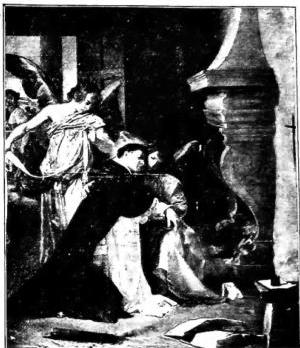
The originality of St. Thomas’s work therefore lies in the boldly accomplished project of directing the principles of Aristotelianism within the climate of Christian Revelation ("secundum quod est consequens ad positiones Aristotelis" — De subst. sep., c. 15; ed. De Maria, III, p. 255) and of reflecting on dogma in accordance with Aristotle’s sound naturalism ("secundum vera philosophiae principia quae consideravit Aristoteles" — De spir. cr., a. 3; ed. L. W. Keeler, p. 42, 14). Hence the frequent attribution to Thomism of an intellectualism that contrasts with the Augustinian school, whose voluntarist tendency affirms the primacy of the will over the intellect, the affective-practical character of theology, and places the essence of final beatitude in joy rather than in contemplation.
(photo Godiat)
TOMMASO D'AQUINO, santo - Temptation of St. Thomas Aquinas. Painting by D. Velázquez (17th c.), from the Convent of S. Domenico — Orihuela, Diocesan Museum.
Yet this accusation is unfounded. In reality, while in Thomism the first moment is entrusted to the object and thus to the intellect (the specification of powers and sciences according to their respective objects), the second moment is attributed to the subject, which perfects itself through its acts in the possession of the object. Theology is therefore certainly a speculative science, but virtually it is also practical; it treats of human acts, but only insofar as "through them man is ordered to the perfect knowledge of God" (Sum. Theol., 1ᵃ, q. 1, a. 4). Moreover, if faith is the beginning of salvation, the true principle of the entire supernatural organism, for St. Thomas, is sanctifying grace through charity (Sum. Theol., 2ᵃ-2ᵃᶜ, q. 23, a. 8; Utrum charitas sit forma virtutum). In this regard, it may be observed that St. Bonaventure — if we consider his principles — is in this point rather vague and less inclined to affirm the preeminence of charity, since he categorically states (following William of Auxerre) that the acts of faith, hope, and charity "are equal in the ratio of meriting when they are informed by grace. For charity alone is meritorious in its act to the same extent as faith in one and the same person" (In III Sent., dist. 25, dub. 4, ed. Quaracchi, p. 553; ed. minor 1941, p. 546 b).
Finally, while St. Thomas affirms the superiority of the intellect over the will (Sum. Theol., 1ᵃ, q. 82, a. 3) and declares that beatitude consists essentially in the contemplation of the divine essence (Sum. Theol., 1ᵃ-2ᵃᶜ, q. 3, a. 4), he nonetheless reserves for the will the delectatio, the fruitio, and the gaudium of happiness; and in the Lectura in Matthaeum he provides a formula that can eliminate all unnecessary disputes, precisely by appealing to Aristotle: "It should be noted that, according to the Philosopher, for contemplative acts to make one blessed, two things are required: one substantially, namely that it be an act of the highest intelligible; the other formally, namely love and delight" (Exp. super ev. Matth., c. V, lect. 1; ed. Parm. t. X, p. 49 b).
The sense of Aristotelian concreteness increasingly leads Thomist theology to value finite reality even within the economy of supernatural life. Whereas traditional theology conceived habitual sanctifying grace as identical to charity and as an extrinsic gift of divine liberality received in the soul, St. Thomas defines grace in the Summa Theologiae (1ᵃ-2ᵃᶜ, q. 110, a. 1) as a "participation" in the divine nature (2 Pt 1:4) and thus conceives it as the formal cause of justification, inhering in the essence of the soul as an intrinsic quality, that is, as an entitative "habitus" (ibid., ad 2). For the former, he uses the term "gratia actualis" (cf. Lectura in Ioan., c. IX, lect. 1, n. 5; ed. R. Cai, Torino 1952, p. 243 b; cf. E. Filthaut, op. cit., p. 136). Thus the ontological status of the supernatural order conforms to that of nature, so that grace no longer derives from a merely extrinsic accession but — in harmony with Aristotle’s doctrine of substance — through a form of intrinsic derivation "ex potentia oboedientiali," in which the soul, under God’s action, develops toward supernatural life: "And in this sense grace is also said to be created, because men are created according to it, that is, constituted in a new being from nothing, that is, not from merits, according to Phil 2:10" (Sum. Theol., 1ᵃ-2ᵃᶜ, q. 110, a. 2, ad 3). Consequently, even the sacramental character is defined as a quality inhering in the soul (Sum. Theol., 3ᵃ, q. 63, esp. aa. 1 and 4).
In St. Thomas, therefore, Aristotelian immanence and Platonic transcendence coexist in the right balance, whereas the Augustinian school was confined to a timorous extrinsicism that, beginning with Peter Lombard, was exacerbated in nominalist theology and reached catastrophe in Luther’s theory of extrinsic justification. Just as grace, of which it is the root, so too charity and all infused theological and moral virtues are operative qualities (“habitus”) inherent in the subject. The supernatural order, in its structure, cannot be inferior to the natural; and if natural activities proceed from the immanent sciences in the subject, the same must be admitted for supernatural acts—all the more so since “no virtue has such delight in its act as charity, nor any so delightfully.” Charity and all infused virtues are not reduced to transient motions of the Holy Spirit, but are realities present in the soul elevated to the supernatural order: just as the powers actualize the soul in the natural order, so too the infused virtues, founded on sanctifying grace, actualize it in the supernatural order (Sum. Theol., 2°-2°, q. 23, a. 2: Utrum caritas sit aliquod creatum in anima). The transcendental aspect must integrate, not suppress, the immanence of operative principles, for every finite perfection (life, wisdom, etc.) is a participation in the divine perfection which is such by essence… “et sic etiam caritas qua formaliter diligimus proximum est quaedam participatio divinae caritatis.”
The reality is that the Augustinian school interpreted formal causality in terms of efficient causality, whereas the problem must be posed in the reverse sense: “Hic modus loquendi consuetus est apud Platonicos, quorum doctrinis imbutus fuit Augustinus: quod quidam non advertentes ex verbis eius sumpserunt occasionem errandi” (ibid., ad 1). And just as St. Thomas expanded the Aristotelian metaphysics of substance for the essence of sanctifying grace, so too for the efficacy of the Sacraments he transcends the uncertainties of his earlier works, where he had defended the traditional doctrine of dispositio causality, and applies the metaphysics of the subordination of causes: God is the principal perfective cause, and the Sacrament is the instrumental perfective cause, i.e., the “separate instrument” that draws its efficacy from the “conjoined instrument” which is the Humanity of Christ (cf. Sum. Theol., 3°, q. 62, aa. 1–5). This new doctrine arose from the synthesis of Aristotle’s distinction between animate and inanimate instruments—between the slave and any lifeless tool “separate” from the agent (Polit., I, 4, 1254 a 15–17)—and the teaching of St. John Damascene, who regarded the Humanity of Christ as “an instrument of the Godhead” (ἐργάνον τῆς θεότητος: De Fide Orth., III, 19: PG 94, 1080 b; cf. c. 15, 1060 a).
Thus, while acknowledging the constant prestige that St. Augustine, especially in the theological field, exercises over St. Thomas, the more original developments of Thomistic theology—and in particular its Christology and the entire economy of salvation—depend on a more direct and profound knowledge of the Greek Fathers. The aforementioned doctrine of Damascene on the causality of the Humanity of Christ, St. Thomas finds already explicitly formulated in St. Cyril of Alexandria and in St. Athanasius himself, and he is the first to recognize the formula that appears in the Acts of the Third Ecumenical Council of Constantinople (680–81; Denz.-U., 291–92) with the authority of the two aforementioned Fathers; even the citation of St. Leo the Great in those Acts recurs twice in the Tertia Pars (q. 19, a. 1 and q. 43, a. 2). It must still be noted that St. Thomas is the first in the West to make use of those Acts for theological reflection (cf. Th. Tschipke, Die Menschheit Christi als Heilsorgan der Gottheit, unter bes. Berücksichtigung der Lehre des hl. Th. V. A., in Freib. Theol. Stud., Heft 55, Freiburg in Br. 1940, pp. 188 ff.).
It is precisely this rigorous distinction between the two orders that enables St. Thomas to affirm the absolute transcendence of the mysteries of faith, for which reason is absolutely powerless and can exercise only an extrinsic, propaedeutic, and apologetic function under the guidance of Revelation (cf. Sum. Theol., 1°, q. 32, a. 1). The saint therefore reproves the presumption of those who, following the old school, wished to adduce arguments to prove the mysteries and thus demonstrate their intrinsic rationality, for this would cause grave confusion and provoke the scorn of unbelievers (Sum. Theol., 1°, q. 46, a. 1). According to this criterion of theological sobriety—both for the existence of the mysteries of faith and for the exposition of their content, the choice of appropriate terms, and the correspondences that may obtain among the principal mysteries (Trinity, Incarnation, Eucharist)—the first and principal source is divine Revelation. St. Thomas rigorously applied this criterion with regard to the existence of the entire created supernatural order, that is, what has been called the “motive” of the Incarnation. To the more widespread approach of the Augustinian tradition (cf. Alexander of Alexandria, Sum. Theol., 3°, q. 2, membr. 13 and Albert the Great himself: In III Sent., dist. 20, a. 4)—which found its historical formulation with Duns Scotus—St. Thomas opposed the solid methodological criterion: “Ea quae ex sola Dei voluntate proveniunt, supra omne debitum creaturae, nobis innotescere non possunt nisi quatenus in Sacra Scriptura traduntur per quam divina voluntas nobis innotescit.” Now, in Scripture and in patristic tradition, the Incarnation of the Word is always presented as the merciful work of God to lift man from sin… “ita quod peccato non existente, incarnatio non fuisset,” even though divine omnipotence, absolutely speaking, could have decreed the Incarnation apart from sin (Sum. Theol., 3°, q. 7, a. 3). Regarding the orientation of patristic theology on this point and its relation to the Thomistic position, V. A. Spindeler, Cur Verbum caro factum? Das Motiv der Menschwerdung und das Verhältnis der Erlösung zur Menschwerdung Gottes in den christologischen Glaubenskämpfen des 4. und 5. Jahrhunderts, in Forschungen zur christlichen Dogmengeschichte; Bd. XVIII, 2, Paderborn 1938, pp. 28 ff. On the progress that the Summa Theologica represents in this and other points of theological material compared to the youthful Commentary on the Sentences, a direct influence was also exercised by the Commentary on the Sentences of Peter of Tarentaise (cf. H.-D. Simonin, Les écrits de Pierre de T., in Innocent V, P. de T., Rome 1943, pp. 145 ff.). The distinction between the two orders of nature and grace informs the inner articulation of Thomistic Christology: for example, the necessity that even the soul of Christ be elevated by habitual grace and endowed with virtues in their respective powers (Sum. Theol., 3°, q. 7, aa. 1–2), and the admission in Christ of an “experiential knowledge” acquired, in addition to the beatific and infused knowledge (ibid., q. 12, aa. 1–2).
V. TOMISM
4. Historical lines of development
The controversy aroused by the doctrinal innovations of Thomistic Aristotelianism, far from abating after the death of the Saint, intensified, and it was thought necessary to renew and broaden the condemnation of Averroism (already struck down in 1270, thanks especially to the definitive critique made by St. Thomas) by including some Thomistic theses. The condemnation was issued, again by Bishop Tempier, on 7 March 1277 (cf. Chart. Un. Paris., vol. I, no. 473, pp. 543-55) and comprised as many as 219 propositions, among which have been recognized as Thomistic those concerning the unity of the world (aa. 34, 77), the individuation of material and immaterial substances (aa. 27, 82, 96, 191), and the localization of separate substances (aa. 69, 218, 219). Codex E. 5532 of the Biblioteca Nazionale in Florence, ff. 128ʳ, 128ᵛ, also considers propositions 124, 129, 156, 163, 173, 187, 212, 218 as Thomistic (cf. J. Hofmans - A. Pelzer, Etud. sur les manusc. de Godefroid de Fontaines, in Les philos. Belges, XIV, Louvain 1937, p. 211, note).Yet it must be acknowledged that these condemned articles deal with rather secondary doctrinal points of Thomism, and the explicit formulation of the very thesis of the unity of the substantial form—at the heart of the public dispute in Paris in 1270 and the focus of the bitter controversies following the Saint’s death—is missing. This censure was lifted on 14 February 1325, after the canonization of the Saint, by the Bishop of Paris, Stephen Bourret, who on that occasion delivered a eulogy of St. Thomas (Chart. Un. Paris., II, no. 838, pp. 280 ff.). Upon hearing of the condemnation of 1277, St. Albert the Great, heedless of his advanced years, traveled to Paris to defend his great pupil (cf. the extensive and moving testimony of Bartholomew of Capua in the Processo di Canonizzazione di s. T., ed. M. H. Laurent, no. 82, in Fontes..., fasc. VI, pp. 382 ff.).
Immediately after the condemnation of 1277, however, the Roman Curia ordered the Bishop of Paris to suspend the effects of that condemnation and to conduct a precise inquiry into the authors of the individual propositions and their exact meaning (cf. the letter of John XXI to the Bishop of Paris, in A. Callebaud, J. Pecham et l'Augustinisme, Aperçus historiques [1263-85], in Arch. Franc. Hist., 18 [1925]). The Parisian condemnation had the effect of uniting the forces of the Dominican Order around the doctrine of St. Thomas, which was soon proclaimed the official doctrine of the Order. Already the General Chapter of Milan (June 1278) and that of Paris (June 1279: Chart. Univ. Paris, vol. I, no. 481, pp. 566 ff.) instructed provincials, visitors, and priors to punish severely (acriter) friars who dared to criticize the doctrine and writings of St. Thomas. As the controversy raged, first the General Chapter of Paris (June 1286) and then that of Saragossa in 1309 expressly ordered superiors to exert every effort to ensure that all teaching friars taught and at least defended the doctrine of St. Thomas and to chastise the recalcitrant in a salutary manner (the ordinance was applied, for example, at the Chapter of Arezzo of the Roman Province in 1315 against a certain Friar Uberto Guidi, who was removed from his chair and sentenced to ten days of bread and water; cf. M. H. Laurent, Fontes..., fasc. VI, pp. 663 ff.). The obligation to follow the doctrine of the Saint and to explain his text in the schools was proclaimed at the General Chapters of Metz (1313) with the official declaration: “Cum doctrina venerabilis doctoris fratris Thomae de Aquino sanior et communior reputetur et eam Ordo noster specialiter prosequi teneatur, inhibemus districte...”. The ordinance was repeated at the subsequent Chapters of London (1314) and expressly at Bologna (1315), with the added recommendation to gather all the works of the Saint at the Order’s studia generalia (Chart. Univ. Par., vol. II, no. 704, p. 166 and no. 717, pp. 173 ff.). Meanwhile in Paris, around this time, John of Naples, O.P., defended the question: Utrum licite possit doceri Parisius doctrina Sancti Thomae quantum ad omnes eius conclusiones, in which he examined the following articles of the 1277 condemnation: 79, 81, 124, 129, 156, 173, 187, 212, 218 (cf. the edition by C. Jellouschek, in Xenia Thom., vol. III, Rome 1925, p. 88 ff.).
The direct opposition to Thomistic doctrines was conducted especially by the Franciscan Order, stronghold of Augustinianism, under the pretext of the theological consequences feared from Thomistic Aristotelianism; it was thus a continuation of the polemic waged against the Saint, particularly in the last years of his life. The most active representative of this movement was the Englishman Friar John Pecham (q.v.), colleague and opponent of St. Thomas in Paris, later reader at the Roman Curia, and finally Archbishop of Oxford. To him is largely due the dispute held in Paris in 1270, in which, among other things, the Thomistic thesis of the unity of the substantial form was condemned in a special way; this thesis formed the core of this polemical direction, and Pecham even claimed to position himself as a defender of St. Thomas against his own brethren, asserting that “etiam a fratribus propriis argueretur acute” (Letter to the Bishop of Lincoln of 1 June 1285, in M. H. Laurent, Fontes..., fasc. VI, p. 643). In the Paris dispute of 1270, according to Friar Roger Marston, who was present, “...haec opinio — of the unity of the form — fuit excommunicata solemniter tamquam contraria Sanctorum assertionibus et doctrinae et praecipue Augustini et Anselmi” (QQ. Disp., ed. Bibl. Fr. M. E., VII, Quaracchi 1932, pp. 116 ff.). Yet even within the Dominican Order a line of defense of St. Thomas’s doctrines began to take shape, perhaps also under the stimulus and authority of St. Albert the Great, as in the case of Giles of Lessines (cf. M. De Wulf, Le De Unitate formae de Gilles de Lessines, in Les philos. Belges, I, Louvain 1902; cf. esp. p. 79 ff.). Giles’s work dates to 1278 and is directed against the Dominican Kilwardby of the old Augustinian school. After the condemnation of Averroism in 1270, Giles had promptly informed Albert the Great, who responded with the treatise De quindecim problematibus, the last two of which were proposed for condemnation but not condemned, and concerned Thomistic doctrines on the unity of the form in bodies and the simplicity of angels (cf. P. Mandonnet, Siger de Brabant, II, 2nd ed., Louvain 1911, p. 29 ff.; see also F. Van Steenberghen, Le «De quindecim problemat.» d’Albert le Grand, in Mél. A. Pelzer, Louvain 1947, p. 415 ff.).
Pecham made much of the fact that this thesis had been proscribed not only in Paris but also by his predecessor at Oxford, the Dominican Robert Kilwardby (q.v.), on 18 March 1277, immediately after the Paris condemnation (cf. Chart. Un. Par., I, pp. 588 ff.: propositions 15-30 In naturalibus, all concerning points of Thomistic metaphysics; esp. prop. 17: “Quod nulla potentia activa est in materia”; prop. 26: “Quod vegetativa, sensitiva et intellectiva sint forma simplex”; prop. 27: “Quod corpus vivum et mortuum est aequivoce corpus”, to be supplemented by propositions 28 and 30: “Intellectiva (forma) unitur materiae primae”). The condemnation caused quite a stir and is recalled even by Ockham (cf. the note by M. H. Laurent, Fontes, fasc. VI, pp. 617 ff.). For the historical development of the controversy, see D. A. Callus, The Condemnation of St. Thomas at Oxford, Westminster 1946, p. 11 ff. On Kilwardby’s anti-Thomism, see E. M. F. Sommer-Seckendorff, Studies in the Life of R. K., Rome 1937, esp. p. 159 ff.
The action and influence of Pecham did not, however, prevent a growing favour for the doctrines of St Thomas among the Franciscans. This alarmed the authorities of the Order, who took steps to counter it: for this purpose, Brother William de la Mare was commissioned to list and refute all the Thomist theses contrary to the doctrinal tradition of the Order, and thus was born the Correctorium fratris Thomae (between 1277 and 1279: Callebaud). The General Chapter of the Friars Minor at Strasbourg in 1282 ordered that the Summa Theologica of St Thomas might be read only by friars “notabiliter intelligentes” and with the obligation of accompanying it with the reading of the “declarations” of De la Mare (cf. P. Mandonnet, Siger de Brabant, I, 1st ed., Louvain 1898, p. 402). In all likelihood the Correctorium is the elaboration of a previous list of errors attributed by De la Mare to St Thomas, contained in Cod. 174 (ff. 552-58 v) of the Biblioteca Comunale of Assisi, subsequent to the Correctorium itself (cf. F. Pelster, Das Ur-Correct. W. de la Mare, Eine theol. Zensur zur Lehre des hl. Th., in Gregorianum, 38 [1947], pp. 220 ff.).
The Correctorium in substance merely codified the official teaching which the Order had accepted even in the time of St Bonaventure (A. Callebaud, art. cit., p. 467 ff.). The Dominicans called it the Corruptorium and refuted its arguments with a series of polemical writings, the principal ones of which bear the title Correctorium Corruptorii, indicated by their opening word. The first of these Correctoria seems to be the Quare, whose author is already indicated in 16th-century editions as Giles of Rome (recently the attribution has been disputed between two English Dominicans, Richard Knapwell and Thomas of Sutton: cf. F. Pelster, Thomas von Sutton u. das Correct. « Quare detraviati », in Mélanges Pelzer, Louvain 1947, pp. 441 ff.). It is the most complete and consists of 118 articles drawn from the principal works of St Thomas (Sum. Theol., 1a, 1a-1ae, 2a-2ae; Quodlibetal Questions, De ver., De an., De pot., Quaestiones disputatae and In I Sent.: many questions are repeated) and has the advantage of containing the text of De la Mare (P. Glorieux has prepared a critical edition in Bibl. Thom., IX, Le Saulchoir, Kain 1927). The Correctorium Circa is the work of the Dominican John of Paris and contains the first 60 articles up to Sum. Theol. 1a-2ae inclusive; its composition seems contemporary with the preceding, if not earlier, i.e. between 1282 and 1284, while P. Pelster places it around 1300, according to his editor J. P. Müller (Le Correct. corruptorii « Circa » de J. Quidort de Paris, in Stud. Anselm., XII-XIII, Rome 1941, cf. p. xxxiv ff.). Next, around 1290, comes the Correctorium “Quaestione” (unpublished) of Merton College Cod. 167, which seems attributable to William of Macklefield or to Hugh of Billom. The authorship of the Correctorium “Sciendum”, also unpublished, is disputed between Robert of Collotorto and Robert of Oxford: but the claim is also made by Durandellus and John of Parma on behalf of Robert of Collotorto (P. Bayerschmidt, R. V. Collotorto Verfasser des Correctoriums « Sciendum »?, in Divus Thomas [Freiburg, 17 (1939)], pp. 311 ff.).
Before 1300, between 1286-87, Rambert of Primadizzi of Bologna, a Dominican, produced the Apologeticum veritatis contra Corruptorium, which deserves credit for broadening the field of discussion to include other opponents of St Thomas, such as the Franciscans Matthew of Aquasparta and Richard of Middleton, and especially Henry of Ghent and Giles of Rome himself. The date of composition is fixed (this time in agreement with P. Pelster) by the editor J. P. Müller in 1299 (cf. Studi e testi, Vatican City 1943, p. xxvi); it comprises only 16 questions, all referring to the Summa Theologica, and follows step by step the text of De la Mare.
The names of Henry of Ghent and Giles of Rome (q.v.) recall the tangled and most consequential phase of the early anti-Thomist controversy. As regards Giles of Rome, whom tradition had regarded as a faithful Thomist, study of the manuscripts has shown that especially in theological matters he often appears among the opponents (cf. G. Bruni, Egidio Rom. e la sua polem. antitom., in Riv. di fil. neosc., 26 [1934], pp. 239-51; see p. 245 the list “Egidius contra Thomen” in Cod. Vat. lat. 772, which contains as many as 73 points of divergence with regard only to Book I of the Sentences). Bruni has edited from the same codex the Impugnationes contra Fratrem Egidium contradicentem Thome super primum Sententiarum of a fervent Dominican whose identity has not yet been established (in Bibl. Augustin. M. Aevi, Vatican City 1942). In the controversy with Henry of Ghent, however, Giles defends the Thomist thesis of the real distinction between essence and act of being, but with personal arguments and introducing the terminology of esse essentiae and esse existentiae, of esse generis and esse speciei, which reveals an ontological realism foreign to St Thomas and which took a decisive first step down the inclined plane of formalist realism: this led to the “reification” of the principles of being, confusing ideas and not a few Thomists on the important question, down to Suárez, and which persists through his work to our own day (cf. E. Hocedez, Aegidii Rom. Theorem. de esse et essent., Introd., Louvain 1930, p. [116 ff.]). This “bending” of Thomist realism in Giles derives from his personal doctrine of participation.
The main bulwark of opposition, against which for almost twenty years Giles and most Thomists had to contend, was none other than Henry of Ghent (q.v.), a leading and highly influential figure at Paris: thrust and counter-thrust in the controversy over the distinction between essence and existence of the two masters followed one another unceasingly, dominating the intellectual life of the end of the 13th century and relegating other points of contention to the background.
versus
Enrico di fronte alla distinzione puramente logica di concreto e astratto e a quella reale massiccia di Egidio che finiva nel concepire l'essentia e l'esse come « res et res », come « duae res », escogitò la via intermedia della « distinctio secundum intentionem » in quanto lo « esse existentiae » della creatura non può essere concepito dall'intelletto se non come dipendente da Dio e quindi « essentia » ed « esse » non sono « duae res » ma « duo respectus »; la « essentia » si rapporta a Dio come a causa esemplare e lo « esse » a Dio come a prima causa efficiente e perciò l'esistenza e l'essenza si distinguono non perché facciano composizione reale ma soltanto perché indicano un diverso rapporto di dipendenza da Dio, cioè secondo il nostro modo d'intendere (J. Paulus, H. de Gand, Essai sur les tendances de so métaph., Parigi 1938, spec. pp. 278-91). La soluzione ha il suo immediato riflesso non solo nella determinazione metafisica del concetto di « creatura » dentro i confini della filosofia cristiana, ma anche nell'ardua teologia dell'unione ipostatica in Cristo. In merito alla questione polemica: Utrum sit duplex vel unum esse in Christo, Enrico combatté direttamente la posizione tomista che afferma in Cristo un « duplex esse naturae » e un unico « esse subsistentiae » e dalla sua critica hanno avuto origine le varie posizioni antitomiste in questo punto (Scoto, Tifano, Suárez...) fino ai nostri giorni. Enrico attribuisce un « esse actualis existentiae » anche alla natura umana di Cristo - mentre nega in Cristo, persona divina, uno « esse absolutum subsistentiae » poiché la Persona divina è costituita dallo « esse ad aliquid » (cf. lo studio fondamentale di P. Bayerschmidt, Die Seins- u. Formenmetaph. des H. V. Gent in ihrer Anwendung auf die Christol., in Beitr. Baeumkers, XXVI, 3-4, Münster in V. 1941, p. 81). Nega ogni composizione reale di essenza ed « esse », in un modo ancor più radicale di Enrico, il contemporaneo maestro secolare Goffredo di Fontaines, anch'egli legato alla terminologia egidiana di « esse essentiae » e « esse existentiae », mentre difende con energia la tesi tomista della potenzialità pura della materia, protestando contro i denigratori di s. T.: « Aliqui doctrinam non modico fructuosam cuiusdam doctoris famosi, cuius memoria cum laudibus esse debet, ut in pluribus impugnantes, vel deinde contra dicta sua procedentes, ad diffamationem personae pariter et doctrinae opprobria magis quam rationes inducere consueverunt » (M. De Wulf- A. Pelzer, Les quatre premiers Quodl. de G. de F., Quodl. I, a. 4, in Les Philos. Belges. II, Lovanio 1904, p. 7).
Nell'Ordine domenicano, dopo i pronunciamenti ufficiali a favore del tomismo, la lotta contro le innovazioni tomiste si riduce a iniziative tosto represse dall'autorità. Dopo l'episodio del Kilwardby, il caso più clamoroso è quello di Durando de S. Pourcain. Le ricerche di J. Koch hanno sfatato la leggenda, giunta fino a noi, di una primitiva adesione di Durando al tomismo e dimostrato ch'egli, insieme col suo maestro Giacomo di Metz, si collega alla vecchia scuola agostiniana dell'Ordine, ostile all'accettazione dell'aristotelismo e vicina, ad es., nella teoria dei « modi », a Enrico di Gand (J. Koch, Jakob von Metz O. P., der Lehrer des Durandus a s. Porciano, O. P., in Arch. d'hist. doctr. et litt. du m. d., 4-5 [1929-30], spec. p. 192 sgg.). Questa direzione conservatrice secessionista fu repressa con energia dalle autorità dell'Ordine. L'anima di questa difesa contro tutto l'indirizzo di Enrico di Gand, Giacomo Erveo (v.) Natale: il primo fu attaccato a fondo nei Quodlibeta (ed. veneta di M. A. Zimara 1513) il secondo nel Correctorium Frat. Jacobi Metensis (cf. J. Koch, art. cit., p. 194 sgg.); il terzo specialmente nel Quodl. II, del 1308, qq. 3, 7 e 8; quodl. IV del 1310, qq. 4 e 14, con altre dissertazioni speciali e un complesso di scritti polemici ritrovati e studiati dal Koch: Reprobationes excusationum Durandi del 1314, Correct. super dicta Durandi del 1315, De artic. pertinent. ad IV ll. Sent. Durandi del 1314-15 e le Evidentiae cont. Durandum super ll. IV Sent.; è sua, e sembra scritta non più tardi del 1307, la Def. doctr. s. Th. (cf. J. Koch, Durandus de s. Porc., Forschungen zum Streit um Th. V. A. zu Beginn des 14. Jahrh., I, Beitr. Boeumhers, XXVI, 1, Münster in V. 1927, spec. p. 211 sgg.). Altri tomisti individuati dal Koch, che hanno polemizzato contro Durando, sono: Pietro di Palude, Giacomo di Losanna, Giovanni di Napoli, ch'è il principe dei difensori di s. T. in tutta questa tempesta, Bernardo Lombardo e l'ignoto ma forte tomista Durandello. L'Ordine di sua autorità pubblicò una prima lista di 191 errori del Commento alle Sentenze di Durando il 3 luglio 1314, raccolti da P. di Palude e G. di Napoli cui Durando rispose con le « Excusaciones »; seguì presto una seconda lista di ben 235 articoli nei quali Durando si allontana da s. T. e va collocata tra il 1316-17, e Durando fu messo fuori della tradizione dottrinale dell'Ordine.
In questa polemica si affaccia la figura di Scoto, da cui direttamente dipende Occam che ha attaccato ad armi scoperte i fondamenti del tomismo sia in filosofia come in teologia (cf. Fr. Hoffmann, Die erste Kritik des Ockhaismus durch den Oxford. Kanzler J. Lutterell, Breslavia 1941, p. 14 sgg., 23 sgg., 75 sgg., passim); ma sembra che dallo stesso Scoto, certamente per la teologia sacramentaria, dipenda anche Durando (cf. J. Koch, Die Verteidigung der Theol. des hl. Th. V. A. durch den Dominikanerord. gegen. Durandus de s. Porc. O. P., in Xen. Thom., III, Roma 1925, p. 251). D'altronde le ricerche del P. Balic per l'edizione critica di Scoto hanno accertato che la fonte principale da cui questo dipende è Enrico di Gand, ossia il corifeo dell'antitomismo medievale, che resta il punto di riferimento principale per la maggior parte delle dottrine filosofiche e teologiche con le quali la rinnovata scuola agostiniana fu tentato con energia, non senza notevoli successi, di arginare l'affermarsi del tomismo (cf. I. D. Scoto, Op. Omnia... ad fidem Cod. ed., Roma 1950, t. I, spec. p. 1667 sgg.). In tale cumulto di polemiche del primo mezzo secolo dopo la morte di s. T. si è venuta formando e cristallizzando quella tradizione dottrinale che ha preso il nome di « tomismo ».
Per un giudizio critico sulla formazione storica del tomismo, va rilevato il fatto che fra gli stessi primi discepoli di s. T. e i primi fautori del tomismo si notano oscillazioni non lievi: valga come esempio la posizione di uno scolaro di s. T., il maestro secolare Pietro di Avernia, che mette nella forma il principio d'individuazione e da cui dipendono Giacomo di Metz e Durando (cf. J. Koch, Jakob V. Metz..., op. cit., p. 211 sgg.). Lo stesso paladino del tomismo e generale dell'Ordine, Erveo Natale, non assimila le dottrine tomiste che gradualmente e nega quel capossaldo della metafisica tomista ch'è la distinzione reale fra essenza ed atto di essere; essa è negata anche da Bernardo Lombardi O. P. Per Bernardo de Trilia (m. nel 1292) che ha fama di fedele tomista, la distinzione reale è « positio probabilit » (cf. G. André, Les Quodl. de B. Trilia, in Gregorianum, 2 [1921], p. 252). Oscillazioni analoghe si sono riscontrate anche in varie dottrine sia filosofiche come teologiche (per quelle, ad es., riguardanti la metafisica della relazione, V. A. Krempel, La Doctr. de la relation chez st Th., Parigi 1952, p. 20 sgg. e passim, che parla di una « demi fidelité des premiers adeptes »).
The ripest fruit of the first century of Thomist controversies is the work of Capreolus (d. 1444, q.v.), the “Princeps thomistarum”: his Defensiones theol. Divisi Th. Ap. (new ed. by Paban-Pègues, Tours 1900 ff.) provide an exact panorama of the School’s situation in the fifteenth century, after the struggle that Thomism had waged and continued to wage against its principal adversaries, and contain all the key theses of the School. Capreolus himself follows mainly the work of Durandellus, and the main line of Thomism established by him continues into the sixteenth century with the Hungarian Peter Niger (d. 1492) and the Italians Paul Soncinas (d. 1494), Chrysostom Javelli (d. c. 1534), and Peter of Bergamo, author of the Tabula aurea, which is the first “index thomisticus.” Francesco Silvestri of Ferrara (q.v.), commentator on the Summa contra Gentiles, is equal to Capreolus in fidelity to St Thomas but often surpasses him in synthetic and speculative vigour. These outstanding figures were almost eclipsed by the overpowering authority of Cajetan, which was reinforced by the fluid systematic approach of the Spanish followers such as Domingo Báñez (q.v.) and John of St Thomas (q.v.), among whom the formalistic and excessively systematic tendency often supplanted the original sobriety of the Thomist text adhered to by the older school.
Such oscillations were almost inevitable when one considers, first, the predominantly polemical formation of Thomism; second, the fact that until the end of the fifteenth century the official textbook for teaching, even among Dominicans, was the Book of Sentences of Peter Lombard, and only in the sixteenth century, thanks to the Belgian Peter Crockaert, master of Francisco de Vitoria (q.v.), was the Summa Theologica introduced as a school text; and, third, the lack of study of sources and critical method, so that not a few Thomists relied on spurious pamphlets, preferring them to authentic texts. It is therefore not surprising that in the fourteenth to sixteenth centuries, when it came to defending the real distinction between essence and act of being, Thomists often resorted to the terms and arguments of Giles of Rome more than to those of St Thomas himself (thus even John of St Thomas makes extensive use of the spurious Summa totius logicae, which contains the formula that has unsettled, not entirely without reason, the opponents of the real distinction and has shaken those Dominicans who likewise denied it, beginning with Hervé Nédellec down to Fr. A. Lepidi (d. 1921): “In creaturis esse essentiae et esse actualis existentiae differunt realiter ut duae diversae res” [In creatures, the being of essence and the being of actual existence differ really as two diverse things]; ed. De Maria, vol. I, p. 23). Another explicit example is found in the Quodlibeta of Alverius O.P. (still unidentified) in a miscellaneous codex of the Biblioteca Antoniana in Padua from the fourteenth century (Shelf XIII, no. 295): in Quodlibet XIX, “Utrum esse et essentia differant realiter” (fol. 19 vb), the three well-known opinions are proposed as if canonized, and the author forthwith declares himself for the third (“probabiliter”), which defends—like Henry of Ghent and later Suárez—the distinction merely in modes of signifying and rejects the arguments for the real distinction, including that of participation (ibid., ad tertium, v.b.).
The unease created within the Thomist school on this point is reflected even in the position of Domingo Báñez (q.v.), who knows and expounds the three opinions that had been debated for three centuries and for each indicates a Dominican representative (1). In the first, among the deniers of the real distinction, forgetting the principal ones—namely the Averroists, who would have shown him by contrast the true position of St Thomas—he places at the head of the deniers Hervé Nédellec, followed by nominalists of every stripe. The second opinion (that later adopted by Suárez), which defends the intermediate distinction (“secundum intentionem”) of Henry of Ghent “ex natura rei,” has as its champions Scotus and Alexander of Hales or rather the general Franciscan A. Bonini of Alessandria (cf. C. Fabro, Una fonte antitom. della metaf. suarez., in Divus Thomas Plac., 30 [1947], pp. 57-68), together with Nifo and the Dominican Domingo Soto. The third opinion holds that essence is distinct from “esse” as thing from thing, so that not only is the proposition “essentia est esse” false in formal sense (as in the second opinion), but also “essentia est res quae est esse” (Domingo Báñez, Schol. Comment. in Primam Partem..., q. 3, a. 4; ed. Lyon 1588, col. 140). Supporters cited for this position are Capreolus, Cajetan, Soncinas, and Javelli. Yet Báñez seems to move with difficulty: the opinion attributed to St Thomas is judged “multo probabilior et ad rem theologicam magis accomodata,” and Báñez himself accepts II. But—here lies the crux of the problem we are addressing—Báñez also deems probable the opinion of Scotus (and of Soto), namely that of the principal adversary of St Thomas, Henry of Ghent: “Sententia tamen Scoti et magistri Soto potest probabiliter sustineri et argumenta quae contra illam fient ab assertoribus tertiae sententiae (i.e. the Thomist one, mind you!) poterunt hoc exemplo dissolvi”... (ibid., col. 141). A similar attitude had been taken a century earlier by Peter Niger, an outstanding Thomist, regarding the position of Hervé, according to whom “esse essentiae et esse existentiae differunt secundum diversos modos significandi per modum verbi et per modum nominis significatorum.” And he concluded: “Opinio doctoris huius nolo impugnare quia satis rationabilis videtur et in nullo videtur dictis Sanctorum et philosophorum contraria sed consonaque rationi.”