
OMILIARIO. — From homiliarius, homiliarius liber doctorum, it originally and properly denoted a collection of discourses by the holy Fathers on the Gospels for the use of concionatores: a preaching handbook (in the sense and for the purpose in which, in 1903, Cardinal G. Vives published the Homiliarius Breviarii Romani... in usum concionatorum et scholarum sacrae eloquentiae). Sermonary, on the other hand, was a repertory of patristic treatises or commentaries on the psalms or on other books of Sacred Scripture, intended to serve as reading in the Divine Office. These terms, however, neither had nor have an absolute meaning; to o., once its original meaning had been abandoned, was attached that of sermonary: « Omeliae sive tractatus beatorum Ambrosii, Augustini, Hieronymi, Fulgentii, Leonis, Maximi, Gregorii et aliorum catholicorum et venerabilium patrum legendae per totum anni circulum », as is read in a manuscript from Montpellier of the ninth century. The title of o. is generally very prolix. The title is followed by the list of the capitula, that is, the index of subjects. The division of o. into two volumes is the most common: the first contains the homiliae from the first Sunday of Advent or from Christmas to Holy Saturday, the second from Easter to the end of the year.
At the beginning, in the Office of Vigils, readings other than Sacred Scripture were rarely admitted (the Acta Martyrum on their anniversary are an exception). The New Testament, especially the Pauline epistles, had the
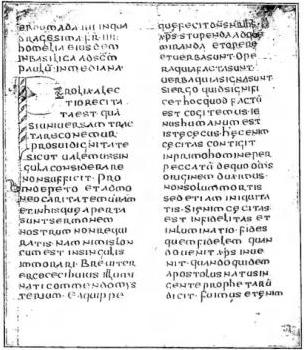
OMILIARIO - O. written by “Agimandus presbyter basilicae SS. Apostolorum Philippi et Jacobi” (Rome); homily of St. Augustine on Joan. Evang. Tract., 44: PL 35, 1713 - Vatican Library, cod. Vat. lat. 3836, f. 299 (beginning of the 8th century).
preference. In the long run, to avoid repetition, the reading of the commentaries of the holy Fathers was added. An o. was compiled by the Arian bishop Maximinus (5th century; cf. B. Capelle, Un homiliaire de l'évêque arien Maximin, in Revue bénédictive, 34 [1922], pp. 81-108): but this is a collection intended for paraenetic use. St. Benedict (d. 543) prescribes in the Regula (chap. IX): “Legantur... expositiones earum quae a nominatis doctorum orthodoxis catholicis patribus factae sunt”. If the text refers to a collection in its own right, this would constitute here (at the beginning of the 6th century) the first mention of an o. Cassiodorus (d. 570) gives the same direction (De instit. divin. litt., I, praef.), as does St. Gregory the Great (d. 604; Epist., XII, 24: PL 77, 1234); and it is well known that his forty homilies on the Gospels spread everywhere for public reading in the churches. With the growing interest in the liturgy in the 8th-9th centuries and the codification of the liturgical books, these collections multiplied. The more important churches, such as the Roman basilicas, had their own o. They were compiled by the Roman priest Agimundus (d. 730) for the basilica of SS. Philip and James (today SS. XII Apostoli), by St. Bede the Venerable (d. 735), and by Alcuin (d. 804: G. Morin, L'homiliaire d'Alcuin retrouvé, in Rev. bénéd. 9 [1892], pp. 491-97). Secular churches, too, were supplied with them (v. the so-called Ordo of Giovanni archicantor, which in reality is a reuse of the Capitulare ecclesiasticae [!] ordinis of the 8th century, in M. Andrieu, Les Ordines Romani du haut moyen âge, III, Les textes, Louvain 1951, p. 177).
Two o. are of particular interest: that which Paolo Diacono (d. in 797?) composed at the request of, and with a preface by, Charlemagne (PL 95, 1159-1566; cf. F. Wiegand, Das Homilianium Karls des Grossen auf seine ursprüngliche Gestalt untersucht, Leipzig 1897), extremely widespread in the Middle Ages and remaining in use until the Council of Trent, the principal source of the present o.; and the group of o. that arose at the basilica of St. Peter in the Vatican, recently studied by Fr. G. Löw. According to him, at St. Peter’s, in the 9th century, a copy was made of a sermon collection of an archaic and purely Roman character, preserved in cod. Basil. C 105 and subsequently copied several times (cod. Basil. C 107 [12th century], C 106 [14th century], archive of St. Peter), remaining in use until the
16th century. This o. is identical with that attributed to Alano di Farfa (d. 770), written around the year 760 and widely circulated as early as the 8th century in southern Germany, and with the other by Eginone da Verona (d. 802), written around the year 800 and in use at the Swabian abbey of Reichenau-Niederzell. In reality, all three of these sermon collections (the Basil. C 103, Alano, and Egino) would be copies of a single ancient and authentic Sermon Collection of St. Peter from the 6th century. With the insertion of the lessons into the body of the Breviarium, the o. lost their practical importance and disappeared from use. The patristic lessons are read in the Second Nocturn (sermones) and the Third (homiliae) of the Divine Office; the writings of the greatest Fathers and Doctors of the Church, Latin and Greek, are used for this purpose. Among the Latins, first place goes to St. Augustine, with 363 lessons, taken principally from the Sermones and the Tractatus in Evangelium secundum Joannem. He is followed by St. Gregory the Great (220 lessons), St. Ambrose (180), St. Jerome (130), St. Leo the Great (75), St. Bede (57), St. Bernard (47), St. Hilary (36), and St. Cyprian (15). St. Bonaventure, St. Thomas Aquinas, St. Bernardino da Siena, St. Francis de Sales, St. Robert Bellarmine, and St. Peter Canisius are also represented. Among the Greek Fathers, the place of honor is held by St. John Chrysostom, with 117 lessons, followed by St. Athanasius, St. Basil, St. Cyril of Jerusalem, St. Cyril of Alexandria, St. Gregory Nazianzen, and St. Ephrem. The authorship of the lessons is not always certain; the painstaking work of the revisers under St. Pius V and Urban VIII (especially Bartolomeo Gavanti, 1638) dealt with the matter repeatedly and, considering the period and the scholarly means available, successfully, though without managing either to restore every lesson to its true author or to remove all the apocryphal lessons, of which the Breviary still contains a considerable number (v. list in G. Morin, Critique des sermons et homélies apocryphes du Bréviaire romain, in Anecdota Maredsolana, I, 1913, pp. 487-501, republished by Bäumer [V. BIBLICA.], II, pp. 452-60 and by the
(from Ephemerides liturgicae, 1917, p. 311)
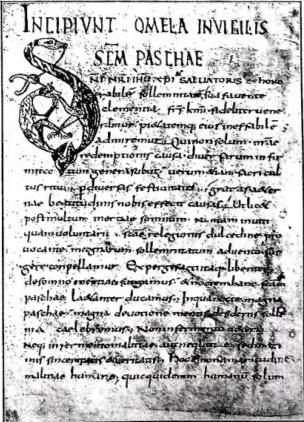
OMILIARIO - Sermonario di Alano di Farfa: omelia per la vigilia di Pasqua - Monaco di Baviera, Biblioteca, ms. Clm. 14368 (cod. Emmeran. D 93 del sec. IX).
Righetti [V. BIBLICA.], II, pp. 537-39). Dal tempo di Pio IX per i sermones è invalso l'uso di servirsi anche di testi ufficiali pontifici. Quanto alla lunghezza delle pericopi nella revisione di Pio V si tenne la misura delle lezioni del Breviario della Curia (secc. XIV-XV), ma in seguito ci fu la tendenza ad una certa prolissità.