
ORDINES ROMANI. —
I. NOTION
The O. R. are “libelli” compiled between the eighth and fourteenth centuries, containingthe description and rules for the conduct of the principal sacred ceremonies: Baptism, Mass, ordinations, the dedication of Churches, the Offices of Holy Week, and the principal feasts of the liturgical year.
The earliest liturgical books contained only the texts to be read or sung during the performance of the rites. References to the ceremonies to be carried out were extremely rare. At the beginning, in fact, these must have been very simple and spontaneous, dictated and guided by practice. But as the external forms of worship developed and became more elaborate, especially in the majesty of the Roman basilicas, where in the Middle Ages the Domnus apostolicus habitually officiated, and as the Roman rite subsequently spread throughout the West under the impetus of Charlemagne, the need was felt to codify what oral instruction and custom had until then regulated. Thus, through private initiative, the O. arose: manuals of ceremonies, written in popular Latin and in the jargon of the master of ceremonies, which set out the essential outlines of the rite. These booklets, regarded as almost official, were subsequently adopted and then adapted for episcopal ceremonies and for settings outside Rome. They are of capital importance both for the history of the liturgy and for sacramental theology. Suffice it to say that they form the basis of the Pontificale romanum, the Caeremoniale episcoporum, the Rituale, and, in general, the various rubrics of the other liturgical books of the Latin Church.
II. STUDIES
The primitive O. R. were limited to the description of the ceremonies (rubrics), excluding the formulas. When rubrics and formulas were merged in the same book, the liturgical books as we now have them came into being, and the O. R. ceased to serve their function. They came to light again, but as an object of study, in the second half of the sixteenth century through the work of G. Cassander (Ordo Romanus de officio Missae, Colonia 1561) and M. Hittorp (De divinis catholicae Ecclesiae officiis..., there 1568). A century later G. Mabillon brought together a collection of 15 O. R., extending from the ninth to the fifteenth century (cf. Museum Italicum, II, Paris 1689). It is the most important collection and remained the standard one until the present day (reproduced in PL 78, 851–1408). The designation O. R., still in use today, is also Mabillon’s, although improper, since most of the O. R. have non-Roman origins. In the first half of the eighteenth century F. Bianchini published a Veronese group of O. R. from the Carolingian period (cf. Liber Pontif. Anastasii bibliothecarii de vitis Roman. Pontif., III, Rome 1728, prolegomena). E. Martène and L. A. Muratori reproduced Mabillon’s edition, each adding an old monastic O. R. New and important texts, discovered in Switzerland and Austria, were made known by M. Gerbert in Monumenta veteris liturgiae alamannicae, I–II, Sankt Blasien 1777–79. In the last century G. B. de Rossi published a fragment of an O. R. in the Inscriptiones Christianae, II, I, Rome 1888, p. 349, subsequently reproduced by L. Duchesne in an appendix to the Origines du culte chrétien, 5th ed. (Paris 1909), together with two other O. R. of the ninth century, previously unknown. Finally, in 1916 L. Fischer printed the twelfth-century O. Lateranensis in Munich; and C. Silva-Tarouca published the O. R. of Giovanni, “archicantor” of S. Pietro, in the Memorie della Pont. accad. rom. di archeol., Rome 1923. More recently, a veritable Corpus of the O. R., in a critical edition and with extensive introductions, was undertaken by M. Andrieu (cited in the bibliography). To date, 3 volumes have been published, of which the first contains the list and description of the manuscripts (107, distributed among 36 libraries); the second, O. R. I–XIII; and the third, O. R. XIV–XXXIV. A fourth volume, containing the remaining O. R. and the general indexes, will follow. By “early Middle Ages,” Andrieu understands the period extending from the beginning of the seventh century through the whole of the tenth. Within the limits of these four centuries, he grouped and examined a body of more than 40 O. R., some of them in double recension and therefore numbered from I to L; this numbering will henceforth replace Mabillon’s numbering from I to XV. I remains Mabillon’s Ordo primus, and L Hittorp’s Ordo romanus antiquus, a point of transition between the O. R. and the Pontificals. Here is the concordance between Mabillon’s collection and Andrieu’s Corpus:| Mabillon | Andrieu | |
|---|---|---|
| Ordo I | §§ 1–21 | = I |
| " | § 22 | = II |
| " | §§ 23–26 | = XXII |
| I App., | §§ 27–47 | = XXVIII |
| " | §§ 48–51 | = III |
| Ordo II | = V | |
| " | III | = VI |
| " | IV | = VII |
| " | V §§ 1–2 | = VIII |
| " | § 3 | = IX |
| Ordo VI | = X | |
| " | VII | = XI |
| " | VIII | = XXXIV |
| " | IX §§ 1–6 | = XXXVI |
| " | §§ 7–9 | = XXXVII |
| " | X | = |
| " | XI | = |
| " | XII §§ 88–91 | = XLV |
| " | XIII | = |
| " | XIV | = |
| " | XV | = |
Other O. R.:
| Ordo of S. Amando | |
|---|---|
| (Duchesne, Orig., 475) | IV |
| Ordo of Giovanni “archicantor” | |
| (Silva-Tarouca, 194) | XV |
| Ordo in Purific. BMV | |
| (Duchesne, Orig., 499) | XX |
| Ordo letaniae majoris | |
| (Duchesne, Orig., 493) | XXI |
| Ordo of Einsiedeln | |
| (De Rossi, Inscr., II, 1, 34) | XXIII |
| Ordo rom. antiquus | |
| (Ordo vulgatus of Hittorp) | L |
Furthermore, Andrieu, who does not follow the chronological order but the systematic one, grouped the O. R. as follows:
| Ordo | I–X = Masses of the Pope or of the bishops. |
|---|---|
| XI = Baptism. | |
| XII–XIV = Chants and readings. | |
| XV–XIX = Monastic ordinances. | |
| XX–XXXIII = Services of the liturgical year. | |
| XXXIV–XL = Ordinations. | |
| XLI–XLIV = Dedication of churches. | |
| XLV–XLVIII = Coronation of emperors. | |
| XLIX = In obsequium defunctorum. | |
| L = Ordo romanus antiquus. |
III. FORMATION
Largely Roman in origin, the O. found in Gaul a setting suited to their development. At the beginning of the ninth century, in fact, the triumph of the Roman liturgy beyond the Alps was an accomplished fact. The Roman Sacramentaries had replaced the pre-existing Gallican books and, in most cases, had fused with them. But the Sacramentaries contained only formulae, prayers, blessings, and consecrations. To perform solemn functions according to the Roman rite, it was also necessary to have a detailed description of the new ceremonies, precisely those contained in the O., the necessary complement to the Sacramentaries. The O. therefore also penetrated Gaul, adapting themselves to the local environment and customs, while preserving clear traces of their Roman origin. Following the branching of the manuscripts, two collections of O. can be identified: 1) Collection A, the oldest (eighth century), composed of purely Roman elements and represented by cod. 412 of the Faculty of Medicine of Montpellier. 2) Collection B (ninth century), composed of Gallicanized Roman elements; it reveals a kind of compromise between Roman usage and indigenous Frankish customs (cf. Andrieu, I, pp. 467–76). The first collection,originally, had the eminently practical purpose of a booklet intended for church use, as a directory for the accurate performance of the functions. But the booklet was too incomplete and too Roman to be adopted as it stood by a master of ceremonies in Gaul, and it eventually became a library codex. The second collection, on the other hand, was more convenient for the Frankish churches, especially because of the Ritual of ordinations. It therefore achieved wide circulation: with the addition of a few other rites, it soon became a genuine manual of episcopal ceremonies. Under the impetus of the Carolingian ecclesiastical reforms, other writings of a theological-juridical nature were added to Collection B, giving rise to liturgical-theological summaries intended for the instruction of the clergy. These didactic collections (represented by cod. Can. C 102 of Zurich) multiplied almost everywhere, especially in German territory, in the Reichenau–St. Gall region. Finally, there are other, older collections of O., which are not easy to reconstruct, but whose highly important traces have found their way into compilations contemporary with the preceding collections.
With all these materials, a considerable portion of them, as has been said, of Roman origin, a monk from Mainz, in the second half of the tenth century, composed a hybrid book of ceremonies and text for the use of bishops, today called (after Andrieu) the Romano-Germanic Pontifical, a designation that aptly indicates its composite nature, its elements, and their reworking with additions in Germany. The importance of the compilation lies in the fact that it has preserved for us so many elements of the Roman liturgy that would otherwise have been lost. Reworked several times, it formed the principal nucleus of the Roman Pontifical of the thirteenth century, after the Pontifical of Durandus of Mende (d. 1296), which, abridged and reworked, became our Pontificale Romanum.
IV. CONTENT
The Ordines edited by Mabillon present the following particular features: Ordo Romanus I: this is the oldest (early eighth century) and is composed of various layers. The later introduction (cols. 1–3) provides some brief information on the organization of the Roman clergy and the rotation followed in the stational Masses. The first part (nos. 4–21) contains a description of the papal stational Mass; the second (nos. 22–51), which, according to Andrieu, has nothing to do with Ordo I, describes the liturgy of Lent and of the four final days of Holy Week. This part dates from the ninth century. Ordo I is the most important and the most extensively studied. Mabillon (reproduced in PL, 78) used cod. A (Sangall. 140, ninth–tenth century); H. Grisar (Analecta Romana, I, Roma 1889, pp. 217–20) used a very defective codex (ms. S = Sessorianus 52) of the National Library of Rome; Riccardo Stapper reproduced ms. W (= Wolfenbüttel 4175, ninth century; coll. Opuscola et textus, Münster in V. 1933). Ordo II is an adaptation of the rites of the pontifical Mass described in Ordo I, for a church outside Rome. The oldest manuscripts date from the ninth century, but reflect the situation of the preceding century. Ordo III, too, is a reworking of Ordo I, carried out in Germany in the tenth century. It likewise contains the papal Mass, which is also found in the later Ordo IV, a simple fragment reproducing the Gregorian Canon of the Mass from the Quam oblationem to the end. Ordo V, deriving from a codex of S. Gallen of the tenth century, lists the liturgical vestments of the Roman clergy and describes the episcopal Mass. The list of vestments according to G. Braun (Die liturgische Behandlung, Friburgo in Br. 1907, p. 6) is older and may be regarded as dating from the ninth century. Ordo VI, too, contains a description of an episcopal Mass. It was composed in Germany in the middle of the ninth century. Ordo VII, known from several manuscripts of the ninth century, establishes the order of the scrutinies and the rite of Baptism and Confirmation. Ordo VIII derives from the Vatican codex Palat. lat. 487 of the ninth century and reports the ancient Roman ritual of ordinations. Andrieu found a development of this Ordo in a manuscript of the British Museum (Add. 15222; ninth–tenth centuries), with a description of the minor Orders. The rite of ordinations is found again in Ordo IX; Ordo X, extracted from the Pontificale della Curia of the thirteenth century, in its first part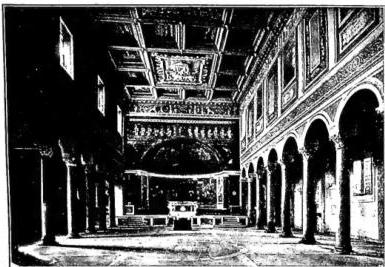
Outside the Mabillonian series, but partly now included in Andrieu’s Corpus, are the following O.: the Ordo of Giovanni “archicantor,” published from cod. Sangall. 349. Fr. C. Silva-Tarouca considered it to date from the end of the seventh century and thus to be the oldest O., making its author Giovanni of S. Martino, primicerius of S. Pietro, who was sent by Pope Agatho to England in 680. Andrieu (vol. III, p. 3 ff.), however, has demonstrated that it was composed in the terra occidentalis gallicana between 750 and 787. The Ordo of Einsiedeln, published by De Rossi and subsequently by Duchesne (Origines, Paris 1909, pp. 487–90), describes the ceremonies of the sacred triduum: it has commonly been considered to date from the seventh century, but in reality it does not go beyond the eighth century. The Ordo of S. Amando, so called after the abbey of that name in northern France, published by Duchesne (Origines, pp. 462–86; Andrieu, II, pp. 135–70), describes the papal Mass, the ceremonies of Holy Week and Easter, ordinations, and the dedication of churches; it is dated to the middle of the eighth century. The Ordo Romanus antiquus (also called Ordo vulgatus), published by Melchiorre Hittorp (De divinis catholicae Eccl. officiis, Rome 1591, reprinted in M. de la Bigne, Maxima bibl. veterum Patrum, XIII, Lyon 1677, pp. 661 ff.). It is not Roman at all and contains the ceremonial of the Mass for the use of bishops, together with an extensive collection of blessings; it dates from between the ninth and tenth centuries. The Ordo Bernhardi cardinalis, also known as the Ordo Lateranensis, containing the offices and customs of the Lateran basilica, was compiled by Cardinal Bernardo of Porto (d. 1176) and published in 1916 by L. Fischer. Finally, there remains a series of Ordines edited by J. Kösters concerning the election of cardinals and the consecration of the pope (Studien zu Mabillons römischen Ordines, Münster in V. 1905).
Alongside the O., the Liber Diurnus (v.) of the Roman Pontiffs should be recalled; it too contains highly important liturgical rites and formulas concerning the consecration of the pope and the dedication of churches. — Vedi tav. XIII.