
CERIMONIALE DEI VESCOVI. — This is the body of sacred rules and directives governing the preparation, attitudes, movements, and gestures to be observed in the solemn celebration of Mass and the choral Office in the presence of the bishop, as well as the conduct of the latter in the various manifestations of his personal dignity.
After the initial germ had been implanted by Christ himself in the institution of the Sacraments, and the first development had been given by the Apostles,
the Church, in the course of the centuries, modified and specified this body of ceremonies surrounding the essential acts of worship. These ceremonies, transmitted at first orally, were subsequently inserted here and there into the liturgical books in general forms. This gave rise to a great variety of secondary elements, which were regulated differently by the authority of individual bishops. Thus, when the need was felt to codify all the ceremonies, various ceremonial books arose; especially from the eleventh century onward, every church and every monastery had its own Customaries or Ordinaries (Ordines), or Rituals (Rituales libri or Libri agendarum).
Some code of ceremonies may perhaps have been known to s. Girolamo, who (Ep., 56, ad Heliod.) gives testimony concerning the priest Nepo-
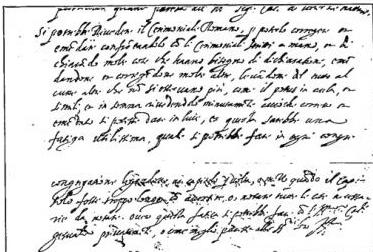
CERIMONIALE DEI VESCOVI — Extract from a Memorial presented between 1595 and 1600 by Giuseppe Paolo Mucante, master of pontifical ceremonies to Cardinal Gesualdo, first prefect of the S. Congr. of Rites, containing proposals for the revision of the c. — Vatican City, Historical Archive of the S. Congr. of Rites, no. 263.
ziano: “He devoted himself attentively to the functions of the Church, so that the least as well as the greater ceremonies and prescriptions might be carried out according to the order arranged and established by his superiors.” St. Augustine also seems to have known some ceremonial, since he laments the scarcity of ceremonial prescriptions relating to certain liturgical practices (Ep., 55, ad Iamuar).
But the oldest documents known go Ordines Romani (v.). The Ordines on which the c. of the V. was formed are specifically those numbered I to VI and XI, XII,
XV (Mabillon’s numbering); while the others concern the pontifical and the Roman ceremonial. Other Ordines of particular Churches were published by L. Duchesne and U. Chevalier for France, by M. Gerbert for Germany, and by M. Ferotin for Spain. For Italy, we note the Ordo Beroldi, which shows the customs of Milan in the twelfth century, published in 1894 by M. Magistretti; and the Ordo officiorum ecclesiae Lateranensis, dating from before 1145, edited by L. Fischer. Nevertheless, a considerable number of them had no influence on the formation of the c. of the V.
Given the great number of Ordines (some of which are also entitled Caeremoniale Romanum, such as Ordo XIII, drawn up at Lyons in 1274), the need was felt in Rome to gather into a single collection the prescriptions to be observed in the sacred liturgy. Thus A. Patrizi, known as Piccolomini, pontifical master of ceremonies, on the basis of these Ordines and contemporary Roman usages, compiled a Caeremoniale Romanum, Libri II, for use in the papal Chapel, and dedicated it to Innocent VIII in 1488. In the second part he was assisted by Burcardo, who later wrote a very diligent and pedantic chronicle of the ceremonies of the Vatican (Libri caeremoniales). Patrizi’s compilation remained unpublished until 1516, when Cr. Marcello, after making certain changes, published and dedicated it to Leo X without presenting himself as its author. Against Marcello, Grassi, then pontifical master of ceremonies, made a vehement indictment, not so much because of the alterations and alleged appropriation as because of the dissemination of the pontifical ceremonies, which to him meant exposing them to contempt. Nevertheless, the book went through many editions. A treatise on pontifical ceremonies was also composed by Grassi himself, but because of the author’s views it remained unpublished until its publication by Martène.
Meanwhile, in the various Churches, owing to the lack of an official text, not a few abuses were introduced,
to eliminate which the Council of Trent ordered the compilation of a single c. of the V. Pius IV had entrusted this task to the Perugian Fulvio della Cornia, and Sixtus V in 1588 established the Congregation of Rites, assigning it, among other duties, the revision of the pontifical, the c. of the v., and the ritual. The c. of the v., compiled by learned prelates, among them L. Torres, later a cardinal, and drawn from Patrizi’s Roman ceremonial and those of Burcardo and Grassi, was published in 1600 by Clement VIII, made official and obligatory for all churches, especially cathedral and collegiate churches.
In 1650 Innocent X, having noted its many typographical errors, ordered a new edition, reprinted under Clement XI. Benedict XIII corrected it again in 1727, removing the typographical defects (due, as the bull states, not so much to the inexperience of the printers as to the fault and negligence of others), clarifying obscure and ambiguous rules, eliminating obsolete ones, reconciling contradictory ones, and adding in their proper places those that had been omitted. In 1741 Benedict XIV wished to issue a more accurate edition, taking particular care with music and chant, and adding the whole of Book III in order to settle a number of controversies that had arisen among the bishops concerning honors and precedence. The last typical edition, issued by Leo XIII, dates from 1886.
The c. of the V. is divided into three books. Book I deals with the duties of the bishop at his elevation and at his entrance into the diocese, the duties of the cathedral officials, pontifical vestments, and the prelate’s private attendance at choir and at Mass without chant. Book II sets forth the ceremonies for pontifical and solemn Mass and Office, whether or not the bishop is present; in addition, it treats of the fixed observances on certain days of the liturgical year. Book III specifies the signs of respect and the honors that bishops and civil authorities must render to one another.