
INNOCENT X, POPE. – Born in Rome on 7 May 1574, died there on 7 January 1655. G. B. Pamphili, descended from a family that had come to Rome from Gubbio toward the end of the fifteenth century, had been educated under the direction of an uncle, who later became a cardinal; he graduated in both laws, became consistorial advocate (1601), auditor of the Rota (1604), nuncio to Naples (1621–25) and to Spain (1626), cardinal (in pectore on 30 August 1627, published on 19 November 1629), and prefect of the Holy Congregation of the Council. His election (15 September 1644) represented a reaction against the pro-French tendencies of the final period of Urban VIII; nevertheless, the Barberini, nephews of the latter, played a major part in II.
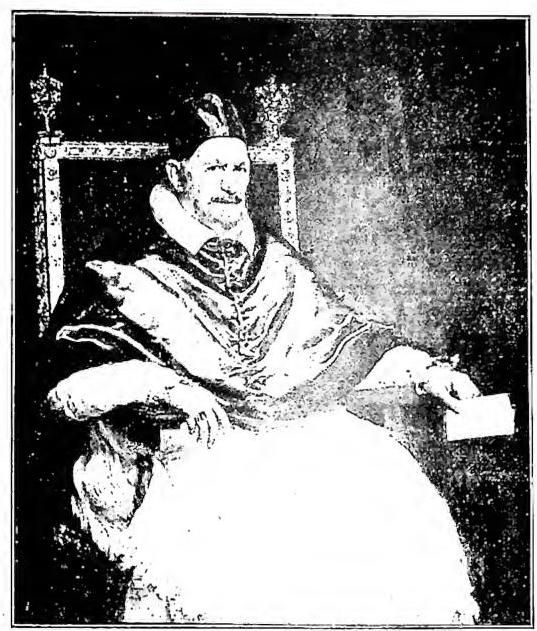
His accession was greeted with joy, because Pamphili had a reputation as a man learned in law and an experienced politician. In reality, his character, which appears under different aspects in Velázquez’s admirable portrait, in Algardi’s statue, and in Bernini’s busts, was complex. Tall and lean, swarthy, bald, and with a sparse beard, he had a forbidding appearance and penetrating gaze; he was taciturn, suspicious, and slow to decide; yet he was pious, good, and fond of justice and peace. Above all, he was harmed by his tendency to accumulate money and then lavish it, not always appropriately, and by his undue love for his own family. The defects of the man and the gravity of the times, in which the unity of the Catholic world was disintegrating and the absolutism of princes was already appearing threatening to the Church, made his pontificate neither happy nor glorious.
He was the first to appoint a Secretary of State who did not belong to his family and, after Pancioli’s death, gave the office to Fabio Chigi, the future Alexander VII, a worthy man; nevertheless, for almost the entire pontificate he allowed himself to be dominated by his sister-in-law Olimpia Maidalchini, intelligent and energetic, but ambitious and possessed of a “nauseating greed”; her influence was such that even illicit relations were rumored. A son first, and later her relatives, occupied the position of “cardinal nephew,” not always in agreement with the intriguing woman. I.’s reputation was also harmed by his failure to notice the falsifications of the sub-datary Mascambruno, whom, after being alerted by Chigi, he had tried and executed.
I. took measures to alleviate the famine with alms and grain supplies. Taking advantage of the insolvency of the Duke of Parma, Ranuccio II Farnese, and of the suspicion that he was an accomplice in the murder of the Bishop of Castro, he had Castro occupied and destroyed (1619) and obtained the transfer of this and other fiefs under the direct rule of the Church. But he neither knew how nor was able to halt the political and economic decline of the Papal States and the deficit, which was also growing because of the Pamphili’s extravagance.
In the continuing struggle between Spain and France, he attempted to maintain a balance, while nevertheless leaning toward the former, whose predominance he judged less burdensome to the Church and to Italy. He had the Barberini, who had aligned themselves with France, tried for their embezzlements; but he had to reconcile himself with them because of Mazzarino’s threats. Nor, for that matter, was he lavish with undue favors toward Spain: he did not permit interference by its king in ecclesiastical affairs; during the rebellion of Naples (1647–48), he offered to mediate between Spain and the insurgents and disapproved, as he did the insurrection itself, of the reprisals and Spain’s failure to keep faith. If he did not recognize Giovanni IV as king of Portugal, this was not so much because the latter was in rebellion against Spain as because of his claims concerning episcopal appointments.
He confirmed Chigi as the representative of the Holy See at the Congress of Westphalia and worked for peace; but he was hostile to concessions to the Protestants and, once peace had been concluded (24 October 1648), protested against the articles damaging to the interests of the Church with the brief Zelus domus meae, which, in order not to worsen Germany’s condition, was published only on 20 August 1650, bearing the earlier date of 26 November 1648. The brief had very little effect; but, more than the protest, what helped the Church recover part of the ground lost in Germany were the convening of synods, the missions, and the establishment of seminaries, all promoted by I. He contributed to the spiritual progress of the Church by approving or imposing reforms of religious Orders, suppressing congregations and convents with too few members, and celebrating, even with excessive pomp, the Jubilee of 1650, which drew 700,000 pilgrims.
In non-Christian lands he sent or supported missions, increasing the powers of Propaganda; he established a Maronite College in Ravenna and raised the Dominican College of Manila to university status. In the controversy, bitterly debated between the Dominicans and Franciscans on one side and the Jesuits on the other, concerning the lawfulness of the Chinese rites, he approved the decree of Propaganda of 12 September 1645, which constituted their first condemnation. In the violent conflict that broke out in Mexico between the extremely powerful Bishop Palafox and the Jesuits, he declared himself in favor of the former, while not approving his extreme measures, and restricted the privileges of the Jesuits to the benefit of diocesan authority.
He assisted Venice against the Turks in the War of Candia and contemplated a league, which foundered because of the distrust of the Venetians themselves, with whom he subsequently came into conflict over the violation of ecclesiastical jurisdiction.
He encouraged the historical studies of Sforza Pallavicini and Rinaldi. He continued, on a smaller scale, the great building projects of his predecessors: he commissioned Bernini to decorate the longitudinal pilasters and create the mosaic pavement of the central nave of St. Peter’s, as well as the colossal equestrian statue of Constantine; Algardi, to execute the large relief of the altar of St. Leo the Great; and Borromini, to carry out the Baroque renovation of the Lateran Basilica. He had Piazza Navona arranged in its ancient stadium form, with Girolamo Rinaldi’s Palazzo Pamphili, Borromini’s church of Sant’Agnese, and Bernini’s monumental fountains, while his nephew Camillo created, with the work of Algardi, the villa on the Gianicolo. He had Carlo Rinaldi continue the Palazzo of the Capitoline Museum and had Antonio del Grande design the “New Prisons” on Via Giulia, “securiori ac mitiori reorum custodiae,” a work at once of enlightened patronage and exceptional humanity for those times.
I.’s remains, after having been left by the avarice of his relatives “in a corner, in a wretched box,” received a modest burial in Sant’Agnese in Agone. – Vedi tav. V. BIBLICA.: Rather than the volume by J. Ciampi, I. X Pamfili e la sua corra, Rome 1878, which is deficient in its information, vedi Pastor, XIV, 1, and the many works cited there. Giovanni Battista Picotti