
GUBBIO, DIOCESI of. — City and diocese of Umbria, immediately subject.
It has a population of 50,000 inhabitants, all Catholics; it comprises 65 parishes, 56 diocesan priests and 25 religious priests, 7 male religious communities with 25 professed members and 17 female communities with 135 professed members (1948).
A letter of Pope Innocent I dated 19 March 416, known as one of the most interesting documents in the history of the ancient Church (Jaffé-Wattenbach, 311), is addressed to Decenzius, bishop of G., the first bishop whose existence is securely known. The prae-decessores mentioned in the document are unknown, and the lists compiled by local authors and accepted by various writers to make up for the silence of the documents deserve no credence.
Likewise to be rejected are the names of the bishops whom the same writers place after Decenzius, up to Bishop Gaudiosus, the second bishop of whom there is reliable information (Jaffé-Wattenbach, 1712-13). A dark period follows in the history of the Church of G.; from documents of the 10th century, the bishops Leudericus and Pietro, of that century, are known only by name. A religious revival became manifest after the year 1000, particularly during the period of reform: the bishops of the Eugubine Church maintained very close ties with the nearby hermitage of Fonte Avellana. According to tradition, its founder, around the year 1000, was Ludolfo, who later became bishop of G., while s. Pier Damiani, prior from 1043 and reformer of the hermitage, administered the Eugubine Church for some time (Epistulae, I, 14: PL 144, 223).
The reforming activity of the Avellana saint spread throughout the diocese, which at the time comprised sixteen hermitages and was governed by distinguished holy bishops: Rodolfo, who corresponded with s. Pier Damiani (Epistulae, IV, 10, 11: PL 144, 320-21); the b. Giovanni da Lodi, a disciple of Damiani and prior of Fonte Avellana (P. Cenci, Vita di s. Giovanni di Lodi, vescovo di G., Città di Castello 1906); and, later, s. Ubaldo (1128-60: Acta SS. Maii, III, Paris 1866, p. 625 ff.) of G., who lived in the city, then a commune, and carried out there an effective work of pacification (P. Cenci, Vita di s. Ubaldo, Gubbio 1924); he was canonized by Celestine III on 4 March 1192. In the 13th century, under Bishop b. Villano, G. became, through the apostolate of s. Francesco himself in this land (1220-22: I Floretti, chap. 21), one of the most vital centers of early Franciscanism, rich in memories and monuments, including the church erected by fra' Bevignate for the Saint (1256; U. Paris, S. Francesco, i Francescani e la città di G., Florence 1928). During the Renaissance, the Eugubine Church had commendatory bishops and administrators; the most illustrious holder of the see at that time was Marcello Cervini (1544-55) of Montepulciano, later elected pope (Marcello II, 1555). In 1563 it was made a suffragan of Urbino by Pius IV, and Benedict XIII renewed the arrangement in 1725. Since 1818 G. has been immediate subiecto to the Holy See.
The history of the city and diocese is connected with that of the formation and development of the Papal States. G. was a city of the Pentapolis, called the mountainous Pentapolis (provincia castellorum) or the Annonarian Pentapolis, occupied by Aistulf in 752. With the restitution made by the Lombards to Pepin in 756, by which a dominion of the Holy See was constituted, G. is expressly mentioned among the lands ceded (L. Duchesne, I primi tempi dello Stato pontificio, Turin 1947, p. 52), and Charlemagne, returning from his coronation in 800, halted in the city. Recovered for the dominion of the Holy See by Cardinal E. Albornoz, G. rose as a free commune in 1376. Having freed itself from the tyranny of Bishop Gabriele Gabrielli, it placed itself under Antonio di Montefeltro, lord of Urbino, in 1384, and belonged to that duchy until, in 1631, when it returned to the Holy See, G. too was restored and remained under papal rule until its annexation to the Kingdom of Italy in 1860.
MONUMENTS. – The oldest certain record of the cathedral church, dedicated to St. Mariano, intra mura civitatis Eugubine, dates back to the 10th century (P. Cenci, Di duc pergamene del sec. X fino ad ora sconosciute, in Bollettino di storia patria dell'Umbria, 14 (1908, II-III), pp. 567–73); later the Cathedral was consecrated to SS. Mariano and Giacomo, African martyrs of Lambesa, whose relics had been transferred to G. already in ancient times, perhaps between the 5th and 6th centuries; Clement III granted permission for all the relics of the saints to be transferred there from the old city (bull Pia desideria of 20 October 1188). The present building, on the slopes of Mount Ingino, where the new city had begun to take shape from the 10th century onward, is assigned, according to a widely accepted opinion, to the 14th century and is said to have been completed under Bishop Pietro Gabrielli, with elements from an earlier period. The recently restored façade has valuable bas-reliefs: the Agnello, the Quattro Evangelisti, and a portal of simple design. The characteristic single-nave interior, with pointed arches, presents restorations and alterations from the 16th century; also characteristic is the high altar, formed by two superimposed pagan sarcophagi.
Serafino Prete
LE TAVOLE DI G. — Known in Latin as iguvine or eugubine, these are seven bronze tablets: four larger and older ones, inscribed on both sides in indigenous characters, and three smaller and more recent ones in Latin characters. They were discovered in 1444 and sold to the Commune, which preserves them in the Civic Museum. The canonical ordering from 1 to 7 does not correspond to the actual order of the text. Their content is chiefly religious, and the subjects may be grouped as follows.
Tav. I and VI–VII a: Consecration of the citadel (ocris) of Iguvium and lustration of the people, preceded by the removal (exterminatio) beyond the boundary of the territory of all those who, as foreigners, had no right to be present at the ceremony; these were the Tadinati (Gualdo Tadino), the Tusci (Etruscans), and the Japudici (Illyrians from the Adriatic coast, the peoples along the Nahr [Nera]).
Tav. II a: Sacrifice to Hontus Iovius, of an apotropaic nature against adverse auspices.
Tav. III–IV: Annual ceremonies of the confraternity of the Atiedian brothers, so called because they originally came from Atiedio (Latin Attidium).
Tav. V: Internal regulations of this confraternity. Tav. II b and V: Social and juridical relations among the groups living together in G.
The deities invoked with prayers and sacrifices are: the triad Jupiter, Mars, and Vofionus, entirely male, analogous to the Roman Jupiter, Mars, and Quirinus, both following the Etruscan model of Jupiter, Juno, and Minerva; the triad Trebo Jovius, Tefrus, and Fisius Sancius (cf. Fidius Sancus, Deus Fidius of the Romans), to the last of whom the acropolis of G. is dedicated.
In the rite of the lustration of the people, female divinities are also invoked: Prestota Çerfia, with the meaning of protectress, and Torsia Çerfia, in the sense of banisher of enemies, invoked in a single prayer together with Çerfus, the god of the city, who is given the epithet of Mars. In the annual sacrifice of the Atiedian confraternity, sacrifices are offered to Jupiter the Father, to Poemuno (Pomono), god of fruits, and to Visona.
The Iguvine Tablets are the most notable ancient monument relating to the Umbrians. From them, besides the religious data mentioned above, it may be inferred that the Italic peoples originally lived in fortified settlements rather than in true cities; but also that the Iguvines already inhabited a territory of their own, geographically delimited, and that, in addition to the generic grouping of the people (tauta), they knew the division into tribes (trifis) in the territorial sense, as well as an internal subdivision of the citizens into decuries (tehetias), below which stood the fameria, corresponding to the collective grouping of the gens.
Nicola Turchi
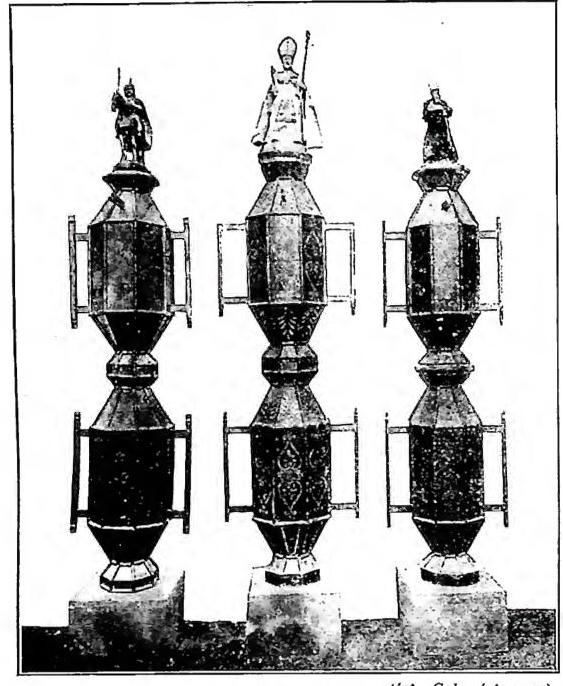
FOLKLORE. — The ancient Umbrian city is renowned for the festival of the ceri, held every year on 15 May, the eve of the feast of the patron saint, s. Ubaldo.
The so-called ceri, which replace the genuine wax torches formerly offered to the Saint and carried in procession, are three large and heavy yet elegant wooden structures, about ten metres high, in the shape of two superimposed prisms, each surmounted respectively by the statues of s. Ubaldo (the masons’ guild), s. Giorgio (merchants), and s. Antonio abate (peasants). They rest on four long, framed beams decorated with the coats of arms of the quarters, and are carried on the shoulders by sturdy young men, known as «ceraioli», who are distinguished by a particular costume: a yellow shirt for the cero of s. Ubaldo, a light-blue one for s. Gregorio, and a black one for s. Antonio. According to tradition, the ceri are placed in the courtyard of the former Convent of S. Pietro, awaiting the «alzata», which takes place precisely at noon. A first circuit then follows, in which the individual ceri are displayed through the city streets. Each cero is preceded by two captains, one called the captain of the axe, because he carries an axe, and the other carrying a sword. In front of the houses of the principal gentlemen and of the civil and ecclesiastical authorities, the ceri stop and turn on themselves once, twice, or three times, according to the importance of the persons being honoured: this is called «far la birata». The ceraioli then share a communal meal, with the participation of the authorities. In the afternoon, after the bishop’s blessing, the race of the ceri takes place; its origin is attributed to the miraculous victory won by G. over the eleven confederated cities through the merits of its bishop Ubaldo. After passing through the principal city streets and circling the walls, the ceraioli set off, still running, in a furious race that puts their physical endurance to the severest test, towards the Sanctuary standing on the slope of the mountain some distance from the city. At sunset they all descend again amid songs and cheers. It is believed that on this day «it must rain»; and if instead the sky remains clear, the common people climb onto the roofs and overturn large containers of water there. It is also believed that the festival serves to win the protection of s. Ubaldo and the other two Saints for the fertility of the fields, the abundance of the production of grapes and hay, and the health of the livestock. The complex of these customs and beliefs suggests an ancient substratum of rites of springtime propitiation and purification, analogous to what takes place on the same date with the «pugnaloni» of Allerona and the «barabbata» of Marta. — Vedi tav. LXXXVI.