
AGNELLO. — Born of the ram and the ewe, whose symbolism presents itself so immediately to the mind
nocturnal? morning and evening, called ‘olat ha-tāmīd (Num. 28: 6, 10, 15, 23 f.; Vulg. holocaustum iuge or sempiternum) and simply tāmīd in later Judaism (Dan. 8: 11–13; 11: 31; Mišnah); this rite is prescribed in Ex. 29: 38–42 and Num. 28: 3–4, 6, 8. As in these passages, hēbhes is often accompanied by the qualification ben-šanāh “ [son] of one year”: that is, more than 7 days old (Ex. 22: 30; Lev. 22: 27) and not more than one year old. For the holocaust, the a. also had to be tāmīm “perfect” or without defect (Septuagint ἀμωμος, Vulg. immaculatus): Lev. 1: 3; 3: 6; Num. 28–29: 15 times; cf. Lev. 4: 3–32; 5: 15, 18). This epithet tāmīm (“immaculate”: cf. I Pt. 1: 19) is also found at Ugarit (mtum tm; Syria 10 [1929], pl. 61, no. 1).
The law specifies the rite of the a. offered in sacrifice
1. A. IN THE BIBLE. - In the Bible the lamb is often mentioned as the customary victim of sacrifices.
The proper Hebrew term is hēbhes (Septuagint ἀμνός), with the feminine kibhsāh (ἀμνός, Vulg. agna; Num. 6, 14), or, more rarely, kēsebh and kisbāh (metathesis). The smallest lamb is called taleh (I Sam. 7, 9; Is. 40, 11), Greek ἀρήν. Kar is the somewhat developed male lamb, not yet a ram, regarded as a delicacy (Deut. 32, 14; Am. 6, 4), coveted booty (I Sam. 15, 9), and the tribute paid by Moab (Is. 16, 1; II Reg. 3, 4: Meša). Less precise is seh (a head of small livestock, belonging to the sōn “flock”), which designates either a lamb or a kid (Deut. 14, 4: Hebrew “a seh of lambs and a seh of goats”); the Septuagint (and Vulgate) usually understand “lamb” (40 times; only once “kid”). Kēbhes occurs 87 times in Exodus, Leviticus, and Numbers, in passages attributed to the “priestly code,” in connection with sacrifices.
Among these the daily double burnt offering is distinguished—
“peace offering” (Lev. 3, 7-11) and “sin offering” (Lev. 4, 32 [hēbhes: Vulg. de pecoribus]. 35). On all feast days and sacrifice (v.) the Mosaic Law prescribed the slaughter of lambs (cf. Gen. 4, 3-4; Num. 6, 12; I Sam. 7, 9; I Reg. 8, 63, where the generic term sōn is used: 120,000; etc.). On the Sabbath tāmīd, the lambs numbered 2 in the morning and 2 in the evening (Num. 28, 9 ff.). Other “perfect” burnt offerings of lambs were prescribed: 7 at the new moons, 7 in addition to the tāmīd on each day of the seven-day Passover (Num. 28, 11. 19-24); 7 at the New Year (Num. 29, 2-4), 9 in all at Pentecost (Lev. 23, 18 ff.; Num. 28, 27), 7 in addition to the tāmīd on the Day of Atonement (Num. 29, 8-11); during the Feast of Tabernacles the daily number rose to 14, but there were only 7 on the eighth day (Num.
29, 13-36). Other sacrifices of lambs were enjoined upon the purified woman after childbirth (Lev. 12, 6-8) and upon the leper who had been healed (Lev. 14, 16-24: two lambs and one ewe lamb). Each year the obligatory official cult, in the name of the nation, required the slaughter of 1093 lambs (or kids), in addition to those offered in private sacrifices. Most preferred the lamb, more valuable and more expressive, but in many sacrifices the kid could be substituted for it, though it was no longer white. Thus for the paschal lamb (cf. II Par. 35, 7): “Your lamb (seh) shall be perfect (tāmīm)... take it from the lambs (hēbhāsīm) or from the goats” (Ex. 12, 5; the Vulgate iuxta quem ritum tolletis et haedum is inaccurate; cf. Deut. 14, 4).
The Paschal Lamb (v. PASQUA), ordained by God at the exodus from Egypt (Ex. 12, 2-11; Num. 9, 2-14; Deut. 16, 1-7), preserved the families of Israel from the slaughter of the firstborn by its blood, with which the doors were smeared (“as a sign”) (Ex. 12, 7. 13. 22 ff.; the whole house was thereby consecrated as an altar). Male and perfect (tāmīm, V. 5; as for burnt offerings: Lev. 1, 3), it was slaughtered by the head of the household (later by the Levites, Esd. 6, 20; II Par. 30, 17; 35, 6) in the court of the sanctuary on the evening of the 14th day of the first month (nīsān), and its blood was poured (after the erection of the sanctuary) at the foot of the altar. It was then eaten roasted (stretched out on two pieces of wood forming a cross, without breaking its bones, Ex. 12, 46; Num. 9, 12; cf. Io. 19,
36), in groups of ten to twenty, and nothing was to remain of it (the remains were burned).
Flavius Josephus relates (Bell. Iud., VI, 9, 4) that, before the destruction of the Second Temple, 256,500 lambs were slaughtered at one Passover; but W. M. De Wette had already pointed out the exaggeration of this figure (Lehrb. der hebr.-jud. Archäologie, 1814, 4th ed. 1864, § 218). The Babylonian Talmud (Pésahm 64 b) reaches a figure of 1,200,000 (for the same period).
The paschal lamb was a true sacrifice: it is called zébhah (Septuagint θωία; Ex. 12, 27; 23, 18; 34, 25) or qorbân (Num. 9, 7, 13), with the verb hiqrib, technical terms expressing sacrifices. Its sacrificial character is also evident from the expression pésah lê-Jahweh, “Passover sacred to J.” (Ex. 12, 11, 48; Lev. 23, 5; Num. 9, 10, 14; Deut. 16, 1 ff.; II Par. 30, 1, 5; etc.), and from the rite of the blood poured by the priest at the foot of the altar of burnt offerings (Lev. 17, 3-6; II Par. 30, 16; 35, 11). For this reason Philo (Vita Mos. 3) and Flavius Josephus (Antiq. Iud. II, 14, 6; 11, 4, 8; Bell. Iud. VI, 9, 3) call the paschal lamb θωία and θωία (cf. θωία in Mc. 14, 12; Lc. 22, 7; I Cor. 5, 7). But it sacrifice (v.) to one of the common categories of the Mosaic Law; it was at once expiatory and a “peace offering” (F. X. Kortleitner, Archaeol. Biblica, Innsbruck 1917, pp. 264-66).
As a sacrifice, the paschal lamb had to be killed in Jerusalem, and the rite ceased in Judaism with the destruction of the Temple. Today, in place of the lamb, the head of the household gives the afiqómen (v.), which he raises while saying, before distributing it: Zéher lqorbân pésah (“memorial of the paschal sacrifice”).
Such a familiar creature furnished biblical writers with various images. The gamboling of lambs in spring represents the rejoicing of Israel delivered from Egypt (Sap. 19, 9), to which inanimate nature joins (Ps. 113 [114], 4, 6; cf. Mal. 4, 2 [Hebrew 3, 20]: the calves).
Timid and innocent, ordinarily white-fleeced, “without blemish” (tâmîm) as the ritual requires, the lamb is in the Bible, as in other literatures, a symbol of innocence and gentleness, in opposition to cunning and violence. It is the opposite of the wolf (Eccl. 13, 21 [Hebrew 17a]; cf. Mt. 10, 16; cf. Horace, Epod. IV, 1; Phaedrus, etc.). The cessation of this instinctive opposition will characterize the messianic age (Is. 11, 6; cf. 65, 25). Weak, inexperienced, and in need of guidance and protection (cf. Nathan’s parable II Sam. 12, 3-4), the lamb requires the shepherd as its correlative (cf. Dante, Par. IX, 131 ff.; X, 94; XXIX, 106). The Messiah will be a solicitous shepherd of men, a flock without guidance (cf. Mt. 9, 36; Mc. 6, 34; I Pt. 2, 25; Num. 27, 17); he will be the Good Shepherd (Io. 10, 2-16; cf. Lc. 15, 4-6; Mt. 12, 12; 18, 11 ff.) who entrusts his lambs to Peter (Io. 21, 15; τὰ ἀρνία μου).
The just person, simple and upright, who suspects neither snares nor betrayals, persecuted by cunning enemies, is “like an innocent lamb (bébhes) dragged to the slaughter” (Ier. 11, 19). The image characterizes the suffering and most patient “servant of Yahweh,” “a lamb (seh) led to the slaughter and silent” (Is. 53, 7).
In the Jewish apocrypha the biblical allegory of the lambs (= the faithful) under the Shepherd (= God) persists: Henoch 83-90; Ps. Salom. 8, 14 ff. But the allusions to the Lamb-Redeemer seem to be due to influences in the Testamenta XII Patriarch.: “From Judah and Levi there will arise for you the Lamb of God (ὁ ἀμνὸς τοῦ Θεοῦ) who saves the nations by grace” (Test. Ioseph 19).
In the New Testament, John the Baptist points to Jesus as the Lamb of God (ὁ ἀμνὸς τοῦ Θεοῦ), indicating, beyond his innocence and gentleness, his quality as an expiatory victim “who takes away the sin of the world” (Io. 1, 29, 36; for sin, connected with death, cf. Num. 9, 13b). The article preceding the title of the Lamb, and the precise manner (18e “behold”) in which the Baptist applies this appellation to Jesus, demonstrate that he employs a figure widely known as referring to the Mes-
The Evangelist John handed down to us the evocative title of the Savior, which he learned “from the beginning,” at the time of his vocation (Io. 1, 36; cf. I Io. 1, 1; 2, 24), and made it the scenic fulcrum of the Apocalypse, where the living symbol of the Lamb (= Jesus) recurs 28 times (always τὸ ἀρνίον). It has been held (C. F. Burney, followed in part by I. Rohr, Der Hebräerbrief u. die geh. Offenbarung des hl. Joh., 4th ed., Bonn 1932, p. 92) that τὸ ἀρνίον corresponds to the Aramaic taliō, which is ambiguous between the meanings “young one” and “lamb.” But John “sees” Jesus as the Lamb. The figure dominates the whole of the Apocalypse, beginning with 5, 6 (“Lamb ... as though slain”). The slain and victorious Lamb is the link between the two supreme salvific events: the accomplished Redemption and the final Judgment; the Lamb bears the former and exercises the latter. Heaven and earth look to the Lamb: he reigns in heaven (5, 6; 7, 17; 21, 1, 3) and upon the mountain (14, 1); he is the temple and the light of heaven (21, 22, 24), and the saints, saved by his blood (7, 14; 12, 11), take part in the banquet of his wedding (19, 7, 9; 21, 9). Simple and meek, the Lamb struggles against and triumphs over the cunning and powerful Beast (the Antichrist is an anti-lamb: 13, 11) and conquers together with his saints (12, 11; 17, 14), who are likewise immaculate (ἄμωμος: 14, 5).
(phot. Sansini)
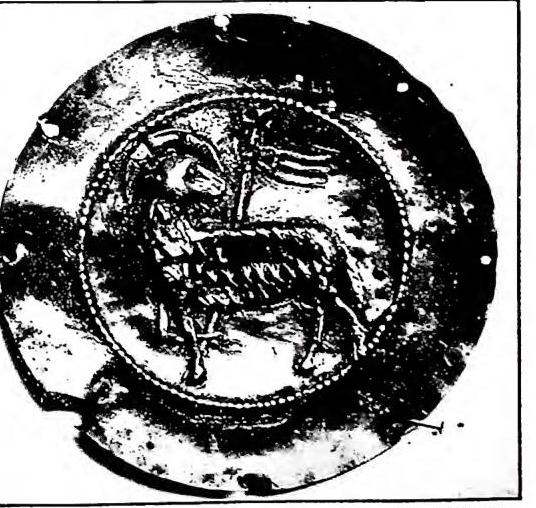
AGNELLO — Silver repoussé “Agnus Dei” from the acheiropoieton (15th century) — Rome, Sancta Sanctorum.
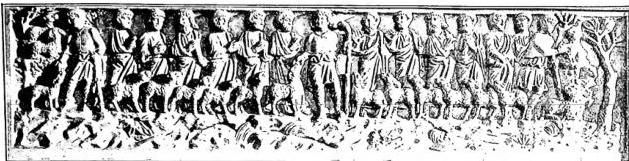
AGNELLO - Christ the Good Shepherd, with a dual representation of the Apostles, one of them in the form of a lamb. Sarcophagus (4th cent.) - Lateran Museum.
(Int. Alinari)
Is. 53:7]; PG 6, 561, 732), Tertullian (Adv. Marcion. 4, 40 [cites Is. 53:7]; 5, 7; PL 2, 490 ff. and 518), Origen (Hom. 2 in Lev.; Hom. 23 in Num.; Hom. 12 in Jer.; In Io. tom. 10, 11-13; PG 12, 421, 752; 13, 396; 14, 328-40; Tract. de libris SS. Scripturarum, ed. P. Batiffol, Paris 1900, pp. 96-103), St. Cyprian (Ad Demetrianum 22: PL 4, 580), and Lactantius, St. Jerome, St. Ambrose, St. Augustine, St. Gregory Nazianzen, St. Cyril of Alexandria, St. Leo the Great, St. Gregory the Great, St. Thomas (Sum. Theol. 1a-2a, q. 102, a. 5 ad 2; 3a, q. 73, a. 6: the most expressive figure of the Eucharist in the Old Testament).
Among Catholics, M.-F. Lagrange, followed by F. Ceuppens, denies that the appellation “Lamb of God” implies, in the mouth of the Baptist, the expiatory death, because this concept would have been unknown to him and to his listeners. But the majority of believing exegetes (among recent ones, F. S. Porporato and A. Médebielle) uphold this meaning, clearly recognized by the whole Catholic tradition.
The Fathers generally explicitly associate and unify the type of the paschal lamb, “the Lamb of God who takes away the sin of the world,” with the oracle of Is. 53:7 (Origen, In Io. tom. 10, 13; PG 14, 336). And they depict Jesus as the “Lamb of God,” that is, the most pure and gentle Victim who offers himself in sacrifice to save sinful humanity: Origen (In Io. tom. 6, 32-35; PG 14, 289-93), Eusebius (Demonstr. Evang., 10; PG 22, 717), St. Augustine (In Io. tr. 4, 10-11; tr. 7, 5-6 [“sanguine agni victus est leo”]; tr. 120, 3; PL 35, 1410, 1439 ff., 1953), St. John Chrysostom (In Io. hom. 17, 1; PG 59, 109), St. Cyril of Alexandria (In Io. 2; PG 73, 192). Dante (cf. Par. XVII, 33) applies the title “Lamb of God” to the Emperor (Epist. VII, to Henry VII), whom he invokes as “Redeemer.”
Theological speculation has drawn significant conclusions from the symbol for the dogma of Redemption. Some non-Catholics also exaggerate this, such as S. N. Bulgakov (L'Agneau de Dieu. Sur l'humanité divine, Paris 1933).
Christian figurative art presents Jesus as a Lamb, drawing its inspiration chiefly from Apoc. 5:6-14 and 7:9-17.
Catholic liturgy, especially during the paschal season, frequently alludes to the paschal lamb. From the earliest centuries, the appellation “Lamb of God” has been applied to Jesus in liturgical language to signify the immaculate Victim for the redemption of the world. Thus in the Mass of the Roman rite, in the Gloria and after the breaking of the Host, and when the priest, before Communion, displays the Lord in the Host to the faithful. Likewise in the liturgies of St. John Chrysostom, after the lavabo, while the priest inserts the lance into the right side of the seal and when he makes the sign of the cross over the bread; when he cuts the bread into four parts, after the adoration (cf. Liturgia s. Joh. Chris., Venice 1687, p. 433). In the liturgy of St. Mark, the appellation occurs in the third prayer of the kiss of peace and in the adoration at the bowing of the head (Missale Alex. s. Marci, ed. Gius. L. Assemani, Rome 1754, pp. 53, 71).
v. selon st
Jean, Paris 1925, pp. 40-41; L. Pirot, Agneau pascal, in DBs, I, cols. 153-59; F. S. Porporato, Ecce Agnus Dei (Io. 1, 29), in Verbum Dom., 10 (1930), pp. 329-37; P. Federkiewicz, «Ecce Agnus Dei», ibid., 12 (1932), pp. 41-47, 83-88, 117-20, 156-60, 168-71; F. Sole, Gesù A. di Dio nel pensiero di Gio. Batt., in Scuola Catt., 60 (1932, 1), pp. 359-70; id., Gesù A. di Dio nell'interpretazione della liturgia e dell'arte cristiana, ibid., 60 (1932, 11), pp. 353-64; J. Schuldenberger, Ecce Agnus Dei, in Benediktin. Monatschrift, 14 (1932), pp. 120-30; A. Médebielle, in DBs, III, col. 205 ff.; J. Jeremias, Ἄρνις τοῦ Θεοῦ-παῖς Θεοῦ, in Zeits. f. d. neutestam. Wiss., 39 (1935), pp. 115-23; E. Barnikol, Kennt Paulus Christus als Passadionum? Der Urtext vom I Kor. 5, 7 ohne die nachpaulinische Passadionum; in Theol. Jahrbuch, 7 (1939), pp. 65-68; F. Ceuppens, Theologia biblica, III: De Incarnatione, Rome 1939, p. 12; P. Jouon, L'agneau de Dieu, in Nouvelle Revue Théol., 67 (1940), pp. 318-21; P. Samain, L'agneau de Dieu qui ôte les péchés du monde, in Rev. Doc. Yosmai, 1 (1946), pp. 165-70. E. E. May, Ecce Agnus Dei! A philological and exegetical approach to John 1, 29, 36, Washington 1947.
Antonino Romeo
2. CHRISTIAN ARCHAEOLOGY
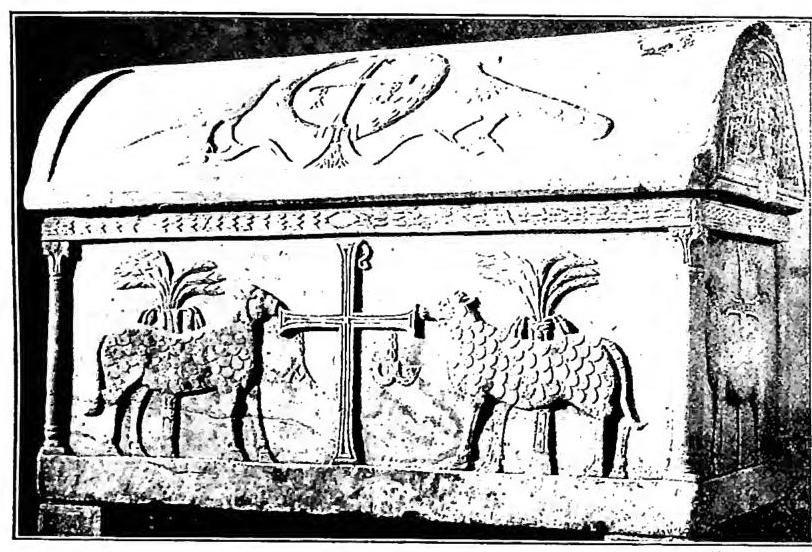
The lamb is often mentioned, together with the sheep, by Jesus Christ in the Gospel, figuratively indicating the flock of the Good Shepherd, that is, his faithful; here it is difficult to maintain the distinction between sheep, meaning the apostles and bishops, and lambs, meaning the ordinary faithful. The same is true of the sheep and lambs that early Christian art, from the end of the 2nd century onward, places beside the mystical shepherd, representing both the Church militant and the Church triumphant.But the symbolism of the lamb applied to Christ was more refined and fruitful. In the Old Testament he was prefigured in the paschal lamb and explicitly described by Isaiah as such, especially in the apocalyptic transfiguration of the agnus stans tanquam occisus before the throne of God, qui occisus est et redemit nos Deo in sanguine suo (Apoc. 5). This conception came into widespread use in Christian art from the 4th century onward, both in the funerary sculpture of sarcophagi and in the more solemn biblical compositions in mosaic or painting. In this same art, the lambs (generally twelve) moving toward Jesus signify the apostles or all the faithful. A singular case sarcophagus of Junius Bassus (v.), where on the extradoses of the arches in the lower zone the artist sculpted six biblical compositions in which both Jesus and the other figures are represented by lambs. The Council in Trullo of 692 recommended replacing the representation of Jesus himself with that of the lamb, haloed or bearing a cross, on the mountain or throne; but it was not obeyed, at least in the West. Finally, it should not be forgotten that at times on funerary inscriptions the lamb is a simple allusion to the name of the deceased (for example, a Probata, since the lamb is called πρόβατον in Greek), or to the deceased’s tender and innocent age. For the paschal lamb