
EXODUS (ἐξοδός “departure”).—Pentateuch (v.), so called by the Septuagint from the subject of its first part; in Hebrew, from its opening words, semoth (“names”) or vev'ellet semoth (“and these are the names”). After the brief introduction (1:1-7), linking it with the narrative of Genesis, it has three parts: the departure of the Hebrews from Egypt (1:8-12:16); their journey to Mount Sinai (13-18); the Sinaitic covenant (19-40). It is the history of the origin of the chosen people, written by their own leader.
After the tenth plague Pharaoh not only permitted, but commanded, the Israelites to depart from Egypt that very night (Passover: 14-15 ntsdn), and they took the “way of the desert” toward the Red Sea. From Ramesse they came to Socoth, where Jahweh gave the law concerning the Passover (12:43 ff.) and imposed the obligation of the offering of the firstborn (15:2). From Socoth they reached Etham, at the furthest boundary of the desert: the Lord would go before them to show them the way, with the cloud, dark by day and fiery by night. They were then obliged to turn back and encamp before Philahirot, between Magdal and the sea, opposite Beelsephen (14:2). The topographical identifications are highly uncertain, including that of the place where the Red Sea was crossed.
The figure of 600,000 Israelites fit to bear arms (12:37) presents a difficulty, since it would imply a total population of 2 million Israelites in the desert; some resolve
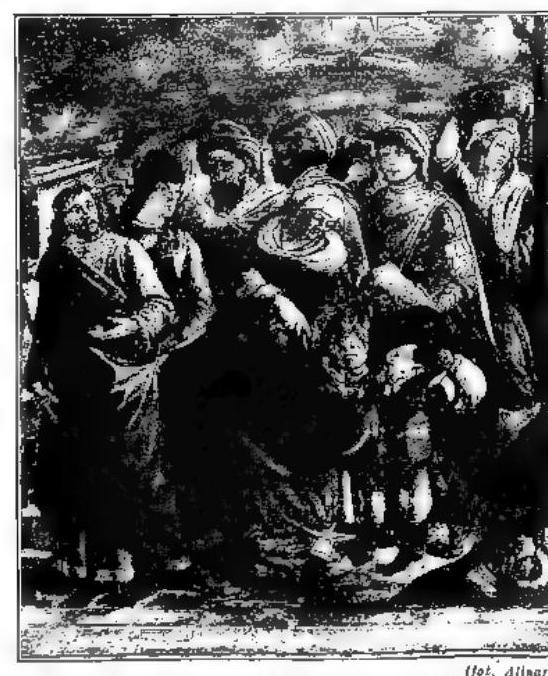
On the eastern shore of the Red Sea the Israelites found themselves in the desert of Sur or Erham; they reached Mara, then Elim, where there were twelve springs and seventy palms; from there they departed and came into the desert of Sin, where they were satisfied with quails and received manna (16-35). Thence they came to Daphne and Alus, then to Raphidim; CAMITI (v.). Sinai (v.), in the third month after their departure from Egypt they encamped opposite the mountain, upon which God gave the Law to Mosè and entered into a covenant with Israel, which became “the people of Jahweh” (16:5-6).
The conviction of Mosaic authorship handed down in Israel (Ios. 1:7 ff.; 8:30-35; I. Reg. 2:3) is accepted in the New Testament (Mc. 12:16—Ex. 3:2, 6). The historical authority of E. is presupposed and affirmed throughout the Old Testament: slavery and the miraculous departure from Egypt are frequently recalled therein (e.g., II. 43:16; 51:10; Ps. 66:6; 78:13; 106:9; 114:3); Mosè (v.) stands out in the history of Israel as liberator, builder of national unity, and legislator; Hebrew worship was formed around feasts (Passovers and Pentecost) and observances (unleavened bread, the offering of the firstborn) intimately connected with E. Moreover, the book itself provides many internal proofs of authenticity: the Hebrew character of many passages (the Decalogue, the song of Mosè [Ex. 15], and the code of the covenant). The complete correspondence of the events narrated in E. with the Egyptian environment confirms the very ancient origin of the book.
The “critical” school of J. Wellhausen (v. PENTATEUCO) has applied the distinction of sources to the book of E., attributing, for example, to J chapters 7-10 (together with E and P) and 33:12-34:28; Decalogue (v.) and the “book of the covenant” (20:1-24:8); to P 6:2-7:13; 25-31; 34:29-30, 36. It attributes to Mosè only the description of the slaughter of the Amaleciti (17:24), elements of the “book of the covenant” (20:23-25:33), and its codification (24:4-7; 34:27). But the analysis of sources does not attain conclusive results, since it is much more difficult than in Genesis to distinguish between Jahvistic and Elohistic documents.
The rationalists maintain that the miracles attributed to Mosè must be regarded either as idealized history (providential interventions of God and favour shown to Israel), or as fictions (appearances of God), or as embellished natural events (the ten plagues, the quails, the manna), or as etiological legends intended to explain a religious observance or symbol (Jahweh’s inscribing the characters upon the two tablets explains the two stones kept in the ark; the efficacy of the paschal lamb is taught by the tenth plague). But the objections raised do not hold. The appearance of Ex. 3:1-6, for example, conditions the whole mission and work of Mosè, which without it would remain inexplicable. As for the plagues and manna, even granting their local colouring, the miracle is at least quad modum or praeter naturam. The miraculous crossing of the Red Sea is a historical fact of such a kind that it cannot be suppressed without shaking the entire edifice of the Old Testament (Ex. 14; 15:4, 22; Num. 33:8; Deut. 11:14; Ios. 2:10; 4:24; 24:7; Ps. 105 [106]:8; Id. 11:16; Neh. 9:11; Sap. 10:8; I Mach. 4:9; Act. 7:36).
The centre and foundation of Israel’Decalogue (v.), inscribed on stone. The first nucleus was enlarged by the addition of other laws, required by various circumstances and by the progressive organization of the nation. Intermingled and interpenetrated with social prescriptions, the legislation contains many liturgical prescriptions, including chapters 25-31 (description) and 36-40 (execution) concerning worship in the portable sanctuary (“tabernacle”); Area (v.) of the covenant, the manna, the candlestick (v.), the tabernacle (v.), and the sacred vestments and furnishings.
The principal truths taught in E. are: the unity and spirituality (prohibitions of images) of God; the covenant with God. Morality is regulated therein and external worship established.
Sina: F. Hummelauer, Cones, in Ex. et Lev., Parigi 1897; A. Mallon, Les Hébrons en Egypte, Roma 1921; id., Exode, in DBs. II, cols. 1333-42; B. Ubach, L'Esode-El Levite, Monserrat 1927; G. Ricciotti, Storia d'Israele, I, Torino 1932, p. 201; following: A. Bea, De Pentateucho, in Institutiones Biblica, II, 1, 2nd ed., Roma 1933; P. Heinrich, Das Buch Exodus, Bonn 1934; A. A. A. A. A. A. A. A. A. A. A. A. A. A. A. A. A. A. A. A. A. A. A. A. A. A. A. A. A. A. A. A. A. A. A. A. A. A. A. A. A. A. A. A. A.