
ARCA. — Latin name used as a synonym for sarcophagus (v.) ancient Christian cemeteries (v.) above ground. It was used, from the end of the fourth through the fifth century, rarely in the Christian inscriptions of Milano, Brescia, Vercelli, Ravenna, Oderzo, and Aquileia; very frequently at Concordia (Portogruaro) and Salona in Dalmatia; and in two examples in Pannonia, at Sirmio and Siscia. It is found only once in Latium, on a sarcophagus from Velletri, now lost (CIL, X, 6608). It is never found in the inscriptions of underground cemeteries.
The author of the collection known as the Palatina (cod. Pal. Vat. 591) uses it to indicate the place of the tomb of s. Pietro (G.B. De Rossi, Inscript. Christ., II, 1, Roma 1888, p. 54, n. 7).
In non-funerary epigraphs it was read on the ancient altar of the basilica of S. Giovanni evangelista in Ravenna, where the apostle was called arca Christi (CIL, XI, 277). For the liturgical use of the term V. PISSIDE.
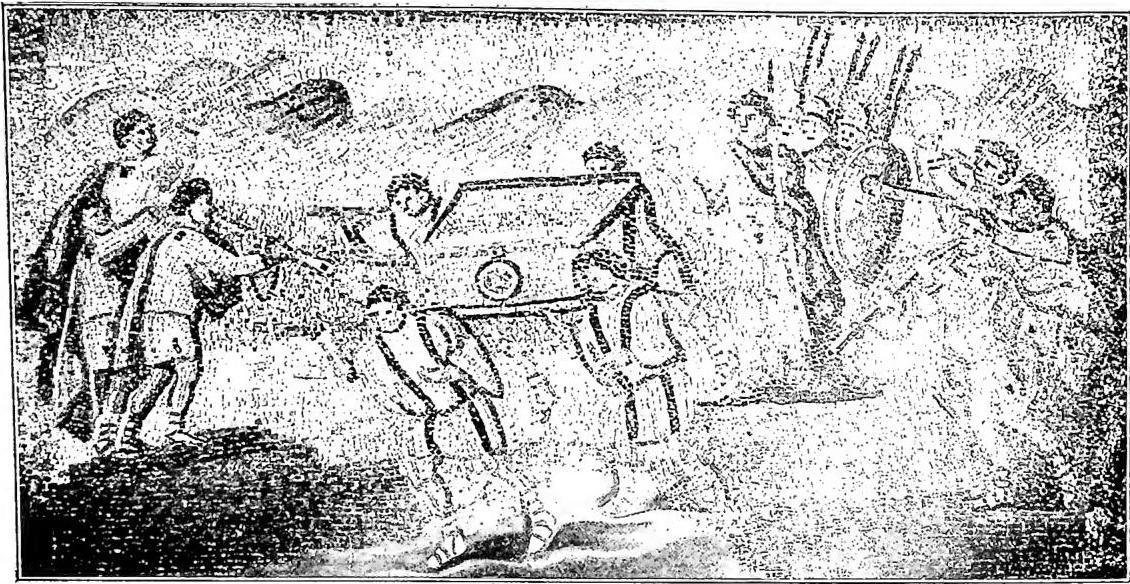
ARCA dell'ALLEANZA — Detail of a mosaic panel in the central nave of the basilica of S. Maria Maggiore (late fourth–fifth century) — Roma.
for s. Agostino in S. Pietro in Ciel d'Oro at Pavia. Much simpler, by contrast, is the a., also from the fourteenth century, for s. Cerbone (Massa Marittima) by Goro di Gregorio, with reliefs framed by an elegant and restrained motif. The fine a. of the blessed Marcolino (Forli, Museo), which Bernardo Rossellino executed in 1458, likewise derives from this type consisting of a simple chest. That of s. Bernardino da Siena (Aquila, S. Bernardino), from the beginning of the sixteenth century, instead takes the form of a small building which, with its architectural framework and reliefs, encloses the wooden chest and the small compartment in which it is kept. Particularly well known, and such as to form part of the architecture of the buildings beside which they stand, are those called “of the glossators,” next to the apse of S. Francesco in Bologna, and those within the lateral arcades of the Malatesta temple in Rimini.
The type of a. with tegurium was revived with excessive frequency in the emphatic funerary architecture of late Romanticism and Neoclassicism. Among the latest examples are the a. installed in the Vittoriale by the architect Maroni. — Vedi Tav. CXXVIII.