
DALMAZIA. –
I. GEOGRAPHY
Historical region corresponding to the Adriatic marginal strip of the Balkan Peninsula, from the Quarnaro to the Gulf of Drin. It consists of a continental sector of varying width (a minimum of 5–10 km in the north; a maximum of 100 in the centre) and a garland of islands, islets, and reefs (approximately a thousand) lying offshore as far as the latitude of Ragusa. The coast, for the most part high and rocky, is indented by frequent and characteristic inlets (channels and “gullies”), branching inward and protected seaward by the islands that extend parallel to it, sometimes in several rows. The nearby mountain ridge (the Velebit and Dinaric Alps), rising to 2,000 m., sharply separates, including climatically and floristically, the elevated Dinaric hinterland from the coast and the Dalmatian archipelago, whose Mediterranean character is further underscored by the predominant cultivation of olives, vines, and fruit trees (almonds, figs), and locally of citrus fruits. Despite its karst nature, D. has barely 3% of arable ter-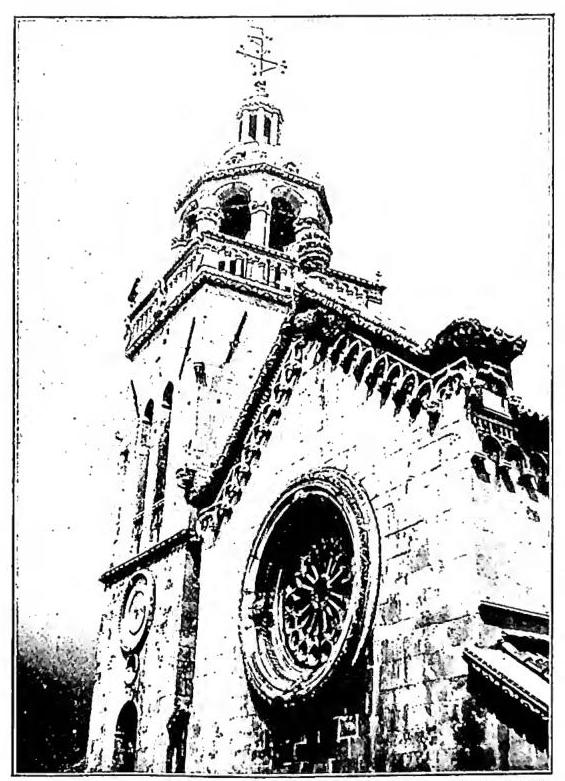
Natural D. encompasses approx. 18,000 sq. km., with just over 80% mainland; but its regional unity was lost in the new organization of the Federal Republic of Yugoslavia, of which it forms part. Its ethnic and linguistic character has changed considerably over time; at the end of the last century the Italian element (predominantly urban) probably still numbered 75,000–80,000. The Treaty of Rapallo (1920) left Zara and Lagosta to Italy (along with Cherso and Lussino, included in Istria); the agreement of 18 May 1941 additionally recognized Italy’s possession of the whole of central D. and the region of Cattaro (5,242 sq. km. with 325,000 inhabitants); as well as the islands of Veglia and Arbe, annexed to the province of Fiume. With the Paris diktat (11 February 1947), however, the entire region passed to Yugoslavia, including Zara, where the predominance of the Italian element was incontrovertible.
The major population centers of D. are all coastal; the most populous today is Spalato, in central D.; no other exceeds 20,000 inhabitants.
II. HISTORY
It was inhabited during the Metal Age by the Illyrians, who around the 3rd century B.C. were organized into two principalities (one of which, that of the Dalmatians, gave the country its name), and by the Liburnians, who inhabited especially the islands; the southern region had many Syracusan colonies and frequent exchanges with Apulia. The Roman conquest, begun at the end of the 3rd century B.C., was fairly successful and was completed in A.D. 9 with the subjugation of the entire country and the establishment of Illyricum, in which very many cities flourished, foremost among them Salona. Diocletian was born here, and near Salona he built his great palace.After the fall of the Western Empire and the decline of the short-lived kingdom of Giulio Nepote (476–80), D., already
Little information is available about D. for the 7th and 8th centuries; it is certain, however, that the region continued to depend on the exarch of Ravenna until it formed a “theme,” that is, a government of its own headed by a strategos. In the early years of the 9th century, the Franks attempted to seize the region; but their failures induced Charlemagne to recognize Byzantine rule in the Peace of 812. This rule, however, was continually declining and was no longer able to defend its cities and provinces against the piracy of the Croatian and Narentan corsairs. Various maritime cities then began to provide for their own necessities and needs. As early as the 10th century, the communes of Veglia, Arbe, Ossero, Zara, Traù, Spalato, Ragusa, and Cattaro arose, governed by tribunes, priors, consuls, and judges. The bishop, elected by the clergy and the people, did not hold temporal government in his hands, but exercised an important function in communal life. The Cassinese Benedictine monasteries, which were rapidly spreading throughout the region, likewise exercised considerable influence over the population, orienting it ever more toward Rome. At the same time, various coastal cities entered into agreements against their common enemies with Venice, which had already become powerful and strong at sea. Thus, precisely at the end of that same century, invited by the Dalmatians themselves, Doge Pietro II Orseolo placed himself at the head of a formidable fleet, defeated the Croats and Narentans, and, after receiving homage and promises of loyalty, assumed the title of Duke of D. (1000).
In 1060, the papal legate Mainardo, abbot of Pomposa, arrived in D. to promulgate and apply there the constitutions of the Lateran Easter Synod of the preceding year, and took the opportunity to restore to the Church of Spalato jurisdiction over the territories of ancient Roman D., then largely held by the Croats. In the final years of the following century (1199), during the pontificate of Pope Innocent III, a council was held in the region that was therefore called the Council of D.: it was attended by Giovanni, the pontiff’s chaplain, and Simone, his deacon, legates of the Holy See, assisted by the archbishop of Dioclea and his six suffragan bishops. Various abuses that had been denounced were condemned, such as simony, the marriage of ecclesiastics, and violation of the secrecy of confession, etc.; and Catholic doctrine was restored in all its purity.
In a struggle lasting approximately three centuries, from the 12th to the beginning of the 15th century, Venice disputed possession of D. with the kings of Hungary, and for a long time the region remained divided into two zones of influence: the northern, from the Quarnaro to Zaravecchia, belonging to Venice; the southern, from Zaravecchia to Almissa, belonging to the Magyar kings. But in 1409 the Republic of St. Mark, by paying one hundred thousand ducats, obtained from Ladislao, king of Naples and Hungary, the cession of all rights over D., which soon became the favorite of its provinces. During this 15th century, the region’s administrative reorganization took place. The commune no longer existed; each city was governed by a Venetian nobleman bearing the title of count or captain. Craftsmen and the popular classes, organized into “universities of the people and citizens,” asserted themselves and gained importance; agriculture progressed and the arts and industries developed, so that even the small cities were adorned with magnificent monuments, like the cities on the opposite Adriatic shore and throughout Italy.
But this prosperity, which coincided with the age of the Renaissance, was interrupted and jeopardized by the seven wars that Venice had to wage in D. from 1468 to 1718—that is, over a period of two and a half centuries, with intervals of greater or lesser length between one war and the next. Along with the freedom and independence of the region and of its dominant city, the fate of all Christian Europe was at stake, and the popes naturally did not remain indifferent to the formidable struggle; they lavished aid of every kind in favor of the defenders of the faith and civilization. At first the Turks had the upper hand and succeeded in occupying some parts of the region; but beginning in the 17th century, Dalmatian-Venetian victories followed one another almost without interruption, so that the lost territory was not only recovered but extended beyond its former limits. In 1671, after the Peace of Candia, the Nani line marked off the so-called old acquisition; in 1700, after the Peace of Carlowitz, the Grimani line, including the districts of Tenin, Signo, and Dernis, marked off the new acquisition; finally, in 1720, after the Peace of Passarowitz, the Mocenigo line, adding the territory of Imoschi, marked off the newest acquisition. Thus regional unity and the authority of the “general provveditore of D. and Albania” were fully restored.
Yet, although victorious, these Venetian-Dalmatian-Turkish wars profoundly disturbed the region’s economic life and also caused major ethnic upheavals: the Latin element declined, the Slavs of the hinterland were welcomed into the cities, and the countryside experienced a continual ebb and flow of Croatian, Serbian, and Morlach refugees. Venice and the Dalmatians themselves promptly employed every means to repair the damage suffered, especially in the lands most recently acquired; but they did not have sufficient time to complete the work begun, since, when the storm of the French Revolution arrived, Venice itself was threatened with utter ruin. Faced with the grave danger threatening the Dominant,
twelve thousand Dalmatians crossed the Adriatic to defend it; but their surge of loyalty and attachment proved futile. By the Treaty of Campoformio (1797), the Austrian monarchy replaced Venice in D., as in Istria and northeastern Italy; but only briefly, for Napoleon’s victories soon reunited D. and Istria with the Kingdom of Italy (1806–1809). During these few years, D. was governed by the Venetian provveditore Vincenzo Dandolo, who introduced many improvements, opened new roads and schools, and pursued a wise and enlightened social and economic policy. In 1810, D. was incorporated into the “Illyrian Provinces,” in which the small Republic of Ragusa also disappeared; but at the beginning of 1814, after Napoleon had been defeated and overthrown, the entire region returned to Austrian rule, and from then on it had neither a representative body nor Provincial Estates, like the other former Austrian dominions. Only a few districts and cities retained some of the rights and privileges they had enjoyed under Venetian rule. Several decades of uneventful politics followed. During the fortunate biennium of 1848–49, the Dalmato-Venetians took an active part in the Italian revolution: Niccolò Tommasco, of Sebenico, played a leading role in the government and defense of Venice; Dalmatian legionaries distinguished themselves through acts of valor during the siege of
Rome and in the unyielding resistance on the Venetian lagoon. In the following years, two clearly distinct political movements, armed against one another, began to emerge in the region: the Italian autonomist and irredentist movement, and the Croato-Habsburg annexationist movement. The government of Vienna waited for a while to see how matters would develop; then, beginning in October 1865, it inaugurated its pro-Croatian policy and began systematically persecuting the Dalmatian Italians. Nevertheless, the latter still managed to preserve their positions in the Diet, the Imperial Council, and the municipal councils until around 1870. From that year onward, however, they began to lose ground and, despite the heroic efforts of Antonio Bajamonti, the acknowledged leader of the national movement, were gradually reduced to almost complete political insignificance. Finally, in 1909, a ministerial administrative decree abolished—that is, prohibited—the use of the Italian language in state offices.
In 1914, at the outbreak of the First World War, the national struggle came to a halt; but four years later, in October 1918, it resumed with the victory of the Entente. On the 31st of that same month, the Hon. Ziliotto, president of the Municipal Council of Zara, took possession of the Town Hall with a group of armed commoners; and on the following 15 November, Admiral Enrico Millo arrived in Sebenico, and on the 19th in Zara, as the effective Italian governor of the area occupied under the Treaty of London (Zara and the islands of Lagosta and Carra). Later (April 1941), following the dismemberment of Yugoslavia, Italy occupied several other regions of Dalmatia, but was then obliged to evacuate them at the end of the Second World War. Today, in Yugoslavia’s new political-administrative division, Dalmatia no longer exists, that is, it does not appear by name. There do exist, however, the three banates of Primorje, with Spalato as their capital; Savska, with Zagabria as its capital; and Zetska, with Cettigne as its capital.
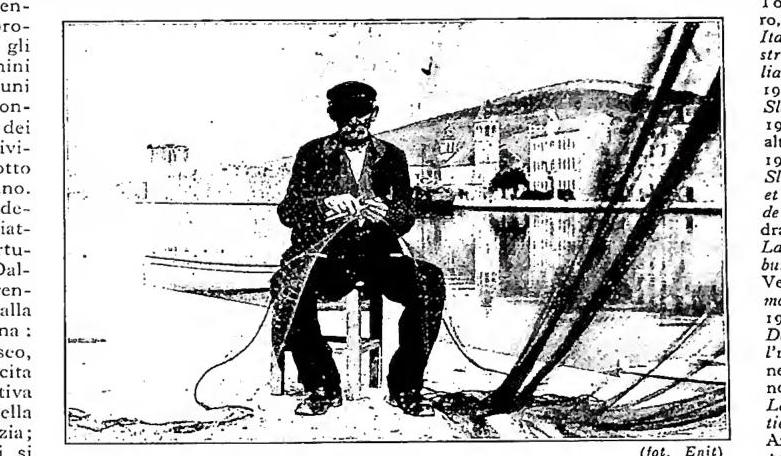
DALMAZIA - Fisherman of the island of Bua - Traò.
Turin 1914; A. Tamaro, Le condizioni degli Italiani soggetti all'Austria nella Venezia Giulia e nella D., Rome 1915; id., Italiani e Slavi nell'Adriatico, ibid. 1915; G. Dainelli and others, La D., Genoa 1915; S. A. Evans, Les Slaves de l'Adriatique et la route continentale de Constantinople, London 1916; A. Dudan, La monarchia degli Asburgo, Rome 1917; A. Venturi and others, La D. monumentale, Milan 1917; L. Vojnovic, La Dalmatie, l'Italie et l'unité yougoslave, Geneva 1917; C. Maranelli and G. Salvemini, La questione dell'Adriatico, Florence 1918; G. Amendola and others, Il patto di Roma, Rome 1918; G. D. Belletti, L'italianità della D.,
Bologna 1919; J. Bulic, Jugoslavia e Italia, Spalato 1919; A. Chaboseau, Les Serbes Croates Slovènes, Paris 1919; Z. Moravec, L'Italie et les Jugoslaves, ibid. 1919; A. Tamaro, La Vénétie Julienne et la Dalmatie. Histoire de la Nation italienne sur ses frontières orientales, II and III, Rome 1919 (with extensive bibliography); S. Gbelli, La maschera dell'Austria nell'Adriatico orientale, Prato 1919; A. Giannini, Libro verde [on the direct negotiations between the Italian and Yugoslav governments for Adriatic peace], Rome 1921; A. Alesani, La D., Zara 1933; A. Consiglio, D. veneta e romana, ibid. 1941; B. Dudan and A. Teia, L'italianità della D. negli ordinamenti e statuti cittadini, Milan 1943; O. Randi, D. etnica. Incontri e fusioni, ibid. 1943 (with a bibliography more especially Yugoslav).
Ersilio Michel
III. ARCHAEOLOGY
The Christian life of D. Salona (v.), which documents it with a wealth of monuments unique among the provincial Roman cities. The first sign is an oratory dating from the end of the 3rd century; the first known bishop, St Domnio (or Doimo), was martyred together with many companions, soldiers and civilians, under Diocletian. Salona, a metropolitan see from 414 to 639, was replaced by Spalato after the serious Avar and Slavic incursions (the relics of the martyrs were brought to Rome); it was subsequently suppressed in 1828. Eleven episcopal sees were its suffragans, while another ten were suffragans of Scodra, which was later replaced first by Doclea and then by Antivari. The latter is currently the primatial see for D., but the title of primate of D. also belongs to the patriarch of Venice. There is also the see of Zara, to which five other episcopal sees are suffragan. D., from which the Church received two popes, St Caius and Giovanni IV, takes pride in having given birth to St Jerome, at Stridone. The majority of the population is Catholic; the Orthodox constituted approximately 17% in 1921. The Austrian occupation first, and subsequently the Yugoslav occupation, made a considerable contribution to the number of Orthodox.IV. ART
Architecture, which is D.’s foremost contribution to art, has been exceptionally vigorous since the Roman period, favored by the excellent stone quarries. Works of considerable importance, almost all of them, however, poorly preserved, are found in every city: at Salona (amphitheatre, theatre, baths, twin temples), at Aenona, at Asseria (walls and Trajanic gate), at Burnum (praetorium), and at Doclea (basilica). Of particular importance is the palace of Diocletian, around which Spalato arose, remarkable for its organic, lucid conception, its powerful and animated, fully Roman architecture, and the notable integrity of its remains. It also displays characteristic features of Dalmatian decorative sculpture, vividly pictorial and of oriental inspiration. In D. too, thanks to relations with Attica, the two fundamental tendencies of Roman sculpture coexist. As for the minor arts, the glass industry deserves mention (Aenona, Iadera).Salona possesses precious remains of Christian buildings; noteworthy are the variety of basilical types (with a rectangular hall, three naves, a cross-shaped plan, or open to the sky), the two-celled mausoleums with high buttresses, the mosaic pavements, and the elegance of the marble furnishings.
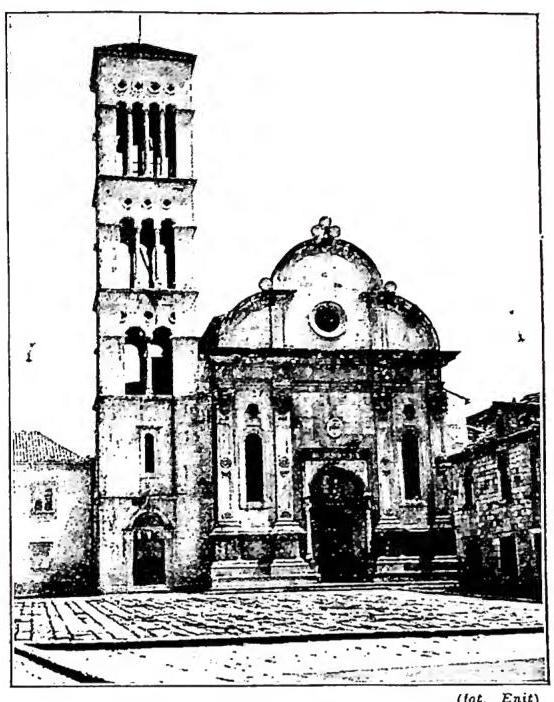
The early Middle Ages preserved the Roman interest in the central plan in many small churches of differing appearance (S. Donato at Zara, the Trinity at Spalato, S. Croce at Nona); characteristic is the small dome over the central nave of some others (S. Lorenzo at Zara). In the thirteenth and fourteenth centuries, often through the work of Benedictine monks, a broad series of works in polished stone fused Apulian, Lombard, and Pisan-Lucchese forms, both in their structures (the cathedral of Zara) and in their rather sumptuous decoration. Byzantine influences, whether direct or transmitted through Venice, are also evident in sculpture.
Gothic arrived with the advent of the Serenissima and has many examples, especially of a decorative character, in religious and civic buildings. The Renaissance, at first immature (the Palazzo dei Rettori at Ragusa), became measured and assured, especially through the work of Giorgio Orsini (the cathedral of Selenico), who had established himself through his personal, exuberant youthful works, and through those of Andrea Alessi and Niccolò Fiorentino (the Orsini chapel in the cathedral of Traù, which reprises the vault of the temple of Spalato). Military architecture produced noble works, also marked by Sammicheli (the gate of Zara). Orsini and Luciano da Laurana brought to the peninsula a wealth and originality of outstanding architecture.
Orsini, impetuous yet elegant, set his mark upon the vigorous sculpture of his time (Giovanni Dalmata is noteworthy); masters from Zara clothed their painting in Tuscan forms; the minor arts are distinctly Venetian. The contribution of the great Venetian painters of the Renaissance is frequent; the strong colors of Andrea da Zara (lo Schiavone) deserve mention, while other painters gravely echoed Venetian forms.
In the seventeenth and eighteenth centuries architectural activity was more limited; Ragusa is the city richest in works of this period, generally Roman in character, while sculpture and painting remained Venetian. After the Austrian occupation, works of distinction are lacking, although considerable building activity took place in various cities (Spalato, Zara). The sculptor Ivan Mestrovich is the only great voice of modern art, which in painting produced a few appreciable nineteenth-century artists. Among illustrious figures in other fields, Niccolò Tommaseo should be remembered. – Vedi tav. LXXVIII.