
TOMMASEO, NICCOLÒ. – Writer and politician, born in Sebenico on 9 October 1802, died in Florence on 1 May 1874. Having completed his initial studies at the seminary of Spalato, in 1817 he went to Padua to study law; there he met Rosmini, with whom he thereafter maintained a close but troubled friendship, and broadened his culture through the study of the major modern Italian and foreign philosophers and writers.
Between 1819 and 1824 he stayed sometimes in Padua and sometimes in Rovereto, at Rosmini’s home, and for brief periods in Sebenico and Venice. His restless, proud, abrasive, polemical temperament made it difficult for him to remain long in one place, and in 1824 fierce literary controversies prompted him to move to Milan, where he met Manzoni and took part in the dispute between the Romantics and the classicists (v. ROMANTICISMO), writing in support of the Romantic theses the pamphlet Il Perticari confutato da Dante (1825) and various articles. In October 1827 he went to Florence at the invitation of G.
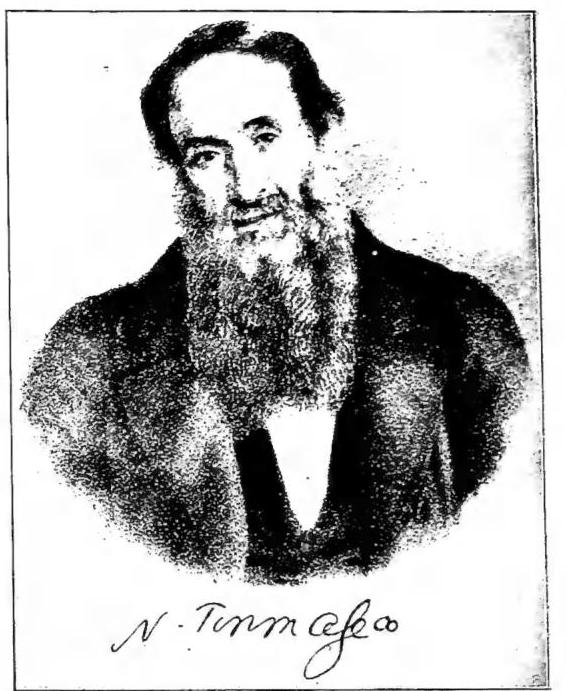
Rich in virtues and vices, and still richer in talent, T. is one of the most complex personalities of the nineteenth century. Among his fundamental characteristics is religious faith, lived with intensity and intransigence, although at times with excessively personal accents and dangerous nuances (of his books, the Studi filosofici and Roma e il mondo were placed on the Index, decrees of 13 September and 20 April 1842). His intransigence and ardor sometimes led T. to one-sided and unjust judgments, both in the moral and political sphere and in the literary one. But the habit of considering everything in the light of faith, of living continually in a religious atmosphere, imparts to every detail of his life a meaning and depth that make them elements of an exceptional spiritual experience. Connected with this is his habit of introspective inquiry and a singular knowledge of the psychology of sin, together with an original intuition of universal life and of the relations between the physical and moral worlds: an intuition akin to that of the German Romantics and the Symbolists. From this inner life, rich though disharmonious, T.’s thought and art derive their novelty and intensity of expression.
In T. one finds not so much complete logical constructions as flashes, bursts of insight, and premonitions. Particularly noteworthy are many reflections of an aesthetic and linguistic nature, often bearing a distinctly modern character. In language T. sees the form of the inner man, and in its history the history of the human spirit. All his philological activity is informed by these principles; in breadth and complexity, knowledge of the language, acumen, and sensitivity in interpreting it, this activity has no equal in our nineteenth century (besides the Dizionario della lingua italiana, the Dizionario dei sinonimi is of great importance). Connected with his philological activity is his critical work, which, although not supported by a unified method, finds its most original and successful expressions in observations of a stylistic nature. Also worthy of mention are his numerous writings of moral and educational inspiration, such as those collected in Dell'educazione (Lugano 1836).
As a poet, T. is among the most original figures of the nineteenth century. In many of his poems he transferred his personal experiences, especially those concerning love, preferably representing states of mind wavering between friendship and love, sensual pleasure and remorse, sensuality and compassion (cf. Voluttà e rimorso, Una serva, La contessa Matilde), often in boldly realistic forms. In the second period of his life, religious inspiration predominates; the poet’s imagination thus ranges throughout creation, from the humble flower to the luminous stars, from the insect to angelic creatures, and everywhere discovers correspondences and harmonies, which merge into the supreme harmony that is God (cf. I mondi, Gli spiriti, Le altezze, Pe' morti, etc.). New in its themes and rich in profound thoughts and delicate, or grand and powerful, images, T.’s lyric poetry is nevertheless often fragmentary.
In prose too, T. is more lyrical and artistic than either a narrator or a logician; the novel Fede e bellezza is largely autobiographical and is valuable less for its construction of characters and the movement of its narrative than for its lyrical-descriptive digressions, especially its impressions of nature, captured in a highly sensitive, refinedly colorful, and musical language. It is also noteworthy for its new and delicate psychological analyses, while from the moral point of view, despite the author’s intention to represent the expiation of sin through faith and suffering, its overall tone is rather uncertain.
T. also produced numerous splendid translations (cf. in particular those of the Canti popolari illirici e greci and those of the Salmi and the Vangelo).