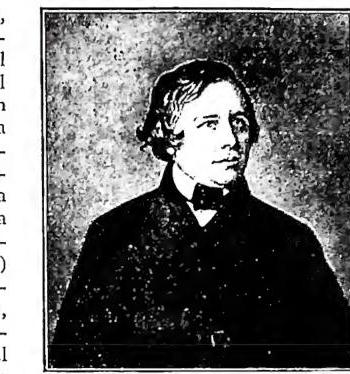
MONTALEMBERT, CHARLES-RENÉ, FORBES de. – Publicist and politician, born in London on 15 April 1810, died in Paris on 13 March 1870. He was educated first under the guidance of his maternal grandfather, James Forbes, an austere Protestant who saw in his England the “sanctuary of religion, virtue, and true liberalism”; then in France, from 1819 onward. As an adolescent, he already visited Germany, read extensively, and became enthusiastic about Rousseau, de Staël, and Chateaubriand: as both a Christian and a Romantic, he was already opposed to the “Voltairean spirit” widespread among the educated. On the other hand, the influence of liberal teachers, from Cousin to Guizot, Thierry, and Michelet, detached him from legitimism. In 1830, amid an aura of messianic expectation, he embraced La Mennais’s revolutionary Romanticism: he joined the editorial staff of Avenir (November 1830) alongside the older Lacordaire and Gerbet. The Breton polemicist dominated them, tending to give his initiative a supranational significance, exalting Belgium’s exemplary revolution and developing an entire political-religious doctrine.
M., who had visited O’Connell’s Ireland, idealized its experience and became impassioned for all oppressed nationalities, above all Catholic Poland. This romantic-revolutionary policy took shape in the Agence générale pour la défense de la liberté religieuse, founded by the editors of Avenir: they opened the struggle for freedom of education, basing themselves on the promise contained in the Charte. The trial of the école libre led M., as the accused, to defend himself before the Chamber of Peers, of which he became a member upon his father’s death (22 June 1831). Meanwhile, French democracy in 1830 was proving increasingly irreligious: in November 1831, M. could still admire the workers’ movement in Lyon, which he witnessed, because it seemed to him apolitical, but he already feared “democratic despotism,” while at the same time condemning the “despotism of legality” and “government as guardianship.” In 1833 M. translated A. Mickiewicz’s Livre des pèlerins polonais, in which a political-religious mysticism is expressed, and in the preface he called for a return to Christian solidarity among the peoples struggling against the twofold egoism of kings and materialist liberals.
After Avenir was suspended (15 November 1831), M. departed for Rome with La Mennais and Lacordaire: the journey provided an opportunity for contacts with the Italian liberal Catholics. Upon leaving Rome, the “pilgrims” received in Munich on 30 August the encyclical Mirari vos, which condemned their doctrines. A brief of Gregory XVI, issued in 1833, censured both La Mennais’s indiscipline and the book on Poland. Troubled, M. reached complete submission only in December 1834. In contact with the Catholic group in Munich between 1832 and 1834, he began studying medieval historical and religious texts and prepared a history of St Elizabeth of Hungary, while, together with F. A. Rio, defending the Christian art of the Middle Ages (Contre le vandalisme en France. Lettre à V. Hugo, in Revue des deux Mondes, 1 March 1833, and other writings, in Oeuvres, VI). In 1836 he married a de Mérode, daughter of a hero of Belgian independence: in Italy, with his wife, he was received by the Pope, who guided M. toward a conciliatory position toward Louis-Philippe. Between 1837 and 1839, M. partly abandoned his political theses; he nevertheless retained the principles inspiring the polemic against the alliance between throne and altar, against Gallicanism, and against the “materialist” policy of the “July Monarchy.” Thus he urged the government to protect the Christians of the East, became an advocate for Belgium, defended religious orders, contemplated a Catholic party as early as 1838, and in 1839 supported and directed Univers with Bailly, which Veuillot would later make famous. In 1840, in connection with a bill on child labor, he imposed on the public authorities the obligation to intervene for the protection of workers; he nevertheless demanded the autonomy of private charitable associations vis-à-vis the State, just as he demanded the revocation of the state monopoly in the field of education. This central problem of French Catholicism during the Restoration prompted M.’s parliamentary action and led him to write in 1843 on the “duty of Catholics in the question of freedom of education.” Through this writing, and through all his activity during the crucial years of the struggle, between 1842 and 1846, M. persuaded the French clergy and Catholics to demand freedom comme en Belgique, and by the same method: winning over public opinion and action by laypeople (Bishop Parisis wrote “on the role that laypeople must assume in questions relating to the freedom of the Church”). But only the political and social crisis of 1848 shook bourgeois anticlerical prejudices: in an atmosphere of social fear, the Falloux Law of 1850 crowned M.’s twenty-year effort on behalf of free education.
Although he rejected indifferentism together with radical separatism, and declared the theological problem irrelevant, analyzing solely what pertains to «political conduct», he was attacked by the intransigents. Cardinal Antonelli privately conveyed a reprimand to him. The «Syllabus» seemed to strike at his position and that of his friends in 1864; but in 1891 Mgr d'Hulat would note that his liberal theses always contained «the most explicit reservations in favor of the superior rights of truth». M., as publicist and orator, lacked the logical rigor of the jurist and theologian: the contingencies of political polemic, the struggle against the authoritarian Empire, and against those French Catholics who seemed to him to accept the ideology of Caesarism, dominated his thinking. The predominance of political concerns disturbed his vision in the face of the preparations for the First Vatican Council: Gallican motives resurfaced in him, as in Dupanloup. He did not, however, pass from criticism of a feared worldly «degeneration» of theological formulas to open insubordination. A testament to his faith in the final years of his life remains the great research he undertook on the history of monasticism in the West, from its beginnings to the twelfth century, without being able to complete II. M.’s works were meanwhile collected in 9 vols., between 1860 and 1868; during that same period 5 vols. of Les moines d'Occident depuis st Benoît jusqu'à st Bernard were published: after his death, another 2 vols. appeared (1877). Many valuable collections of correspondence then came to light, among which may be cited Correspondance de M. et de L. Cornudet, 1831-72 (Paris 1905); as early as 1873, the Lettres à un ami de collège (from M. to the same person) were being published; G. Goyau and P. de Lallemand collected several of M.’s letters to La Mennais (there 1932) and to others. A complete collection of his correspondence is lacking.