
LACORDAIRE, HENRI-DOMINIQUE. — An eminent Dominican orator and apologist, born at Recey-sur-Ource (Côte-d’Or) on 12 May 1802, died at Sorèze on 21 November 1862. Orphaned of his father at the age of four, he was educated by his mother at Dijon, in whose lycée he received an excellent linguistic education. In contact with the Voltairian milieu, he had already lost his faith at the beginning of his legal studies (1819). In Paris, where he had gone for the customary legal apprenticeship, he encountered the social problems then being vigorously debated and found their solution only in the Christian faith, which he embraced again with fervour and enthusiasm. He entered the Seminary of Issy (1824), from which he transferred to that of S. Sulpizio (1826), and was ordained a priest on 22 September 1827. Chaplain of the Visitation convent in Paris (1828) and of the Henri IV Lycée (1829), he came into contact with F. de Lamennais and became one of the principal editors of the Avenir.
After the condemnation of the newspaper, L. (1832) was the first to submit to the Pope; and when Lamennais expressed his rebellion in the notorious pamphlet Paroles d'un croyant and in other writings, he refuted his errors in Considérations sur le système philosophique de M. de Lamennais (Paris 1834) and in Lettre sur le St-Siège (ibid. 1837).
The trial refined L.’s spirit; devoting himself more earnestly to the interior life, he began that intellectual apostolate which is the distinctive feature of his life. The religious conferences held in the chapel of the Collège Stanislas (1834) achieved great success, and the following year L. was invited by Archbishop Quèlen to ascend the pulpit of Notre-Dame during Lent. It was a triumph, repeated in 1856, the year in which the now celebrated orator decided to become a Dominican. He prefaced the implementation of this plan with Mémoire pour le rétablissement en France de l'Ordre des Frères Prêcheurs (Paris 1839). Having gone to Rome, he received the religious habit at S. Maria sopra Minerva (9 April 1859) and, after completing his year of novitiate at the Convent of La Quercia (Viterbo), made his vows on 12 April 1840. In December, the evocative Vie de st Dominique (Paris 1840) appeared, creating around the adamantine figure of the Saint and the work of his Order an aura of sympathy and admiration.
Returning to France, he inaugurated the golden period of his activity (1841–54): he resumed the conferences at Notre-Dame, delivered acclaimed courses in preaching in the principal cities (Bordeaux, Nancy, Grenoble, Lyon, Strasbourg, Toulon, Toulouse), and founded convents and houses of study, culminating in the full establishment of the province of France (1850), of which he was appointed the first superior. This province was divided in 1858 for the erection of that of Lyon. On this point L. held views different from those of Fr. Danzas and Fr. Jandel, his former disciple, who had become Master General of the Order. He also founded the Teaching Third Order (1854), for which he worked with tireless tenacity and to which he always gave his special predilection. It was precisely at the College of this institution, opened at Sorèze (Tarn), that L. spent his final years, wisely making himself little with the little ones. On 2 February 1860 he was admitted to the Académie française: once again a little stir was made around this man who, weakened by illness and refined by suffering, forgetful of the glory of time, aspired to that of eternity.
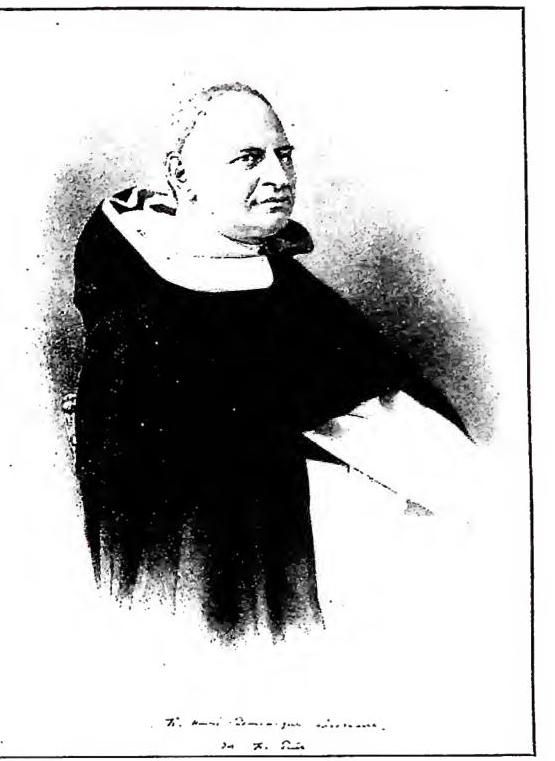
(from Panthéon des illustrations françaises au XIXe siècle published under the direction of Victor Frand. Clergé, Paris, n.d.)
LACORDAIRE, HENRI-DOMINIQUE - PORTRAIT.
Madeleine (there 1860): a work written for the restoration of the holy places of Provence, where scant critical sense is offset by a dazzling style, beneath which vibrate accents of deeply moved piety; De la liberté de l'Eglise et d'Italie (there 1860); Testament du père L. (edited by Montalambet, there 1870): these are the memoirs dictated during his final illness, concerning the vicissitudes of the restoration of the Order in France. There also remain numerous panegyrics, funeral orations, occasional speeches published by the author, and many letters and fragments printed posthumously. The complete works (9 vols.) were published several times; translations of the individual works are innumerable (in almost every language).
L.'s reputation is bound up with his conferences, which proceeded along a strictly logical thread, taking their point of departure from the historical and concrete fact of the Church; they are divided into three groups. Those of 1835-36 constitute the prologue, in which the Church is presented as the only authority capable of leading man to truth and to God (conf. 1-7); immediately afterward the listener is introduced to a consideration of the Church's doctrine in general, in its nature and sources (conf. 8-13). Those of 1843-46 expound the effects of Catholic doctrine on the spirit (conf. 14-20), on the soul (conf. 21-28), and on society (conf. 29-36); suddenly the audience is transported to contemplate the living figure of Christ, author of the Church (conf. 37-44). Those of 1848-51 bring the soul face to face with the massive block of the Church's dogma: God (conf. 45-52), man's relations with God (conf. 53-59), the Fall and reparation (conf. 60-66), and the providential economy of the Redemption (conf. 67-73). The conferences at Toulouse (1854) form a separate group, since they concern morality in its relations with the supernatural.
The method introduced by L. in his apologetics is partly new. He himself acknowledges (conf. 27) that he changed tactics; instead of ascending from the base, he began at the summit; he did not excavate the foundations of the pyramid, but, considering its apex, slowly descended into its most hidden part, which supports the entire structure. The Apostles saw the Head and believed in the still undeveloped body of the Church; L. saw the body and led the men of his time to believe in the invisible Head of the Church. The most beautiful and deeply felt conferences are precisely those dealing with Jesus. The figure of Christ, which in 1823 had overwhelmed the young Voltairean, won over his ardent spirit; it grew and towered in the thought and speech of this convert, whose life, like that of St. Paul, resolves itself into a lyrical song to the Divine Conqueror. Romanticism, through Chateaubriand, gave his song form and splendor; the theology of St. Augustine and St. Thomas gave it vigor and strength; his genius and the character of his native Burgundy gave it color and life. If his eloquence is neither as learned nor as profound as that of Bossuet and Bourdaloue (and is not free from imprecision), it nevertheless has a more human accent, more spontaneous movements, and a crystalline transparency of soul that draws near, in an animated and lived colloquy, cor ad cor, to his audience, which had become his interlocutor. L.'s speech, while always soaring in pure regions, touched life—life as it then tumultuously stirred in the souls of his listeners—and with a beat of its wings brought it close to the sources of the Gospel. The men of Romanticism, agitated by the religious and social turmoil provoked by the Revolution, understood, through the winged and imaginative speech of a poet who had become an apostle, that the religion of Christ was not a straitjacket but substantial nourishment for the harsh journey of life.
Posterity's judgment on L.'s political attitude has been varied (the phrase is well known: « I die as a penitent Christian and an unrepentant liberal »); some of his doctrinal statements are considered debatable, yet no one has ever doubted the nobility of his intentions, and all have admired his straight character and the austerity of his life.