Machine translation of the 1948–1954 Italian original. The original text is authoritative.
VISITAZIONE. – Religious order, known as the Visitandines or the Order of the V.
I. HISTORY
The V. was the joint work of St. Francesco di Sales (v.) and St. Chantal (v.). It was founded on 6 June 1610 at Annecy. St. Francesco’s intention was thereby to open the way to perfection for women too advanced in age or too weak to endure the cloister. He gave his institution a twofold purpose: on the one hand, contemplation, in order to practise charity toward God; on the other, visiting the poor and the sick, in order to practise charity toward one’s neighbor. Hence the name V. chosen for the new Order, which was to be nothing more than a congregation with simple vows. This was indeed how matters proceeded for five years; but in 1615, when he wished to establish a second house of the Institute at Lyon, St. Francesco had to consult the archbishop of Lyon, Msgr. de Marquemont, who was alarmed by the boldness of the undertaking, since, in his view, a community of religious women could live only in enclosure. St. Francesco yielded to this idea and discontinued assistance to the sick; he accepted enclosure and drew up new Constitutions for his religious women. The Visitandines retained their name, but became a cloistered Order, approved by Paul V on 6 October 1618. From that moment the vows were solemn and, by a privilege hitherto unheard of, the Visitandines replaced the canonical Office with the Little Office of the Blessed Virgin, as more suitable to their health. The Rule adopted was that of St. Augustine.
II. EXPANSION
The new Order spread rapidly. During the lifetime of s. Francesco di Sales himself (d. in 1622), monasteries were founded at Annecy, Lyon, Grenoble, Paris, Montferrand, Nevers, Orléans, Valence, Dijon, Belley, and Saint-Etienne. At the death of s. Giovanna di Chantal, in 1641, there were 87 Visitan-
(phot. Bildarchiv d. Ö. Nationalbibliothek)
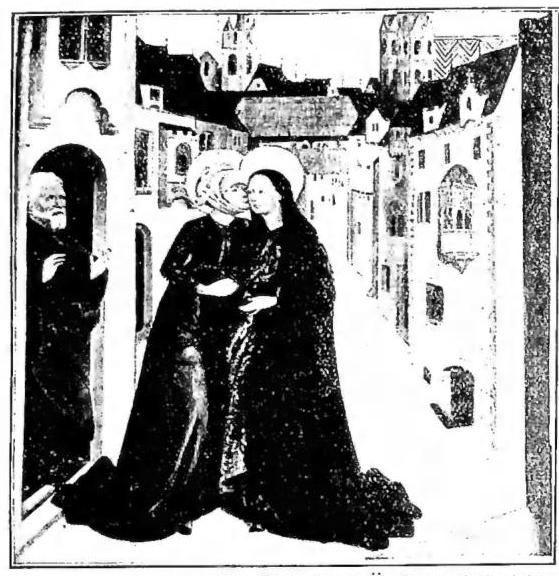
VISITAZIONE di MARIA SANTISSIMA - V. of Maria Vergine. Panel preserved in the church « ad Scotos » (ca. 1470) - Vienna.dine houses. After her death the Order established itself in Poland, the Netherlands, Bavaria, Germany, Austria, and Lebanon. It already existed, before 1641, in Switzerland and Italy. During the 18th century the V. reached its apogee, with 200 monasteries distributed throughout all Christian countries. After the French Revolution it resumed its expansion. At the end of the 19th century it had approximately 190 monasteries, with approximately 7,000 religious. From that time onward, the recruitment of religious declined. In 1925, there were 169 houses, of which 63 were in France, 29 in Italy, 17 in Spain, 20 in Canada and the United States, 9 in Belgium and Holland, 12 in South America, 7 in Germany, 3 in Austria, 2 in England, 2 in Switzerland, 3 in Poland, and 2 in Syria. At present the number of houses has declined further, and the measures taken to group the monasteries into provinces so as to support them through the rotation of personnel do not yet appear to have produced the hoped-for results.
III. WAY OF LIFE AND SPIRIT OF THE ORDER
The Order comprises choir religious, lay sisters, and portress sisters. The spirit of the Order was summed up by Pope Pius XI in the letter he wrote for the third centenary of the death of St. Francesco di Sales, in 1922: « There, neither long vigils nor lengthy psalmody, neither penances nor harsh expiations, but obedience to laws so gentle and so easy that even the least vigorous nuns can carry out all their provisions without difficulty. But these easy and pleasant actions must be inflamed by the fire of charity; and thus the religious... attain total self-denial and the humblest obedience, and, pursuing virtues that are not showy but solid, die to themselves in order to live in God ».
BIBL.: s. Francesco di Sales, Direct. spirit. pour les Soeurs de la Visitation S. Marie, Annecy 1889; Mère de Chaugy, Vie des quatre premières Mères de la Vis., Parigi 1892; anon., La Vis. S. Marie, Parigi 1923. V. FRANCESCO DI SALES; GIOVANNA DI CHANTAL. Leone Cristiani
Cite this article
“VISITAZIONE.” Enciclopedia Cattolica, vol. XII (1954), p. 943. Azione Romana digital edition, https://azioneromana.com/article/visitazione.