
LIBANO. – A state that proclaimed itself independent on 26 November 1941 and encompasses the southwestern part of Syria. It takes its name from the eponymous mountain massif, which lies entirely within II.
I. CIVIL HISTORY
As a unitary political state, L. has existed only since 1920. If, therefore, the last 30 years are excepted, its history must be understood by projecting backwards through the millennia the at least approximate boundaries of a recent entity; in this way, the history of a region is isolated which, although united in the present, cannot readily be regarded as such in the past.If, in fact, the geographical aspect is examined, L. can hardly be dissociated from the remainder of the mountainous strip separating the Arabian desert from the Mediterranean; and this although the rivers that cut transversely across the mountain chain, plunging between the rocks, constitute minor dividing lines. Nor, from the ethnic and religious point of view, can one certainly speak of unity in L.: yet, by a singular paradox, precisely the extremely varied range of ethno-religious communities established in the region gives it a distinctive individuality.
The condition of the land—rugged mountains in a double chain (Lebanon and Anti-Lebanon) descending towards the coast, broken into sections by valleys and torrents—is reflected historically in two essential characteristics: the relative autonomy of the inhabitants, under any government; and the taking refuge there and gradual establishment there of minorities of every kind and origin.
If, then, it is legitimate to treat a history of L., its typical character requires that it be developed with constant reference to regions more clearly defined in historical terms, and within whose histories those of Lebanon can readily be set: Phoenicia (v.) Syria (v.) later. It is above all the history of the latter that must be regarded as the guiding thread. Moreover, the events of the individual cities and ethno-religious communities (v. le voci relative) will also have to be followed in parallel, since their sum ultimately constitutes the history of L. itself.
1. Pre-Islamic History. - The most ancient history of L. was determined by the interest of the great surrounding powers in the wealth of its forests in timber, which subsequently grew progressively thinner. The Egyptians exercised supremacy over the trade in this building material, conducted through the coastal cities of Phoenicia, from as early as the third millennium B.C., and continued to do so until approximately the 13th century B.C., interrupted only by the period of the Hyksos (v. ca. 1750–1580). The invasion of the so-called “Sea Peoples” then ushered in a period of unstable equilibrium, during which the coastal cities assumed greater autonomy. Among them, Sidon predominated until approximately 1000, and thereafter Tyre. In the 8th century the region was conquered by the Assyrians and subsequently passed under the Babylonians, the Persians, Alexander the Great, the Ptolemies, the Seleucids, and finally the Romans, who in 64 B.C. incorporated it into the province of Syria. From then on, the history of Phoenicia lost all autonomy, and the events of L. are better understood within those of Syria.
2. Islamic History. - The Arab conquest, begun in A.D. 634, did not immediately extend to the mountain region, which, as in the past, remained in a state of partial autonomy. Then, under the Umayyad caliphate (661–750), Arab penetration intensified, though it encountered vigorous resistance. Ethnic and religious minorities began to flow into the rugged and easily defensible region, where they would remain until the present era: on the Christian side, the Maronites, the most important and numerous community, and, only later, groups of Melkites, Armenians, Syrians, Chaldeans, and Latins (among the Catholics); “Orthodox,” Armenians, Protestants, and Jacobites (among the non-Catholics); on the Muslim side, alongside the Sunnis, Druzes, Musayris, and Mutawalis; finally, small Kurdish and Jewish groups. To this multifaceted fragmentation must be added the traditional division of the Arabs into northern tribes
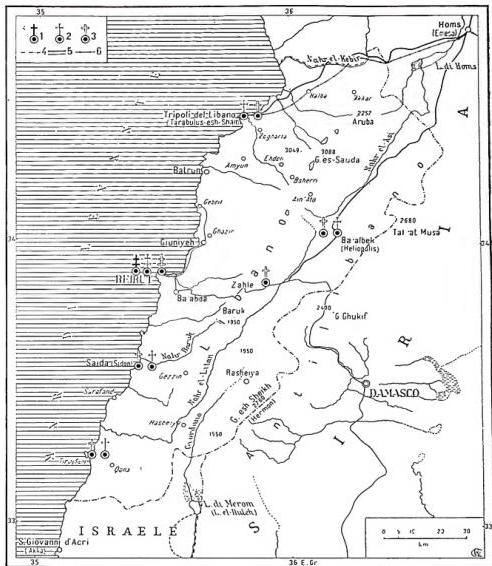
LIBANO - 1) Armenians; 2) Maronites; 3) Melchites; 4) State boundaries; 5) Railways; 6) Oil pipelines.
Among the aforementioned dynasties, that of the “emirs of Garb” deserves mention. Belonging to the Arab tribe of Tanûh, they established a principality around Beirut toward the end of the 9th century. In 1305, a revolt by the Muslim sects was suppressed by the Mamluks in central Lebanon; the Maronites took advantage of this to spread throughout that region. At the end of the 16th century, the Tanûh dynasty was succeeded by that of Banû Ma'n, Druzes; its foremost representative was the famous Fahr ad-dîn II (Faccardino: 1585–1635), author of the first major attempt to establish an independent state in Lebanon, with a policy of broad
In 1914, at the outbreak of the First World War, the Ottomans unilaterally abolished Lebanese autonomy. French and British troops, however, liberated the region in 1918.
3. The new Lebanese State
In 1920 the State of “Greater L.” was established, including the coastal region from the mouth of the Nahr al-Kabir to Rās an-Naqūrah, with the cities of Tripoli, Beirut, Sajdā, and Tyre, and inland the mountainous region of L. and part of the Anti-L., with the intervening plain of al-Biqā'. Over this State, the League of Nations officially confirmed the mandate to France in 1922. In 1926 the Constitution of the new State was promulgated: it was established as a republic, with a president serving for 3 years and eligible for re-election after an equal interval of time, a Chamber elected by direct universal suffrage for 4 years, and a Senate partly elective and partly appointed by the president for 6 years. The rights of the mandatory power were explicitly provided for. This Constitution subsequently underwent many vicissitudes: it was suspended on two occasions (1932-36 and 1939-43) and frequently amended, until the president’s term of office was extended to 6 years and he was made eligible for re-election, while the Senate was abolished, with the deputies appointed by the president transferred to the Chamber, whose membership was increased several times. From 1926 to 1933 the president was a Greek Orthodox Christian, Charles Debbās, while the head of government was a Maronite (various individuals). The presidency then passed to the Maronites and the direction of the government to Sunni Muslims. This situation continues to the present day.The Banū Ma'n were succeeded in 1679 by the Šihāb, Sunni Muslims. Like their predecessors, they too relied on the Maronites, encouraging their immigration to the south. The most important emir of the Šihāb was Bāṣir II (1788-1840), who again attempted to unify L. under his rule; the temporary Egyptian occupation (1831-40), which he had encouraged, proved fatal to him. After his fall, the Porte assumed direct control of L., dividing it into two qa'immaqāmāt, one Druze and one Maronite. Internal dissensions, aggravated by the Ottomans, culminated in the massacres of the Maronites in 1860: the European powers intervened at that point, and French troops landed in L.; the Porte was obliged to grant the region administrative autonomy, under a Christian governor approved by the European powers.
In 1936 the drive toward complete autonomy culminated in the Treaty with France, which provided for the end of the mandate within 3 years, with L.’s entry into the League of Nations (the same was to occur for Syria). However, the Treaty was not ratified by the French side and never entered into force; moreover, the Second World War broke out in 1939. First under a high commissioner of the Vichy government, L. was occupied in 1941 by de Gaulle’s and British forces; on that occasion General Catroux solemnly proclaimed the independence of L. (and of Syria). When, however, in 1943, the Lebanese Chamber abolished the mandatory rights, the French delegate-general Helleu ordered the arrest of the president and the members of the government. Riots broke out throughout L.; General Catroux, dispatched urgently, ordered the immediate release of those arrested. In 1945 two important events took place for L.: its accession to the League of Arab Countries and the Anglo-French agreement for the evacuation of the Levant. Under this agreement the French forces evacuated L. by 31 Aug. 1946. Effective independence had thus been achieved.
Among the most recent events, the following should be recalled: Lebanese hostility to the project for “Greater Syria,” which would absorb L. into a broader Arab State; the re-election as president on 27 May 1948 of the Maronite Bišārah al-Ḥārī, already in office since 1943; the war against the State of Israel and the armistice signed on 13 March 1949.
II. LEGAL STATUS OF THE CHURCH
Throughout history, L. has been the refuge of Christians. The first to Maronites (v.), who developed there into an important people. In the eighteenth century, the Catholic patriarchs of the Armenians, Melkites, and Syrians, on the other hand, sought shelter there from the persecutions of their adversaries. Three Catholic patriarchs still reside there: the Maronite at Bekorki, the Armenian and the Syrian at Beirut, and one dissident Armenian patriarch at Anjelias near Beirut.The population, according to the most recent statistics, is 1,241,598 and is distributed as follows: Christians
As can be seen, in L. there is a tangle of various religious communities, and the great difficulty is that of forming all these into a single people—a difficulty all the more serious because these communities are not merely different confessions but equally distinct social groups, with different pasts and many historical antagonisms. The most serious is the antithesis between Christians and Muslims, which is not merely religious but also social, since the Muslims are the descendants of the former conquerors and the Christians of the conquered. Christians and Muslims did indeed fight together for independence, but mutual distrust has nevertheless not entirely disappeared (v. BEIRUT; MARONITI).
In L., as in the other States where the system of personal status is in force, the juridical condition of the religious communities rests upon that status. This is particularly evident in the composition of Parliament, where the seats are distributed according to religious confession, in proportion to the numerical strength of each community, with the aim of thereby ensuring, in the best possible manner, the interests of all religions.
This particular confessional structure of L. creates in the country a balance of forces and an atmosphere of tolerance, making possible the coexistence, in the same territory, of groups so diverse ethnically and religiously. There have nevertheless been, and continue to be, apprehensions concerning the Christian majority. The Muslim groups, in fact, tend to seek the majority and political predominance in the nation, and find a favorable element for this purpose in the migration of Christians. Lebanese emigrants are almost as numerous as those who have remained in their homeland, and the great majority of them are Catholics. If one also considers the demographic factor, which likewise favors the Muslims, one understands the seriousness of the danger. For this reason, the Christian communities received with particular satisfaction the decision taken by the government in 1949 to recognize nationality for the 168,000 emigrants who, under the terms of the Treaty of Lausanne of 24 June 1923, opted for Lebanese citizenship. Eighty percent of these emigrants are Christian, and of these 50% are Catholic.
In the educational sector, the Lebanese Catholic hierarchy has not lacked grounds for concern. Indeed, decree no. 7000 of 1 October 1946, contrary to the Constitution, which guarantees freedom of teaching without special restrictions (part 1, chap. 2, art. 10),
subjected every school to strict control and made the opening of schools dependent on interminable formalities.
The Lebanese bishops immediately adopted an attitude opposing the decree, and their efforts were crowned with success, since on 23 March 1950 the Ministry of Public Education issued a decree that amended the previous one and represented a clear improvement over it, especially when one takes into account the particular difficulty posed in this matter by the confessional composition of L.
Relations between L. and the Holy See are cordial. On 8 April 1946 there was an exchange of notes between the Lebanese government and the Holy See, in which the former requested official recognition of independence and the establishment of diplomatic relations, and offered assurances and guarantees concerning the full freedom of Catholics; the latter took note of the assurances and recognized the independence of L. On 17 March 1947, the first plenipotentiary minister of the Republic of L. to the Holy See presented his Letters of Credence to the Holy Father, and the following June the first apostolic nuncio arrived in Beirut.
Ippolito Rotoli
III. L. IN HOLY SCRIPTURE (Hebrew Lèbhánôn; Akkadian Labnânu). - Mountain range between inland Syria and Cilicia. To the north it ends at the Nahr el-Kebîr, and to the south at the Nahr el-Litânî (the Leontes River of the ancients). The range broadens progressively from south to north and follows a south-southwesterly to north-northeasterly direction, reaching a length of approximately 170 km. Its greatest elevations are in the northern section, with the peaks of Dahr ed-Dubâb (3066 m.), Gebel Makmal (3126 m.), and Dahr el-Kotib (3063 m.); in the southern region the average elevation is lower (Gebel el-Barûk, 2200 m.). The el-Beqâ' valley separates L. from the Anti-Lebanon (Hebrew Sênîr), which forms an almost parallel range to the east. The highest summit of this range is the Great Hermon (2760 m.).

(courtesy of the Procurator General)
LIBANO – Portrait of Mons. Germano Farhât of the Aleppine Maronite Antonian order, Archbishop of Aleppo from 1725 to 1732. – Rome, Procurator General’s Office.
poetic texts (cf. Iudc. 9, 15; Is. 2, 13; 60, 13; Jer. 22, 23; Ez. 17, 3; 27, 5; 31, 3; Zach. 11, 1; Ps. 28, 5; 91, 13, etc.) as well as in the historical books (cf. I Reg. 5, 6, 9, 11, 13, etc.), the Egyptians already exploited the famous timber of L., which they came to collect from the port of Byblos. The Assyrians continued the plundering, as did the Israelites, as is clear from the well-known account of King Solomon’s building projects (cf. I Reg. 5, 6, 9, 11, 13, etc.); and alongside various species of conifers (Is. 60, 13), the Bible also recalls the wine of L. (cf. Os. 14, 8), while, in poetic language, it speaks admiringly of the fragrant scents (cf. Cant. 4, 11, Hebrew text) of so many trees (Is. 35, 2).
#### LIBELLATICI : V. ASI.