
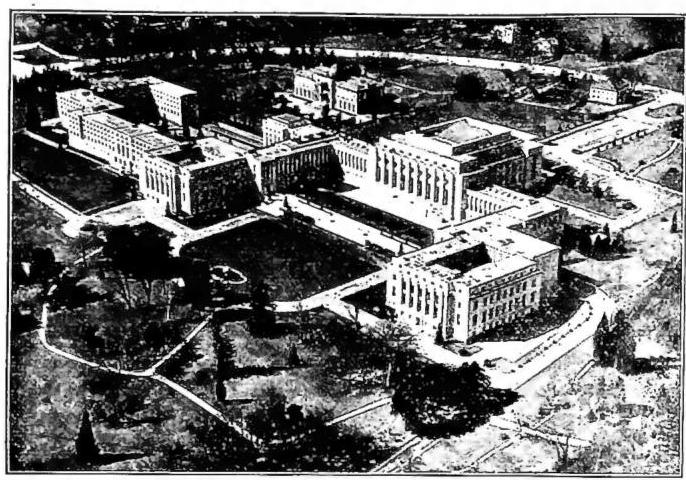
SOCIETY OF NATIONS. - An association among States for the maintenance of peace and the better governance of relations between peoples. The aspiration to bring about such an association had, at the beginning of the present century, taken on greater liveliness and a greater sense of concreteness, an atmosphere favorable to a realization that appeared necessary at the close of the First World War, which was to be, in the minds of those who made themselves interpreters of that ideology, the last war.
The one who decisively set the problem on the path toward a concrete realization, with the authority that came to him from the fact of having become the arbiter of the war, and then of the peace, was the President of the United States, Woodrow Wilson. The plan to bring about a L. of N., launched among the points of the program of the future peace during the conflict, became reality during the Paris Peace Conference, which entrusted the drafting of the covenant to a special Commission, whose presidency Wilson insisted on assuming
(Italy was represented there by V. E. Orlando and V. Scialoja). Taking into account the American draft and that of other States (there was also an Italian draft), it in fact drafted what was later commonly called "the pact" (Covenant) in 26 articles.
I. THE SOURCES
Regarding the covenant as the keystone of the system of peace, Wilson insisted, and the Conference accepted, that it should become the preamble of the great peace treaties. Indeed, the five great peace treaties of 1919-20 open with the Covenant and close with the charter of the International Labour Office, which is the earliest organization of the League of Nations and which came into being contemporaneously with the League itself. This was not intended to condemn the Covenant to follow the fortunes of the treaties, and therefore to live and fall with them. If, at bottom, that is what happened, it was a mere coincidence. The other argument may seem stronger: that the entry into force of the Covenant coincided with the entry into force of the peace treaty with Germany (Treaty of Versailles), but this served only to set the Covenant in motion. It was also said that the peacewas an appendix to the Covenant, but this is inaccurate and is contradicted by the fact that the Peace with Turkey (1923) is unconnected with the Covenant. The latter went its own way and was amended in accordance with the prescribed procedure (art. 26) on 13 Aug. 1924 (art. 6), on 26 Sept. 1924 (arts. 12, 13, 15), and on 29 July 1926 (art. 4), since it had not proved possible to harmonize it entirely with the Briand-Kellogg Pact, commonly known as the "outlawry of war."
II. CONSTITUTION OF THE LEAGUE OF NATIONS
The L. of N. was a permanent association of States with free government, governed by a written statute (the Covenant).The member States that constituted the L. of N. were all in a situation of legal equality, but historically a distinction was made between the original members, that is, the allied and associated powers, signatories of the Peace Treaty, which invited 13 States that had remained neutral during the war to participate in the League, with equal title. Subsequently other States were admitted, after the entry into force of the Covenant. The former enemies, although signatories of the peace treaties, were not part ab initio of the L. of N., despite its character as a construction for peace, but entered it subsequently (Germany after the Locarno Pact). The Covenant (art. 1), while requiring that adherence to the League be made without reservations by means of a declaration deposited with the secretary of the L. of N., allowed withdrawal from the League with two years' notice, provided that at the time of withdrawal the withdrawing party had fulfilled all its international duties and all the obligations deriving from the Covenant.
III. ORGANS OF THE LEAGUE OF NATIONS
There were two: 1) the Assembly, made up of the representatives of the members of the League (no more than three, but with only one vote), which met at least once a year, at the fixed seat of the League (Geneva) or in another place. It had the power to deal with any matter relating to the action of the League or to the interests of world peace (arts. 2 and 3), conducted its activity in accordance with internal rules, functioning through six commissions, which examined the reports and accounts of the organs, of the permanent organizations and of the temporary ones, proposing recommendations and resolutions on which the Assembly decided on the basis of a report by a general rapporteur; 2) the Council, which was composed of permanent members (representatives of States expressly designated, practically the great Powers) and of non-permanent members designated by the Assembly. The number of members of the two categories varied over the course of the League's development, while the twofold category was maintained, it being held that the possession of a permanent seat was justified by the greater responsibilities and burdens borne by the great powers in achieving the League's aims. Each Statemember was represented on the Council by a single representative and with a single vote. Member States could participate in the meetings of the Council during the discussion of affairs that especially concerned them, but without a vote. In general (art. 4, no. 4) the competence of the Council was determined specifically as that of the Assembly (arts. 2 and 4).
According to the provisions of arts. 3 and 4 the functions of the two organs are equal and parallel. But in reality they must be interpreted differently. When an express provision reserved certain measures to the competence of the Council, or to the Assembly, the competences were differentiated. When express provisions were lacking, a primacy was reserved to the decisions of the Assembly.
The Holy See, although in some cases its collaboration was also sought, was not part of and did not seek to be part of the L. of N., given also the purely [biciata] character with which the L. of N. arose and maintained itself until the end.
According to the literal wording of the Pact (art. 2) the secretary general is not an organ of the L. of N. He assists the two organs and participates in their sessions. But in practice (later expressly accepted in the Statute of the U.N.) he came to be recognized as an organ of the League. Moreover, he was at the head of the secretariat, established at the seat of the League in Geneva, which could however be changed by the Council, and which was divided into numerous and overstaffed offices.
Organs of the L. of N. were also: a) the Permanent Court of International Justice (art. 14) established at The Hague, governed by an autonomous statute and rules (v. ORGANIZZAZIONE DELLE NAZIONI UNITE (ORGANISATION DES NATIONS UNIES, O.N.U., OPPURE UNITED NATIONS ORGANISATION, U.N.O), II).
b) the International Labour Office (ILO), whose charter, as mentioned, was inserted in the last part of the peace treaties (v. ORGANIZZAZIONE INTERNAZIONALE DEL LAVORO (INTERNATIONAL LABOUR ORGANISATION; SIGLA: I.L.O)).
IV. PURPOSE OF THE LEAGUE OF NATIONS
They are indicated in the preamble of the Covenant and are those of promoting international cooperation and achieving the peace and security of States, through the undertaking not to resort to arms in certain cases (and therefore war was not absolutely excluded and its legitimacy was admitted in certain cases), the establishment of open, just and honourable relations between Nations (hence the condemnation of secret diplomacy and the affirmation of just relations between peoples), the firm recognition of the rules of international law as effective norms of conduct among Governments (hence the necessity of codifying international law, so that it might become certain), the observance of justice and scrupulous respect for every treaty in the mutual relations of civilized peoples. For the realization of these purposes, certain principles already appeared, with absolute or merely programmatic character, in the Covenant, such as the reduction of armaments (art. 8), protection against aggressions (art. 10), the condemnation of war (art. 11), the peaceful settlement of disputes (arts. 12, 13 and 15), the consequences of violations of these principles (art. 16), disputes with non-member States (art. 17), the registration and supervision of international treaties (arts. 18 and 20), respect for regional understandings (art. 21), the institution of assistance to other peoples through the system of mandates (art. 22), a programme of social and humanitarian action (art. 23), the coordination of international institutions (arts. 24 and 25).Certain attributions, aimed at preserving peace, were assigned to the League of Nations by the treaties themselves (Saar, Danzig, protection of minorities, etc.).
V. ORGANIZATIONS OF THE LEAGUE OF NATIONS
In order to attend to its vast institutional tasks and to those which were rapidly being added to those provided for by the Covenant, or as a development of them, the L. of N. created a series of technical organizations and permanent consultative commissions (auxiliary bodies), on whose systems and functions we shall merely recall: a) among the technical organizations, the economic and financial one, that of communications and transit, that of hygiene; b) among the consultative commissions, that of military, naval and air questions, that of mandates, that of intellectual cooperation,that of the protection of childhood and youth, that of opium (in addition to a central committee, likewise permanent), etc. Special consultative commissions of a temporary character were instituted from time to time, and they were very numerous. Finally, mention should be made of certain administrative or executive bodies (high commissioner for Danzig, for refugees, government commission for the Saar, etc.) and certain special institutes (intellectual cooperation in Paris, for the unification of private law and for educational cinematography in Rome, etc.).
This complex of organizations entailed a considerable and growing expense which was regulated annually through a budget approved by the assembly, apportioning the relative burden among the members.
VI. BIRTH, DEVELOPMENT AND END OF THE LEAGUE OF NATIONS
The L. of N. was born on 10 Jan. 1920 with the entry into force of the Treaty of Versailles, with the grave disappointment of the absence of the United States of America, since Congress had not approved the Treaty, thereby stripping of authority Wilson, who had been the foremost architect of the L. of N. But other great States were also missing, such as Germany, because it was defeated, and the U.S.S.R., inasmuch as the policy of the sanitary cordon was being pursued against it, and it had no interest in being part of it. The first five years of its life were therefore uncertain and difficult, while France and Great Britain gained the upper hand in the League's policies. Germany's entry (1926) marked a new surge of momentum, and the subsequent acquisition of the U.S.S.R. also appeared a great success. From 1926 to 1934, in fact, came the period of the greatest development of the L. of N.'s authority; but after the sanctions adopted against Italy over the Ethiopian affair, a rapid period of decline and loss of authority began, culminating in the outbreak of the Second World War, which it proved powerless to prevent. Italy and Germany abandoned it, and before them Costa Rica, Spain and Brazil. The U.S.S.R. was expelled from it following the aggression against Finland. In practice it was already entirely paralyzed by 1940. When therefore its end was decreed in 1947 and it was put into liquidation, it had already been reduced to a memory. Yet its activity cannot be judged with a summary condemnation. It worked in every field, with a tendency to do much, even if at times only on paper. Its greatest initiatives, namely those in which its strength and its ascendancy could be tested and which were, in fact, the truly living part of its constitutional functions, had a succession of failures. The economic conference failed, as did the financial one, that on the codification of international law, that on disarmament, that on general arbitration, etc. Its political action was not so fortunate, because if, for better or worse, it was able to settle the problems of the Åland Islands, of Vilnius, of Upper Silesia, of Albania's borders, of Memel, etc., that is, action against the small States, when it struck the great ones, or was able to resolve problems insofar as everyone wished to escape from distressing situations, such as the Corfu incident, it either failed miserably, as over the question of Eastern Karelia, of Finland, of Ethiopia, of the Sino-Japanese war.These failures, which undoubtedly stripped it of authority, also caused the much that was good it had accomplished to be forgotten.
VII. LEGACY OF THE LEAGUE OF NATIONS
When the Second World War was drawing to a close with the victory of the United Nations, no thought was given to reviving the League of Nations. A new one was created at the San Francisco Conference (1945). The second League of Nations is called the Organization for World Security (U.N.O. [v.]). Despite the extensive changes in rules and names, the old institutions live on substantially in the U.N.O.BIBL.: sources
of Nations, London 1927; C. Baldoni, La S. delle N., I. Padua 1936; A. C. De Breyha Vauthier, La Société des Nations centre d'études et source d'informations, Paris 1937.