
INTERNATIONAL LABOUR ORGANISATION (International Labour Organisation; abbreviation: I.L.O.). – It is a tripartite institution in which
governments, employers, and workers, directly represented, carry out, at the international level, action aimed at protecting and improving working conditions, in order to promote the international stability of economic and social conditions.
Part of the peace treaties following the First World War (Part XIII of those of Versailles, St-Germain, and Trianon, and Part XII of those of Neuilly and Sèvres) is devoted to the I.L.O.; included in it (cf. Art. 427 of the Treaty of Versailles) is the so-called “International Labour Charter,” containing certain general guiding principles for the social policy of the League of Nations, within which, with a certain degree of autonomy, the Organisation was incorporated (the principle that labour must not be regarded simply as a commodity or an article of commerce; the right of association for all purposes not contrary to the law, both for wage earners and for employers; remuneration of workers by a wage ensuring them a suitable standard of living, consonant with their surroundings and the period; adoption of the eight-hour day and the forty-eight-hour week, to be achieved wherever they had not yet been introduced; adoption of a weekly rest period of at least twenty-four hours, including Sunday whenever possible; abolition of child labour and the obligation to impose on the employment of young people of both sexes the limitations necessary to enable them to continue their education and ensure their physical development; the principle of equal pay without distinction of sex for work of equal value; the assurance, in the regulations enacted in each country concerning working conditions, of equitable economic treatment for all workers legally resident in that country; organisation by each State of an inspection service, including women, to ensure the application of laws and regulations on the protection of workers).
The I.L.O. survived the collapse of the League of Nations, continued to function during the Second World War, and subsequently became associated with the new United Nations Organisation (U.N.O.). Among the organs of the latter is an Economic and Social Council with particular competence concerning the
achievement of the purposes of the U.N.O. relating to international cooperation in economic and social matters (including the promotion of a higher standard of living, full employment of the workforce, and the conditions for economic and social progress and development). The I.L.O. is recognised as a specialised agency of the U.N.O.; their relations are governed by a special agreement (1946). It has a distinctive characteristic among inter-State institutions, since in its
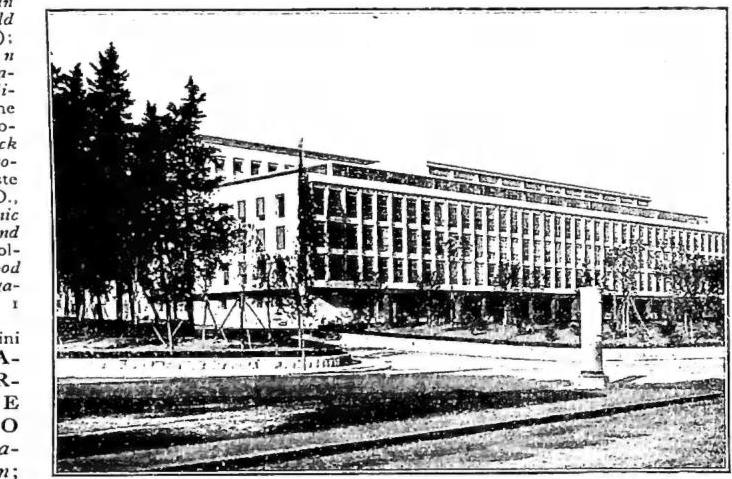
There are three essential organs: the International Labour Conference, the highest deliberative organ, which generally meets once a year; the Governing Body, the directing organ, which meets four times during the same period; and the International Labour Office, the executive and administrative organ and permanent secretariat (with an office also in Rome, as well as in other cities of various countries).
The Conference brings together the national delegations of the member States, which have reached a total of 61. Italy has belonged to it from the beginning (1919), except during the final period of Fascism, when it withdrew for political reasons following the Ethiopian war, rejoining it in 1945. The principal task of the Conference consists in drawing up standards of uni-
ORGANIZ. INTERN. DEL LAVORO - ORGANIZ. METEOROLOGICA
universally applicable, making them the subject of international conventions (multilateral, open) or of recommendations to governments (for adoption in individual domestic legal systems). The constitution of the I.L.O. requires member States to submit the conventions adopted by the Conference to the competent national authorities, with a view to proposing their ratification. A convention enters into force when it has been ratified by a specified number of States. Through ratification, the State undertakes to modify or supplement its legislation in order to bring it into conformity with the provisions of the convention itself; it also undertakes to submit to the I.L.O. a report on the measures taken in this regard. Measures are also provided for to ensure that ratified conventions are effectively brought into force. Recommendations are not subject to the ratification procedure, but member States nevertheless have the obligation to give practical effect to the provisions adopted through them.
The Governing Body consists of 32 members: 8 representatives of workers, 8 of employers, and 16 of governments, of whom 8 are permanent representatives of an equal number of countries of major industrial importance (including Italy), and 8 are elected from among the other States. It sets the agenda of the Conference; directs and supervises the Organization’s services, and adopts the annual budget.
The Office comprises all the technical services; it is responsible for studies and research and for the preparation and printing of numerous publications, ensures secretarial services, prepares the documentation relating to the topics under discussion, and provides the means intended to ensure the application of the conventions.
As of 1 August 1949, 98 conventions and 90 recommendations had been adopted; the former had received 1,022 ratifications. Under the auspices of the I.L.O., a great number of missions have been sent to countries and regions in need of the work of experts. For some time, this task of providing technical assistance to member States has been expanded. A particular effort is directed toward promoting and guiding all countries toward a more efficient use of their labor resources, and this entails the organization of employment placement, vocational training, and emigration for work purposes. At the same time, the I.L.O. has developed its regional activities, convening conferences and preparatory meetings in Europe, Latin America, Asia, and the Near and Middle East. Among the conventions adopted may be mentioned, for example, those concerning the eight-hour day and the forty-eight-hour week, freedom of association, the protection of wages, paid holidays, insurance against sickness and old age, and the prohibition of forced labor and night work by women, etc. Numerous conventions concern particular sectors of economic activity; a whole series, for example, is directed toward improving the conditions of seafarers.
After 1945, industry committees were established with the aim of contributing to the solution of economic or social problems in particular industries (for example, coal, iron and steel, petroleum, etc.). To facilitate the Organization’s work in different sectors, special committees were established (such as those for accident prevention, industrial hygiene, women’s work, employees, social security, etc.).
plication des conventions internationales du travail, there 1937; P. Zanela, Saggio sull'organizzazione permanente del lavoro, Palermo 1939. Ferruccio Pergolesi