METEOROLOGICAL ORGANIZATION. — Meteorology as a science owes its development to air navigation and radio, since it is becoming increasingly necessary for assisting aircraft flying over countries, nations, continents, and oceans.
The organization of the meteorological service is based: 1) on a network of meteorological stations, normally distributed in such a way that their observations provide a general and detailed knowledge of surface conditions in the regions for which meteorological assistance must be ensured.
These stations make observations at fixed times, internationally agreed upon, required for weather forecasting (synoptic observations), and others for direct assistance to air navigation (hourly observations, half-hourly observations, observations of the moment). In all States, the work of recording facts is carried out according to the same system, and the relevant messages are transmitted in coded form in order to save transmission time and also to enable scholars and pilots to express the same information independently of national languages. This fixed network is supplemented by that of the mobile stations, consisting of suitably designated ships equipped with meteorological instruments, and by the vehicles of the air lines. 2) On a network of stations that observe air currents at various heights by tracking, with theodolites, balloons (pilot balloons) filled with hydrogen. 3) On a network of stations that observe temperature, pressure, humidity, and, when possible, also wind in the free atmosphere up to heights exceeding 12–15 km. These stations are equipped with special radio-receiving apparatus capable of receiving the signals of a transmitting device carried by a hydrogen-filled balloon. 4) On a network of meteorological-radar stations for identifying rainy areas and the nature of clouds. 5) On a network of stations for identifying storm areas associated with electrical disturbances in the atmosphere (atmospherics). 6) On a network of scientific-experimental observatories that carry out special observations of solar radiation, fluctuations in the ionosphere, atmospheric electricity, turbulence, and everything else related to the field of meteorological phenomena. 7) On a network of regional meteorological centers, whose task is to centralize the observations of the regions under their jurisdiction and to provide a specialized weather-forecasting service aimed at meteorological assistance to flight (flight, route, and landing forecasts, storm warnings and safety warnings, regional and local forecasts), on the basis of a thorough analysis of the dynamic and thermodynamic conditions of the atmosphere at the surface and aloft, preparing special thermodynamic diagrams and particular geographical charts on which meteorological bulletins are entered using symbols that are likewise internationally agreed upon.
The organization of the meteorological service in Italy is, for a substantial part, entrusted to the Ministry of Defence—Air Force, which, through its bodies, provides for: a) the organization and operation of the meteorological network; b) procurement and installations; c) studies and climatology; d) forecasts and information.
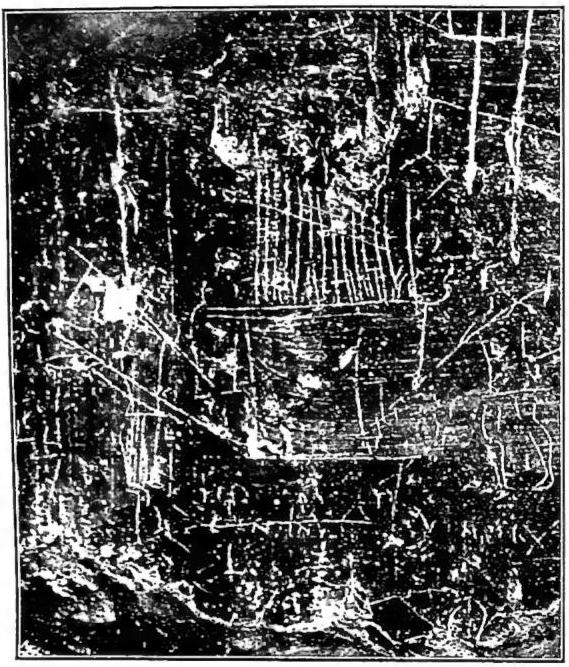
(photo. Pont. Comm. di arc. sacra)
ORGANO — Hydraulus graffito on the wall of a Roman house discovered beneath the basilica of S. Sebastiano (ca. 3rd century), depicting an organist and persons at the bellows — Rome.
are centralized, by the safest and most rapid means, at the regional meteorological centers, which proceed to broadcast them according to scheduled times: in synoptic collective bulletins every three hours and in abbreviated collective bulletins every hour.
The three-hourly collective bulletins are gathered by the Information Center together with other international collective bulletins which, in accordance with worldwide conventions, are broadcast at predetermined times. Europe and North Africa, in particular, are divided into four regions, whose respective collective bulletins are broadcast separately from one another, so as to follow one another in a specified order, with the aim of facilitating reception by those services that require meteorological bulletins. This is because a weather forecast cannot be made for a region or locality, or for a flight, unless one possesses a general picture of the meteorological situation over a wider area. For example, a weather forecast for Italy cannot be made unless one has the bulletins for all of Europe, the Atlantic Ocean, and North Africa. The meteorological services of each country form part of a World Meteorological Organization (O.M.M.), which is currently affiliated with the United Nations Organization (O.N.U.). There is another international organization concerned with meteorology solely in relation to air navigation: the International Civil Aviation Organization (O.A.C.I.).