
ORGANO. — A musical instrument with air-operated pipes (from about ten in primitive examples to several thousand in modern ones), of varying size, shape, and material (metal, wood, etc.), grouped according to their timbre into stops. The sound is produced either by the air vibrating within the body of the pipes, and is lower the higher the column of vibrating air (the other characteristics of the pipe—diameter, cylindrical or conical shape, etc.—affect only the timbre), or by a vibrating reed inserted into the foot of the pipe, which serves only to balance the sounds emitted by the reed. The necessary air current, generated by mechanical means
(pumps, bellows, fans), is forced into the windchests, the vital ganglia of the organ, constructed according to various systems (slider, wind, piston, membrane, electric, etc.); resting on these are the pipes of the same kind and shape, arranged in rows and in progressive sizes. The windchests are connected by the transmission (mechanical or by tracker action, tubular, electric) to the console, at the organist’s disposal, which carries the keyboards (from one to five, in exceptional cases up to seven, with varying numbers of keys), the pedalboard (with a maximum of 32 pedals), the mechanisms for operating the stops, and all the other devices that facilitate the handling of the instrument or amplify its tonal resources (toe pistons, couplers, unisons, reversible pistons, small pistons, collective controls, cancelers, free and adjustable combinations, swell pedals, etc.).
The o. originated from the addition of an air reservoir, as in the bagpipe, to Pan’s syrinx. In its two-thousand-year evolution it underwent the most astonishing technical and tonal transformations.
The ûghâbh of the Bible, organum in the Vulgate, a term retained in the new translation of the Psalter, generically indicates a wind instrument. A primitive bellows-operated o. seems to have been the maghrêphâh mentioned in the Talmud. According to A. Kircher (Musurgia universalis, Roma 1650), the maîrôgîthâ' (Dan., III, 5, 7, 10, 15) also belonged to the same class, but his description of it is fanciful. The history of the o., however, begins with the hydraulus, so called because water was used to balance the pressure of the air produced by pumps. Invented by Ctesibius, who lived under the reign of Ptolemy I (246–21 B.C.), it is described by Heron of Alexandria in Spiritalia seu pneumatica, I, 42. Ancient Arabic sources preserve, under the name of Muristus, Greek treatises, including a description of the hydraulic o., perhaps by Ctesibius himself. In any event, Eastern sources provide no information about instruments of this kind earlier than the hydraulus. In the instrument described by Vitruvius (De architectura, X, 13, 1–6), groups of pipes could be selected at will. This characteristic is confirmed by the discovery at Aquincum (1931) of the remains of an authentic Roman o. Each group of pipes was controlled by a perforated bar, moved by means of a handle between the boards of the windchest in the longitudinal direction. The analogy with the mechanism of the stops in the slider windchest is evident. In the hydraulus, however, the individual groups of pipes do not select, as in the stops,
different timbres, but different pitches or modes. Other perforated bars, placed above the preceding ones but sliding in the depthwise direction of the windchest, were connected to the keys; when the holes in the bars coincided with those in the boards of the windchest, the pipes sounded. The latter, very different from modern pipes, were nevertheless flue pipes of small proportions, mostly covered and with narrow mouths, made of a laminated brass alloy. They must have sounded under high pressure, since they were fitted with reinforcing rings. The hydraulus had great dif-
(photo: Musei di Roma)
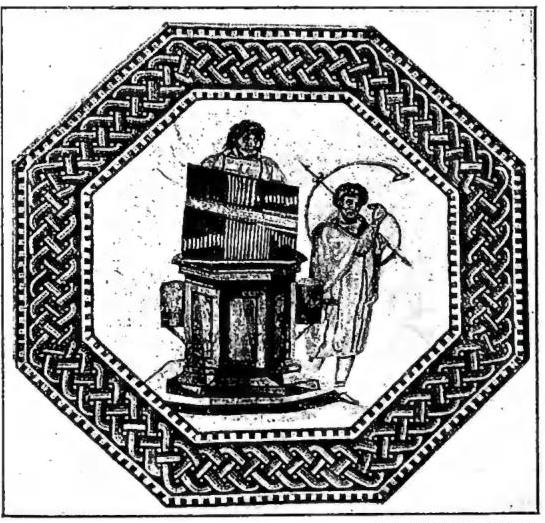
ORGANO - Hydraulus with an organist, of whom only the legs remain. Terracotta from the end of the 1st century–beginning of the 2nd century—Carthage, Lavigerie Museum.
The hydraulus became widespread, especially as a secular instrument, and is reproduced in numerous archaeological monuments, such as the celebrated terracotta found at Carthage in 1885 and the graffiti discovered in 1928 beneath the basilica of S. Sebastiano in Rome, etc. (cf. C. Mercurelli, Hydraulus graffito su epigrafe sepolcrale del cemeterio di Commodilla, in Riv. Arch. Crist., 15 [1938], pp. 43–106). The obelisk of Theodosius (d. in 393) in Constantinople depicts an o. with bellows.
It appears that the Roman o. disappeared with the barbarian invasions. It survived in the East, whence it returned to Europe; in the year 757, all the annals record, venit organum in Franciam, the admired gift of the emperor Constantine Copronymus to Pippin. In 826 Balderic, marquis of Friuli, brought to Louis the Pious the Venetian priest George, a builder of o. according to the Greek manner, who was commissioned to construct one in Aachen. But only the discovery of the ventilabrum (also called a windchest), the valve that would replace, in all its functions, the holes of the sliding rods used in the hydraulus, enabled the medieval o. to develop. It became an object of study, and the monks wrote the first theoretical treatises on its construction (De mensura fistularum, 9th century, Paris, Bibliothèque nationale, ms. lat. 12049, fol. 43; Incipit ordo fistularum by the anonymous Bobbio author, Milan, Biblioteca Ambrosiana). Certain reports concerning the use of the o., derived from unreliable documents, should be accepted with due reservations.
In the 13th century, under the impetus of the Ars nova, the o. made considerable progress, and the highly agile portative (portable organ), played with the right hand while the left pressed the small bellows, became especially widespread. There is abundant iconographic evidence of this in the paintings of the period, from Giotto onward. These reproductions also show that the portatives were equipped with handles, certainly for selecting the stops or for opening the air supply to certain low pipes called bordons (in Andrea da Firenze’s allegory of Music, ca. 1355, in the Spanish Chapel at S. Maria Novella in Florence, four handles can be seen on the side of the instrument, while three are depicted in Caterino Veneziano’s Incoronazione della Vergine, in the Accademia of Venice).
Gradually, instruments began to assert themselves
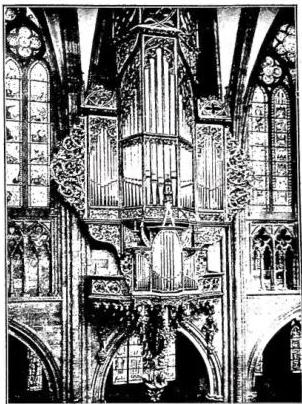
(courtesy of Dr. Renato Lucelli) ORGANO - Silbermann’s organ in Strasbourg Cathedral.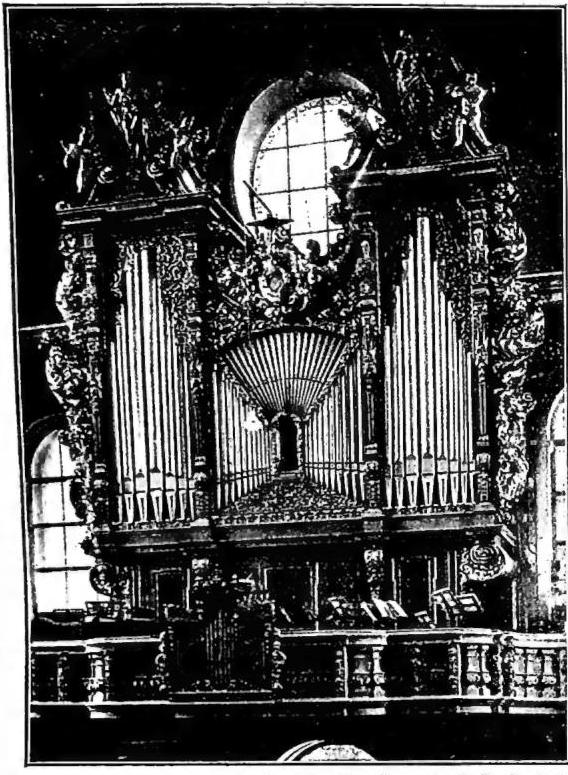
(courtesy of Monsignor Frutoc)
ORGANO - O. of the provost church of S. Giacomo with 5500 pipes (1725), rebuilt after the penultimate war - Innsbruck.
The Trevisan organ of 1436, in which the expense of iron wire ad infingenda registros et tastos in the organ of the Cathedral is recorded, was followed by many decades before the use of regular registration in large organs could be demonstrated. The well-known Bernardo d'Alemagna, like perhaps Matteo da Prato, still belonged to the old school, which did not know the division of the registers in the windchests. Zarlino (1588) recalls an ancient organ, of suitable size, in the Basilica del Santo of Padua, whose windchest “had many ranks of sounds, which contained many pipes, and therefore had no register at all.” But Bernardo’s son, known as Antonio Dilmano, in 1487 reduced de antico ad modernum the organ of Milan Cathedral made by his father, and more explicitly, in 1495, transformed, al modo novo cum registri, an instrument at Feltre. In this period and in the sixteenth century, among Italian organ builders, the outstanding figures were Lorenzo di Giacomo (S. Petronio in Bologna, 1471, one of the few ancient instruments still in existence), Domenico di Lorenzo (S. Pietro in Vaticano, 1496), G. Battista Fachetti (S. Lorenzo in Genoa, 1552), Vincenzo Colombo (S. Marco in Venice, 1558), Luca Biasi (S. Giovanni in Laterano, 1597), and above all the Antegnati family of Brescia. In the Arte organica, published in 1608, Costanzo Antegnati illustrates the artistic merits of his family; and Antonio Barcotto, in a short treatise of 1652, completes the technical information on the classical Italian organ. It has no innovative tendencies: to the family of the principal stops forming the chorus in the final decades of the fifteenth century, only the flute in 15th and 12th was added, and in the second half of the sixteenth century the fiffaro or voce umana, a stop based on acoustic tremolo. Instruments with two keyboards or numerous stops of varied timbre, common abroad, are exceptions in Italy. Having reached technical perfection, the organ achieved a tonal balance that favored the development of organ composition and reached its culmination in Giovanni Sebastiano Bach. This was the period of greatest
flourishing of German organ building, and celebrated organ builders created important and magnificent instruments. In Italy there was no parallel development at that time, although foreign organ builders sought to broaden the perfect but restricted scheme of the Italian organ. Eugenio Gasparini (1624–1706), a Silesian and the first teacher of Andrea Silbermann, propagated a new technique in the Venetian territories for almost half a century. Guglielmo Hermans (1601–83), a Flemish lay Jesuit, spread the developed forms of the northern organ throughout Italy; the Provençal school made its way into Piedmont with Antonio Julian, and perhaps also through an anonymous treatise (manuscript in the Biblioteca Martini, Bologna), in which the Italian and French organ-building schools of the second half of the seventeenth century are compared. But Italian organ builders did not depart from the national tradition; only in the eighteenth century did Azzolino della Ciaia (1671–1753) in Pisa and Donato del Piano (1698–1785) in Catania create instruments of exceptional size for Italy, while the Venetian school of Pietro Nacchini (1694–1770?) and Gaetano Callido (1727–1813) adopted proportions skillfully studied from classical models and foreign technical treatises. Only with the Bergamask Serassi family was the Italian organ enriched with new timbres, especially from the reed family; yet in its forms it did not assimilate the technical characteristics necessary for performing the organ compositions of German and French authors.
German Romanticism replaced the characteristic sonorities of the Baroque organ with orchestral timbres. The nineteenth-century organ benefited from many innovations, such as the Barker pneumatic lever, tubular transmission, piston windchests, and so forth; these innovations were in part detrimental to true organ sonorities. The French organ likewise underwent Romantic influence, but in Carvaillé-Coll (1811–99) it found a gifted artist who knew how to avoid every excess. In Italy, toward the final decades of the nineteenth century, with the spread of the Cecilian movement, reform of the organ was not limited to necessary technical updates concerning the number and form of the keyboards and pedals, but modified the traditional sonorities in order to follow Romantic ideals. The Englishman William Trice (1847–1918) was the first to introduce the new manufacturing systems in Italy. Carlo Vegezzi-Bossi (1858–1927) showed himself a highly sensitive artist, grafting traditional Italian tonal qualities onto the reformed organ.
Around the first quarter of the present century, a reactionary movement arose in Germany in favor of Baroque sonorities, while the American organ of the last decades, through the ingenious technical innovations of skilled artists such as Robert Hope-Jone (1859–1914), spread the new sonorities of high-pressure stops and perfected electric actions. But even the best European factories, including the Italian ones, competed in technical perfection with products from overseas. Modern technology has succeeded in replacing the pipes of the organ with electrical circuits; various types of instruments have become widespread as substitutes for the traditional organ, the best known among them being the Hammond electrophone.
With the introduction of figured bass, the organ became the instrument most suited to the realization of the basso continuo in sacred compositions. It subsequently performed an analogous function in concerted sacred music with instruments, even when the orchestra assumed considerable importance, as in the so-called Viennese classics (Haydn, Mozart, etc.). In accompanied vocal music, the organ is now often entrusted with an obbligato part carrying prominent duties. A particular development was attained by the organ accompaniment of Gregorian chant, which in modern times is often a practical necessity and increasingly enhances the importance of the organ as support for popular singing.
The resources of modern technology, which facilitate the connection at a single console of several organs situated in different locations, can be usefully exploited, provided that one does not make the mistake of considering the individual bodies, placed at a considerable distance from one another, a single instrument.
For the use of the organ in churches v.: MUSICA.
nell, Mainz 1938); A. Banchieri, Conclusioni nel mono dell'o., Bologna 1609 (reprinted in facsimile, Milan 1934); M. Practorius, De organographia, Wolfenbüttel 1610 (reprinted under the direction of W. Gurlitt, Kassel 1929); J. F. Bedos de Celles, L'Art du facteur d'orgues, 3 vols., Paris 1766–78 (reprinted under the direction of C. Mahrenholz, Kassel 1931); G. Serassi, Lettere sugli o., Bergamo 1816. — Studies: Regolamento generale internazionale per la costruzione degli o. (1929), translated and annotated by C. Sangiorgio, Bronte 1914; id., Fonica e registrazione dell'o., there 1923; E. Rupp, Die Entwicklungsgeschichte der Orgelbaumst. Einsiedeln 1929; C. Mahrenholz, Die Orgelregister, ihre Geschichte und ihr Bau, Kassel 1930; Y. Rokseth, La musique d'orgue au XVIe siècle et au début du XVIe, Paris 1930; R. Manari, Arte della registrazione (dell'o.), Rome 1931; R. Lunelli, Note sulle origini dell'o. italiano, there 1933; H. Klotz, Über die Orgelkunst der Gotik, der Renaissance und des Barock, Kassel 1934; G. Frotscher, Geschichte des Orgelspiels und der Orgelkomposition, Berlin 1935; N. Dufourcq, Esquisse d'une histoire de l'orgue en France du XIIIe siècle, Paris 1935; J. G. Toepfer and P. Smets, Lehrbuch der Orgelbaumst. 3rd ed., Mainz 1936–39; R. Lunelli, Organari stranieri in Italia, Rome 1938; id., Amiens traitéss de facture d'orgues italiens, in L'orgue, 39 (1939), pp. 131–34; C. Locher, Manuale dell'organista, with an appendix by F. Vignanelli, 2nd Italian ed., Milan 1940; M. A. Vente, Baunstraffen tot de Geesedens van het Nederlandse Orgel in de 16 de Eeu, Amsterdam 1942; K. Jeppesen, Die italienische Orgelmusik am Anfang des Cinquecento, Copenhagen 1943; W. Kwasnik, Die Orgel der Neuzeit, Cologne 1948; R. Lunelli, Musica ed estetica delle sonorità organistiche al servizio della liturgia, Trento 1930. — Bibliographical works: R. Fallou-N. Dufourcq, Eleni d'une bibliographie de l'histoire de l'orgue en France, Paris 1929; B. Weigl, Handbuch der Orgelliteratur, Leipzig 1931; E. Flade, Handschriften und Drucke zuzeier Jahrtausende zum Thema der Orgel, in Deutsche Musikkultur, 6 (1942), pp. 126–43. Renato Lunelli
ART. — No monumental organs are known in churches dating from before the mid-fifteenth century. In the earliest examples, the case is devoid of ornament, and the pipes may be concealed from view by shutters, generally painted on the outside with a single scene, with figures of saints or separate scenes on the exterior. This decoration of the organ, often entrusted to the greatest artists, was common in northern Italy (a famous example is the shutters by Cosme Tura, now in the Museo del duomo of Ferrara), especially in the Veneto and in regions artistically connected with Venice; organ shutters were painted by Giambellino, Carpaccio, Sebastiano del Piombo, Tintoretto, and Veronese, and in Brescia by Romanino and Moretto, well into the late sixteenth century. In central Italy, as early as the beginning of the sixteenth century, the organ with visible pipes set within an architecturally conceived façade had come into use: one of the earliest known examples is that of S. Maria della Scala in Siena, based on a design by Peruzzi; only slightly later is that of the cathedral of Arezzo, dated 1535, Vasari’s first architectural work, conceived as an altar frame and connected with the gallery below.
But above all in the seventeenth century, with the development of sacred music, the importance of the organ increased, and Baroque magnificence increasingly enriched its façades with ornament and enlarged them by connecting them with the gallery (v.). After Bernini, who in the famous organ of the right transept of S. Maria del Popolo achieved a new pictorial effect through the contrast between the rigid verticality of the pipes and the movement of the twisted foliage, seventeenth-century imagination delighted in enlivening organs with festoons, scrolls, and statues (Chiesa Nuova); when transferred to the counter-façade, the organ became the central motif of the architectural composition of the entire wall (S. Maria della Vittoria, Gesù e Maria, etc.).
In the eighteenth century, that of the Maddalena is a lively example of the most imaginative Rococo. Architectural façades from the nineteenth century are rarer; among them are those of the Gesù in Rome, which coldly repeat sixteenth-century motifs, and that of the church of the Servi in Rimini, which forms a monumental complex with the gallery supported by caryatids. — Vedi tavv. XVIII-XIX.
(by courtesy of dalt. Renato Lunelli)
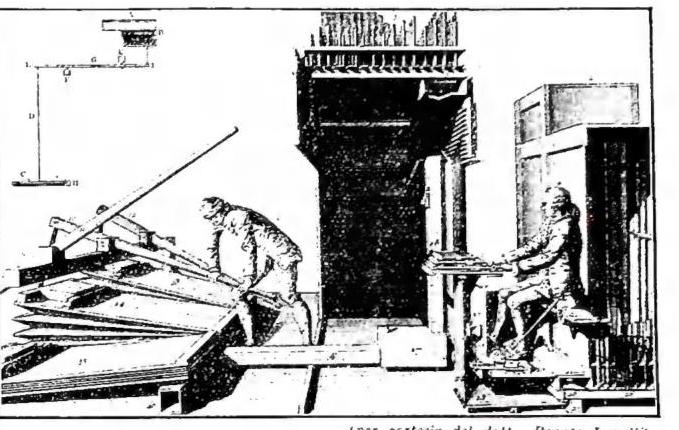
ORGANO – Operation of an o. (18th century). From a print of the period.