
MUSIC. - The philosophical concept of music, which among the ancients had a predominantly ethical character and among moderns falls within the vast framework of aesthetics, can be expressed—beyond contingent particularities of time and space—by first assigning music a religious value, and then a highly educational purpose (cf. Sum. Theol., 2ᵃ-2ᵃᵉ, q. 91, a. 2).
In the ensemble of theories prior to the advent of Christianity, the aesthetics of music did not find significant development except in the Greek world. Among the Hebrews, just as philosophy had little place, so too was the theory of music, which they willingly subordinated to the practice of that art. Among the Greeks, by contrast, both the practice and the theory of music were cultivated, both of which were later inherited by the Christian world. For Greek philosophers, music had a triple value: religious, moral, and therapeutic. For the first interpretation, one must recall those thinkers who, following the Egyptians, Assyrians, and likewise the Hebrews, considered the teaching of music a mission reserved for priests: among them are Plutarch, Plato, and, in the Roman world, Censorinus, Quintilian, Horace, etc. For the second, one may again cite the authors of the first current, Plutarch and Plato, to whom Aristotle, Aristoxenus, and others are added; for Aristotle, there was a division of musical modes according to the psychic effect they produced and, thus, a triple ethos: debilitating, exciting, calming. Finally, in the group of thinkers who attributed a therapeutic value to music, one may recall those who followed the path of Aristotelian catharsis, according to which music had a soothing efficacy: among them is again Plato, who in the Charmides affirms that the care of the body began with the care of the soul’s illnesses, then Theophrastus, who suggested treating causalgia with music in the Phrygian mode, and again Plutarch, who reports the case of Thales of Crete who freed Sparta from the plague with music.
From the very beginning of the Christian era, as will be seen further on, music held particular importance in the life of the Church, and sacred chant gradually acquired an independent position, while still preserving notable elements derived from Hebrew, Greek, Gnostic melodies, etc., and a liturgical functionality that made it the praying soul of the rite. For almost the entire first millennium, Christian liturgical chant, in its various aspects derived from rich and ancient traditions of Ambrosian, Gallican, Mozarabic, and Byzantine chant, remained strictly monodic, even if some indications suggest, in the Schola cantorum of Rome or elsewhere, the beginnings of polyphony. Codified by St. Gregory the Great (v. GREGORIO MAGNO), Latin chant spread throughout the West, thus constituting the substratum of all music, the primary source from which European sound art drew for several centuries. Indeed, upon the framework of Gregorian melodies, the first tentative polyphonies were woven around the year 1000, and upon their rich thematic background, the grandiose architectures of Palestrinian polyphony were constructed in the 16th century.
In considering the formation of this vital sap, the conceptual position of the musical problem is of no small importance, arising first as an ethical-social issue, or even with a mystical-ascetic character, before becoming an aesthetic one. In the thought of the early Church Fathers, music, as an echo of a dissolving pagan world, was harshly condemned, while the rise of chant as homage to God in the Christian temple met with the greatest favor and encouragement. The Fathers, grafting their conception onto the ethical current of Greek thinkers (Pythagoras, Plato, Aristotle, Theophrastus, Aristoxenus, Stoics, and Eclectics) and the mystical current of the Alexandrian school (Philo the Jew, Plotinus), attributed to chant that ethical-religious function which was to continue throughout the Middle Ages, culminating in the doctrine of modal ethos, which extends to this day with distant and not entirely extinguished offshoots of ancient thought. At the end of the first millennium, characterized by monody and homophony, in which liturgical expression dominated musical art, the era of polyphony (9th–16th centuries) ensued, first announced as heterophony (9th–14th centuries) with not yet well-defined laws, then unfolding in the superb lines of true vocal polyphony, whose flourishing, predominantly sacred with the forms of the Mass and the motet, but also secular with the madrigal, is due to the Flemish, Roman, and Venetian schools (15th–16th centuries). Shortly after the year 1000, another important aspect emerges in the history of musical manifestations, namely the rise, with the formation of national or "vernacular" languages from the Latin stock, of new musical forms of popular and secular character that developed with different features from country to country. It was the Ars nova, with the rondeau, the virelai, and the ballade in France, with the madrigal, the ballata, and the caccia in Italy, all forms of genuine secular vein and agile polyphonic texture, which grafted onto the stock of the Ars antiqua, eminently liturgical, that had produced conductus, clausulae, and organa with Leoninus and Perotinus, masters of the cathedral of Paris. In the same way as the Romance languages in relation to their Latin mother tongue, forms derived from and akin to Gregorian chant branched out, in a sense, into a musical "vernacular" of tropes, sequences, sacred drama, etc.: the troubadours and trouvères flourished in France, the Minnesänger and Meistersinger in Germany (the former with less, the latter with greater technical and formal derivation from Gregorian chant): languages that share a common source of life but already speak new idioms and set out on new paths toward new goals. At the threshold of the 17th century, after a new style had been foreshadowed by the predominance of the upper voice, monody prevailed, which, however, no longer had the pure melodic linearity of Greek or Gregorian chant, being imbued with a centuries-old harmonic experience: of the connective tissue of polyphony, only a harmonic background remained, stratified in instrumental accompaniment, from which emerged accompanied monody, with the rise of typical forms such as the aria, the cantata, melodrama, and the oratorio. In the 18th century, new forms, especially instrumental ones like the sonata and the symphony, took on new developments and characteristics, while existing forms transformed through the Romantic current, assuming ever-renewing aspects up to the present day in various countries.
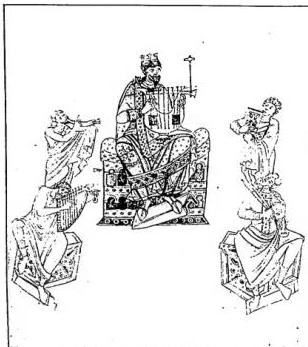
(from V. Leraqueix, Les Poutiers mss. lat. des bibl. publ. de France, Mâcon 1856-61, pl. 21)
MUSIC - David with four musicians. Miniature from the Psalter of Saint-Germain-des-Prés (11th century) - Paris, Bibliothèque nationale, ms. lat. 11550 f. 7°.
In the nineteenth century, after Romanticism, there emerged a positivist reaction of a scientific character, and finally, in the twentieth century, criticism and aesthetics began to develop along lines that are still in full evolution today.
#### I. HEBRAIC MUSIC.
The Hebrew music of the biblical period has not been transmitted through musical texts or theoretical works, as was the case for Hellenic music. The nature of primitive Hebrew music is deduced from: a) the character of the reproducing instruments used in the Temple of Jerusalem and in religious and secular festivals; b) current Oriental music, whether Semitic or not; c) the melodies collected in Jewish communities of the East (Yemen, Babylon, Syria), Europe (Italy, France, Poland, Germanic countries, and the Netherlands), and North Africa.
SUMMARY:
I. Primitive religious music
II. Relationships between Hebrew music and Gregorian chant
III. Evolution of Hebrew music from the Middle Ages to the 20th century.I. PRIMITIVE RELIGIOUS MUSIC
1. The similarity of Hebrew instruments to those of other ancient Eastern peoples partially justifies the assimilation of Hebrew music to Oriental musics in general. The Bible itself reveals the use of various instruments. String instruments: the nēbhel, or large harp; the himōr, or smaller harp, with fewer strings, which was David’s instrument. Wind instruments: the lōphār, which produced few sounds (tonic, fifth, octave) and did not allow for the playing of melodies. It could be heard from a great distance and served as a signal to summon the people; it was reputed to disperse enemy gods in battles. By the time of the Second Temple, it was made from a goat’s or ram’s horn. At the beginning of the Christian era, another instrument of appeal was added: the maghrēphāh, a kind of extremely powerful syrinx. Silver trumpets were played by priests, not by Levites, the true musicians of the Temple. For the dedication of the Temple, Solomon assembled 120 silver trumpets. The large flute and the small flute are represented by the ḳālīl and the 'āghābh; the double flute by the 'ālāmōth. The drum, timpani, and cymbals represent the category of percussion instruments, used especially in joyful celebrations, whether religious or profane; they were mandatory in religious dances. After the destruction of the Second Temple, instrumental art fell into oblivion. Vocal tradition, however, was preserved in synagogues.2. The comparison of Hebrew melodies traditionally preserved with the Oriental melodies still in use today among Muslim peoples or in Greek, Jacobite, Nestorian, or Maronite Christian communities confirms the similarity of musical systems in the following respects: a) the manner of composition is analogous; freedom and originality in the creation of new melodies consist primarily in the ability to arrange existing small motifs differently and embellish them. A category of motifs combined together is called a mode; modulation shifts a motif from one mode to another. b) Rhythmic freedom exists in melodies of a sacred character; they are treated as ornate recitatives. In songs accompanying dance, the music receives a metric framework suggested by the poetic text. Oriental music avoids sustaining a note that is not embellished. c) The tonal system admits quarter tones; there can be 24 degrees in an octave; but among the four principal scales, two are distonic and similar to the Greek Phrygian and Dorian scales. d) Harmony is entirely unknown to Orientals: for them (as for the Hindus), aesthetic pleasure lies in hearing a pure melody and its ornaments. Instrumental accompaniment, when present, repeats the melody itself, perhaps with its own embellishments. e) The popular character of Oriental musics is revealed by the brevity of musical phrases, the frequency of refrains, and the simplicity of melodic invention. f) Finally, Oriental music was not written down but learned by heart and transmitted orally. The Jews attempted to fix traditional modes in writing; the result was the transcription of the Bible according to a complete system of accents and mnemonic signs in the 9th century A.D. Melodic intervals are not transcribed one by one but suggested stenographically; the same applies to variations in tempo and intensity. These signs are known as tē'āmīm or nēghīnōth ("notes," "tones").
3. Each of the Sacred Books used in liturgical service had its own characteristic formulas. Thus, the Pentateuch, the Prophets, the Psalms, the Lamentations, Job, Ruth, Esther, etc., each had its own special "mode." The expressive value of this mode, not to be confused with a scale, is related to the content of the portion of Holy Scripture for which it is intended. Thus, the mode of the Pentateuch expresses dignity and spiritual elevation. Though minor, the mode of the Prophets, sung on a scale equal to the Greek Phrygian (1st Gregorian mode), is imbued with hope and tenderness. The influence of the surrounding culture is recognized in the variants of the same mode. The mode of Esther offers an example of transformation due to local circumstances. Originally, the Book of Esther was read in a Phrygian or Dorian scale with very few inflections. German Jews ('āhēnāzīm) saw in the story of Mordecai an opportunity to express their bitterness against persecutors; gradually, the primitive form of biblical reading was enriched with emphatic formulas. Alongside the melodies for readings, there was another group of prayer chants with text taken from Holy Scripture. In the Talmudic period, many prayers were composed by rabbis; biblical examples, however, inspired content and form. These prayers, which remained in use, are classified into various groups: chants of adoration, praise, petition, penitence, lamentation, hymns.
II. RELATIONSHIP BETWEEN HEBREW MUSIC AND GREGORIAN CHANT
Musicologists who have studied the origins of Gregorian chant have not doubted the dependence of early Christian liturgical chant on Hebrew chant. Gastoué does not hesitate to call Jesus Christ the First Cantor of the Church, and indeed the Gospel records two instances in which the Lord sang Hebrew melodies: for the reading of the prophecy of Isaiah in the synagogue of Nazareth and for the celebration of the last Passover of the Old Testament with the singing of Hallel (v.). The structure of some liturgical hours, partly identical in Christian and Jewish liturgy, allows us to suppose that some Hebrew musical pieces were also used by the first Christians of Palestine and then transmitted to posterity. It has been suggested that some element of the Easter Graduale Haec dies may be of ancient Hebrew origin. However, the coincidence of five Gregorian podatus with a similar Hebrew musical sign is not a decisive argument (cf. A. Gastoué, p. 79).The comparison of traditional Hebrew melodies in Idelsohn’s collection should yield clearer results. The mode of the Pentateuch would be found in some formulas of the 3rd Gregorian mode (e.g., in the Kyrie 111 Deus sempiterne). The material coincidence of some notes does not demonstrate a direct influence: the identity of some modal scales in Hebrew music and those of Hellenic and Gregorian music suffices to explain melodic similarity. The fact that the ornate melodies of the Kyrie appear only after the 6th century invites us not to readily accept other identifications made by the same Idelsohn, an undisputed specialist in Hebrew music. With this reservation in mind, one may note: psalmodic formulas such as that of the 2nd tone rather similar to psalmodic motifs of the Sephardic tradition (Spanish Jews expelled from Spain in 1492); recitatives of the Lamentations according to the Babylonian Jewish tradition resembling certain Lamentations of the Latin Church. Some formulas of the 4th Gregorian mode (ant. Quid faciam) show a marked affinity with the Abhillah mode of the Talmudic period, in the traditions of Yemen, Syria, and the Sephardim: in the 5th Gregorian mode, the Easter and Pentecost Invitatory can be compared with melodies of the Ashkenazi synagogue, which are linked to Yemen; the hymn Itte Confessor, in its first verse (Lib. Usualis, Tournai 1950, p. 1177), echoes an Ashkenazi chant. But a new reservation is necessary here: this is almost an imitation, and no longer merely a material similarity of a few notes; yet it is unknown in which direction the scarcely deniable influence occurred: the hymn existed at the end of the 7th century; however, the date of the Hebrew chant of Germanic tradition is not known!
Material similarity does not reveal whether an influence occurred and in what direction. The hymn Gloria Laus, sung on Palm Sunday, shares common points with a secular Arabic chant; but it is impossible to know whether the Arabic melody existed when Theodulph, bishop of Orléans, composed it, or if he had heard II. For some, the similarity is still discernible between the intonation of the Sanctus (XVII of the Vat. ed.) and a chant of adoration (called 'Alēna), widely diffused during the period of the Crusades.
The influence exerted by Hebrew chant on Christian liturgical music is recognized in a general way in some very ancient forms of psalmodic chant, and especially in the responsorial form. The Psalter was the prayer book of the Church as it was of the Temple and the synagogue, and traces of the three ways in which the assembly responded to the soloist’s chant are found in the Gregorian repertoire: a) the soloist sings the first half-verse of the psalm, then repeated by the assembly after each psalm verse; b) the cantor performs each verse in full, of which the people repeat only the last part; c) the cantor, called presentor as in the West during the Middle Ages, divides the verses into short phrases, which all can then repeat without error; this last system was used especially for teaching the Bible to the young.
Some other elements of Roman liturgical chant may be of ancient Hebrew origin: the centonic composition procedure, that is, the art of using preexisting formulas to create new compositions, almost musical mosaics in which originality lies in the ability to stitch together and ornament already known phrases; but this procedure is not unique to the synagogue: it also belongs in a certain way to Hellenic music, in which the formulas were called nōmoi.
Two characteristics of Eastern music have passed into Christian music: the use of melismas on the final syllable of a phrase, incise, or word, and the absence of long-sustained notes; the voice never remains still and, if it must stay on the same sound, it lightens it with repercussions, trills, or turns, etc.
The persistence in the liturgical chant of all Churches of Hebrew words is testimony to the original dependence of Christian liturgy on the liturgy of the Temple and synagogues; but it is not possible to say that the musical motifs on which the words Amen, Alleluia, Osanna are sung, nor even the melodies appended to the letters 'āleph, bēth, gimel, etc. of the Lamentations are of Hebrew origin. On the other hand, attention must be paid to the rhythmic diversity that individualizes each music. For example, Hebrew religious music originally ignores measured rhythm entirely; the chant of the oldest Latin Christian hymns—the hymns of St. Ambrose—are of metrical rhythm with 12 beats per verse. Hebrew religious music was of free rhythm, and Gregorian melodies on commatic texts are also of free rhythm; but the difference is great between the two, given that in the latter the first beat is indivisible, while in the former it is divisible.
### III. EVOLUTIONS OF HEBREW MUSIC FROM THE MIDDLE AGES TO THE 20TH CENTURY.
The expansion of the repertoire of Hebrew religious music up to the 7th century had been achieved with the utmost respect for ancient formulas. The emergence of a distinctly Western music—from the flourishing of tropes and sequences to the development of polyphony—placed the Jewish tradition in Europe in confrontation with new currents, to which it long resisted. It is true that infiltrations of ecclesiastical and secular themes are recognizable in some cases; more certain is that the tonal system transformed, losing intervals smaller than the semitone and seeking to give a major character to motifs previously known in a minor mode. However, a large part of the traditional melodies was preserved through the work of the ḥazzān. This presentor of the Israelite community, originally a mere beadle, had risen to the role of reader and cantor, assisting the priest. Over time, his liturgical function was not always sufficient; sometimes he would lend himself to secular concerts, much to the rabbis' disdain. His vocal skill explains his prestige and influence, at times so great as to obtain from the community members what was denied to the rabbi.
Around 1500, a new era seemed to open for Hebrew music with the rise of new tendencies among Jewish musicians in Italy, who cultivated madrigal music in particular. The most famous, Salomone Rossi (d. 1628), wrote not only Sinfonie e gagliarde but also polyphonic Salmi e preghiere. A new edition was produced by S. Naumbourg and V. d'Indy (Paris 1877). The novelty lay precisely in the introduction of polyphony into Jewish worship. Leone da Modena triumphed over the opposition of traditionalist rabbis; choirs were established in Ferrara, Venice, Mantua, Padua, and Casale Monferrato. But all too soon, the Austrian invasion, with the capture of Mantua in 1630, cut short this first attempt to align Jewish musical culture with the evolution of art. In 1724-27, Benedetto Marcello would visit the great synagogue of Venice to hear the ancient melodies revived. In reality, among the themes (about 12) that Marcello drew from Hebrew chant for his 50 psalms, only one could be said to be truly traditional, and only in German synagogues (Šāphēt kol hā-'āres, p. 167).
To explain the resurgence of modernization in Hebrew music in the last century, one must recall the great ferment of ideas in Europe during the second half of the 18th century. Many Jews were influenced by the ideals of emancipation propagated under the names of liberty and equality. For them, everything that distinguished Jews from their Italian, German, French, etc., fellow citizens had to be abandoned. In the temple built by Jacobson in Seesen, Westphalia (1810), hymns modeled on Protestant chorales replaced the old Hebrew chants; the Bible was read without vocal modulations; music inspired by the classics of the 18th century was entrusted to a choir; the organ also made its appearance. In 1817, an ultra-reformed temple was erected in Hamburg; in 1842, another in Berlin. Collections of chants were published by Goldberg and Freudenthal in 1843, by Rosenstein in 1849, and the Innario of Hamburg in 1845. Curiously, the composers called upon for this reform were mostly Christians.
A reform was also carried out in the Orthodox synagogue, but by Jewish musicians. The first in chronological order, and the one who would have a decisive influence, was Salomone Sulzer (1804-90). He was cantor of the Vienna community in 1825. He founded an excellent choir; wrote hymns and polyphonic compositions; followed the example of Israel Lovy, who in Paris, in 1822, had rejected the three-voice choir (boy soprano, bass, and ḥazzān, i.e., tenor) and introduced four parts. While harmony and classical style form the basis of Sulzer's compositions, he also grasped the general character of the traditional musical language; he returned to the brevity of the ancient phrase; he clothed the melody in dignity and seriousness, which were lacking in many so-called religious compositions of the 18th century. Sulzer's great popularity in the Jewish circles of his time is explained by the power and flexibility of his tenor voice, but also by his resolute stance against the invasion of the German manner, and herein lies the great difference with the other reform movement led by the Hamburg temple. Alongside and after Sulzer, several names stand out in Germany and France: Maier Kohn, Samuel Naumbourg, Hirsh Weintraub, Israel Japhet. The most illustrious was Louis Lewandovski, born in German Poland in 1823 and died in Berlin in 1894.
He understood the importance of the congregation's participation in liturgical chant; he knew how to develop original themes with an ancient flavor, while also admitting elements of German or Slavic folklore; the collection he produced after many years of waiting had the great merit of offering a complete repertoire for all the gatherings of the year. The Qól rimāh, published in 1871, supplanted Sulzer's Šir Şijjôn in many places, which had appeared in 1840-65. The freshness of the style, which often recalls the German Lied, the reminiscences of the chants performed in Eastern Germany by the ḥazzānîm, the vocality accessible without extraordinary technical preparation, and the skill with which the organ accompaniment (not obligatory) was treated, ensured the lasting success of Lewandovski's religious musical work. However, in his ideas lay the seed of a tendency that would one day push moderate reform onto the same path as musical reform, which in turn softened its intransigence to the point of reintroducing readings in the traditional manner. He had not only rejected the notion that the religious music of the dispersed people of Israel should be one of lament and sorrow, but he also came under the influence of Sulzer, who had studied extensively and had works performed after his youthful years at the Berlin Academy of Music, where he won a composition prize at 16! Now, in Sulzer, the forms of Catholic religious chant are quite recognizable to a good Jew, though a Christian might not claim them as his own. In the preface to Qól rimāh, Lewandovski expressed the opinion that the choral parts could be created by non-Jews using non-Jewish melodic material: this was the starting point of Jacobson and the Hamburg temple.
1. Collections of chants: A. Baer, Ba'al tēphilāh, Gothenburg
1877; J. and M. Cremicu, Zémiróth Jisrá'el, Chants hébraïques, Marseille 1885; P. Consolo, Sepher širš Jisrá'el, Libre dei canti d'Israele, Florence 1891; M. Gaster, Sa'ar haš-lāmajīm (Spanish and Portuguese Hebrew songs), London 1904; A. Z. Idelson, The source of Hebrew-oriental melodies, 6 vols., Leipzig 1914 (noteworthy that in 1918 a Catholic priest and scholar, Roschenstein, a sincere friend of the Jews, was among the first to attempt collecting traditional modes). The introductions to song collections are a valuable contribution to the historical and scientific knowledge of Hebrew m.
2. Literature. One must wait until the mid-19th century for valuable studies on Hebrew m.: no Jewish theorist existed in the biblical period, nor afterward. Important material is found in the Responsa of rabbis from the 8th century onward regarding questions of chant. The first music historian to attempt tracing a coherent scheme of the evolution of Hebrew m. is Forkel (d. 1801). a) Journals: Liturgische Zeitung; Der Jüdische Cantor (Bromberg); Die Österreichische ungarische Cantoren Zeitung; Die Höchener (Vienna); Das hamburger Familienblatt, etc. - b) Authors: F.J. David, La musique chez les Juifs, essai de critique et d'histoire, Paris 1873; F. Cohn, The rise and development of Jewish music, London 1888; E. Birnbaum, Jüdische Musiker am Hofe von Mantua von 1512 bis 1628, Vienna 1893; E. Breslau, Sind originale Synagogue- und Volksmelodica bei den Juden geschichtlich nachweisbar?, Leipzig 1898; A. Friedman, Lebensbilder berühmter Cantoren, 3 vols., Berlin 1918-27. Among Catholic authors: O. Fleischer, Neumentudieu, Berlin 1897, chaps. 1-2; D. Parisot, Rapport sur une mission scientifique en Turquie d'Asie, Paris 1899; A. Gastoux, Les origines du chant romain, Paris 1907, chap. 1; P. Wagner, Einführung in die gregorianischen Melodie, I, Leipzig 1910, chap. 1; III, Leipzig 1921, pp. 240, 367; H. Berl, Das Judentum in der Musik, Berlin and Leipzig 1926.
Pietro Thomas
II. SACRED AND RELIGIOUS MUSIC.
SUMMARY:
I. Historical notes
II. The Church and sacred music
III. Ecclesiastical legislation.I. HISTORICAL NOTES
The Jewish custom of accompanying chant in the exercise of worship passed almost intact to the early Christians. Indeed, from the very rise of Christianity, references to chant appear in the Acts of the Apostles, in the Epistles of St. Paul, and in the earliest ecclesiastical writers.However, it was in the patristic era that music established itself as an integral part of Catholic worship.
While, on the one hand, the Fathers of the Church, the Pontiffs, and the Councils opposed pagan music, on the other, they insisted—through advice, instructions, and even didactic treatises—on the use of sacred chant not only in public worship but also in private devotion. The richest and oldest musical heritage of Christian civilization is contained in Gregorian chant, so named after Pope St. Gregory the Great (590-604). Gregorian chant is thus the body of vocal music that flourished within the Church from its origins until the Humanist era, when polyphony emerged.
This chant, therefore, while constituting the bridge between ancient and modern music, is the true source of all European music, sacred and secular: and it is to the credit of the Catholic Church to have gathered, preserved, and artistically synthesized the scattered elements of ancient music.
Although Gregorian chant is essentially monodic, as early as the 8th and 9th centuries, some melodies began to be adorned with a second part.
Thus, either a sustained note at the upper fifth was superimposed on the Gregorian chant line, or it was accompanied by parallel fourths and octaves: this procedure was called organum (v.) because it resembled the instrumental accompaniment of the ancients. A less elementary procedure was the discantus (v.), where the principal Gregorian chant is accompanied by a more animated second melody. The first form to arise from this combination is the motet (v.), a similar form is the conductus (v.), where all voices are of free invention. Other procedures used by the English were the Gymel (twin chant), which consisted of accompanying the principal chant with an interval of a third, and the drone or continuous low note, over which two melodic parts were performed. But with counterpoint, the most daring procedures in combining voices were achieved. The basis of counterpoint (punctum contra punctum) is imitation, that is, the reproduction of a melodic pattern by a se-
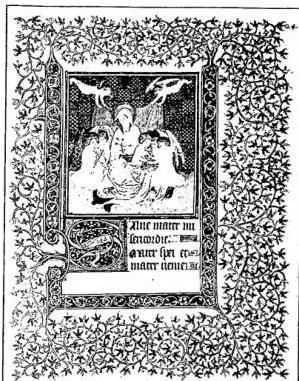
from V. JALABERT, LOUIS, Les livres d'Heures mss. de la Bibliothèque nationale, Paris 1917, pl. 23
MUSIC - Angels teaching music to the Infant Jesus. Book of Hours executed for a member of the Berthier family of Troyes (15th century) - Paris, Bibliothèque nationale, ms. lat. 924, f. 241.
A second voice is added to the first, then a third, and a fourth, up to 18 real voices and 36 nominal ones.
The prince of the Roman PALESTINA (v.). His predecessors were: Costanzo Festa and Giovanni Animuccia; his contemporaries: the two Nanino, Giovanni Maria and Giovanni Bernardino; then came Felice and Giovanni Francesco Anerio, Ruggero Giovannelli, Francesco Suriano, Luca Marenzio, Giorgio Allegri, Francesco Foggia; the Spaniards Cristoforo Morales and Ludovico Vittoria da Avila. In the Venetian school shine the names of Giuseppe Zarlino and the two Gabrieli: Andrea and Giovanni. Polyphony developed not only in vocal music but also in instrumental music, especially for the instrument proper to the Church, organ (v.).
Just as polyphony and popular religious song sprouted from the trunk of Gregorian chant, so too did the Protestant Reformation derive great benefit from it with the chorale in the vernacular, as did the Catholic Reformation with spiritual lauds.
From further progress and new orientations arose opera or "drama for music," of both secular and sacred character. The first sacred melodrama was the Rappresentazione di Anima e Corpo by Emilio de' Cavalieri. Alongside opera appears the oratorio, which retains an essential polyphonic form, into which monodic parts are grafted. These new developments in extra-liturgical sacred music exerted a harmful influence on liturgical music, which gradually lost the hieratic spirituality of Gregorian chant and the severe monumentality of classical polyphony. Even externally, signs of this degeneration are evident: the choir, which previously had a truly and purely liturgical function and was therefore composed of clerics and situated in the presbytery, came to be formed of secular singers and even women, and was supported not only by the organ but also by other instruments. In liturgical functions, alongside Latin, the official language of the Church, the vernacular was increasingly used.
The cause of this decline may perhaps be sought in the fact that the distinction between sacred music (liturgical and extra-liturgical) and religious music was not clearly maintained. Moreover, it is not uncommon even today for these terms to be used interchangeably. In reality, sacred (Catholic) music is the musical interpretation of the rites, forms, and prayers of Catholic worship; and although it is primarily vocal, instrumental organ music is also admitted. Since worship includes both liturgical and extra-liturgical sacred functions, sacred music will likewise be liturgical or extra-liturgical depending on whether it musically interprets the one or the other, following established norms. Whoever violates these norms writes anti-liturgical sacred music, even if they intend to musically interpret rites, formulas, and prayers of Catholic worship.
The genres of sacred music are Gregorian chant and popular chant, the classical polyphony of modern music. The forms of liturgical music are primarily the Mass in its fixed and variable parts and psalmody in its various elements (psalm, antiphon, hymn, verse). The forms of extra-liturgical music are choral compositions of various kinds that interpret texts in Latin or the vernacular referring to different extra-liturgical sacred functions. The instrumental part of liturgical and extra-liturgical music, in addition to accompanying vocal music, unfolds in pieces of various forms and denominations intended to connect the different moments of the liturgical or extra-liturgical action.
Religious music, on the other hand, is the free vocal and instrumental interpretation of individual or collective religious sentiment: such are oratorios, cantatas, sacred symphonies, passions, etc. In this respect, anti-liturgical music may also be classified as religious, even if, while not responding to the spirit and demands of Catholic worship, it musically expresses truly religious sentiments. Thus, J. S. Bach's monumental Mass in B minor is undoubtedly a profoundly religious work, yet it cannot be called liturgical music insofar as, among other things, its vast proportions far exceed the scope of the liturgical function it intends to interpret. Likewise, the excessive dramatic spirit of L. van Beethoven's Missa solemnis and G. Verdi's Messa da Requiem places these works among religious music but not among liturgical music.
BIBL.:
A. Schering, Geschichte des Oratoriums, Leipzig 1911; P. Wagner, Einführung in die gregorianischen Melodien, 3 voll., Leipzig 1911-1921; K. G. Fellerer, Geschichte der katholischen Kirchenmusik, 2 voll., Kassel 1932-1939; A. Gastoué, Le cantique populaire en France, Paris 1924; A. Pirro, Histoire de la musique de la fin du XIVe siècle à la fin du XVIe, Paris 1940; R. Casimiri, Palestrina, Roma 1940; G. Baini, Memorie storico-critiche della vita e delle opere di Giovanni Pierluigi da Palestrina, 2 voll., Roma 1828; F. X. Haberl, Wilhelm du Fay, Leipzig 1885; H. Leichtentritt, Geschichte der Motette, Leipzig 1908; A. W. Ambros, Geschichte der Musik, 5 voll., Leipzig 1862-1882; H. Riemann, Handbuch der Musikgeschichte, 2 voll., Leipzig 1904-1913; G. Reese, Music in the Renaissance, New York 1954.
II. THE CHURCH AND SACRED MUSIC
It should come as no surprise that ecclesiastical authority exercises normative power over sacred music, since the latter is an integral part of Catholic worship, the regulation of which is obviously the exclusive competence of the Holy See. It must be clarified, however, that ecclesiastical authority does not impose aesthetic canons on sacred composers; rather, while leaving them freedom in the choice of technical and artistic means, it indicates the animating spirit and functional characteristics their works must possess to ensure the dignified conduct of Catholic worship. General and particular prescriptions on sacred music can be found from the earliest days of the Church. For brevity’s sake, omitting the numerous dispositions of synods and councils, we shall limit ourselves to recalling the most important pontifical documents on the subject. References to the prescriptions of the early pontiffs on sacred music are scarce; more notable, however, after the great reform of St. Gregory the Great, is the severe letter of Leo IV, which ordered, under pain of excommunication, Honorius, perhaps abbot of Farfa, to adhere to the Gregorian tradition of sacred chant. But a fundamental document in this matter is the apostolic constitution Docta Sanctorum Patrum of John XXII, issued in 1324-25 against certain abuses that had crept into sacred music through the indiscriminate use of new technical procedures of the time. In this constitution, the Pontiff establishes the two principles upon which all legislation on sacred music rests. First, he requires that the music performed in worship not only not contradict the spirit of the liturgy but support and enhance II. Furthermore, he admits innovations in sacred music that the passage of time brings to the musical language, provided they do not entirely depart from ecclesiastical tradition. These principles were fully realized in classical polyphony, and thus the Council of Trent, on 17 September 1562 (Session XXII de Reform.), did not prohibit or censure this form of sacred music but merely prescribed that those musics—whether for organ or for singing—which contained lascivious or impure elements be banned from churches. Also important is the apostolic constitution Piae sollicitudinis studia, issued for Rome on 23 April 1657 by Alexander VII, who, under pain of excommunication and fines, prescribed that the liturgical text to be set to music be only that prescribed and approved by the Sacred Congregation of Rites. The Alexandrine Constitution was later supplemented by two successive ordinances of the Vicariate of Rome, dated 30 July 1665 and 20 August 1692.On the occasion of the Jubilee of 1750, Benedict XIV issued on 19 February 1749 the encyclical Annus qui, in which, recalling with great erudition the previous pontifical prescriptions for Rome, he added particular norms on the use of instruments in church. The Benedictine encyclical was also supplemented by edicts of the Vicariate of Rome dated 4 March 1749 and 1756. Vigorous reform of sacred music in Rome took place during the 19th century. On 20 December 1824, Cardinal Vicar Placido Zurla published an edict On Divine Worship and Respect for the Church, containing specific norms for sacred music, later reconfirmed by Cardinal Odescalchi in his notification of 31 January 1835.
Under Gregory XVI, Gaspare Spontini prepared an extensive reform project for sacred music, which was later utilized by Cardinal Vicar Costantino Patrizi in his edicts of 16 August 1842 and 18 November 1856. Outside Rome as well, in Italy and other Catholic nations, a broad reform movement in sacred music emerged through conciliar and synodal prescriptions of great theoretical and practical importance. Thus, on the occasion of the Vatican Council, Cardinal Riario Sforza, Archbishop of Naples, together with his suffragan bishops, proposed severe penalties against ecclesiastics who neglected to learn Gregorian chant. Similarly, the German bishops, gathered in Rome for the same Council, requested the establishment of a Pious Association for Germany, modeled on the Roman Congregation of St. Cecilia, for the implementation of sacred music reform. This was granted by Pius IX with the apostolic constitution Multum ad movendos animos of 16 December 1870.
These Cecilian Associations, which soon spread to other nations, played a crucial role in sacred music legislation, as they highlighted existing abuses, suggested appropriate remedies, and prepared the ground for an organic reform. Indeed, following the resolutions expressed at the Italian Catholic Congress held in Naples in 1883, the Sacred Congregation of Rites issued on 25 September 1884 a comprehensive Ordinatio quoad sacram musicam, followed by a less successful one on 7 July 1894. With Blessed Pius X, the legislation on sacred music—even before the Codex iuris canonici—found its wise and diligent codifier; in the same year of his election, he issued the motu proprio Inter pastoralis officii sollicitudines, which he himself defined as the juridical code of sacred music. The CIC (can. 1262), after recalling the general principle established by the Council of Trent, refers to the particular liturgical laws on sacred music. Pius XI, following the celebrations in honor of Guido d’Arezzo held in Rome and the 25th anniversary of the promulgation of Pius X’s motu proprio, almost in response to the petitions he had received, issued on 20 December 1928 the apostolic constitution Divini cultus sanctitatem, providing precise practical norms for the implementation of pontifical prescriptions on sacred music. Finally, Pius XII, in the encyclical Mediator Dei of 20 November 1947, while recalling and reaffirming the previous prescriptions of Pius X and Pius XI on sacred music, laid down wise principles on popular religious singing and contemporary sacred music.
BIBL.:
A. Scharnagl, Die Kirchenmusik nach dem Konzil von Trient, München 1914; F. X. Haberl, Magister choralis, Ratisbona 1884; P. Wagner, Einführung in die gregorianischen Melodien, 3 voll., Leipzig 1901-1912; A. Schering, Geschichte der Musik in Beispielen, Leipzig 1931; L. Feininger, Documenta polyphoniae liturgicae Sanctae Ecclesiae Romanae, Roma 1947; A. Gastoué, Le chant grégorien, Parigi 1924; A. Mocquereau, Le nombre musical grégorien, 2 voll., Roma 1908-1927; R. Molitor, Die nachtridentinische Choral-Reform zu Rom, 2 voll., Leipzig 1901-1902; A. Schuler, Die Reform der Kirchenmusik unter Papst Pius X, Roma 1947; G. Suñol, Exposition des principes du chant grégorien, Parigi 1925; J. de Valois, La musique en France au temps de Richelieu, Parigi 1932; Acta et decreta sacrorum conciliorum recentiorum, Collectio Lacensis, Friburgo 1870-1890; Bullarium Romanum, Torino 1857-1872; Enchiridion liturgicum, Roma 1936; Raccolta di decreti e istruzioni sulla musica sacra, Roma 1934.
A. GARGANO
III. ECCLESIASTICAL LEGISLATION
1) It pertains solely to the Holy See to regulate the liturgy and sacred music (can. 1257; CA, beginning, D. 1134: for abbreviation V. BIBLICA.).2) Liturgical laws on sacred music bind all, and the norms established for liturgical music must, in themselves, be observed also for extra-liturgical music, unless they are prescriptions which, by their very content, refer solely to liturgical music (RR n. 30).
3) Against transgressors of these laws, local Ordinaries may impose canonical penalties, in accordance with cann. 2378; 2222; 2291 n. 10, 12° of the CIC.
4) Sacred music, as an integral part of solemn liturgy, must possess to the highest degree the qualities proper to sacred liturgy, namely sanctity and goodness of forms, excluding all profanity not only in itself but also in the manner of its execution. It must be true art, for otherwise it cannot have upon the soul of the listener that efficacy which the Church intends to achieve. But it must be universal in this sense: while admitting in ecclesiastical compositions those particular forms which constitute, in a certain way, the specific character of the music of each nation, these must nevertheless be so subordinated to the general characteristics of sacred music that no one from another nation, upon hearing them, should receive an unfavorable impression (MP n. 2).
5) Since these qualities are found to the highest degree in Gregorian chant, a composition for the church is all the more sacred and liturgical the more it approaches Gregorian melody in inspiration and movement; and it is all the less worthy of the temple the more it deviates from II.
6) The ancient traditional Gregorian chant must therefore be widely restored in the functions of worship and in the use of the people, so that the faithful may take a more active part in ecclesiastical offices (MP n. 3).
7) The Gregorian chant that must be performed in every church is that restored to the fidelity of the ancient codices and proposed by the Church in the Vatican typical edition (CA IV).
8) The printing of Gregorian chant in modern notation is permitted provided that the danger of altering the order of notes and neumes is carefully eliminated (D. 4166 ad VII).
9) Editions enriched with rhythmic signs are permitted, provided that the original text is not altered (D. 4178-4529).
10) The classical polyphony proper to the most solemn functions of the Church, such as those of the Pontifical Chapel (MP n. 4), must also be used in solemn functions celebrated by a cardinal.
11) Modern music is also admitted in church when it offers compositions of such goodness, seriousness, and gravity that they are not only in no way unworthy of liturgical functions but must contribute to the splendor of sacred rites, the elevation of souls, and true devotion (MP n. 5; LE n. 188).
It must therefore contain nothing profane, nor reminiscences of theatrical motifs, nor should its external forms be modeled on the style of secular pieces.
It must have nothing unseemly to the sanctity of the place, nor derive from a vain search for extraordinary and unusual effects (MP n. 5; LE n. 188).
12) Modern works of sacred music intended for worship must be approved by the diocesan commission for sacred music, unless they have already been approved by the Association of St. Cecilia or St. Gregory (RR. 19). Neither authors nor publishers may claim any fee for the performance of sacred music works in liturgical functions (Instruction of the Sacred Congregation of the Council, 25 February 1932: AAS, 24 [1932], p. 72 ff., can. 1160).
13) The proper language of the Roman Church is Latin; therefore, in liturgical functions, any singing in the vernacular is prohibited (MP n. 7). Likewise, in the solemn procession with the Most Blessed Sacrament, vernacular hymns alternating with liturgical hymns are not permitted (D. n. 3975 ad V). Any contrary custom, if introduced in some place, must be eliminated (D. 3827 ad I; 3113 ad I; 3230; 3994 ad I; Ordin. SRC a 1884 art. 3; Ordin. SRC a 1894 art. 7).
14) It is permitted to sing in the vernacular approved texts: 1° in Low Masses, provided they are not properly liturgical texts, which must not be sung except in Latin (D. n. 4235 ad VII-VIII; 3880). 2° Before the Most Blessed Sacrament exposed, provided they are not the Te Deum or other liturgical prayers, which must not be sung except in Latin (D. 3537 ad III, 4237 ad VII; 4268 ad X). 3° After Eucharistic benediction (D. 2698; 2791 ad II).
15) Since for every liturgical function specific musical texts and the order in which they must be presented are determined, it is not licit either to confuse this order, or to change the prescribed texts for others of one’s own choice, or to omit them entirely or even in part, except as provided in art. 38 (MP n. 8; D. 3624 ad IX).
16) The liturgical text must be sung as it stands in the books, without alteration or postponement of words, without undue repetitions, without breaking syllables, and always in a manner intelligible to the faithful who listen (MP n. 9).
17) The custom whereby canons and mansionarii assigned to the choir, in conventual Masses and even in pontifical Masses, neither sing nor recite the parts of the Mass in a low voice, but leave everything to the organist, is an abuse to be eliminated (D. 3786).
18) In the chanting of the Passio, the Gospel text cannot be sung by the organist, even if he is a minor cleric or subdeacon (D. 3110 ad X).
19) The priest celebrating a conventual Mass, in which the choir is obliged to sing the Credo, may not continue the celebration during the time in which the choir sings said Credo (D. 1936, 2242).
20) After the chanting of the Offertory, it is permitted to occupy the remaining time until the Preface with the performance of some motet on words approved by the Church (MP n. 8).
21) During the Elevation of the Host and Chalice, as well as during benediction with the Most Blessed Sacrament, the singers must remain silent and in adoration (D. 3827; 2464; 27-22 ad III; 3058 ad II, 3530 ad II).
22) The Benedictus must be sung after the Elevation; it is then permitted to perform a Eucharistic motet until the Pater noster.
23) The psalms must be sung by the choir and by the canons themselves, beneficiaries, and others of the Chapter in tone and Gregorian chant with gravity and decorum, so that their words are intelligible to all (Caerem. Episc., Lib. I, c. I, n. 8; 521).
24) In particular, in psalmody, attention must be paid both to the precision of tones with their proper medial and final cadences, and finally to the full concordance of the declamation of psalmic verses and strophes of hymns (C. A. III).
25) The antiphons at Vespers must be intoned both for the bishop and for the canon by the most senior canon after the dignity or by the scholastic master or by the one to whom it pertains according to custom (2216 ad III). If singers cannot be had, the Lamentations and Lessons from the 2nd and 3rd Nocturn must be sung by the canons, beginning with the youngest (379).
26) Where the custom exists and the number of choristers is insufficient, it is licit for some verses, while simply recited in choir, to be supplied by the organ.
27) Sacred music must retain its choral character at least in the greater part (MP 12); however, solo voice is not entirely excluded, which must never predominate but have the character of a simple indication and melodic cue to be strictly linked to the rest of the composition in choral form (MP 12). Since chant must always prevail, the organ and instruments must simply support it and never overwhelm it (MP 16). It is not permitted to precede the chant with long preludes or to interrupt it with intermezzo pieces (MP 17).
28) The individual parts of the Mass and the Divine Office must also musically preserve that harmony and form which ecclesiastical tradition has given them and which is very well expressed in Gregorian chant. The manner of composing an Introit, a Gradual, an antiphon, a psalm, a hymn, a Gloria in excelsis, etc., is therefore distinct (MP 10).
29) In particular, the following norms must be observed: 1° the Kyrie, Gloria, Credo, etc., of the Mass must each maintain the unity of composition proper to the text. It is therefore not permissible to compose them in separate pieces such that each piece forms a complete musical composition and, as such, to detach them from the rest and substitute them with another (MP 11, lett. a). 2° The Gloria and the Credo, moreover, according to Gregorian tradition, must be relatively brief (MP 22). 3° In the Office of Vespers, Gregorian chant must ordinarily be used for the psalmody (MP 11, b). So-called concert psalms remain excluded and prohibited (MP 11, b). In the hymns of the Church, the traditional form must be preserved. The antiphons of Vespers must ordinarily be presented with their proper Gregorian melody (MP 11, d). If, however, in some particular case they are sung in polyphony, they must never assume either the form of a concert melody or the amplitude of a motet or a cantata (MP 11, d).
30) In every choir, whether of canons or religious, a competent person shall be elected as cantor or choir director, who, while overseeing the observance of liturgical rules and choral singing, corrects in practice the defects of individuals and of the entire choir (CA IV).
31) The true and genuine ecclesiastical tradition of sacred music is that: 1° the entire assembly of the faithful associates itself in song with the liturgical functions, performing those parts of the text assigned to it; 2° a special Schola cantorum alternates with the people and presents the other parts of the text, richer in melody and more specifically reserved to it (MP 3, 12, 27; RR 1).
32) Church singers, even if secular, properly take the place of the ecclesiastical choir and exercise a true liturgical office in church (MP 12, 13).
33) The church choir must consist of men of known piety and upright life, who, by their devout and modest conduct during liturgical functions, show themselves worthy of the holy office they perform (MP 14). It is prohibited for heretics, schismatics, and Jews to sing in Catholic churches (cf. Collect. S. Congr. de Prop. Fide, n. 1845, 1851). It is prohibited for choir directors, organists, and singers to belong to associations alien to the Catholic Church or to serve in heterodox churches or chapels, or for musical performances that in any way may result in contempt for religion or morality, or even merely be unworthy of the office of church singer (RR 66).
34) It is fitting that singers, while singing in church, wear the cassock and surplice (MP 14); if, however, due to a lack of clerics, they are employed in the choir, they may not use copes (D. 38 ad IV).
35) It is desirable that the choir loft not be situated at the entrance of the church but on the side of the altar, where the Sacred Mysteries are celebrated (Ordin. SRC a 1884, art. 40). If, however, the singers are in choir lofts too exposed to the public view, these should be screened by grilles (MP 14, V. pure n. 5283).
36) In processions, singers dressed in surplices must proceed after the Cross before the canons or in a place agreeable to the bishop (Caerem. Episc., I, c. 2, n. 4; 931; 948).
37) When the high voices of sopranos or contraltos are to be used, these should be sustained by boys, according to the most ancient usage of the Church (MP 13). Schools for boy choristers should therefore be established not only in cathedrals but also in minor and parish churches, and they should be trained in singing by choir masters (CA VI).
38) Women may not sing in sacred functions unless they form part or represent the people (RR 12). However, the diocesan Ordinary may permit girls and women, from the pews assigned to them in church, to sing the parts of the Mass and the Office, or, outside strictly liturgical functions, hymns and popular songs; provided that: they do not distinguish themselves from the rest of the people; except for the separation of men from women, where this praiseworthy custom is preserved. Where choral Office is held, the singing of women alone is not admitted unless for a grave cause recognized by the Ordinary with due regard to avoid any disorder (D. 4210 ad II).
39) Religious women, to whom it is permitted, according to their constitutions or liturgical laws or with the permission of the local Ordinary, to sing in their own church or public oratory, must sing from a place where they cannot be seen by the people. However, it is prohibited for religious women and their pupils to sing solo, and they are exhorted to prefer Gregorian melodies in Masses and Vespers, performed if possible by the internal Community (RR 12). It is never permitted for religious women and their pupils, even if the latter belong to a pious sodality, to accompany with singing the solemn cardinalitial functions (D. 4404). Religious women may not sing the part of the crowd in the Passio during solemn Masses celebrated in their churches (D. 2169).
40) In the playing of the organ, that mixture of sacred and profane must be avoided which, through the initiative of builders on the one hand and the musical audacities of some organists on the other, threatens the purity of the mission that the organ is destined to fulfill in the church (CA, VIII). Therefore, it is not permissible to add to the organ so-called "tubular bells" and profane instruments (D. 4344), nor to use gramophone records in divine worship (SRC 25 Sept. 1939). Plans for the restoration or acquisition of new organs, both for the technical and artistic aspects, as well as for the location and construction of choir lofts, must be submitted to the diocesan Commission for Sacred Music (RR 332). Where it is not possible to have a pipe organ, the use of the harmonium is permitted. When women sing in church, it is permitted to place the harmonium among them to accompany their singing, played by one of them.
41) The electrophonic organ and the so-called auto-organ may be introduced into the church only with the consent of the local Ordinary (SRC 15 July 1949; 27 Feb. 1948, n. 1917/48).
42) The task of the organ in sacred functions is to accompany the singing or to play when the voices are silent (MP 18; CA VIII), and its sound must not only be conducted according to the nature proper to such an instrument but must also participate in all the qualities proper to truly sacred music (MP 18).
43) The church organ may be played: 1° on all Sundays and feasts of the year; 2° at the entrance and exit of a bishop who celebrates or merely assists at Mass (ibid., n. 3); 3° at the entrance into the church of an apostolic legate, a cardinal, or an archbishop or bishop, until they pray and Mass begins, and at their exit (ibid., n. 4); 4° at the beginning of Matins, celebrated solemnly on major feasts, and likewise of Vespers (ibid., n. 5); 5° to accompany Gregorian or polyphonic chant, except in the liturgical functions of Holy Week and at the intonations of the celebrant (4267; 4287, MP n. 12 [4009]); 6° in Low Mass, during those times when the priest does not recite the prayers aloud or read the Gospel.
44) The sound of the organ is prohibited in church during Advent and Lent unless: 1) on the Third Sunday of Advent ("Gaudete") and the Fourth Sunday of Lent ("Laetare"), both at Mass and Vespers, but not during the other canonical hours (2245); 2) on Holy Thursday at the Gloria in excelsis, for a short time after the intonation, and also, according to custom, until the end; but not for the entire duration of the Mass, notwithstanding any contrary custom (D. 3515 ad IV; 4067 ad VI; 35-37 ad VII); 3) during the exposition of the Most Blessed Sacrament on the afternoon of Holy Thursday or the morning of Good Friday, during which it may be tolerated, where an ancient custom exists, to sing motets with organ accompaniment (3804 ad II); 4) on Holy Saturday at the Gloria in excelsis Deo (Caerem Episc., lib. I, c. 28, n. 2); 5) on days when it is necessary to celebrate solemnly and joyfully pro re gravi and for a public cause of the Church (Caerem Episc., ibid.; 235 ad XII; 3922); such as on the feasts of St. Matthew, St. Thomas Aquinas, St. Gregory the Great, St. Joseph, the Annunciation, and the like (Caerem Episc., l. I, c. 28, n. 2; 3448 ad IX); 6) during the First Communion of children (3448); 7) during solemn votive Masses of the Blessed Virgin Mary celebrated on Saturdays, and during the Litanies of the Blessed Virgin Mary sung after Vespers (2424 ad IV); 8) in the month of March for the devotion to St. Joseph (3448 ad XI); during the Offices of the Dead; while in sung Masses of requiem, it is only permitted to accompany the chant (Caerem Episc., l. I, c. 28, n. 13; 4243); during the chanting of the Praefatio and the Pater noster, as well as in the other liturgical accents and recitatives of the celebrant and ministers; in the votive Mass of the Passion (with violet vestments) that is customarily celebrated on Fridays during the year in some places (3922, 4, n. 2); during the Matins of Tenebrae; during the chanting of the Passio, the Lamentations, the Responsories, the Miserere, and other liturgical parts; nor may the use of the harmonium and other string instruments, or of the harmonium alone, be tolerated, notwithstanding any ancient custom (3804 ad II; 4044 ad I; 4156 ad II).
45) No instrument, however excellent and perfect, can surpass the human voice in expressing the sentiments of the soul, especially when the soul uses it to raise praises and prayers to God (CA VII). Therefore, chant accompanied by instruments is not at all considered by the Church as a more perfect form of music or more suited to sacred functions (CS VII). Thus, it is the human voice itself that should resound in sacred places: the voice, that is, of the clergy, the singers, and the people (CA VIII).
46) In addition to organ accompaniment (MP 15), in certain particular cases, within due limits and with appropriate considerations, string instruments (violins, violas, cellos, and double basses) may also be admitted alongside the organ, but always with the permission of the Ordinary (MP 15; Caerem Episc., l. I, c. 28, n. 11).
47) The use of the piano in church is prohibited, as are loud or frivolous instruments. Only in special cases, with the consent of the Ordinary, may a limited and proportionate selection of wind instruments be admitted in church, provided that the composition and accompaniment to be performed are in a grave style, appropriate and entirely similar to that proper to the organ (MP 20).
48) It is strictly prohibited for musical bands to play in church (MP 20). However, in processions outside the church, their use may be permitted by the Ordinary, provided they do not perform secular pieces in any way. It would be desirable that on such occasions, the musical concert be restricted to accompanying some spiritual canticle in Latin or the vernacular, proposed by the singers or the pious congregations participating in the procession (MP 21).
49) Since sacred music is part of the liturgy and its humble handmaid, it is to be condemned as a most grave abuse that in ecclesiastical functions the liturgy appears secondary and almost in service to the music (MP 23).
50) It is not licit, for the sake of singing or playing, to keep the priest waiting at the altar longer than what the liturgical ceremony requires. The Sanctus of the Mass, according to ecclesiastical prescriptions, must be completed before the Elevation, and therefore the celebrant must also take the singers into account at this point (MP 22).
51) For the exact execution of the pontifical prescriptions on sacred music, bishops must establish in their dioceses: 1) a special commission of persons competent in the matter of sacred music, entrusted with the task of supervising the music performed in their churches; they should not only ensure that the music is good in itself, but that it corresponds to the abilities of the singers and is always well executed (MP 24); 2) the Association of St. Cecilia or of St. Gregory, according to the Statutes approved by the competent ecclesiastical authority (Pius IX, apost. const. Multum ad movendos animos, 20 Dec. 1870; Pius XII, apost. lett. E certo ben nota lo zelo, 2 June 1951).