
FERRARA, ARCHDIOCESE of. — In Emilia; it lies entirely within the province of the same name, which also contains the whole diocese of Comacchio and a considerable part of the archdioceses of Bologna and Ravenna. The province has an area of 2,622 sq. km and approximately 500,000 inhabitants, while the archdiocese extends over 1,218 sq. km and has 219,986 inhabitants, of whom 217,090 are Catholics (1948).
The city within the walls consists of two areas: the older one to the south, and the newer part to the north, with a regular layout, conceived by Duke Ercole d’Este (1471–1505) and carried out by Biagio Rossetti; the centre consists of the Cathedral, the castle, and the archiepiscopal and municipal palaces. Outside the walls, the city has expanded considerably to the south and north-west, giving rise to numerous industries. The surrounding countryside is rich in agricultural produce. The Po facilitates inland navigation, as in antiquity, by means of the river route connecting Venice with Milan and, before long, with Switzerland.
The archdiocese is divided into 99 ecclesiastical jurisdictions (parishes and curacies), with 147 diocesan priests, 11 male communities with 56 fathers and 15 lay brothers, and 55 female communities with more than 650 religious women (1950). It is immediately subject to the Holy See.
The patron saint is s. Giorgio (feast on 24 April).
HISTORY. - F., whose etymology is uncertain but certainly medieval, has obscure origins that may be traced back to the Roman period, as the archaeological remains demonstrate.
Situated at the bifurcation of the Po di Volano and the Po di Primaro, along the road which, from Ravenna, followed the course of the Po through Ostiglia and reached the Brenner, it was important for control of the surrounding lands and valleys
circumcirca. While precise information is lacking concerning Roman F., there is information about Voghenza, or «Vicus Aventinus», approximately 13 km. from the city. Numerous pagan sarcophagi were found there. The earliest documents (774) record the transfer of the duchy of F. from the power of the Lombards to that of the pontiffs, who governed it through vicars, among whom the marquises of Canossa may be recalled.
Then, under the communal regime, the Ghibelline Torrelli-Salinguerra families and the Guelph Marche-
(lat. Vecchi e Giacomo)
FERRARA, ARCIDIOCESI di - Mosaic with Constantinian monogram and clay oil lamps (4th century) - Ferrara, Museo archeologico di Schifanoia.
selli-Adelardi families dominated it in turn. Through a spontaneous act of submission, F. subjected itself to the Este marquises (13th century), who, as vicars of the Apostolic See, governed it until 1597. The splendour to which it rose during this period made it one of the most sumptuous and cultivated courts in Italy. The Este family built the castle there (1385), founded the university (1391), introduced printing at an early date (1471), enlarged the city, surrounding it with solid walls, built villas in the surrounding countryside, and established kinship ties with the popes and rulers of the period. They were lords of the duchies of Modena and Reggio, the county of Rovigo, and the Garfagnana. When the direct branch of the Este family died out (1597), the duchy of F. was governed thereafter by cardinal legates, among whom Cardinal Caraffa (1778-1786) and Cardinal Odescalchi, later Pope Innocent XI (d. 1689), distinguished themselves. From 1796 to 1815 it shared the fortunes of Italy, and with the Treaty of Vienna returned to the popes, from whom it was again taken in 1859 and annexed to the Kingdom of Italy on 18 March 1860.
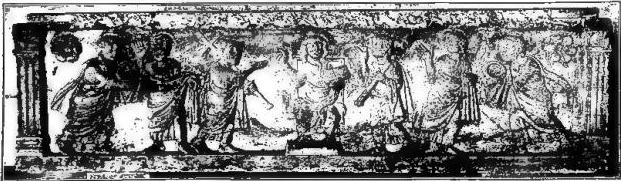
FERRARA, ARCIDIOCESI di - Christian sarcophagus (5th century) - Ferrara, atrium of the Cathedral.
(lat. Vecchi e Giacomo)
The erection of the diocese may date to the end of the 4th century or to the 5th century, with its see at Voghenza: St. Pier Crisologo consecrated a bishop named Marcellinus around 430, but it is not known whether he was bishop of Voghenza. The catalogue of bishops contains several gaps in the early centuries; the most notable bishops were St. Maurelio, martyred during the iconoclastic struggle supported by the archbishop of Ravenna, Mauro, to whom the diocese was subject; after 680 the original see was moved farther north, to F., to escape the rule of the archbishops of Ravenna; then there were Blessed Alberto Pandoni (d. 1274), bishop during the beginnings of the Este house; Blessed Giovanni Tavelli da Tossignano (d. 1446), a precursor of the Tridentine reform, whose reports of pastoral visitations survive unpublished; Giovanni Fontana (d. 1611), formerly an associate of St. Carlo and implementer of the decrees of the Council of Trent; Cardinal Ruffo (1727-37), builder of the archiepiscopal palace and the new seminary and the first archbishop of F.; the Venerable Bonaventura Barberini (d. 1743); and the servant of God Cardinal Carlo Odescalchi, archbishop of F. (1823-1826), later cardinal vicar of Rome (1838), and finally a Jesuit (d. 1841).
Among the illustrious figures, especially during the Este period, the following should be mentioned: SAVONAROLA, GIROLAMO (v.), the Este cardinals, builders of the Villa d’Este at Tivoli and patrons of Ariosto and Tasso; C. Calcagnini, a 16th-century polymath; Cardinal Guido Bentivoglio (d.
(phot. Vecchi e Graziani)
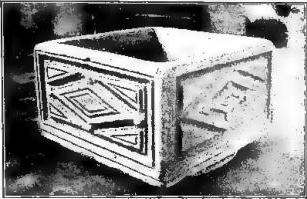
FERRARA, ARCIDIOCESI di - Ambon panel from Voghenza (530). Ferrara, Museo della Cattedrale.
1644), apostolic nuncio in Flanders and France. Also: Daniello Bartoli, historian of the Society of Jesus; Alfonso Muzzarelli, author of the pious practice of the «month of May»; Cardinal C. Bentivoglio, founder of the Biblioteca Ariostea (1740); the archaeologist Bellini, who founded the Museo archeologico with his own collection (1738), now rich in medals and coins from the Ferrara mint (1200-1748); Guarini and Scalabrini, authors of valuable works on the churches of F.; and finally Antonelli, a student of local history.
The principal ecclesiastical institution, until a few years ago (1932), was the theological faculty, transferred from the local university to the archiepiscopal seminary; at present the latter gathers together, for instruction, the best elements of the diocesan clergy.
The archives of the archiepiscopal Curia, the Metropolitan Chapter, and the surviving ecclesiastical institutions are rich in parchments (10th century), medieval land registers (13th century), and statutes (12th century).
(phot. Vecchi e Graziani)
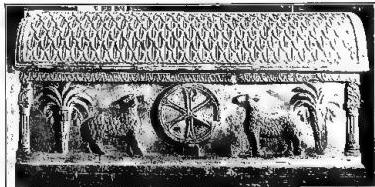
FERRARA, ARCIDIOCESI di - Christian sarcophagus (6th century). Rear side. Ferrara, church of S. Francesco.
(phot. Ferrari e Graziani)
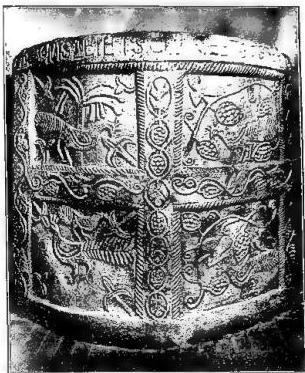
FERRARA, ARCIDIOCESI di - Baptismal basin with inscription (11th century), formerly the base of a Byzantine column - Ferrara, Pinacoteca comunale.
MONUMENTS. – The plutei of the primitive ambo of Voghenza are preserved, bearing the inscription: « De donis dei, et sec Marie et sci Stefani temporibus dom. Georgio ven. eps hunc pergamum fecit ind. 11 », dated to 539, a dating confirmed by B. Berenson, contrary to the interpretations of L. A. Muratori, Robault de Fleury, and A. Friasi. A sarcophagus lid from 548 bears the inscription: « In ne dni temporibus dni matricini vb episca servus tuus serviens tibi fecit ind. XI ».
Also recalled is the inscription of a church from 586, built by Bishop Vittore « ut pestes inguinaria non pertranseat fines nostros ».
Among the oldest churches, the Cathedral (1135–1260) remains the city’s most characteristic building. The masterpieces it preserves range from the Byzantine baptismal font to the Romanesque sculptures of the « porta dei mesi », from the illuminated choir books to the canvases by Tura, Francia, Garofalo, and Guercino, and to the tapestries of the Dossesca school (1551–53).
ABBEYS AND MONASTERIES. — Although outside the territory of Ferrara, the thousand-year-old Abbey of Pomposa is linked to the diocese of F. through the branch of S. Benedetto, a three-naved church with three Renaissance cloisters, built in the city at the end of the fifteenth century, heir to its historical and artistic splendor.
Other abbeys of considerable historical and artistic value, now secularized or reduced, are: the thousand-year-old Abbey of S. Bartolomeo, with a Byzantine apse; that of S. Giorgio fuori le mura, the ancient cathedral from the seventh to the eleventh century and formerly the seat of the Olivetan general abbot; the Lateran Abbey of S. Giovanni, dating from the sixteenth century, seat of the Knights of Malta from 1826 to 1834; and finally the great Charterhouse of the fifteenth century, which for more than a century has housed the remains of the citizens of Ferrara.
THE SHRINES. - Among the shrines, the most celebrated are: that of Our Lady of Graces in the Metropolitan Cathedral itself; that of the Miraculous Blood spurted from the Host at the hamlet of Sacre Specie on 28 March 1171, still visible in the basilica of S. Maria in Vado; that of the Crucifix of S. Luca, a Byzantine work which appeared in the waters of the Po in 1128; that of the b. Beatrice II d’Este (d. in 1264), whose relics are preserved in the monastery of S. Antonio, containing a rich body of Ferrarese painting from the 13th to the 17th century; that of S. Maurelio (d. in 657), whose remains are preserved in a chased silver casket of the 15th century; that of Corpus Domini, founded and sanctified by the presence of s. Caterina Vigri, who there had her visions and wrote her ascetic works;
that of the b. Giovanni Tavulli da Tosignano (d. in 1446). In the diocese there are the shrines of Madonna della Pioppa and Poggetto, which for centuries have been the object of great veneration.
In the architectural field, three “types” of Ferrarese churches may be noted: the first is represented by the Gothic churches of the 14th and 15th centuries, whose notable traces are preserved almost exclusively in the façades, namely: a single nave, a simple façade with a cusp, acroteria, a central portal surmounted by a rose window and flanked by two windows; every architectural element is decorated with graceful terracottas, characteristic of Ferrarese pre-Renaissance decorative art. The second type, more varied than the first, developed in the 16th century through the work of Rossetti; it comprises grandiose basilicas with three naves, a transept and sumptuous decoration, and a façade with volutes and acroteria, in two levels, the lower of which reflects the interior style. The third type, that of the churches in the surrounding countryside, may be grouped around Foschini (18th century); their single-nave interiors reflect the Baroque period, while meeting the requirements of worship.
The figurative arts were cultivated extensively from their origins. The Cathedral is enriched by a body of sculptures ranging from the 12th century, with the sculptures of Niccolò and of Antelami (13th century) on the façade, to the masterpieces of Baroncelli and Paris, which form the group of the Crucifixion, the terracottas of the Lombardi, the holy-water fonts of the Vaccà, and the decorative statues of Ferrari.
To this varied body of work in the Cathedral must be added the works scattered throughout the churches of the city: the terracotta Pietà by Mazzoni (15th century), the funerary monument of Barbara of Austria at the Gesù (16th century), and the tombs dispersed here and there, including the famous ones of the Estensi at Corpus Domini (16th century) and of the Villa family at S. Francesco.
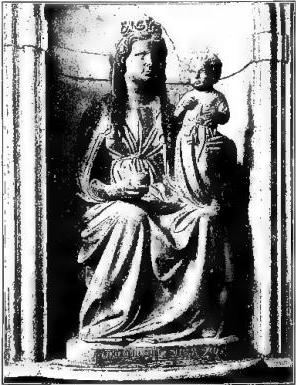
In the Cathedral Museum, in addition to the aforementioned allegorical sculptures of the months, there are preserved the Madonna del melograno by Jacopo della Quercia and a statuette believed to represent S. Ambrogio, by the same artist. In the other churches, although stripped of their furnishings during the suppressions of the last century, excellent canvases by Tura, Francia, Carofalo, Dossi, Guercino, and other artists of the Ferrarese school from the 15th to the 18th centuries are still preserved.
(fot. Alinara)
FERRARA, ARCIDIOCESI di - Madonna del melograno, Scultura di Jacopo della Quercia (1408) - Museo della Cattedrale.
The mosaic is represented by the unicum of the Duomo depicting a head of the Blessed Virgin, belonging to the decoration of the triumphal arch of the Cathedral, in which one of the earliest examples of our vernacular poetry was preserved: “Li mille cento trenta cenque nato - fo questo templo a San Giorgio donato - da Ghelmo ciptadin per so amore - e mea fo l'opra Nicolao Scolpiore”.
Illumination flourished as early as the end of the 12th century, when the monk Giovanni Aldighieri (1195), an ancestor of Dante, who took his grandmother and his “name” from F., appears as a skilled illuminator; it reached its greatest splendour with the illuminations of the Bible of Borso and of the aforementioned choir books of the Cathedral and the Cortesa.