
OROPA, SANTUARIO di. — One of the major Marian shrines of Piedmont, 11.68 km from Biella, in the province of Vercelli, at an elevation of 1,180 m above sea level, in the alpine basin of the same name.
A medieval wooden statue of the Virgin with the Child in her arms is venerated there. A tradition, recorded in Orsi’s first Biellese chronicle of 1488 and in the stone document of 1593 kept near the shrine, has it that the statue was brought from the East by s. Eusebio di Vercelli (v.), who had been exiled there by the Arian emperor Constantius.
(from Villes d'art de la Suisse, Neuchâtel 1860, pl. 3)
OROLOGIO — O., the work of the master Spoeth of S. Gallo (ca. 1667), Sion, Town Hall.
(courtesy of its [sic], Mario Trompetto)
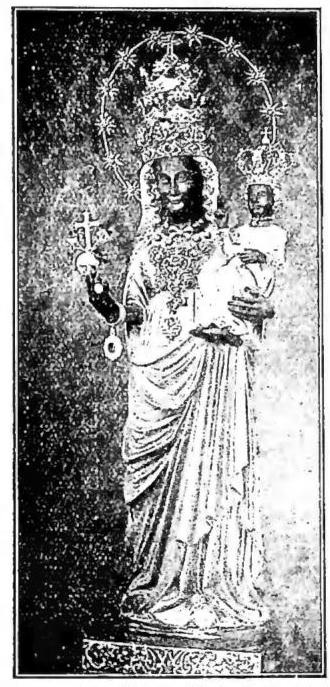
and by the same Saint
brought to the mountains of
O., both to preserve it
from further persecutions
and to consecrate the
Biellese pre-Alps, then the site of remnants
of pagan cults. « Apol-
linis nemus et fa-
num », in fact, marks
those mountains on a map
of Koeler’s Descriptio or-
bis antiqui, and the recent
discovery of a vast pre-
Christian necropolis at the
northern boundary of the city
of Biel-
la proves the exis-
tence in the region
of a considerable cen-
tre of Roman civilization. The
crosses, still discernible,
engraved by the
earliest devotees on
the erratic boulders near
the first deposits of
the sacred statue, and the ris-
ing near the
rough shrine of a
first and then a
second « cella »
(those which in
later documents
are called « ecclesias
S. Bartholomei et
S. Marie de Valle Orepe » [bull of Innocent III,
2 May 1207: Acta Reginae Oropae, I, p. 3] and subsequently the priories of S. Bartolomeo and S. Maria della Valle d’O.) of hermits professing Eusebian monastic life, together with the frequent sojourn there, as in a mystical retreat, of the successors of Eusebio in the see of Vercelli, are facts that shed light not only on the origins but also on the earliest development of the sanctuary.
The two aforementioned priories, with their commendatory priors, effectively disappeared at the end of the fourteenth century, and legally through the bull of Pio II (1459), which assigned the church of S. Maria di O. to the Chapter of S. Stefano of Biella (now the Cathedral), and then through the Royal Establishments of 1644, 1711, 1735, and 1748, which, in recognition of the merits acquired, entrusted alongside the Chapter’s authority the supervision of the Municipality of Biella, with a permanent administrative congregation composed of four canons and four representatives of the city under the presidency of the bishop. Thus began the period of the sanctuary’s greatest development. Around 1600, the little church built beside the primitive shrine was demolished, and the latter was enclosed at the centre of a larger church, which still exists today. Most of the old dwellings that had arisen nearby were demolished, and construction began—through popular offerings and the generosity of the Savoy princes—of the imposing buildings for lodging pilgrims. Their complex now consists of a double series of structures rising along the slope of the mountain and enclosing four successive squares. The first two are lined with religious shops and restaurants; the third—which is reached by the monumental staircase and the Juvarra-style royal gate—is the true sacred courtyard, very spacious and entirely surrounded by austere porticoes framing the Basilica that rises at the centre, exceptionally beautiful in the sober lines of its stone architecture; higher up one ascends to the immense square at the rear of which the imposing new church rises. In the surroundings stand the eighteenth-century chapels illustrating the mysteries of the life of the Virgin and the monumental cemetery.
The devotion of the subalpine peoples, which found its greatest expression in the four centuries-old coronations of 1620, 1720, 1820, and 1920, has enriched the sanctuary over the centuries
with gifts of the greatest value for history and art, from the fourteenth-century frescoes of the Shrine to the panels, furnishings, vestments, and sacred vessels now preserved in the Museum, Treasury, and Library. — Vedi tav. XXIII.