
CLOCK. — Since antiquity, there has been knowledge of instruments designed to measure time and applied to buildings; nevertheless, the clock understood also as a decorative element of architecture is a rather late creation.
In the Middle Ages, even before the need arose for clocks in public buildings for the use of citizens, there was a need for an exact division of time in religious communities, in order to regulate the monks’ life and the hours of the Office. It therefore seems established that this was the reason why the first medieval clocks were installed inside rather than outside churches; only later were they equipped with a bell and an external dial, thus also serving as public clocks. Moreover, they gradually became increasingly complex in their internal mechanism and in their dials, which were adorned with astronomical or allegorical representations and animated by automata that performed specific gestures when the hours struck.
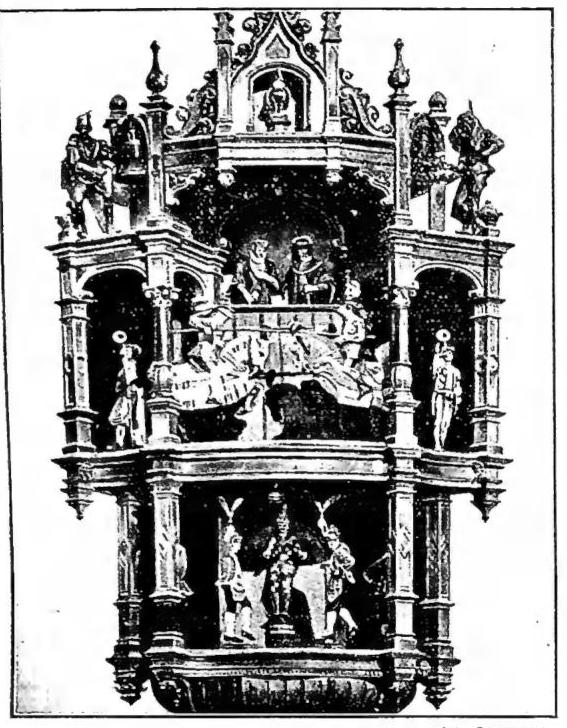
(phot. Lempower)
OROLOGIO - Automata with a tournament scene and masks (17th century).
Monaco, Town Hall tower.
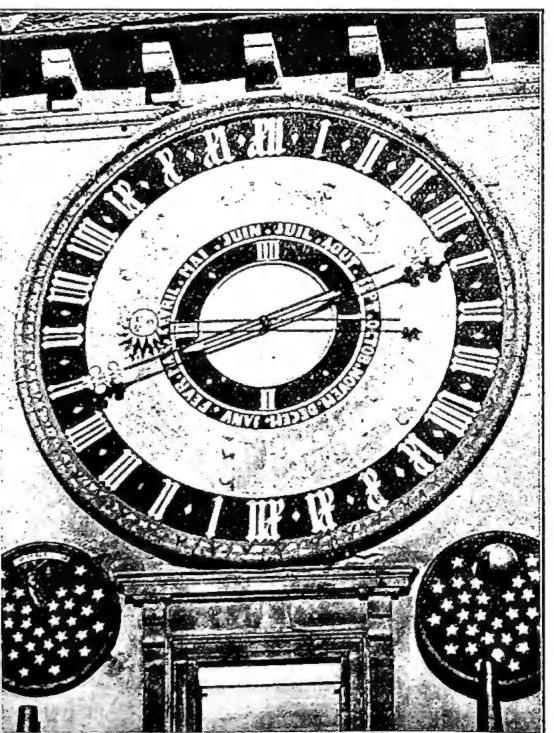
While the Swiss type (Berne, Sion, Solothurn, Zurich, Zug) resembles the French and German prototype, the English o. diverges from it: it is generally less complex and monumental, with a small dial surmounted by a few automaton figures: Exeter Cathedral, ca. 1317, restored later; Wells Cathedral, already mentioned in 1394, with an external and an internal dial surmounted by a few automaton figures; Saint-Dunstan in London, with automata (1671); York Cathedral (1750).
The primitive type of Italian public o. is also rather simple and animated by a few figures: at Orvieto, that of the Torre Maurizio, named after the bronze statue that strikes the hours on the bell, and at Udine, that of the Torre dell'o., built by Giovanni and Bernardo da Udine around 1530, but bearing an o. already existing in 1397 on an earlier building, are its oldest examples. Dating from the 16th century are the o. of the Confraternity of Arezzo, with an astronomical dial; of the Torre dei Matti in Brescia, with automaton figures; of the Torrazzo in Cremona; and of the Torre dell'o. in Padua, which repeats, in simplified form, the type of Venice. It is the o. of Venice that most closely approaches the transalpine type among Italian clocks: the building, erected by Mauro Coducci in 1496–99, houses a large astronomical dial above which is a small loggia where, when the hours strike, the Three Kings appear to pay homage to the Virgin and Child; the whole is finally surmounted by a bell on which two bronze figures strike the hours with a long hammer. There are, naturally, numerous o. on bell towers and on the façades or towers of palaces in the 16th century and the following centuries, but in general they are of little interest from an artistic point of view, with the exception of those in the Baroque style, which form part, as decorative and scenographic elements, of the complex architecture of the period (Rome, S. Agnese in Piazza Navona, Collegio dei Filippini, St. Peter's; Superga, sanctuary, etc.), and some from the last century, such as that of the Houses of Parliament in London, from 1859. - Vedi tav. XXII.