
BOURGES, ARCHDIOCESE of. — City in central France, capital of the department of Cher; the archdiocese also extends into the department of Indre. Under the name Avaricum it was the principal oppidum of the Bituriges; conquered by Caesar in 52 B.C., Biturigae became the metropolis of Aquitania and, with the Diocletian reform, the capital of Aquitania Prima. It was taken by the Goths in 475, incorporated into the kingdom of the Franks in 507, and later became the county of Berry.
Until the French Revolution, B. possessed an eleventh-century ivory diptych (now in the Cabinet des Médailles in Paris) containing the catalogue of its archbishops, continued to the end of the thirteenth century (Simone di Beaulieu, 1281–94). A copy of it is found in a capitular cartulary from the middle of the thirteenth century; another copy contains the list of the archbishops up to 1789 (ms. 9861 of the Bibliothèque Nationale in Paris). Two other transcriptions of the list are found in a canonical collection (Paris cod. 4280, fol. 56), which ends in 1096 (Archbishop Aldeberto), and in a collection by Roberto di S. Mariano. First in the episcopal list is St. Ursino, whose feast B. celebrates on 29 December. The list becomes more complete from St. Rodolfo onward (840–66). Numerous male and female abbeys flourished in B. during the Middle Ages.
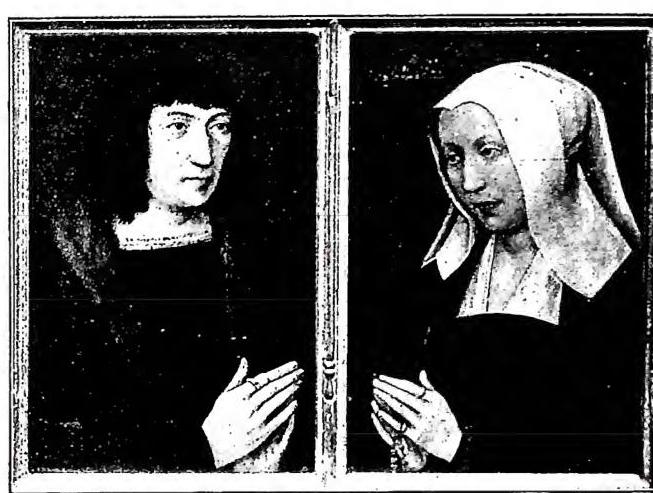
(courtesy of Dr. B. Degenhart)
BOURDICHON, JEAN — Two portraits.
New York, Mortimer Schiff Collection.
of St-Louis, St-Martin, and the Bonne-Dame. The patron saint of the archdiocese is the protomartyr St. Stephen. The archbishop bears the ancient, purely honorary titles of primate of the Aquitaines and patriarch.
Since the end of the eighteenth century, B. has as suffragan dioceses those of Clermont, Limoges, Le Puy-en-Velay, St-Flour, and Tulle.
Notable figures: St. Sulpicio Severo (591), St. Sulpicio il Pio (644), St. Rodolfo (866), St. Solange (tenth century), St. Guglielmo (1209), St. Giovanna di Valois, duchess of Berry, wife of Luigi XII, foundress Annunciation (v.).
Provincial councils were held at B. in 473, 1031, 1145, 1225, 1240, 1276, 1280, 1286, 1336, 1438, 1440, and 1528; at Issoudun in 1081.
Notable pilgrimages are those to Notre-Dame du Sacré Coeur at Issoudun; to Notre-Dame de Miséricorde at Pellevoisin; to Notre-Dame des Miracles at Deols; and to Notre-Dame des Enfants at Châteauneuf-sur-Cher.
BIRL.: L. Duchesne, Faites épiscopaux de l'ancienne Gaule, II, 2nd ed., Paris 1910, pp. 21–31; L.-H. Cottineau, Répertoire topobibliographique des abbayes et prierés, I, Mâcon 1939, cols. 461–64; A. Gandilhon, Catalogue des actes des archevêques de Bourges antérieurs à l'an 1200.
Bourges and Paris 1927; id., s. V. in DHG, X, cols. 178–211; Guide de la France chrétienne et missionnaire 1948-49, Paris 1948, pp. 331–32; 529–31; 1015–16. Enrico Josi
ART. — Of the Roman city, there remain the ruins of the temples of Minerva (38–41), Mars, and Jupiter (late first or early second century), as well as remains of the aqueducts and walls (fourth century), which later became integral parts of subsequent constructions. Traces of the Merovingian and Carolingian periods are scant.
Few remains survive of the former Cathedral, built by Gauzlin (1014–30). The cathedral of St Stephen is one of the finest examples of Gothic architecture: begun around 1194, it was consecrated in 1324. It has no transept and is noteworthy for the arrangement of its five naves, corresponding on the façade to the sculpted portals. The façade, whose stained glass, based on designs by Drouet de Dammartin, lends it refinement, is flanked by two towers, the “Sourde” (fourteenth century) and the “du Beurre” (sixteenth century). The cathedral of B., together with that of Chartres, is the richest in stained glass: the finest are those of one of the ambulatories (first quarter of the thirteenth century) and of the apse, in which Italian influence is evident. In the underground church, built between 1180 and 1200 to compensate for a difference in level, there are the statue
of Duke Jean de Berry, by Jean de Cambrai, stained-glass windows from the fifteenth century, and ten statues of archbishops from the Carolingian period.
The church of St-Pierre-le-Guillard, likewise without a transept, dates from the thirteenth century and was rebuilt in the sixteenth. The church of St-Bonnet, of which only the sixteenth-century choir by Guillaume Pelvoysin existed, was completed (notable are the stained-glass windows by Jean Lécuyer and the paintings by Boucher).
The palace of Jacques Coeur is one of the masterpieces of fifteenth-century Gothic civil architecture (1443–51): noteworthy are the sculpted door leaves and the wrought-iron hammer, the false windows from which the stone figures of Jacques Coeur and his wife look out, and the frescoes and sculptures of the chapel.
Although B. remained fundamentally Gothic during the Renaissance, and although the religious element was always present even in civil buildings, Italian influence can be discerned in the decorations of the Gothic Cuyas palace, built in 1515 by Pelvoysin and now housing the Musée du Berry, and of the Lallemand palace, an interesting example of a wealthy bourgeois Renaissance residence (1518), restored several times.
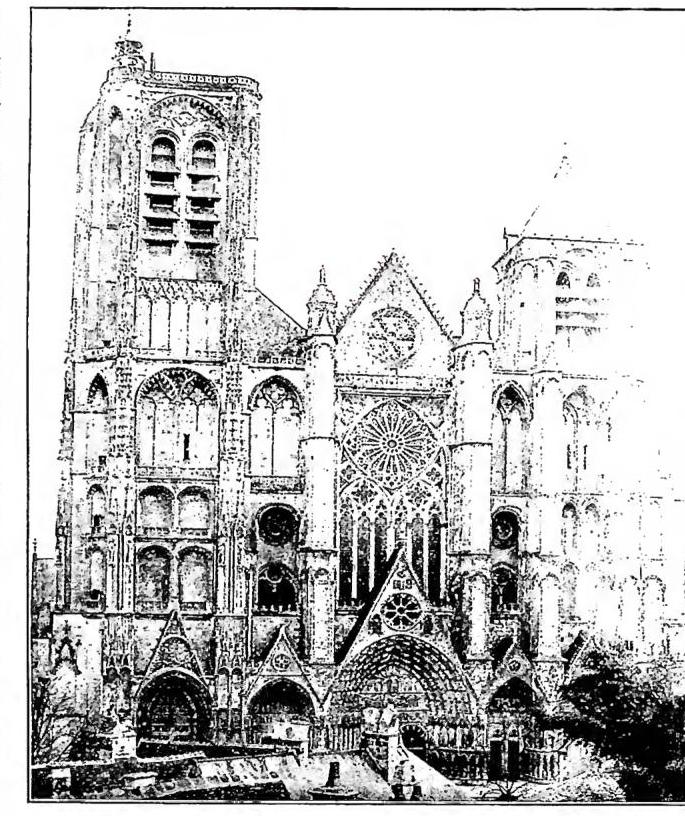
BOURGES – Façade of the Cathedral, consecrated in 1324.
BIRL.: A. Boinet, Les sculptures de la cathédrale de B., Paris 1912; M. Monmarché, France-Centre et Sud, ibid. 1920, p. 73 ff.; G. Hardy - A. Gandilhon, B., ibid. 1926; J. Hubert, L'art pré-roman, ibid. 1938, pp. 39, 54, 146–47; P. Pradel, La cathédrale de B., ibid. 1938. Fabia Borroni