
CANONICAL COLLECTIONS. – Compilations developed over the centuries that contain part of the laws of the Church and constitute, in the language of canonists, some of the fontes cognoscendi iuris canonici.
#### A) WESTERN CANONICAL COLLECTIONS.
SUMMARY:
I. Premises
II. General canonical collections
III. Special canonical collections
IV. Systematic canonical collections
V. The sources of canon law from Pseudo-Isidore to Gratian
VI. The great canonical collections of the 12th–14th centuries.I. PRELIMINARIES
These sources are of various kinds: sources of divine law or ecclesiastical law; genuine, spurious, or apocryphal; chronological or systematic; authentic or public.If one wishes to trace the logical genesis of canonical collections, the first testimonies of canon law are found in the New Testament, especially regarding the constitutional law of the Church; then in the Apostolic Fathers; for the pre-Constantinian period, in the other Church Fathers of the 2nd and 3rd centuries and in the pseudo-apostolic writings.
The Constantinian peace opens a new era in the history of canon law: bishops, sometimes aided and urged by the emperor, can more easily and frequently convene assemblies and take common decisions on various points of ecclesiastical discipline. Thus, written law is born, which replaces custom, the principal factor of ecclesiastical discipline in the preceding period.
From this era onward, Councils are of various kinds and are celebrated in different places: there are four General Councils (Nicaea, Constantinople, Ephesus, Chalcedon), but only two of them hold great importance for ecclesiastical discipline; there are also about twenty particular Councils: Eastern, African, Gallican, Spanish, and Roman. Later, the other two Ecumenical Councils of Constantinople, the second and the third, will have a certain influence on Latin collections.
Starting from the latter part of the 4th century, the epistolary activity of the Roman pontiffs intensifies; with the Decretals, the popes establish the principles of ecclesiastical organization; some imperial constitutions define the temporal statute of clerics and of goods consecrated to worship.
The letters of the pontiffs will become part of canonical collections from the 5th century onward, and from then on, they will increasingly form a notable part of them.
In some Fathers, discipline finds its legislators, and doctrine reaches its greatest perfection, especially in St. Augustine.
Other supplementary and receptive sources of canon law are Roman civil legislation in ecclesiastical matters and the law of the various barbarian states.
These elements, working together, allow for an ecclesiastical discipline with fairly uniform frameworks and clearly differentiated states.
Ecclesiastical archives deserve credit for preserving the canons and decretals, which were notified to the various Churches through systems analogous to those of the imperial bureaucracy; the law that a Church knows and observes is primarily the law contained in its archives. When, later, compilers feel the need to gather these elements into collections, they can easily find them in the archives of their own Churches.
Here, a rapid synthesis of Western canonical collections is given. For the Eastern ones, V. below: c.c. ORIENTALI. However, it must be noted immediately that the first Western canonical collections arose under the influence and in imitation of Eastern collections. A syntagma canonum, whose complex history is variously expounded by scholars, was already circulating in the East after the celebration of the Council of Chalcedon in 451, and included the canons of Ancyra (314), Neocaesarea (314-25), Nicaea (325), Gangra (341-42), Antioch, Laodicea (348-380), Constantinople (380), and Chalcedon (451). Latin canonical collections have an uninterrupted life from the second half of the 5th century; the oldest known ones originate in Africa, but it is in Rome that a canonistic activity begins, unofficial, to be sure, but precious for the subsequent development of canon law.
The epochs of canonical collections are commonly divided into four periods.
First period, studied principally and radically by Maassen: it extends from the time of Dionysius Exiguus to the Pseudo-Isidorian Decretals. This is the period of the elaboration of Western canon law, which integrates itself largely with regional elements, updates itself according to the emergence of various situations and needs of ecclesiastical discipline, and is not yet contaminated by the imposing literary falsification that will characterize the following period.
Second period, of the Pseudo-Isidorians and of the canonical collections that preceded, implemented, and followed the reform of Gregory VII.
Third period, of the classical and fundamental canonical collections that gave life to the Corpus Iuris Canonici.
Fourth period, which begins with the Council of Trent, documents the activity of the Roman Congregations, and is characterized by new types of collections: the Acta of the Pontiffs, of the Councils, and the various collections of Acta or Decisiones of the Holy See.
According to Maassen’s system of exposition, canonical collections are divided into general, special, and systematic; we do not follow the geographical criterion, often uncertain.
General collections are those that have a common foundation, constituted by the Ecumenical Councils and the local councils of the East; to these councils are sometimes added, in chronological order, the canons of the Councils of Africa, Spain, and Gaul, and pontifical decretals. It is these differences that will give individuality to each canonical collection.
Sometimes, and always after the rise of chronological collections, the aforementioned material is arranged systematically, or only particular elements of law are gathered from it, or only canons from one of the many councils celebrated here and there in Christendom, in these centuries and in earlier ones. Thus, systematic collections arise in the first case, and special collections in the second.
II. GENERAL CANONICAL COLLECTIONS
In addition to the Dionysian collections (v. DIONIGI il PICCOLO), the following are noteworthy:1. Collectio ms. Frisingensis: a common core; the Isidorian version of the Greek canons, a good number of decretals from the Dionysiana from Damasus (366) to Gelasius (496), acts of the Acacian cause; probably Italian, from the end of the 5th and beginning of the 6th century.
Alongside this canonical collection, the Coll. Weingartensis is also noted.
2. Collectio Quesnelliana, similar to the Frisingensis with the addition of the canons of Chalcedon and a large number of documents concerning the dogmatic conflicts of the 4th and 5th centuries. Its place of origin is a matter of debate: Quesnel (v.), Gaul according to the Ballerini brothers and Maassen; Rome, or at least Italy, is again proposed by Duchesne and P. Fournier.
3. Four Italian canonical collections of the 6th century: Coll. ms. s. Blasii, Coll. ms. Vaticani, Coll. ms. Theatini, Coll. ms. Iustelli; common core, versio prisca, debate from the first session of the Council of Carthage of 419; Italian, from the 6th century.
4. Coll. ms. Colbert, of uncertain date, originating in Gaul, partly akin to the Quesnelliana and partly to the s. Blasii.
5. Three canonical collections of Greek and African councils: Coll. ms. Parisiensis, Coll. Theodosii diaconi, Coll. ms. Wirceburgensis.
6. General canonical collections with Gallican councils. From the 6th century onward, almost every diocese had a general canonical collection, a Liber canonum; these collections were compiled so that dioceses might have at hand the legal norms to apply. Several survive, composed in Gaul; they include: Coll. ms. Corbeiensis, Coloniensis, Laureshamensis (Lorsch), Albigensis, Pithouensis, Bigotiana, s. Mauri, Diessensis, Burgundiae, Remensis.
(Int. Exc. Cstl.)
7. Finally, there are the general canonical collections of Spain. Chronologically, the Epitome Hispanica comes first, dating after 598, which summarizes the same material as the subsequent canonical collections.
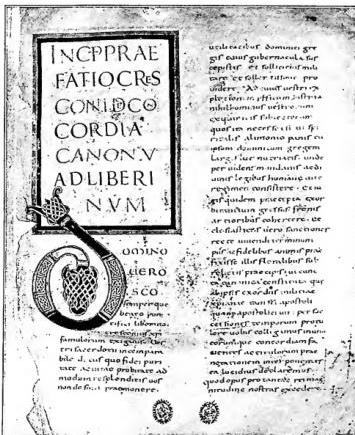
The redaction of the Collectio Hispana underwent various changes over time; thus, the different manuscripts present two distinct redactions of the same canonical collections.
The Collectio Hispana has always been attributed to Spain, but there is a heated debate among scholars as to whether it originated in the milieu of the Church of Arles, as Tarrè and Duchesne believe, who therefore propose calling it Collectio Arelatensis-visigothica. Some hold that its author is St. Isidore of Seville (v. ISIDORO di Siviglia); it was composed, according to a plausible hypothesis, around the time of the Fourth Council of Toledo in 633.
8. The Coll. ms. Novariensis is the last general canonical collection.
III. SPECIAL CANONICAL COLLECTIONS
First, a series of canonical collections of acts of the Greek Councils:Canonical collections concerning the Ecumenical Council of Ephesus: Coll. ms. Turonensis, Coll. ms. Veronensis, Coll. ms. Salisburgensis, Synodicon Casinense; canonical collections concerning the Ecumenical Council of Chalcedon: Coll. ms. Vaticani 1322, Coll. ms. Nostrae Dominae, Coll. Rustici (by Rusticus, Roman deacon, nephew of Pope Vigilius); Codex encyclicus; canonical collections of the acts of the V Ecumenical Council, Constantinople II; the canonical collection was compiled before 590; canonical collections of the acts of the VI Ecumenical Council, Constantinople III; Coll. temporis Sergii I, Coll. ms. Claromontani.
Fragmentum Veronense, refers especially to the heresies of the 4th and 5th centuries.
Canonical collections relative to the affair of Acacius: Coll. ms. Veronensis, Coll. ms. Virodunensis.
Canonical collections concerning the Donatist controversy.
Canonical collections of the Churches of Thessalonica and Arles: Collectio Ecclesiae Thessalonicensis, concerns the affair of the metropolitan of Thessaly, Stefano of Larissa; it was made in 531 before the Collectio Ecclesiae Arelatensis of the late 6th century.
Canonical collections of the African Councils: Coll. Concilii Carthaginiensis 419; Coll. Concilii Carthaginiensis 526; Collectio Conc. africanorum in Hispana: a special canonical collection of African canons, written in the Hispana; of uncertain origin and unknown author.
Canonical collections of Gallican and German Councils: Coll. ms. Lugdunensis, Coll. Concilii a. 813 with the canons of the five reforming Councils of Arles, Reims, Mainz, Tours, Chalon-sur-Saône. Coll. ms. Bellovacensis, an intermediate-period canonical collection because it appears to belong in part to this period; it extends beyond it with other documents. Coll. ms. s. Amandi, contains the canons of the Spanish Councils joined with other Gallic Councils.
Canonical collections of the Councils of Ireland and Great Britain: Coll. ms. Fécamp, which contains Irish, Breton, and Anglo-Saxon penitential canons, excerpts from the Holy Books and the Fathers; other subjects were perhaps added in Gaul. Coll. ms. Sangermanensis has many points of contact with the preceding.
Collectio Avellana (v. FONTE AVELLANA).
Collectio Conc. Romani of 649, by Martin I against Monophysitism and many letters of this pope.
Constitutiones Sirmondianae, contains eighteen imperial constitutions on ecclesiastical matters, from 321 to 425, perhaps later than 581; of Gallican origin.
Collectio ms. Mutinensis, is later than 601 and probably compiled in Italy; contains canons and decretals.
IV. SYSTEMATIC CANONICAL COLLECTIONS
The oldest systematic canonical collection is of African origin: the Breviatio canonum of Fulgentius Ferrandi (v. FULGENZIO).The Capitula Martini, a work by Martino of Braga, which, to correct what was obscure in the collection of Greek canons, classifies all that pertains to the clergy and concerns the laity; it enjoyed wide diffusion.
The Concordia canonum of Cresconius, by a Cresconius, perhaps a bishop and poet. It gathers the entirety of canonical prescriptions into a concordia, with the aim of making them more intelligible through rubrics. It draws from the Dionysian canonical collections. It is later than the Breviatio of Ferrandus and was widely used.
The Collectio Hispana systematica. It uses almost exclusively the Hispana chronologica. It is of Spanish origin, later than the Concordia of Cresconius.
Among the systematic canonical collections, a series of Gallican collections must be noted, specifically:
Coll. ms. Andegavensis, Coll. Herovalliana, I Coll. Bonaevalis, Coll. ms. Sangermanensis, II Coll. Bonaevalis, Coll. in 400 capitula, Cresconius Gallicus, Coll. Dacheriana, Coll. in quatuor libros, Coll. Halitgarii Cameracensis, Coll. ms. Bibl. Vallicellianae, Poenitentialia Rhabani Mauri.
Among these, the Dacheriana and the two Penitentials deserve special mention.
The Dacheriana provides canons from all Councils up to that of Constantinople, according to the Dionysio-Hadriana, and decretals from all Popes, except Felix III and Hormisdas.
The Poenitentialia Rhabani Mauri are two canonical collections related through their sources to some of the previously described collections. Of these penitentials, the oldest was composed around 841; the other dates to 853 (v. PENITENZIALI, LIBRI).
Other special small canonical collections are noted in Maassen’s work.
The Collectio Hibernica. The Irish canonical collection is among the most notable systematic collections of this period; it holds particular importance especially regarding the patristic material it employs, but it is especially interesting for Hibernian law.
The Coll. IX librorum, from the beginning of the 9th century, has points of contact with the Irish canonical collection.
Systematic canonical collections should be compared to the well-known collections of Roman law for clerical use, such as the Lex Romana canonice compta (v.), the Excerpta Bobiensia (v.), and a manuscript extract by Haenel.
The last canonical collections of this period were composed during a severe crisis that afflicted the Merovingian Church between 680 and 740: disregard for ancient law, deplorable conditions of episcopal sees, members of the clergy recruited without observance of canonical rules, and the consequent moral laxity among leaders and members. The Carolingian reform sought to remedy this state of affairs, reorganizing the hierarchy, restoring discipline among the clergy, and safeguarding ecclesiastical goods for their sacred purposes.
The culmination of this reform activity was the delivery of the Dionysio-Hadriana to Charlemagne in 774; the Dionysio-Hadriana spread rapidly; councils and capitularies appealed to it when they wished to restore ancient law. The Hispana, enriched with the Councils of Spain and somewhat modified by various Frankish revisions, also supported the reform and merged with the Dionysio-Hadriana in 810.
The Dacheriana crowns the effort of the Carolingian reform for the restoration, coordination, and classification of texts; it is the principal source of canonical collections in the first half of the 9th century, and its influence extended until the Gregorian reform.
To compensate for the lack of local elements in the great canonical collections that had regained prominence (the Hispana, the Dionysio-Hadriana, the Dacheriana) and their limited practicality, bishops composed specialized canonical collections, Capitularia, which contained, extracted from the great collections, the essential rules of parish administration: thus, the Capitularies of Theodulf of Orléans, Atto bishop of Basel, Gerbald bishop of Liège, a bishop of Freising, two anonymous Capitularies composed between 825 and 850 and between 850 and 875; the Capitula of Hincmar of Reims and of Rudolf of Bourges.
The political and scientific renaissance of the empire gave new importance to Roman imperial legislation: the Church was to make use of the rules established in its favor by Christian princes and gathered in the Justinian compilations; a great compilation of Roman law for clerical use was formed in the first quarter of the 9th century in Italy: the Lex Romana canonice compta; it contains the principal Roman constitutions concerning ecclesiastical organization.
V. THE SOURCES OF CANON LAW FROM PSEUDO-ISIDORE TO GRATIAN
A new period in the history of canonical collections opens in the second half of the 9th century. It corresponds to a grave situation of the Frankish Church, victim of the greed of the lay aristocracy, which arbitrarily deposed bishops and usurped their sees, placing docile instruments in their service. The very life of the Church was threatened and stifled by such a state of affairs. For half a century, a reform had been vainly invoked. After the last attempt failed at Épernay in 847, some thought to present the reform as having been planned long before: to this end, they fabricated numerous apocrypha, from which, mixed with genuine texts, the Pseudo-Isidorian collections arose: Hispana augustodunensis, Capitula Angilramni, Capitularia Benedicti Levitae, Decretales pseudo-isidorianae (v. ANGILRAMNO; BENEDETTO LEVITA; ISIDORO di SIVIGLIA).The distinctive character of the second part of this period is the relationship that canonical collections have with the reform of the Church promoted by Gregory VII: opposing it are the collections compiled in support of the struggle waged by the Pontiff; preceding and following it are two other groups of collections, called pre-Gregorian and post-Gregorian.
All are systematic collections and contain canons of councils, decretals of Roman Pontiffs, civil laws of the Romans or Franks, and writings of the holy Fathers.
1. Pre-Gregorian collections: Collectio Anselmo dedicata, by an unknown author, composed in northern Italy around 882 and dedicated to Anselm, archbishop of Milan (v.);
of good Roman spirit, it reflects Pseudo-Isidore, the Dionysio-Hadriana, the letters of St. Gregory the Great, the Novariensis, and the Lex Romana canonice compta.
Regino Prumiensis libri duo de synodalibus causis et disciplinis ecclesiasticis, which report the rules to be observed in instituting canonical processes during diocesan visitations; composed in 905 (v. REGINONE DI PRÜM).
Collectio Abbonis abbatis Floriacensis, compiled in defense of monastic exemption by the abbot of Fleury between 958 and 976; notable for its distinction and discussion of the sources of law.
Collectio quinque librorum Codicis Vaticanis, written at the beginning of the 11th century in support of the reform of Benedict VIII.
After this collection, P. Fournier-G. Le Bras note other minor collections, which they call Cisalpine and Transalpine. Still noteworthy are:
Decretum Burchardi Wormatiensis (v. BURCARDO di WORMS), composed around 1012 by Burchard, of the diocese of Mainz, who later became bishop of Worms; it supports the reform of the Church.
P. Fournier and G. Le Bras note various other minor collections from the end of the 9th to the beginning of the 11th century, which they classify as Germanic, Western, and Italian.
2. Gregorian collections. — The support given to the reform by these collections has two directives: to gather only the documents of the Roman Pontiffs and to reject corrupt customs.
Collectio septuaginta quatuor titulorum or Diversorum sententiae patrum, composed in Rome in 1050 by an unknown author in defense of the primacy, monastic exemption, and the rules on the appointment of bishops.
Capitulare cardinalis Attonis, by Atto, bishop of Milan, written at the end of the pontificate of Alexander II or at the beginning of that of Gregory VII.
Collectio Anselmi Lucensis, containing varied material, both original and interpolated; polemicists in defense of Gregory VII’s reform drew from it; composed around 1083 by Anselm, Lucca (v.).
Collectio cardinalis Deusdedit, expounding the disciplines of the Roman clergy; composed between 1083 and 1087.
Collections influenced by the Gregorian reform include:
Liber de vita christiana, by Bonizo, bishop of Sutri, later promoted to Piacenza; composed between 1089 and 1093. Collectio Britannica, so called because preserved in a codex of the British Museum, of special importance for papal letters; composed in Italy at the beginning of the 12th century.
Polycarpus, composed by Cardinal Gregory under Paschal II (1110-18); it favors the Gregorian reform but is also influenced by Burchard.
Various other minor collections are noted, especially by P. Fournier-G. Le Bras; the same authors mention other small collections that did not undergo Gregorian influence.
3. Post-Gregorian collections. — Collections from Gaul at the end of the 11th century: The three collections of Ivo of Chartres (v.).
Collections influenced by Ivo: Collectio Caesarungustana, from a codex of Saragossa, composed in Burgundy or Aquitaine in the first decade of the 12th century (dependent on Ivo, it favors the Gregorian reform); and other minor collections noted by P. Fournier-G. Le Bras.
Collectio Algeri Leodiensis or Liber de misericordia et iustitia by Alger of Liège (v.); other minor collections, always noted by P. Fournier-G. Le Bras.
BIBL.:
P. Fournier - G. Le Bras, Histoire des collections canoniques en Occident depuis les Fausses Décrétales jusqu'au Décret de Gratien, Paris 1931-32; F. Maassen, Geschichte der Quellen und der Literatur des canonischen Rechts im Abendlande bis zum Ausgang des Mittelalters, Graz 1870; A. Van Hove, Prolegomena ad codicem iuris canonici, Mechliniae 1945; E. Amann, Dictionnaire de théologie catholique, s. V. Collections canoniques; H. Leclercq, Dictionnaire d'archéologie chrétienne et de liturgie, s. V. Collections canoniques; P. Hinschius, Decretales Pseudo-Isidorianae et capitula Angilramni, Lipsiae 1863; J. Rambaud-Buhot, Les collections canoniques, in Histoire du droit et des institutions de l'Église en Occident, Paris 1955.
A. M. STICKLER
VI. THE GREAT COLLECTIONS OF THE 12TH–14TH CENTURIES
The period that follows is the period of the Decretum Gratiani (v. GRAZIANO), the Compilationes quinque antiquae (v.), and the other collections that will form the Corpus Iuris Canonici (v.), and it fits within that era of literary renaissance in ecclesiastical matters, which saw the flourishing and birth of canon law as a science, now developing with its own life and becoming an organic system. This is the epoch of the great canonical collections, many of which deserve and have in this encyclopedia a separate exposition.Amid such a flourishing of works, a series of minor canonical collections finds its place, which we mention here, preceding the Compilatio I: an Appendix Concilii Lateranensis, which contains, together with the canons of the Lateran Council (1179), decretals and canons, including those of the Council of Tours of 1163.
This collection was imitated by other, lesser-known ones, such as the Bambergensis, Lipsiensis, and Castelana collections. These collections, the object of study by skilled modern researchers, are customarily distinguished into: non-systematic collections prior to the I Compilatio; systematic collections prior to the I Compilatio; and systematic collections subsequent to the I Compilatio.
Their authors and place of origin are unknown; their time of composition is deduced from intrinsic elements; they are designated by the name of the library in which their manuscripts are preserved. Their importance lies in the preservation of decretal texts that would otherwise be less well known or not known at all; they have all been masterfully reviewed by Kuttner.
With the Corpus Iuris Canonici, the era of canonical collections comes to a close. With the celebration of the Council of Trent and the reorganization of the Roman Curia carried out by Sixtus V, the universal law issued by the Pope or, by his order, by the Roman dicasteries, will be gathered in compilations that no longer take the form of the old canonical collections: henceforth, there will be the Bullaria, the Acta Romanorum Pontificum, the Acta of the various Congregations, offices, and tribunals, though formal unification and simplification of the law with the CIC will not be achieved.
Giuseppe D'Ercole
#### B) EASTERN CANONICAL COLLECTIONS.
CONTENTS:
I. Collections of the Byzantine Rite
II. Collections of the Alexandrian Rite
III. Collections of the Antiochene Rite
IV. Collections of the Armenian Rite
V. Rite.I. COLLECTIONS OF THE BYZANTINE RITE. — I. Greek (Byzantine) collections. — a) The primitive canonical collection. At the beginning of its existence, the Church did not possess a complete system of norms and rules. Apart from a certain number of fundamental principles and particular precepts contained in the books of the New Testament or in oral tradition, it had to create its own law. In this process, particular Churches enjoyed very broad autonomy in the early centuries, though the influence of mother-Churches and that of more important cities was also felt during that period.
Custom, rather than legislation, prevailed. The desire to fix such customary or traditional norms and to grant them superior authority led to the composition of pseudo-apostolic writings and orders, of which a considerable number are found in the early Christian centuries.
With the rise of heresies and the growth in the number of the faithful, the need for greater determination and uniformity became increasingly pressing. In the second half of the 2nd century, synods of bishops began to be convened. In the 3rd century, such synods regulated disciplinary matters alongside questions of faith and doctrine. Particularly in the latter part of this century, a penitential discipline emerged, the echo of which is still found in later canons. The 4th century took a further step in that the authority of the canons of Ecumenical Councils was no longer dependent on free acceptance but bound all bishops and faithful without exception.
The canons of councils do not treat a subject systematically. They respond to current issues, resolving difficulties of the moment presented by bishops to the synod. They thus appear incomplete, and the tendency to collect various groups of canons soon became evident. In the East, few traces of such attempts remain. Perhaps because one collection of canons quickly prevailed and supplanted all others. Already the Fathers of the Council of Chalcedon had in hand a collection that included, first, the canons of Nicaea (325), followed by those of the Synods of Ancyra (314), Neocaesarea (314-320), Antioch (328-32, though falsely attributed since antiquity to the council in Encaeniis of 341), Gangra (342), and Laodicea (347-78), all with continuous numbering. The canons of the Council of Constantinople (381) formed a kind of appendix. Together with the canons of Chalcedon (451), they entered the collection before the end of the 5th century, at the beginning of which were placed the 85 so-called Apostolic Canons (composed ca. 360-80).
The origins of this collection remain obscure. According to the most common opinion, a first nucleus would have formed at the beginning of the 4th century, consisting of 24 canons of the Council of Ancyra (the last 10 actually belong to a Council of Caesarea, as lucidly demonstrated by Lebon, Le muséon, 51 [1938], pp. 89-132) and 14 canons of the Council of Neocaesarea. The 20 canons of the First Ecumenical Council of Nicaea were soon added, placed first due to its authority, as expressly stated in an appended note. To this first nucleus were then added the canons of the three Councils of Antioch, Gangra, and Laodicea.
More recently, however, Ed. Schwartz proposed a new explanation. According to him, the Corpus canonum would be the work of the Arian "Homoeans," who effectively directed the Church during the years 360-78. With the same intentions with which they produced a vast pseudo-apostolic literature (the Apostolic Constitutions, the Canons of the Apostles, the false Ignatian writings, etc.), they would have composed the collection of canons, that is, to grant greater authority to the Church of Antioch. Guided by this criterion, they selected the Councils: those of Antioch (attributing the canons to the famous Arian Council of 341), Gangra, Ancyra, and Neocaesarea, in which the bishops of Antioch had presided, and the Council held by anti-Nicene bishops at Laodicea. Only after their fall would the orthodox have adopted the collection, adding first the canons of the Council of Nicaea. A brilliant and plausible conception, though it is prudent to await further confirmation.
At the beginning of the 6th century, the collection appears further enriched by a certain number of canons of the Council of Ephesus and the canons of Sardica, sometimes inserted after the Council of Gangra, sometimes and more often added at the end of the councils. Thus, a collection of canons from 10 synods—4 ecumenical and 6 local—preceded by the canons of the Holy Apostles, had been formed.
b) The Synagogé of 50 titles. The primitive collection, ordered according to the "chronological" criterion, was difficult to consult. Therefore, around 535, an unknown author composed a "systematic" collection in 60 titles. A collection of extracts from civil laws concerning ecclesiastical matters (Collectio XXI capitulorum) seems to have formed its appendix. We know of this work only from the allusion made by John Scholasticus, later Patriarch of Co
CANONICAL COLLECTIONS - Nomocanon - Vatican Library, Vat. gr. 2060, f. 187 (12th century).
b) The Synagogé of John Scholasticus. Around 550, while still a layman and advocate (scholastikós), John, later Patriarch of Constantinople, compiled a collection in 50 titles, distributing among these titles (rubrics) the canons—or even excerpts from them—according to subject matter. The Synagogé contains the 85 Apostolic Canons, those of the ten synods, and also the canons from the second and third canonical letters of St. Basil. Collections of canons and sayings of the Holy Fathers were already in circulation, but John Scholasticus was the first to incorporate them into collections of canons, thereby paving the way for them to acquire an authority they did not possess on their own.
The Synagogé is often accompanied by the Collectio LXXXVII capitulorum, sometimes augmented by the Collectio XXV capitulorum, that is, the Collectio XXI capitulorum enriched with four chapters containing Novels. Benešević believes that the author of the collection and its addition to the Synagogé was John Scholasticus himself. Later, the Synagogé was transformed into a Nomocanon: under the individual titles, texts were placed drawn both from the Collectio LXXXVII capitulorum and from other sources of civil law. However, this likely occurred after the patriarch’s death.
c) The Syntagma of XIV Titles. The method used by John Scholasticus was perfected by the author of another canonical collection, written shortly afterward (ca. 580). The work is divided into two parts: the first comprises 14 titles, subdivided into 329 chapters, in which not the text of the canons themselves is given, but only a reference. The second part contains the "chronological" collection of canons. This approach made it possible not only to specify the subject matter more precisely but also to cite the canons as often as desired without cluttering the text. Furthermore, new sources were included in the collection, particularly the canons of the Council of Constantinople (394) and those of Carthage (419), as well as those of twelve Holy Fathers, among whom St. Basil with all three of his canonical letters. The author appended at the end a collection of civil laws concerning ecclesiastical matters, the so-called Collectio constitutionum ecclesiasticarum (also called Collectio tripartita or Paratitla). Nothing precise is known about the author.
In A.D. 629 or 630, the work underwent an important transformation (v. tit. IX, cap. 1). A jurist, apparently residing in Constantinople and identified—based on what is said in tit. N, cap. 10—with the so-called Enantiophanes, a known figure in Byzantine law, converted the Syntagma into a Nomocanon by placing brief excerpts or epitomized texts of civil laws (drawn, however, not from the Collectio tripartita but from other collections) under the respective chapters of the first part of the collection. He also added to the Nomocanon four Novels of Heraclius and the canons of St. Gregory of Nazianzus and St. Athanasius.
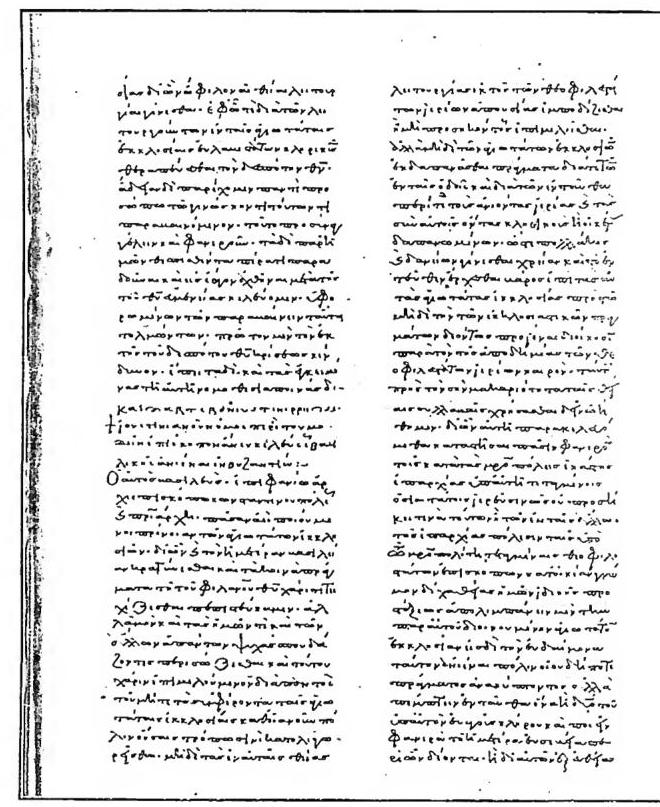
d) The Synopsis sacrorum canonum. Alongside the great collections of canons, a collection with abridged texts of the canons emerged in the 6th century, which included, in addition to the Apostolic Canons, those of the ten synods, the canons of the Council of Carthage, and the three canonical letters of St. Basil. In manuscripts, it is attributed to various authors: Stephen of Ephesus (6th century), Simeon the logothetes (10th century), and Alexios Aristenos, of whom the first was likely the author of the work, while the others were responsible for new recensions. Aristenos wrote a highly esteemed commentary on the Synopsis, praised for its clarity and conciseness. It enjoyed wide diffusion even beyond the borders of the Byzantine Empire.
e) The Σύνταγμα κατά στοιχείον (Syntagma alphabeticum). The Nomocanon of XIV Titles, with the commentaries of Zonaras and Balsamon, was aimed at individuals with a certain ecclesiastical education. In the final years of the empire, as political power declined and the level of education diminished, a clear, concise, and easily consultable manual of law was desired for the clergy. Such a book was written in 1335 by the hieromonk Matthew Blastares, apparently residing in Thessalonica. The work is divided, according to the number of letters in the Greek alphabet, into 24 parts, subdivided into 303 chapters; the subjects are arranged alphabetically.
In addition to the canons of councils and Holy Fathers, and some quotations from Zonaras and Balsamon, it also contains provisions of secular law on civil matters of particular interest to the clergy, an addition that gave it special value. All this is presented in abridged form and, ordinarily, without detailed indication of the source. The book’s popularity is evidenced by its translation into many languages: Modern Greek, Slavic, Serbian, Russian, etc.
f) The Nomocanon of Manuel Malaxos. This work already belongs to the period of Turkish domination. Malaxos, notary of the Metropolitan of Thebes, wrote his book in Nauplia in 1561. Following the first edition in literary language—of which three copies survive today—he produced a version in Modern Greek (1562–63), of which over 300 manuscripts are known, with many others likely to exist. The first edition appears to have contained 580 canons; the number of canons in the second varies between 203 and 694, a variation undoubtedly due to the copyists of the work. It was not the intrinsic value of the collection—alongside the canons, it also includes information on geography, meteorology, and philosophy—but its accessibility to all that explains its wide diffusion.
g) The Πηδάλιον (Pedalion). To address the needs of their time, the two Athonite monks Nicodemus and Agapius composed at the end of the 18th century a manual of canons, accompanied by a commentary, a "concordance" of the canons, and notes. The book was printed in Leipzig in 1800. It gained official authority in the Patriarchate of Constantinople and in Greece. It was reprinted several times and, in 1844, also in Romanian at the Neamț Monastery.
h) Other canonical collections. A Synopsis canonum, a work of modest merit, undeservedly enjoyed the honor of being printed twice; its author, a monk of Mount Athos named Arsenius, was mistakenly identified with the homonymous patriarch (1254–61, 1261–64). More complete, though brief and simple, is the Ἐπιτομή τῶν θείων καὶ ἱερῶν κανόνων (Epitome of the Divine and Sacred Canons) by the judge of Thessalonica, Constantine Harmenopoulos, the well-known author of the Hexabiblos or Πρόχειρον τῶν νόμων (1335). It treats, in six books, bishops, priests, deacons and subdeacons, minor clerics, monks and monasteries, and laity and women, in succession.
A. M. AMORE
Under Ottoman rule, in 1645, the archimandrite Giacomo of Giannina composed the collection titled Ἡ Βακτηρία τῶν ἀρχιερέων (The Staff of the Bishops) at the behest of Patriarch Parthenios. Following Blastares in the arrangement of the work, the author surpasses him greatly in its breadth: it contains 1,274 chapters. It was used in the Balkans and especially among the Romanians after a translation into their language was made in 1754. It was never printed.
Other collections, both printed—such as the Κανονικόν by the monk Christophoros (Constantinople, 1800)—and those remaining in archives, could still be mentioned; however, they did not exert a lasting influence.
2. Melchite canonical collections. — The legal history of the three "Eastern" patriarchates of Alexandria, Antioch, and Jerusalem is little explored. There is no doubt that the canons of the ecumenical and local councils were known and applied there, but reliable data on the reception or rejection of certain collections are lacking.
Only later, according to recent research, does a distinct Melchite collection emerge, which in manuscripts from the 12th to the 18th centuries exhibits characteristics that distinguish it as a whole from others. The canons of the Council of Nicaea are placed after those of Ancyra and Neocaesarea; the Arabic pseudo-Nicene canons, spiritual canons, canons of Epiphanius, apocryphal canons of Basil, the second series of canons from the Second Council of Nicaea (that is, in fact, the Collectio LXXXVII capitulorum), the Prócheiros Nómos, and others are added. There are connections with Chaldean and Coptic collections, but these have not been sufficiently explored to allow for a definitive judgment.
3. Bulgarian and Serbian collections. — In the early period following the country’s conversion, the Bulgarian Church displayed intense activity in translating Greek ecclesiastical books into Church Slavonic, pursuing the impetus given by the disciples of SS. Cyril and Methodius. Many of these translations found their way to Russia, where they facilitated the task of establishing a Church of Slavic rite. However, nothing is known of Bulgarian versions of the most important works of canon law. Later, the Bulgarians, depending on circumstances and the times, made use of Greek works or of translations and editions produced by their neighbors.
The Serbs, too, initially relied on Byzantine writings. But at the beginning of the 13th century, Sava—later the founder of the autocephalous Serbian Church and its first archbishop—during his stay at the Chilandar Monastery on Mount Athos, oversaw the compilation of a new canonical collection in Church Slavonic, the so-called Kormčaja Kniga. This work did not include the full text of the canons but rather the epitomized text of the Synopsis canonum, usually accompanied by the commentary of Aristenos, as well as many documents of later Byzantine legislation, synodal decrees of the patriarchs of Constantinople, Novels of Alexios I Komnenos, responses of bishops or other canon law experts, and so on. Seven manuscripts of this work, with various recensions, are still preserved today.
No less important for practice became the Church Slavonic translation of the Syntagma alphabeticum of Matthew Blastares, completed before the end of the 14th century. In recent times, the Serbian Church has also made use of Russian and Greek editions of the canons.
4. Russian collections. — As early as the 11th and 12th centuries, the principal canonical collections translated into Church Slavonic circulated in Russia, particularly the Synagoge of 50 Titles (in the version probably made by St. Methodius himself) and the Syntagma of 14 Titles. Over time, especially the latter was enriched with many other documents: ecclesiastical ordinances, treatises, responses of metropolitans, statutes of princes, and so on, of Russian origin. On the other hand, Metropolitan Cyril II obtained in 1270 (or 1262?) from the Bulgarian despot Jacob Svetoslav the Serbian Kormčaja Kniga, which was read and recommended at the Synod of Vladimir (1274).
Thus, two families of manuscripts of the Kormčaja Kniga emerged: one with the full text of the canons and additions of Russian origin, the other with the epitomized text and Byzantine sources. When, due to the countless discrepancies and serious corruptions that had gradually disfigured the text, a reform became necessary around the mid-17th century, the then-dominant tendency in Russia and the Russian Church—seeking rapprochement with the customs of the Greek Church—decided in favor of printing the Serbian Kormčaja. It was sent to press in 1650 by Patriarch Joseph, with only minor changes. But as soon as the work was completed, Joseph died, and his successor Nikon—a religious and pious man but authoritarian—having withdrawn the already distributed copies under the pretext of correcting inaccuracies, published another edition in 1653. This edition contained few changes, mainly concerning the treatises placed at the beginning and end of the work. The 70 chapters contained almost exclusively documents of Byzantine provenance. Alongside the canons of the councils in the text of the Synopsis of the 14 Titles, responses of bishops, and so on, one also finds the Donatio Constantini—as proof of the Church’s superiority over the State—Byzantine codes such as the Ecloga of the Isaurian emperors, the Prócheiros Nómos of Basil I, Novels, polemical treatises against the Latins, and in chapter 50, an instruction on marriage, which also included an excerpt from the Rituale Romanum of Paul V.
The Kormčaja Kniga remained the official law book in the following centuries (the "Old Believers," however, clung to Joseph’s Kormčaja, of which they secretly produced new editions). Yet, with the advancement of Russian ecclesiastical culture, its deficiencies became apparent, and thus the Holy Synod, in 1839, commissioned the publication in Church Slavonic of the complete text of the canons, the Kniga pravil. Since then, the practical authority of the Kormčaja Kniga has greatly diminished.
5. Romanian collections. — After the formation of the two Danubian principalities, the Romanian Church remained for a long time under the influence of both the Byzantines and the Serbs. The Church Slavonic version of the Syntagma alphabeticum of Blastares was particularly used and esteemed. From the second half of the 16th century, the Romanians—first in Transylvania (through the work of the deacon Coresi), then also in the principalities—began to publish some minor works of penitential character. In 1652, with the approval of Prince Matthew Basarab, the Îndreptarea legii (Nomocanon), also called Pravila cea Mare, was published in Târgoviște. More an ecclesiastical than a civil code, it officially remained the code of the Romanian Church until modern times. The first part contains 417 canons, of which 314 are drawn from the Nomocanon of Malaxos and 103 from the code of Prince Basil Lupu of Moldavia (1646). The second part presents the Synopsis canonum with the commentary of Aristenos. However, the text of both parts often has the character of a paraphrase rather than a literal translation.
For some time, the Bakteria, translated into Romanian in the 18th century, and the Pedalion, published in a Romanian version at Neamț Monastery in 1844, also enjoyed considerable favor.
BIBL.:
Per le collezioni bizantine: V. Beneševič, Sbornik pamjatnikov po istorii cerkovnago prava, I, Pietrogrado 1914; F. Brandileone, Sul diritto bizantino nell'Italia meridionale, in Archivio giuridico, LXXI (1903), 3-48; J. Zhishman, Das Eherecht der orientalischen Kirche, Vienna 1864; V. Grumel, Les regestes des actes du patriarcat de Constantinople, I, Parigi 1932; V. Laurent, Les regestes des actes du patriarcat de Constantinople, I, fasc. IV, Bucarest 1971; V. Beneševič, Sinagoga v 50 titulov i drugie juridiceskie sborniki Ioanna Scholastika, Pietrogrado 1937; V. N. Beneševič, Drevne-slavjanskaja Kormčaja XIV titulov bez tolkovanij, Sofia 1987; V. N. Beneševič, Kormčaja Kniga. Issledovanija i teksty, Pietrogrado 1910-1914; A. Pavlov, 50-ja glava Kormčej Knigi kak istoriceskij i prakticeskij istočnik russkago bračnago prava, Mosca 1887; N. Suvorov, Sledy zapadno-katoličeskago cerkovnago prava v pamjatnikach drevnjago russkago prava, Jaroslavl' 1888; V. N. Beneševič, Kanoniceskij Sbornik XIV titulov so vtoroj četverti VII V. do 883 g., Pietrogrado 1905; V. Grumel, Les sources du droit ecclésiastique byzantin, in Revue des études byzantines, I (1943), 5-34; V. Laurent, Le droit canonique dans l'Église byzantine, in Revue des études byzantines, III (1945), 5-26.
Per le collezioni melchite: I. Dick, Les canons arabes attribués à saint Jean Chrysostome, in Proche-Orient Chrétien, XII (1962), 289-306; G. Graf, Geschichte der christlichen arabischen Literatur, II, Città del Vaticano 1947, 586-590; V. Grumel, Les canons dits de saint Jean Chrysostome, in Revue des études byzantines, XX (1962), 70-74.
Per le collezioni slave: A. Pavlov, Kritičeskie opyty po istorii drevnejšej Kormčej Knigi, Pietroburgo 1899; V. N. Beneševič, Kanoniceskij Sbornik XIV titulov, Pietrogrado 1905; V. Jagić, Entstehungsgeschichte der Kormčaja Kniga, Berlino 1899; F. Dvornik, Les Slaves, Byzance et Rome au IXe siècle, Parigi 1926; V. Mošin, Kormčaja Kniga, serbskaja i russkaja, in Slavia, X (1931), 1-24; V. N. Beneševič, Drevne-slavjanskaja Kormčaja XIV titulov bez tolkovanij, Sofia 1987; V. N. Beneševič, Kormčaja Kniga. Issledovanija i teksty, Pietrogrado 1910-1914.
Per le collezioni romene: N. Iorga, Istoria Bisericii românești, I, Bucarest 1908; I. Bianu, Catalogul manuscriptelor românești, I, Bucarest 1895; V. Grecu, Indreptarea legii (1652), in Biserica Ortodoxă Română, LXIX (1951), 105-120; I. Mihălcescu, Istoria Bisericii Ortodoxe Române, Bucarest 1952; V. Grecu, Pravila cea Mare, in Mitropolia Olteniei, IV (1952), 1-16.
A. M. Ammann
6. Collezioni georgiane. — Nonostante i frequenti rapporti culturali e letterari che la Georgia ha avuto dal tempo della sua conversione con l'Armenia e la Palestina, si sa di una versione dei canoni nella lingua georgiana solo nel tempo del massimo influsso bizantino. È ancora s. Eutimio (m. nel 1028), l'instancabile traduttore del monastero Iviron (= dei Georgiani) del monte Athos, che oltre il Nomocanone penitenziale di Giovanni il Digiunatore diede ai suoi connazionali in georgiano anche i canoni del Concilio di Trullo. Controversa è la data della versione del «Grande nomocanone georgiano», ossia del Nomocanone di 14 titoli. Il Kekelidze stima che esso sia stato tradotto da Arsenio Iqalthoeli verso la fine del sec. XI, mentre altri, nominatamente il Beneševik, vogliono che già nel sec. X ne fosse esistita una versione e che Arsenio abbia fatto solo una versione perfezionata. Più tardi furono fatte anche raccolte dei canoni dei concili nazionali e dei katholikós. Esse
furono poi accolte nella grande collezione delle leggi georgiane fatta dal re Vakhtang VI alla fine del sec. XVII.
b) V. N. Benešević, Ioannis Scholastici Synagoge L. titulorum, Monaco 1937; J. Voellus et Chr. Justellus, Bibliotheca iuris canonici veteris, II, Parigi 1661, pp. 499-602; J. B. Pitra, op. cit., II, pp. 375-85; V. N. Benešević, Synagoge u 50 titulov i drugie juridijskie sborniki Ioanna Shkolastika, Pietroburgo 1914; E. Schwartz, Die Kanonessammlung des Joh. Scholasticus (Sitzungsber. d. Bayr. Akad. d. Wiss., Phil.-hist. Abt., 6), Monaco 1933.
c) Pitra, op. cit., II, pp. 433-64; G. A. Rhalli e M. Potli, Συνταγμα τῶν θείων καὶ ἱερῶν κανόνων, I-IV, Atene 1852-54; G. Bevergius, Συνόδων, 2 voll., Oxford 1872; PG 104; V. N. Benešević, Kanonijskij Sbornik XIV titulov vo vtoroj četverti VII věka do 883 g., Pietroburgo 1905; E. Zacharić von Lingenthal, Über den Verfasser und die Quellen des (Pseudo-Photianschen) Nomokanon in XIV Titeln (Mémoires de l'Acad. impér. de St-Pétersbourg, 7e serie, 32, XVI).
d) M. Kraznošen, Sinopsis cerkowskij pravil i istorija ngo obrazovanija, in Vizant. Vremennik, 17 (1912), pp. 225-46; id., Tolkovateli kanonijskogo kodeksa Vostočnoj cerkvi, Aristin, Zonara i Valsamon, 2e ed., Jurjice 1911; E. Zacharić von Lingenthal, Die Synopsis canonum (Sitzungsber. d. Kais. Akad. d. Wiss.), 1877, pp. 1147-63; Voellus et Justellus, op. cit., II, pp. 673-709.
e) G. Bevergius, Συνόδων, II; PG, 144-45; Rhalli e Potli, op. cit., VI; F. N. Iljminski, Sobranie ili alfavitnaja Sintagom M. Vlastarja..., Simferopol 1901.
f) E. Zacharić von Lingenthal, Die Handbücher des geistlichen Rechtes aus den Zeiten des untergehenden byzantinischen Reiches und der türkischen Herrschaft (Mémoires de l'Acad. imp. des sciences de St-Pétersbourg, 7e serie, 28, VII); C. A. Spulber, Indreptarea legii, Bucurest 1938; K. I. Αναβωνιάτης, Ο Νομοκάνων τοῦ Μανωήλ Μαλαξιού, Atene 1916; id., Νομοκανουσί μελέτου, IV 1928; Γιάννη Δημ., Ο Νομοκάνων τοῦ Μαλαξιού ὡς πηγή δωκίων τοῦ μετὰ τὴν ἄλωναν Ἑλληνισμοῦ, in Πρατικά τῆς Ἀκούς, Ἀθηνῶν, 13 (1938), pp. 396-401.
g) Voellus et Justellus, op. cit., II, pp. 749-84; PG, 133, 9-62; Leuncelavius, Ius Graeco-Romanum, I, Francoforte 1596, pp. 1-60; St. Gr. Berechet, Istoria vechiului drept românesc, Jassy 1934, pp. 123, 130 eg.; L. Petit, Le manuel canonique du moine Chriotphore, in Echos d'Orient, 2 (1898), pp. 103-106; Chrysostomos Papadopoulos, Ἑλληνικὸ Σύλλογο τοῦ ἱερῶν κανόνων κατὰ τοὺς μετὰ τὴν ἄλωναν ζηθονος, in Θεολογία, 13 (1935), pp. 1-8. - Per le collezioni melchite: W. Riedel, Die Kirchenrechtsquellen des Patriarchats Alexandrien, Lipsia 1900; A. Cousso, Indication des sources du droit canon chez les Melchites, in Studi storici sulle fonti del diritto canonico orientale (Fonti, 8), Città del Vaticano 1932; G. Graf, Geschichte der christlichen arabischen Literatur, I (Studi e Testi, 118), pp. 586-620; J. B. Darblade, La Collection canonique Melhite d'après les manuscrits arabes des XIIIe-XVIIe siècles, in Orientalia Christiana Periodica, 4 (1938), pp. 85-119; id., La Collection canonique arabe des Melhites, Harissa 1946. - Per le collezioni bulgare e serbe: N. Milas, O kanonijskim zbornicima pravoslavne cerke, Novi Sad 1886; id., Savinska Krmčija, Zadar 1886; Tschedomilj Mitrovits, Nomokanon der slavischen morgenländischen Kirche oder die Kormschaja Kniga, Vienna 1898; Stojan Novaković, Matije Vlastara Sintagmat, Belgrado 1907. - Per le collezioni russe: A. S. Pavlov, Personaliznij slavjano-ruskij nomokanon, Kazan 1869; H. F. Schmid, Die Nomokanonübersetzung der Methodismus, Lipsia 1922; V. N. Benešević, Drevne-slavjanskaja Kormčija XIV titulov bez tolkovanij, Pietroburgo 1907; I. I. Sreznevski, Obozrenie drevnikh russkih spiskov Kormčij Knigi, in Sbornik Otdelenija russkago jezyka i slov. imp. Akad. Nauk, 65; G. A. Rosenkampf, Obozrenie Kormčij Knigi, 2e ed., Pietroburgo 1839; Armilius Herman, De fontibus iuris ecclesiastici Russorum, Città del Vaticano 1936. - Per le collezioni romane: C. Popovici jun., Fontanele si Codicii dreptului bisericescu ortodoxu, Cernauti 1886; St. Gr. Berechet, Istoria vechiului drept românesc, I, Jassy 1934; C. A. Spulber, Indreptarea legii, Le Code valque de 1637, parte 1e, Bucurest 1938; Ioannes D. Dan, Pravila Magna etusque auctoritas in Ecclesia Romana, Roma 1944. - Per le collezioni georgiane: Vl. Benešević, Gruzinskij velikij nomokanon, in Khristianskij Vostok, 2 (1914), pp. 349-77; 3 (1917), pp. 112-27; J. Karst, Recherches sur l'histoire du droit ecclésiastique Carth-édien, in Archives du droit oriental, 1, pp. 321-99; id., Code g'orgien du roi Vakhtang VI, Strasburgo 1934 agg.
II. COLLECTIONS OF THE ALEXANDRIAN RITE
Since the vast material concerning the canon law of the various non-Byzantine rites is largely neither published nor explored, it is not possible to expound the history of the version and reception of the canons more or less common to all Eastern Churches and their collections. We shall therefore limit ourselves to indicating, without entering into the history of their genesis, the great canonical collections that, at a given moment, appear in all rites and serve as manuals for their respective hierarchies.
1. Coptic Collections. – In the Coptic Church, the pseudo-apostolic ecclesiastical orders and apocryphal canons have always held great authority, as they were largely gathered in the Arabic Octateuchos, the "127 Canons of the Apostles," and similar writings. However, the authentic canons of the councils, at least those prior to the Council of Chalcedon, were also known; they are found together with the pseudo-apostolic collections and the canons of medieval patriarchs in the great collections of the 12th–14th centuries. Among these, the Nomocanon of Metropolitan Michael of Damietta, written in the 12th century, must be mentioned first. More important, however, became the Nomocanon of aṣ-Ṣafī ibn al-ʿAssāl, written in 1236. He summarizes his sources in a personal and elegant manner. The first part is divided into 22 chapters covering what canonical law collections usually contain. The second part deals with civil law, that is, it includes the "Four Books of the Kings," a singular compilation undoubtedly originating from the Melkites. The first two books consist of the Prócheiros Nómos of Basil I and the "Syro-Roman Law Book." Nallino, in particular, has indicated the fictitious nature of such compilations: Christians presented these books as their legal codes to avoid appearing inferior to Muslims. Unlike the previous ones, the collection of canons by the priest Macarius (14th century) is not a systematic collection (or Nomocanon in the later sense of the word) but a "chronological" collection containing vast material, partly taken from the Melkites, such as, for example, the canons of Chalcedon. A catalog of the canons with their epitomized text is finally found in the "Lamp of Darkness" by Abū l-Barakāt (14th century), a theological encyclopedia gathering all kinds of useful information for clerics. The Nomocanon of aṣ-Ṣafī has been recently edited twice (Cairo 1908 and 1927) for the use of clerics.
2. Ethiopian Collections. – Like other books, the sources of ecclesiastical law reached the Ethiopian Church through the Copts. Nevertheless, it seems that the Senodos or "Book of Synods," in use among the Ethiopians, is rather of Melkite origin. Alongside several series of apostolic canons, it contains the Constitutio ecclesiastica aegyptiaca and other pseudo-apostolic sources, the genuine canons and the so-called Arabic canons of Nicaea, and those of the first six local councils. The book was translated from Arabic before the reign of Zarʾā Yāʿqob (1434–68), apparently, since he sent it to Jerusalem.
The authority of a true code, however, belongs to the Fetha Nagast ("Legislation of the Kings"), which is nothing other than the version, often paraphrased and not infrequently incorrect, of the nomocanon of aṣ-Ṣafī ibn al-ʿAssāl. Scholars dispute the date of the translation: 15th, 16th, or 17th century.
III. COLLECTIONS OF THE ANTIOCHENE RITE
1. Syriac Collections. - Among the Syrians, the primitive collection of canons was soon received; we possess a Syriac version from the year 501, edited by F. Schulthess, Die syrischen Kanones der Synoden von Nicaea bis Chalcedon (Abhandl. Kön. Ges. der Wiss. Göttingen, Phil.-Hist. Kl., new series 10, 11 [Berlin 1908]). It includes the Councils up to that of Chalcedon, except for that of Ephesus. Another manuscript (after 641) contains a different version and also includes the Council of Ephesus; that of Chalcedon was added later. The canonical material grew with the canons attributed to celebrated figures, such as Rabbūlā, Severus, James of Edessa, John, bishop of Tella, and with decisions of the patriarchs. All these sources, along with the pseudo-apostolic collections, e.g., the Syriac Octateuchos, were later used by Bar Hebraeus, the greatest writer of the Syriac (Monophysite) Church, to compile his Book of Directions, divided into 40 chapters, of which the first 8 deal with ecclesiastical law, and the others with civil, penal, and procedural law. This Nomocanon remains to this day the code of the Jacobite Syrians.The same applies to the Jacobite Malankarese, that is, that part of the Christians of St. Thomas in southern India who, in the 17th century, placed themselves under the jurisdiction of the Jacobite patriarch of Antioch.
2. The Maronite Collections
The Maronites, too, received their canonical collection in the Middle Ages. A metropolitan, David, in whom many wished to see the author, appears to have been rather the translator of this Book of Direction (1058-59). The sources are those found in similar collections: the canons of the ecumenical and local councils up to that of Chalcedon (of Ephesus, only one canon), the 23 canons ascribed to the Council of Constantinople, the 130 "canons of the emperors Constantine, Theodosius, and Leo," i.e., the Syro-Roman Law Book, etc. The Maronites also made extensive use of the Nomocanon of aṣ-Ṣafī.IV. COLLECTIONS OF THE ARMENIAN RITE: V. ARMENIA.
V. COLLEZIONI DEL RITO CALDEO
La Chiesa dell'impero persiano sembra aver ricevuto i canoni di Nicea (e forse anche quelli dei concili locali e di Costantinopoli) da Mārūtā, vescovo di Majperqat, quando nella qualità di ambasciatore bizantino venne per la seconda volta in Persia e riformò la Chiesa caldea (409-10). Da parte loro i sinodi nazionali emiserò decreti e canoni. Si formò così il materiale, raccolto, sembra, dal patriarca Timoteo I (780-823), nel libro del Synodikon.Le collezioni posteriori, dovute all'opera di privati, si valsero molto del Synodikon aggiungendovi i decreti dei sinodi recenti e dei Katholikos e delle decisioni e risposte di altri ecclesiastici di grande autorità. Una versione in lingua araba del Synodikon con molte omissioni fu fatta da Elia, metropolita di Damasco (dopo l'893; = Elias al-Gawhari?). Le stesse fonti, ma secondo criteri differenti sono state adoperate nella collezione di 'Abdallāh ibn aṭ-Ṭajjib, dotto filosofo, medico, sacerdote del sec. XI (m. nel 1043). Ma tutti i suoi predecessori vinse il metropolita 'Abdāb' (Ebedjesu) di Nisibi (m. nel 1318). Nella sua «Epitome dei canoni sinodali» (chiamata pure Nomocanone) e nell'«Ordine dei giudizi ecclesiastici» dà una esposizione sistematica dei canoni, introdotta e accompagnata da osservazioni personali. Nel sinodo del 1318 la sua opera fu approvata ufficialmente dalla Chiesa nestoriana. Anche oggi ne è ancora la collezione più autorevole.
Presso i malabaresi cattolici, ossia i cristiani di s. Tomaso uniti con la Chiesa cattolica dal sec. XVI, le collezioni indicate sono sconosciute e forse mai sono state in uso.
3), Città del Vaticano 1931. 2) G. Graf, op. cit., II, p. 91 seg.; F. Dib, Maroniti (Codificazione can. orient., 1° serie, 8), pp. 87-116. Per le collezioni di rito caldeo: G. Graf, op. cit., I, pp. 433-443, 556-621; II, 103-219; J. Vosté, Caldei (Codificazione can. orient., Fonti, 8), Roma 1932, pp. 648-64; C. Korolevskii, ibid., pp. 665-706; J. B. Chabot, Synodicon Orientale, Parigi 1902; Ebedjesu Metropolitae Sabae et Armeniae Collectio canonum synodicarum, in Mai, Scriptorum veterum nova Collectio, X, Roma 1838, parte 1°; Ordo iudiciorum ecclesiasticorum, collectus, dispositus, ordinatus et compositus a Mar Abdiš..., ed. Iacobus-M. Vosté, Roma 1940; id., Discipline chaldéeum, I: Droit ancien, (Codificazione can. or., 1° serie, 4), Roma 1931; J. Dauvillier, Chaldéen, Droit, in DDC, III, coll. 293-388. Emilio Herman