
NIKON, patriarch of Moscow. – In the world Nikita Minič, born in 1605 in the region of Nižnij Novgorod, died on 17 August 1681 near Jaroslavl.
His peasant origins and the mistreatment he suffered during childhood helped to develop in N. a strong and harsh character. He became a priest (1625) in a rural parish, from which he moved to Moscow in 1627. After the death of his children, he withdrew to the hermitage on the island of Anser in the White Sea and then to the Kožezerskij monastery in the province of Archangelo, of which he became abbot in 1643. In 1646 N. was presented to Tsar Alexis, whose most influential adviser he became. In 1649 N. was appointed metropolitan of Novgorod and on 22 July 1652 patriarch of Moscow. N. proved to be a zealous pastor. He promoted missions in Siberia and frequent preaching in the churches, demanding observance of ecclesiastical discipline. Fond of the splendour of worship, he wished to complete the revision of the liturgical books begun by his predecessors. For this purpose he convened several synods and decided to reform Russian liturgical texts and practice according to the liturgical books then used by the Greeks, also suppressing the numerous particular Russian customs sanctioned by long and legitimate usage; this inevitably aroused increasingly strong opposition from the conservatives led by Avvakum. N. claimed the Church’s full independence from the State; indeed, he maintained the superiority of the patriarchal dignity over that of the Tsar, in the manner of the papal dignity in the Holy Roman Empire, and eventually assumed the title of Grand Sovereign (« Velikij Gosudar »), reserved for the Tsar. During his frequent absences from Moscow, Alexis also entrusted the patriarch with the regency of the Empire. Haughty and authoritarian, N. treated state and ecclesiastical dignitaries without regard, and this eventually created many enemies for him and even alienated the Tsar’s own affection.
The open conflict broke out in 1658, and the Tsar ordered N. to relinquish the title of Grand Sovereign. N. withdrew to the Voskresenskij monastery near Moscow. In 1666 the Synod of Moscow, in which the Eastern patriarchs took part, declared N. guilty of arbitrarily abandoning the patriarchal see, abusing the title of Grand Sovereign, pride, and arrogance, and deposed and degraded him. N. was then confined in the distant monastery of Ferapontov-Bělozerskij. In 1676 Tsar Alexis died without N. having been reconciled with him. Finally, in 1681, by order of Tsar Theodore, N. was transferred to his beloved monastery of Voskresenskij, but he died on 17 August, during the journey, near the city of Jaroslavl. At the Tsar’s behest, N. was buried with pontifical honours, and in 1682, when the absolution of the Eastern patriarchs arrived posthumously, N.’s name was once again entered on the list of the patriarchs of Moscow. The Synod of 1666–67 definitively approved the liturgical reform of the Russian Church, and the opponents of N.’s reform gave rise to the schism called « Raskol » (v.).
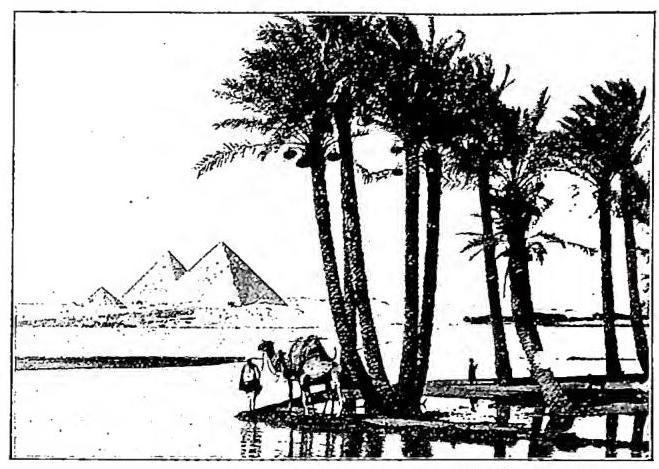
NILO — The Nile near the Pyramids.
(from Souvenir d’Egypte)