
LITURGICAL BOOKS. — This is the name given to books containing the official formulas, together with the corresponding ritual prescriptions or rubrics, for the celebration of Holy Mass, the administration of the Sacraments and Sacramentals, and the Divine Office. In current canonical practice, only those books declared to be such by the Holy See through the competent bodies—that is, the Sacred Congregation of Rites for the Latin liturgies and the Sacred Congregation for the Oriental Church for the Oriental liturgies—are to be regarded as
l. l.
I. ORIGIN
In the ancient Church, the l. l. par excellence was Sacred Scripture, around which, in the course of time, numerous euchological formulae were grouped, often improvised at the moment of the liturgical celebration. Since improvisation had to be the gift of only a few, as early as the second century there are embryonic examples of collections of such formulae, precious aids for celebrants for whom improvisation was difficult. As is well known, there was no obligation to repeat particular formulae verbatim, since the celebrant could freely paraphrase them, as is clear from a passage of s. Ippolito’s Traditio apostolica (cf. edition and translation by B. Botte, Paris 1946, p. 41). In addition to actual liturgical formulae, or references to them, found in various patristic writings of the first three centuries, beginning with the letter of s. Clement (chaps. 59-61), which F. Cabrol and H. Leclercq collected in Monumenta ecclesiae liturgica. Relliquiae liturgicae vetustissimae (2 vols., Paris 1901-1902, 1913), one may recall, for example, for the second century, the euchological formulae contained in the Didaché (chaps. 7, 9, 10, 14); for the third century, those of the already mentioned Traditio apostolica of s. Ippolito; for the third-fourth century, those of the papyrus of Dér-Balizeh and of Berlin 13918 (C. H. Roberts - B. Capelle, An early Euchologium. The Dér-Balizeh Papyrus enlarged and reedited [Biblioth. du Muséon, 23], Louvain 1949), of the Didascalia Apostolorum (ed. F. X. Funk, Paderborn 1905); of the Sacramentarium Serapionis (ed. F. X. Funk, ibid. 1905), of the Constitutiones Apostolorum (ed. F. X. Funk, ibid. 1905), and of various Egyptian papyri (cf. DACL, XIII, 1, cols. 1370-1520), etc. For the same century, among the patristic texts richest in euchological texts or references to them, there should be mentioned principally the Catecheses Mystagogicae of s. Cirillo di Gerusalemme (PG 33), the Catecheses of Teodoro di Mopsuestia (ed. and translation by R. Tonneau - R. Devreesse, Vatican City 1949); the De Sacramentis and the De Mysteria of s. Ambrogio (ed. and translation by B. Botte, Paris 1930), and the liturgical fragments contained in the anonymous Arian work of the end of the fourth century (ed. G. Mercati, Antiche reliquie liturgiche ambrosiane e romane [Studi e testi, 7], Rome 1902, pp. 51-53).The proliferation during the fourth century of euchological formulae that were not always orthodox and were of little value, both in content and in form, concerned bishops and councils. Of interest in this regard are the measures adopted by the African Councils of Ippona in 393 (can. 21 [25]; Mansi, III, col. 922), of Cartagine in 397 (can. 23: ibid., col. 884) and in 407 (can. 103; ibid., col. 1163), of Milevi in 416 (can. 12: ibid., IV, col. 330), and the passages of the De Baptismo contra donatistas (VI, 25: PL 43, 213-14) and the De catechizandis rudibus (chap. 13: PL 40, 320) of s. Agostino. The cited canons of the Councils of Cartagine in 407 and Milevi in 416 virtually mark the end of liturgical improvisation for the common run of celebrants. Meanwhile, in the fifth and sixth centuries, the Churches of the East and the West were decisively turning toward particular euchological collections, more representative in form and content.
II. ANCIENT AND MEDIEVAL WESTERN LITURGICAL BOOKS
Before the Western Churches had oriented themselves toward the euchological collections that later became traditional, certain bishops provided their churches with new liturgical books, such as Sacramentaries, Libelli Missarum, containing one or more Masses, and books of chant. This literary activity was carried out in the fifth and sixth centuries, to mention only the principal figures, by St. Paulinus of Nola, Voconio, bishop of Castellano in Mauretania, Museo of Marseille at the request of his bishop (cf. Gennadius, De scriptoribus ecclesiasticis, 48, 78, 79: PL 58, 1087, 1103, 1104), Eusebius of Milan (cf. M. Magistretti - U. Monneret de Villard, Liber notitiae sanctorum Mediolani, Milan 1917, p. 120), Sidonius Apollinaris, bishop of Clermont (cf. Gregory of Tours, Historia Francorum, II, 22), Peter, bishop of Lerida, Leander of Seville (cf. Isidore of Seville, De viris illustribus: PL 82, 1090, 1104), Massimiano of Ravenna (cf. Agnellus, Liber Pontificalis, ed. O. Holder-Egger, in MGH, Scriptores rerum Langobard., p. 332), etc. Among the Roman Pontiffs who distinguished themselves in this field, Damasus, Leo the Great, Gelasius, Symmachus, John I, and Gregory should be remembered (cf. the Lib. Pont. con l'Ordo Romanus of Giovanni Archicatore, ed. C. Silva-Tarouca, in Memorie della Pont. Accad. rom. di arch., 1 [1923], p. 215; cf. C. Mohlberg, ibid., 2 [1928], pp. 272-75). The value of the evidence of the cited Ordo 99 must now be reconsidered, since M. Andrieu has proved that it is a compilation originating in a Luxovian milieu in the second half of the eighth century: Les Ordines Romains du haut moyen âge, III, Leuven 1951, pp. 6-21).Among the Western euchological collections whose contents go back to the fifth and sixth centuries, the following should be recalled: the (so-called) Leonine, Gelasian, and Gregorian Sacramentary, the Ravenna Roll (ed. A. Ceriani, Milan 1883), etc. The surviving ancient liturgical books relating to the Roman, Ambrosian, Gallican, Visigothic, and Celtic liturgies will be reviewed under their respective entries. It is useful, however, to know the nomenclature employed in medieval liturgical language to designate them. It should be noted that in the Western liturgies listed above, the various liturgical books correspond to one another both in use and content (although the latter has its own arrangement) and in name. The essentially choral celebration of the liturgy until almost the end of the Middle Ages led to the creation of a veritable library of liturgical books intended for the various ministers who were to take part in II. For the celebration of Holy Mass, the following were required: the sacramentary (v.) for the celebrant, the lectionary (v.) and the epistolary (v.) for the reader and subdeacon, the evangeliary (v.) for the deacon, the prosarium or sequentiarium and the troparium, containing sequences and tropes; the sung parts were collected in the antiphonary (v.), antiphonarium Missarum, liber gradualis or responsalis; the cantatorium (v.) contained, at Rome, the gradual formerly reserved for the deacon, and sometimes there was also an alleluiaurium. The ritual prescriptions or rubrics were collected in the Ordines (v.), while the Ordinarium collected the rites peculiar to a particular Church. The fusion of all these books, required by the celebration of private Mass, which, beginning in the Carolingian age, became increasingly common, subsequently gave rise to the missal (v.), Missale plenarium in its various forms. The extraction from the sacramentary of the parts concerning the Sacraments and Sacramentals gave rise to the pontifical (v.), Pontificalis Ordinis liber, for functions reserved to the bishop, and to the ritual (v.), or agenda, ordinarium, manuale, liber agendorum, baptismale, baptisterium, exorcismorum liber, for those reserved to priests.
For the Office, which was likewise choral, the following were required: the psalter (v.), in which the 150 psalms were arranged either according to numerical order or according to weekly recitation, with or without the ordo de tempore and de sanctis; the legendary or passionary (v.), containing the lives of the saints and martyrs; the homiliary (v.), containing homilies; the hymnary; the tropary, with hymns and tropes; and the antiphonary (v.), with the parts reserved to the «schola cantorum». Depending on the locality, the following were also used for the Office: the venitare, with the invitatories; the lectionary, with scriptural passages excerpted from the Bible; the versarius, with the verses; the collectary, with the «oremus»; the nocturnale, the matutinale, and the diurnale for the person directing the Office (the abbot or the hebdomadary), etc. From the fusion of all these elements, beginning in the mid-eleventh century and especially from the beginning of the thirteenth, there arose the breviary (v.) in its various forms.
To the liturgical books required for the daily celebration of Mass or the Office, several others with particular characteristics may be added, such as the exultet (v.) or rotulus paschalis, the processional, with the chants for processions, the emortuale, with the Office for the dead, the calendar, and the martyrology (v.) in their various forms.
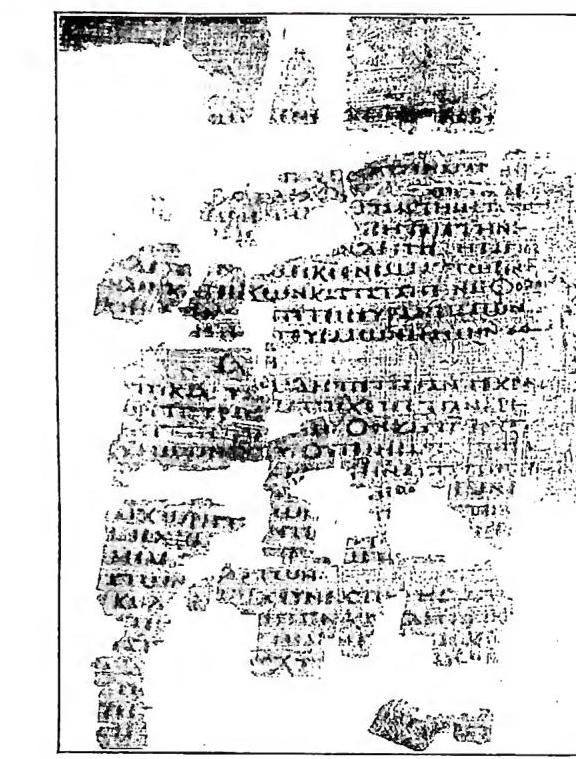
LITURGICAL BOOKS – The Dér Balizeh papyrus, fol. 1r with fragments D and E (social, seventh-century).
III. CURRENT LITURGICAL BOOKS OF THE ROMAN CHURCH
The official and sacred character of the liturgical books led the Holy See, from the time of the Council of Trent onward, to reserve to itself the right of supreme supervision and approval, as well as that of their original and normative edition (editio typica). The CIC, can. 2, fully recognizing the authority of the liturgical books, confirmed the exclusive right of approval to the Holy See (can. 1257).Given the impossibility of meeting the general need solely through the one pontifical printing press (first that of the Camera, then that of Propaganda Fide, and now the Vatican Press), the practice arose of granting the privilege of reproducing the liturgical books also to publishers outside Rome (printers of the Holy See and of the Sacred Congregation of Rites). Recently the entire matter of the reproduction of the liturgical books was reorganized by the decree of the Sacred Congregation of Rites of 10 August 1946 (AAS, 38 [1946], pp. 371-72), which establishes that the publication of the liturgical books is reserved exclusively to the Vatican Press; that publishers must request permission from the Sacred Congregation of Rites for each book and in each individual case; and that, in each case, the Administration of the Goods of the Holy See will fix a permission fee; the obligation of revision, in accordance with the typical Vatican books, belongs, pursuant to can. 1390, to the respective Ordinaries of the place where the book is printed or published; finally, the decree provides a list of the liturgical books covered by II. They are: 1. Missale Romanum (latest typical edition, Rome 1920 [1923]; a new typical edition in preparation); 2. Breviarium Romanum (latest typical edition, ibid. 1950); 3. Rituale Romanum (latest typical edition, ibid. 1925; a new typical edition in preparation); 4. Pontificale Romanum (latest typical edition, Ratisbona 1888); 5. Martyrologium Romanum (latest typical edition, Rome 1914, 1923; latest reprint 1949); 6. Caeremoniale episcoporum (latest typical edition, Ratisbona 1886); 7. Memoriale rituum (latest typical edition, Rome 1920, reprint
1950); 8. Octavarium Romanum (latest typical edition, Ratisbona 1902).
The aforementioned decree further adds the collection of the authentic decrees of the Sacred Congregation of Rites; its reprinting or republication is, naturally, reserved to the same Sacred Congregation. There are also other liturgical books not expressly named in the decree, such as the Instructio Clementina (for the Quarantore), the Lectionarium, published in 1915 (the abridged lessons of the breviary, now inserted directly into breviaries), the Diurnale, or Horne diurnae, a kind of extract from the breviary (a typical edition is being printed by the Vatican Press), the Officium Hebdomadae sanctae and Nativitatis D. N. J. Chr., extracts from the breviary and the missal for Holy Week and the Christmas season, and similar books, produced chiefly by publishers for the convenience of users.
The books of chant of the Roman liturgy are also to be regarded as liturgical books. They are: 1. Kyriale Romanum (Ordinarium Missae); 2. Graduale Romanum (the variable sung parts of the Mass); 3. Antiphonale Romanum (the tones of the psalms and models of various types of chant); 5. Officium defunctorum (the relevant extract for the Office of the Dead; all printed in Rome); 6. Liber usualis, a practical collection extracted from the Kyriale and the Graduale (Solesmes). There are also other partial editions, for greater convenience, for example, the chant of the four Passiones and of the Exsultet. All these books, furnished with the approval of the Sacred Congregation of Rites, are admitted for use in the liturgy, and the text contained in them, as well as the melodies and rubrics, must be regarded as authentic.
I. OF PARTICULAR CHURCHES, RELIGIOUS ORDERS AND CONGREGATIONS
The l. l. of the Roman Church contain the texts and rubrics prescribed for the universal Church of the Roman rite. Particular Churches, religious Orders and Congregations that do not have a rite of their own are obliged to use the aforesaid l. l., but must add the “proper” Offices and Masses, that is, those feasts expressly granted to them by the Holy See, with approved texts. The relevant collection is called the Proprium, and must be authenticated by the competent ecclesiastical superior: Ordinary, General, etc. The granting and approval of the said Propers belongs to the S. Congr. dei Riti. They are ordinarily appended to the Roman l. l. as an appendix. V. L.I. PROPRI DI ALTRI RITI LATINI DIOCESANI
Since the liturgical reform of s. Pio V, the right has been recognized not only to proper books, but to a genuinely proper rite, differing (little or much) from the Roman rite, for those dioceses and religious families that had already been using it for at least 200 years. At present, four non-Roman Latin diocesan rites still exist: the Ambrosian or Milanese, the Bracarense (Braga, in Portugal), the Lyonese (of Lyons, France), and the Mozarabic (of Toledo, Spain, but restricted to a single chapel and certain solemnities). The recent l. l. proper to these rites will be found described under the individual entries.VI. LITURGICAL BOOKS PROPER TO RELIGIOUS FAMILIES
The Premonstratensians: Missale (Malines 1934); Breviarium (ibid. 1930); Graduale (Rome, Tournai 1910); Antiphonarium (Paris, Tournai, Rome 1934); Processionale (Paris, Tournai, Rome 1932); Ordinarius seu Liber Caeremoniarum (Tonglerloo 1949).2. Monastic rite, followed by the Benedictine religious family and its various branches, often (for the smaller families) only with the addition of a simple Proper, as is done for dioceses and Congregations. The fundamental monastic books (in many and various editions) are the following: Missale Romano-monasticum (Regensburg 1937); Missae propriae (various eds.); Breviarium Rom. Mon. (various eds., latest 1940); Antiphonale Mon. pro horis diurnis (Paris, Tournai, Rome 1934); Rituale mon. (varies according to the different Congregations; e.g., 1895, 1931, Congr. of Beuron; 1909, Congr. of Subiaco; 1920, Congr.
of Bavaria; 1936, Congr. of Sankt-Ottilien; 1942, Congr. Americo-Cassinese, etc.); Caeremoniale mon. (various eds., as above, for the individual Congregations). Among the various Benedictine families, the following should be noted: Camaldolese Monks: they use the monastic Breviary and the Roman Missal, adding a Proper of Offices and Masses (1926, reprinted Tournai, Malines 1938); Camaldolese Hermits of Monte Corona: Missale mon., Vatican 1896; Breviarium mon., Rome 1896; Rituale, Malines 1908; Vallombrosans: they use the monastic liturgical books, with the addition of Missae propriae (Florence 1892) and Officia propria (ibid. 1892). The Silvestrines and Olivetans use the monastic books, with the sole addition of their proper Masses and Offices.
3. Although historically derived from the Benedictines, the Cistercians and Trappists (reformed Cistercians) have their own books and rites, with many features of a primitive character. Both branches of the Order use the same books, almost all printed by the Trappist press at Westmalle, Belgium: Missale (Westmalle 1951); Breviarium (ibid. 1951); Antiphonarium (ibid. 1903, 1941); Martyrologium (ibid. 1930); Rituale (ibid. 1949); Caeremoniale abbatum (ibid. 1939); Manuale caeremoniarum (ibid. 1948); Processionale (ibid. 1926-35); Ps. Venite exultamus (ibid. 1904); Psalterium (ibid. 1925); Lectionarium (ibid. 1940); Hymnarium (ibid. 1909); Laudes vespertinae (ibid. 1926); Diurnale (ibid. 1894); Officium parvum B. M. V. (ibid. 1930); Graduale (ibid. 1899, 1934); Rubricae Missalis (ibid. 1923); Collectaneum (Tournai 1908).
4. The Carthusians likewise have a proper rite, and consequently proper liturgical books: Missale (Tournai 1883; own press); Breviarium (ibid. 1880); Diurnale (ibid. 1890); Antiphonarium diurnum (ibid. 1890); Antiphonarium nocturnum (2 vols., ibid. 1888); Graduale (ibid. 1887); Psalterium et Hymni (ibid. 1888). The Monks of S. Paolo primo Eremita had proper liturgical books from their very beginnings, although they did not possess a true particular rite; but from the beginning of the 17th century they adopted the Roman liturgical books, with the addition of their own Proper for the Missal, Breviary, and Martyrology; they do, however, have a proper Caeremoniale (Cracow 1931).
5. The Preachers (Dominicans) have preserved a truly distinct proper rite, of Gallican origin, and therefore also use proper liturgical books: Missale iuxta Ritum S.O.P. (1933); Breviarium S.O.P. (Turin 1947); Antiphonarium S.O.P. (1933); Matutinum seu antiphonarium S.O.P. (1949); Caeremoniale S.O.P. (1869).
6. The Franciscan Order, on the other hand, as is well known, from its beginnings followed the books and rites of the Roman Curia; indeed, the Seraphic Order became one of the most effective vehicles
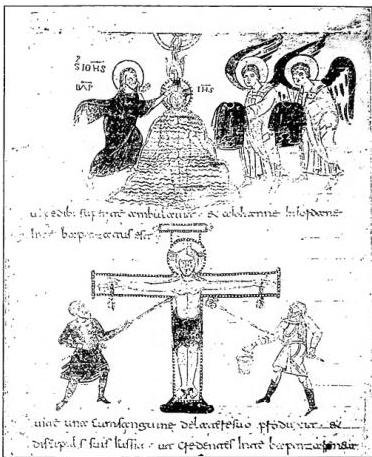
(photo, Enciclopedia Cattolica)
LIBRI LITURGICI - Pontificale of Landolfo I of Benevento (957–84):
Blessing of the Font — Rome, Biblioteca Casanatense, 724 B 1, 13.
7. A true proper rite, derived from that used by the canons of the Holy Sepulchre of Jerusalem in the time of the Crusaders, is still in use among the Carmelites of the ancient observance, whereas the reformed branch adopted the Roman rite and books. The l. l. of the shod Carmelites are: Missale (Rome 1935); Breviarium (Tournai 1938); Horae diurnae (ibid. 1935); Officium Hebd. Sanctae et Octavae Pasch. (ibid. 1899); Rituale (Rome 1903); Caeremoniale (ibid. 1906).
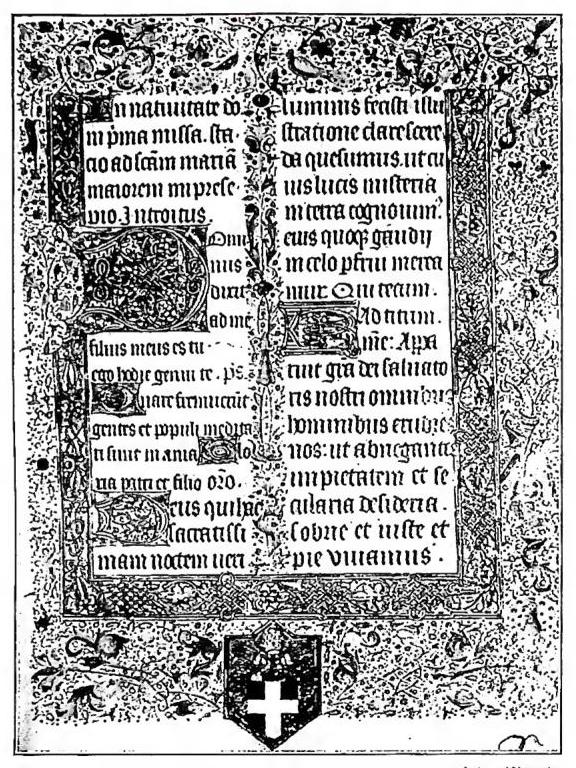
VII. L. L. OF THE EASTERN CHURCHES. - For a long time, the l. l. were published by Eastern Christians at the initiative of a private individual or a bookseller, who would turn to
(phot. Alinari)
LITURGICAL BOOKS - Missal of Pope Felice V: first Mass of Christmas (15th century) - Turin, Library of the Royal Palace.
a priest or deacon for the drafting and correction of the book he wished to print. Even today this method is used in many dissident Churches, with the result that ecclesiastical authority does not guarantee the authenticity of the texts, nor does it give its approval to the ceremonies described in such books. An exception in this field was the Russian Church, where the Holy Synod prepared with the greatest care the edition of the liturgical books which it alone published. Today the Eastern Catholic Churches usually ask the Holy See for approval of their liturgical books; the Synods of the Armenians, Syrians, and Copts expressly prescribe this.
Not all the Eastern Churches have hitherto printed all their liturgical books, but sometimes still use manuscripts; for many centuries these Churches were under Turkish rule and were poor. The Greeks are an exception, because they printed all their books in Venice; the Russians and Ruthenians, on the other hand, being free, had many very fine editions.
1. Byzantine rite. - The Holy See has published almost all the liturgical books of the Byzantine rite in the Greek language. They are as follows: the Euchologion to mega (1873): this is the book of the priest and deacon for Mass, the Sacraments, blessings, and the Divine Office (v. EUCOLOGIO). The Micron Euchologion (1872): besides the three liturgies, it provides a selection of Epistles and Gospels, and is not a traditional book. The Hirologion (1876): this is one of the choir books and contains the invariable parts of all the Hours of the Divine Office; there is a tendency among Catholic priests to use it as a breviary, but in order to serve this purpose it lacks a very great deal, namely all the proper parts contained in the following five books. The Octoechos (1886) comprises the proper parts of the Divine Office for eight consecutive Sundays, each of which is sung in one of the eight tones of Byzantine music. The Paracletiche (1879): adds to the preceding book the Office for the weekdays of the eight weeks corresponding to the eight tones. The Triodion (v. 1879) contains the “proper” for the Lenten season; the Pentecostarion (v. 1884) for the Easter season. The Minaia (1888-1902) form six volumes; each of them includes, for two months, the Divine Office of the feasts of the Lord and of the saints falling on a fixed day of the month. They begin with 1 September, the beginning of the ecclesiastical year. In the Evangelion (1880), the pericopes follow the liturgical order. The Slavs print the four Gospels in full, indicating by notes the pericopes intended for liturgical reading. The same procedure is followed for the Apostolos (1882). The Apostolisse is not intended for liturgical reading. The Pualterion (1873) is divided into 20 cathismata.
The dissidents have published all these books, except the Micron Euchologion, but also possess: the Typicon (Athens, n.d., before 1939), which gives the general rules to be observed in the various liturgical functions, especially in cases of concurrence and occurrence of feasts, proceeding through the calendar of the whole year; the Archieraticon (Athens 1902), corresponding to the Roman Pontifical; mention should be made of the Hieraticon of Constantinople (1895), because it is an almost official edition of the patriarchate; the Aghiamatarion or Micron Euchologion (Athens 1927), which differs from the Grande Eucologio only in omitting the less frequently used blessings and in being pocket-sized (cf. L. Allatius, De libris ecclesiasticis Graecorum dissertationes duae, Parigi 1645; S. Salaville, Liturgies orientales. Notionis générales, ibid. 1932, pp. 178-84).
Among the Ruthenians and Russians, who use the same books, certain peculiarities may be noted. They divide the Grande Eucologio into two parts: the Sluzebnik, which comprises Vespers, orthodox (v.), and the three liturgies, and the Trebnik, which provides sacramental rites, blessings, etc. They also have the Ironologion, with and without musical notation; it gives the text of the model strophes on the pattern of which various hymns are composed and sung. They have continued to print the Anthologion or Minaia prazdnicznaia, that is, the Office of the principal feasts taken from the Menaia of the twelve months. Among various books compiled chiefly for private devotion or for use when the monk is prevented from attending the common office, the best known and most widespread is the Molitvoslov or Časovlov, which contains the whole Orologio and then a series of canons and chants for the feasts of the year. For the more usual chants they have published the Obichod (cf. K. Nikolski, Breve rassegna dei libri liturgici... [in russo], Pietroburgo 1890; see also the liturgical manual by the same author. For the Melkites cf. C. Karalevsky, Histoire des Patriarats melkites, III, Roma 1911, pp. 54-134. A list of the Hungarian books is found in the Schematismus dioecesis Hajdudorogensis ad a. 1918, p. 18).
2. Armenian rite. - Armenian Catholics use the following books: the Badarakamadultz or Khorertadéir (Vienna 1904), which is a complete Missal, that is, with the addition of the Epistles and Gospels; the Giafótz (Venice 1686), containing the readings for Mass alone, with the corresponding chants; the Tebratión (Vienna 1932), the cantor’s book for Mass; the Mafótz (ibid. 1905), corresponding to the Rituale romano; the Gia-mabirk (Venice 1938), containing the invariable parts of all the Hours of the Divine Office; this book serves for the private recitation of the Breviary; the Šaragnótz (ibid. 1938) or Šaragan, which provides the hymns for the series of eight Sundays, a similar series for martyrs, and another for penitential days, then for the cycles of the liturgical year with the saints assigned to them. The dissidents have further retained the Haismavírk, containing the lives of the saints; the Gharendír, which provides a selection of homilies; and the Donatzultz, which is an index of feasts (cf. L. Petit, Arménie, in DThC, I, cols. 1963-66).
3. West Syrian rite. - The last Syrian Catholic patriarchs have published almost all the liturgical books of their rite: the Book of the Rite of the Oblation (Sciarfa 1922) contains the Ordinary of the Mass with the anaphora of St. James, six other anaphoras, the blessing of the chalice, that is, the Office of the Presanctified, and certain additions. The Celebration of the Oblation (ibid. 1931) is a small book for the deacon, transformed into a booklet for the server at Mass; the 1905 edition provided, besides the responses of the Mass, also the various chants required for II. The Book of Priestly Offices (ibid. 1922) corresponds to the Rituale romano; the Rituale of Beirut of 1872 divided its material with the Benedizionale of Beirut of 1877. The Book of the Rite of Funerals (ibid. 1925) contains funeral rites for the three categories of laity: men, women, and children. That for the funerals of priests has not yet been printed. The Fenqitā is a substantial work in 7 vols. (Mosul 1886-1896), prepared by Archbishop Giuseppe David and issued by the Dominican press; it provides the Office for all the feast days of the year. The Prayers of the Weekdays (Sciarfa 1937), called Sēbim, provides only the ferial Divine Office and serves for the private recitation of the Breviary. The Book of the Psalms of David, King and Prophet (ibid. 1912) provides, besides the psalms, also the scriptural canticles. The Readings of the Oblation (ibid. 1912) provides the Gospel texts for Mass, in two columns, in the Syriac and Arabic languages. The book containing the Gospels of the Divine Office was not printed. The Book of Epistles (ibid. 1925) provides the Epistles of the Mass likewise in two languages. The Pontifical will shortly appear for the first time, in two volumes.
Of the dissident Syrians only two liturgical books issued in print are known: a Diaconale (Jerusalem 1929) and a Book of Marriage (Giunieh 1948).
The Catholic Malankarese, who entered into union in 1930, have so far printed the Order of the Oblation (Pampakuda 1934) with two anaphoras; some prayers have been added to it, among them the formula of absolution. The dissident Malankarese, on the other hand, began printing their l. l. in the last decades of the previous century and continue to reprint them. Known are the Book of the Oblation (ibid. 1931) with 18 anaphoras; the latest edition (1950) has omitted the last four; the Ritual of Baptism, Marriage, and the Funerals of the Laity (ibid. 1950); the Ritual of the Funerals of the Priestly Order (ibid. 1938); the Book of the Lamp (ibid. 1932), that is, of the anointing of the sick; the Festal Office (Kottayam, 1920), only for the principal feasts; the Ferial Office (ibid. 1898), the Book for the Rogation Days of the Ninevites (Pampakuda 1933), the Book of the Prayers of the Great Fast (ibid. 1932), and the Office of Holy Week (ibid. 1931).
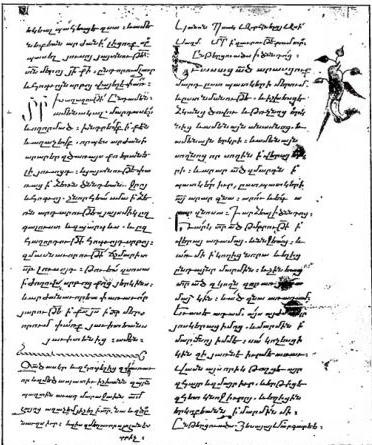
(by courtesy of Fr. A. Reca)
LITURGICAL BOOKS - Armenian Ritual (a. 1268) - Vatican Library, cod. Borg. Arm. 61 f. 424.
4. Syro-Eastern rite. - The Chaldean Catholics have printed almost all their liturgical books in this century. The Rite of the Mysteries (Mosul 1936) contains the Ordinary of the Mass with the customary three anaphoras. The Supplements to the Mysteries (ibid. 1901), a choir book, gives, in addition to the various chants of the Mass, an indication of the Scriptural pericopes to be read. The Priests’ Manual (ibid. 1907) corresponds only in part to the Roman Ritual, because it omits the text of the following three books: the Book of Baptism (ibid. 1907), the Book of Blessing (ibid. 1907), that is, of Matrimony, and the Book of the Dead (ibid. 1907), which provides the funerals of laymen and ecclesiastics. The Canonical Prayer (Lipsia 1886-87; reprint Rome 1938) is a work in 3 vols., edited by the Persian Lazarist Paolo Bedjan, intended to provide priests with a breviary; it contains in full the Psalter, the Book of Vespers, the Rogations of the Ninevites, and a good part of the three principal books of the divine Office: the Hūdrā (Offices for all Sundays and the Lenten weekdays), the Gazā (Offices for feasts and commemorations), the Kaškil (Office for weekdays); it also contains the Wardā (homilies by that thirteenth-century poet and by another called Qamiā of the thirteenth-fourteenth century), the prayers of Abū-Ḥalīm, that is, of Patriarch Elia III, and the qālī of 'ādrānē' with Paracletic chants. The Book of Vespers (literally, “the Rite of Before and After”; Mosul 1947); the Book of the Psalms of David (ibid. 1908). The Gospel Book (ibid. 1901) gives, in two separate books, the Syriac and Arabic text of the liturgical pericopes. The Epistles of Paul the Apostle (ibid. 1900), in two books, like the Gospel Book; the Catholic Epistles, not used by the Nestorians because they are considered non-canonical, are lacking. The Lectionary (ibid. 1901), likewise in two separate books; in addition to the liturgical pericopes taken from the Old Testament, it contains those taken from the Acts of the Apostles. The Tūrgānē (ibid. 1926) contain homilies to be read on feast days after the Gospel and other formulas to be said by the deacon. The Pontifical, already prepared, has not yet been printed.
For the Nestorians, the Anglicans of the Persian mission printed the Holy Order of Oblation and Baptism (Urmiah 1890), giving the Ordinary of the Mass, the three anaphoras, and the baptismal rite; subsequently a priest, Giuseppe Kelajā, published the Order of Priests (Mosaul 1928); it contains both the Missal and the Ritual; its contents are exceedingly rich and traditional. An edition of the Book of Vespers (ibid. 1923), with various additions, was also made (cf. E. Tisserant, Nestorienne [Eglise], in DThC, XI, cols. 320-22).
The Malabarese belong to the same rite; they have published many liturgical books, though not all. The Book of Rites and Lessons (Verapoly 1931) is a complete Missal, arranged like the Latin one. The Book of the Mystery (Mannanam 1926) gives the rite of the bishop’s solemn Mass. The Soldeo Rite of the Office of the Mysteries (Alwaye 1946) contains the sacramental rites. The Book of the Office for the Dead (Mannanam 1921) is for the funerals of laymen. The Book of the Office of the Dead for the Clergy (Alwaye 1948), called Thumā from the first word of its title. In the Order of Preparation and Thanksgiving before and after the Oblation (Mannanam 1937), the second part contains the blessing of water, of the house, of fruits, etc. The Order of Prayers and Psalms and Other Ecclesiastical Offices for Feast Days (Changanacherry 1929) contains the Office only for the major feasts and is used only by monks. The Book of the Office... (Mannanam 1932) gives the weekday divine Office and is used for the private recitation of the Breviary (cf. E. Tisserant, Syro-malabaré [Eglise], in DThC, XIV, cols. 3155-60; Placidus a S. Josepho, Ritus et libri liturgici Syro-malabarici, Thevara 1933).
5. Coptic rite. - For the Coptic Catholics, an edition of many liturgical books was first made in Rome in Tuki (v.). In recent times the Catholics issued the following books: the Euchologion (Cairo 1898) gives the Office of incense, the Mass with the three anaphoras, certain chants, and also the part of the deacon and the people. The Book of the Server (Rome n.d.) gives the deacon’s part for all liturgical functions and adds other prayers. The Book of the Sacraments (Cairo 1900) also gives the rite of funerals. A separate edition was made of the Anointing of the Sick, or the Prayer of the Lamp (ibid. 1932). The Book of the Prayers of the Seven Hours (ibid. 1930) gives the invariable parts of all the hours of the divine Office. A separate edition exists with the Arabic text alone. The book is used for the private recitation of the Breviary. The Office of Holy Week (ibid. 1900 and 1933) is a substantial book, printed first in Coptic only, then in Arabic only. Catameros of the Gospels (ibid. 1930) contains the Gospels for Sundays and feast days. Catameros of the Apostle (ibid. 1932) gives the epistles for Sundays and feast days. The Book of Holy Easter (ibid. 1933) contains the lessons for Holy Week and Easter Week.
Among the dissidents the same books are found, generally published with greater care and sometimes luxuriously. They do not have a ritual, but separately the Book of Baptism and Matrimony (Cairo 1921), the Book of the Anointing of the Sick (ibid. 1908), the Book of the Dead (Cairo 1904), the Book luqāni and sagāda (ibid. 1921), with the particular Offices of Epiphany, Holy Thursday, Pentecost, etc., the Book of the Procession (ibid. 1921) for the feasts of the Cross and of Palms, with the addition of various hymns, the Book of Hymns and Homilies for the vigil of Christmas and Epiphany (ibid. 1920), the Book of Hymns (ibid. 1913), in 2 vols., for the first six months and the last six months of the year, the Book of Hymns for the Month of Khoiah, that is, the Theotahia (ibid. 1911), the Book of Sacred Praises of the Virgin, the Angels, Apostles, Martyrs, and Saints (ibid. 1922), containing the hymns called doxologies. The Catameros, which gives the Epistles and Gospels together, is divided into 3 vols.: the first runs from the month of Toth to the month of Mechir, the second from Lent to Pentecost, the third from the month of Pachon to the end of the Epagonene; or else into 2 vols. (Cairo 1899-1901), each for six months.
6. Ethiopian rite. - After a book containing the Mass, the morning Office, and the New Testament had been printed in Rome (1548) for the Catholics, no further printing of liturgical books took place before the twentieth century. The Book of Consecration (Rome 1945) gives the Proper of the Mass with 18 anaphoras. The Book of Funerals (ibid. 1908). The Book for Ordinations (ibid. 1939) was printed in very few copies. To our knowledge, the following books were published by the dissidents: the Book of Consecration (Addis Abeba 1925-26, 1933-34; Dire Dava 1925-26), the Book of the Feast of Baptism and the Book of Baptism (ibid. 1924-25), the Book of Hymns of the Ancient and Modern Doctors and Masters of Ethiopia (ibid. 1925-26), a non-liturgical collection of 1,500 hymns performed in church. - Vedi tavv. LXXXIII-LXXXIV.