
SACRAMENTS. - In the New Testament, they are sensible signs productive of Grace, instituted by Jesus Christ.
The word sacramentum (which partly corresponds to the Greek term μυστήριον: V. MISTERI; MISTERO) among profane authors indicated both the money deposited in the aerarium and consecrated to the deity by the losing party in legal proceedings (sacramentum pecuniae) and the military oath (sacramentum militiae). Tertullian was the first to apply the term, with a new meaning, to Baptism, Confirmation, and the Eucharist (De praeser., 40; De resurr. carnis, 8-9; De Baptismo, 3; Adv. Judaeos, 10; Adv. Marcionem, 1, 14, etc.), followed by the principal Latin Fathers (St. Cyprian, St. Hilary, St. Ambrose, St. Augustine) until, acquiring an increasingly precise sense, by the 12th century the above definition was reached (cf. J. De Ghellinck, E. de Backer, J. Poukens, G. Lebecqz, Pour l'hist. du mot «Sacramentum», I: Les anténiciens, Louvain 1924; A. Michel, Sacrements, in DThC, XIV, cols. 485-94).
I. DOGMATIC THEOLOGY.
I. ESSENCE OF THE SACRAMENTS OF THE NEW LAW
By its external rite, the Sacrament is the symbol, the representation of a reality not accessible to the senses; for example, in Baptism the external sign (water and the words pronounced by the minister) symbolizes and represents an interior and invisible reality: the renewal and purification of the soul. But the Sacrament is moreover the cause of the reality it signifies, since by virtue of the latent action of God, it produces it: it is a sign that realizes what it represents, an efficacious sign. Two elements therefore concur in intrinsically constituting the Sacraments of the Church: symbolism and causality (Sum. Theol., 3ª, q. 62, a. 1, ad 1).1. The constitutive elements of the Sacraments considered synthetically
The classic definition "The Sacrament is an efficacious sign of Grace" is the fruit of many centuries of reflection on the concrete elements of Revelation. Indeed, the Sacraments are presented in Scripture in concrete form on the occasion of their institution or their use in the nascent Church. However, from an analysis of the biblical texts, the two fundamental elements can be distinguished: the sign and the cause. In Baptism, for example, St. Paul (Rom. 6, 3-11) affirms that immersion and emersion, while reproducing the physical death and resurrection of Jesus, represent the mystical death and resurrection of the faithful (the sign), and simultaneously produce what they signify, since in immersion the catechumen dies to sin and in emersion rises to the new life of Grace (the cause).The first Christian generations made the Sacraments the practical center of their life before constructing the theory; therefore, the oldest documents of Tradition allude to the use of the Sacraments, extolling in biblical terms the effects produced by the sensible rite (cf. Tertullian, De resurrect. carnis, 8: PL 2, 852; St. Cyril of Jerusalem, Catech.).
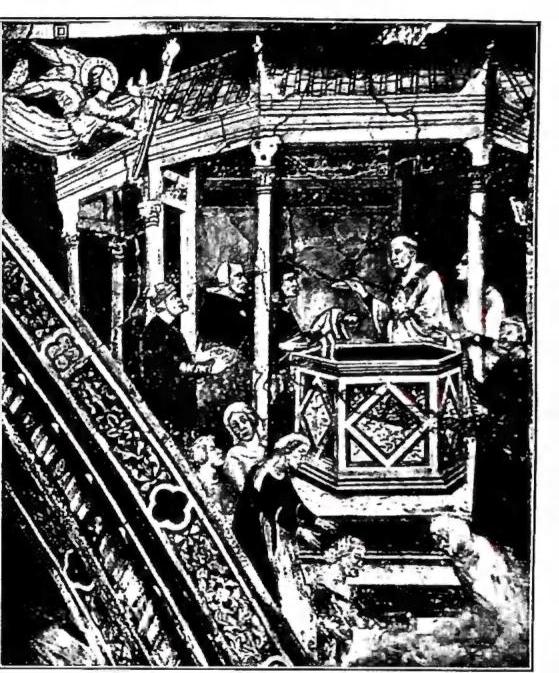
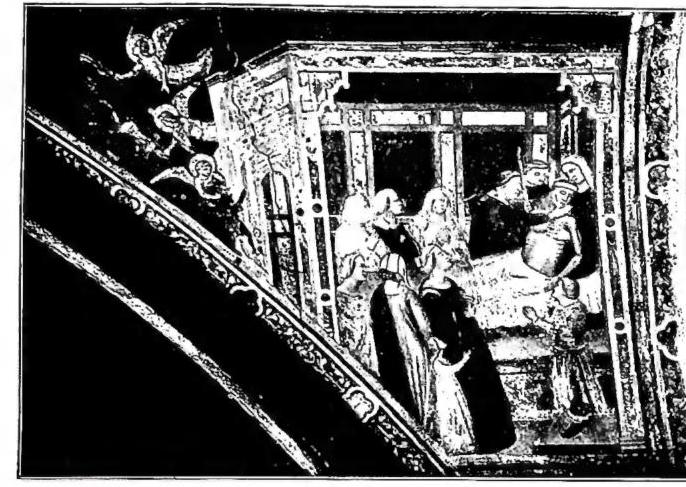
SACRAMENTS - Extreme Unction. Fresco by P. de Oderisio (14th century). Naples, church of the Incoronata.
is like the sensible imprint, the seal affixed to the letter of the New Testament, to better assure the faithful that the promises contained in the Gospel are divine: in short, the Sacrament is an external sign that enlivens justifying faith (Confessio Augustana, a. 13; Apologia Confessionis Augustanae, a. 13; ed. Müller, Gütersloh 1929, pp. 41-43, 202). For Calvin, however, faith is immediately produced by the Holy Spirit in the soul, yet, as if by a preestablished harmony, always in concomitance with the external preaching of the word of God. To the revealed word, God has added, ad instar appendicis, sensible rites, such as Baptism and the Eucharist, to assure the faithful of the reality of His eternal benevolence (predestination). The Sacraments, therefore, are not signs in relation to justification inwardly produced, but attestations of a benevolence previously granted, by the eternal decree of predestination. Since this decree ("horribile, fateor decretum": Institutio relig. christ., III, 21) excludes the reprobate, who in this life are indistinguishable from the elect, Calvin affirmed that in concomitance with the external rite, the Holy Spirit enlivens faith only in the elect, that is, when and how He wills (Institutio relig. christ., I, IV, c. 14). For Zwingli (v. ZWINGLI) God directly produces faith without any dependence (against Luther) and without any synchronism (against Calvin) with the preaching of the divine word and the administration of the Sacraments. These, therefore, can be considered as tokens of recognition issued to those who, entering the Church, enlist in the militia of Christ (cf. Ch. L'Ebraly, La doctrine sacramentaire de Ulrich Zuingli, Clermont-Ferrand 1939, pp. 29-34). Carlstadt (v. CARLSTADT) and the Socinians held that the Sacraments are simple signs by which the faithful distinguish themselves from the infidels (cf. R. Bellarmino, De Sacramentis, I, I, c. 15). The Protestants of the 16th century agreed in recognizing the symbolic value of the Sacrament, but at the same time, all took care to empty it of its content.
The Council of Trent refuted point by point the Protestant error both in its fundamental ideas and in its nuances, following its logical development (original sin: sess. 5; justification: sess. 6; Sacraments in general: sess. 7; Sacraments in species: sess. 13-14; 21-24). In canons 6 and 8 of sess. 7 (held in 1547), it defined that the Sacraments contain and produce "ex opere operato" the Grace they signify (Denz-U, 849, 851). Against this solid dogmatic construction, the Modernists essentially repeated the Protestant error (Denz-U, 2089).
2. Analysis of the individual elements
a) The structure of the sensible sign. - When Sacred Scripture speaks of a Sacrament, it presents it as a rite composed of things (res) and words (verba): e.g., for Baptism: "Go and teach all nations, baptizing them (res) in the name of the Father, and of the Son, and of the Holy Spirit (verba)" (Mt. 28, 19); for the Eucharist: "Jesus took bread (res) and said: This is my Body (verba): and taking the chalice (res) said: This is my Blood (verba)" (Mt. 26, 26-28), etc. Scripture, however, a) does not assign greater importance to words compared to things, b) does not connect the sensible rite with its meaning: e.g., while in Mt. 28, 19 it indicates that the baptismal rite consists of a washing and a Trinitarian formula, in Rom. 6, 3-11 it affirms that the same rite signifies mystical death and resurrection; c) does not state in the abstract that the Sacraments are constituted by a gesture and words, but presents them in their concrete reality. These three indeterminations were gradually eliminated as the Fathers and theologians advanced in the analysis of the sacramental compound. In the first four centuries, the Fathers attributed greater importance to the words than to the material elements of the rite; indeed, they affirmed that the words have the power to complete and sanctify water, oil, bread, and wine (Tertullian, De Baptismo, 4: PL 1, 1304; St. Ambrose, De mysteriis, 3, 8: PL 16, 391; St. Gregory of Nyssa, Oratio in Baptismum Christi: PG 46, 581; cf. B. Braunheuser, De benedictione aquae baptismalis, Rome 1931). In the 5th century, St. Augustine showed how, with the union of the thing and the words, the sacramental meaning is immediately obtained: "Accedit verbum ad elementum et fit Sacramentum" (In Io., tr. 80, 10, 3: PL 35, 1840), that is, the sensible rite becomes "signum rei sacrae." In the 12th and 13th centuries, the Scholastics, having precisely determined the septenary number, were able to easily state, in abstract form, that all Sacraments, considered in their external sign, are composed, at least in a broad sense, of things (res) and words (verba). They also sought to illustrate the manner, adapting to the sacramental world the hylomorphic theory: in the physical compound, the indeterminate and potential element is called matter and the determining one form, so in the sacramental compound the indeterminate element is called matter and the determining one form (cf. Sum. Theol., 3ª, q. 50, a. 6).Some non-Catholic authors (Harnack, Turmel) have criticized this application of Aristotelianism to theology as illegitimate. The reason given shows the appropriateness of the hylomorphic terminology; moreover, it is proper to theology to illustrate dogma "ex eorum, quae naturaliter cognoscuntur, analogia" (Vatican Council, sess. III, cap. 4; Denz-U, 1796). On the other hand, the Church, to which Christ gave the power to guard and explain the content of Revelation, has for centuries adopted this terminology (Denz-U, 672, 695, 914, 1963). The use of a formula that, besides being consecrated by the authority of the Church, helps to clarify some points of sacramental doctrine is therefore legitimate.
b) The nature of sacramental causality. - Defined doctrine. - a) The Sacraments, both in the expressions of Scripture and in the works of the Fathers, are presented as instruments moved by God to produce Grace, independently of the merits of the minister and the subject, though certain moral dispositions in the subject are presupposed as indispensable conditions for the sacramental effect to be introduced. b) The Sacraments are instruments in the hands of God to produce Grace: the Heavenly Father has saved us "by the washing of regeneration and renewal" (Tit. 3, 5); Christ has purified His Church "by the washing of water with the word" (Eph. 5, 26); the Holy Spirit regenerates through water "ex aqua" (Io. 5, 3). It is God who saves, purifies, regenerates through Baptism as through an instrument of sanctification. The Fathers echoed the biblical words: St. Ephrem affirms that the Holy Spirit penetrates the waters "ut eas ad expiationem elevet" (Adv. scrutatores, sermo 40; ed. Assemani, III, Rome
7) The Sacraments produce their effect through the performance of the rite, independently of the merits of the minister and the subject. Indeed, Revelation attributes the power to produce Grace to the rite itself (under God’s influence). The early Christians received the Holy Spirit “through the imposition of the Apostles’ hands” (Acts 8:17; 19:6); Christ affirms that His (Eucharistic) flesh is a principle of supernatural life, just as bread is the cause of material life: “he who eats me, he also shall live because of me” (John 6:57). These and other texts declare the objective efficacy of the sensible rite (imposition of hands, Eucharistic manducation) in producing Grace. The Fathers translated biblical doctrine into various affirmations and analogies (cf. St. Augustine, In Io., tr. 80, 10, 3: PL 35, 1840; St. Cyril of Jerusalem, Catech. myst., 2, 4: PG 33, 1079; St. Leo I, Sermo 25, 5: PL 54, 211, etc.). Revelation, moreover, excludes any dependence of such efficacy on the merits of the minister or the subject. Classic are the words of St. Augustine: “Baptism is not valid by the merits of the one who administers it, nor by those of the one who receives it, sed propria sanctitate atque veritate, communicated to it by Him who instituted it” (Contra Cresconium, 4, 19: PL 43, 559). This teaching is confirmed by the constant practice of recognizing as valid the Baptism of heretics and by the apostolic custom of baptizing children before the age of reason (v. BATTESIMO; CIPRIANO; DONATISTI).
8) The Sacraments presuppose moral dispositions in the subject as indispensable prerequisites for introducing their effect into the soul. From St. Peter’s exhortation to the first converts—“Repent, and let each of you be baptized for the remission of sins” (Acts 2:38, 41)—to the fervent exhortations of the Fathers to catechumens and penitents, the sources of Revelation insistently inculcate the necessity of faith and repentance, also indicating their dispositive function in relation to the justification produced by the Sacraments.
It is in harmony with His justice and holiness that God has ordained man to justification (v.). Since man, through sin, turned away from infinite Goodness to seek an ephemeral good, it is necessary that, to be readmitted to the enjoyment of God, man completely abandon the creature and turn to Him with the humble attitude of the guilty. The Council of Trent, for example, described the acts that unfold in the soul of the penitent, outlining a psychology of conversion: “Faith is the guide of the sinner, because it points to God as the supreme end and infinite justice. But at the same time that he believes, the sinner, realizing the punishment his grave fault deserves, conceives a salutary fear that is the beginning of repentance, and turning to the consideration of divine mercy, he is filled with hope and, trusting that God will be propitious to him through the merits of Jesus Christ, begins to love Him as the source of justice; reflecting on the evil done to his own soul and the injury inflicted upon God, he repents and forms the sincere resolve never to fall into sin again” (sess. VI, cap. 7; Denz-U, 798). Faith, fear, hope, initial love, repentance, and the firm resolve are the six acts that mark the stages of the soul’s journey back to God. Placed under the influence of actual Grace, these acts offer the psychological point of attachment for sanctifying Grace, produced by the sensible rite. For God, though employing an external rite, acts in the deepest recesses of the human being, in regions beyond all created power: first with a movement of His actual Grace, which draws the soul toward the divine, making it capable of bearing “its immense weight,” and then with an outpouring of supernatural current—habitual Grace—which galvanizes the entire human being, from the profound roots of the soul to its operative faculties in intellect and will. This doctrine, while avoiding on the one hand the exaggerated subjectivism of Protestantism, which sees in the Sacrament only a virtue “excitans et nutriens fidem,” and on the other the extreme objectivism that borders on magic, enchantment, or mechanism, also shows how the teaching of the Catholic Church balances and brilliantly surpasses every extreme, in a synthesis that unites and fuses the objective action of the Sacrament and the subjective dispositions of the faithful (cf. encyclical Mediator Dei of 20 Nov. 1947, in AAS, 39 [1947], pp. 530-37). In confirmation, it is useful to recall that the Church has always taught that the Grace infused by the Sacraments is proportionate to the dispositions of the faithful, because God “gives Himself as much as He finds ardor” (Dante, Purg., XV, 70). The penitent who receives the Sacrament with more intense sorrow, the faithful who approaches the altar with greater fervor, receive God’s gifts in greater abundance. Although subjective acts are not the efficient cause of the infusion of Grace, they are nevertheless its causa materialis, that is, the indispensable prior condition and, at the same time, the “amplifier of the soul’s receptivity.” The opening of the window is not the cause of the room’s illumination, yet the room is all the more illuminated the wider the window is opened.
All the elements of this doctrine on the causality of the Sacraments were defined at the Council of Trent: “Sacramenta Novae Legis [ut causae instrumentales] continent et conferunt gratiam ex opere operato non ponentibus obicem” (sess. VI, cap. 7; Denz-U, 799; sess. VII, cann. 6 and 8; Denz-U, 849, 851).
BIBL.:
J. DE GUIBERT, De sacramentis in genere, Roma 1932; A. MICHEL, Sacramentum, in DThC, XIV, coll. 469-523; P. GALTIER, De sacramentis in genere, Roma 1946; H. LENNERZ, De sacramentis in genere, Roma 1947; M. SCHMAUS, Katholische Dogmatik, III, München 1948, pp. 1-100; Encicl. Mediator Dei, in AAS, 39 (1947), pp. 521-595.
A. PIOLANTI
c) Theological Controversy. — The "instrumental" causality of the Sacraments lends itself to further discussion, which lies beyond the realm of dogma: in what precise sense the Sacraments are instrumental causes of Grace. This question constitutes a true problem, for it is difficult to conceive how material elements can produce a wholly spiritual and supernatural effect: Grace. The answers were many and varied, but the principal ones may be reduced to five: a) Guglielmo of Auxerre (A. Van Hove, Doctrina Gulielmi Altissiodorensis de causalitate Sacramentorum, in Divus Thomas Plac., 3rd series, 7 [1930], pp. 305-24) and Durandus asserted that the Sacraments are signs on the occasion of which, as if by a preestablished harmony, God infallibly confers Grace (occasional causality). This system, little followed, was abandoned after the Council of Trent, because such occasionalism does not seem to satisfy the notion of a true cause assigned by the Council as the distinctive mark of the Sacraments of the New Law. 3) Billot (De Sacramentis, I, Rome 1927, pp. 102-41), followed by few disciples, proposes a new theory, according to which the Sacrament is an instrumental cause of an intentional nature ordered to produce a claim demanding Grace (intentional causality). But it is observed that the documents of faith present as the immediate effect of the Sacrament Grace itself, not a claim demanding II. 4) Many theologians of the 16th and 17th centuries (Vitoria, Cano, Vasquez, Lugo; cf. F. Feliziani, La causalità dei S. in Domenico Soto, Rome 1939) and in the 19th century Cardinal Franzelin (De Sacramentis, 3rd ed., Rome 1911, pp. 106-25) were persuaded that the causality of the Sacraments could be explained by considering them rites morally and intrinsically dignified by the Blood of Christ, cuius intuitu God would be moved to confer Grace (moral causality). This opinion seems to many in contrast with Tradition and the Council of Trent, which consistently assert that sensible rites are true instrumental efficient causes of justification. 5) Alessandro of Hales (Sum. Theol., pars 4, q. 5, a. 5), followed by St. Albert the Great, Capreolus, and Ferrariensis, affirmed that the Sacraments are instrumental causes which, under God’s influence, physically produce a spiritual effect, different however from sanctifying Grace but dispositive toward it, which they identified either in the character or in an "ornatus animae," or in sacramental Grace (dispositive physical causality). This doctrine, founded on the false opinion that the Sacraments cannot instrumentally concur in the production of sanctifying Grace because this was considered the effect of a creative act (in creation, indeed, there are no instruments), collapsed when the opinion on which it was based ceased. Moreover, the theory does not seem to harmonize perfectly with the documents of Revelation, according to which the Sacraments directly attain Grace, not a prior effect.
e) St. Thomas taught (Sum. Theol., 3ª, q. 62, aa. 1, 3-5) that the Sacraments are instrumental efficient causes which, moved by God, physically (really) produce Grace (perfective physical causality). The Council of Trent declares that the Sacraments are true instruments of justification (sess. VI, cap. 7; Denz-U, 799); now, it is proper to the action of the instrument, of whatever order, to modify the power of the principal cause, which thus attains its effect as if colored by the particular active capacities of the individual instruments. In the sacramental order, God Himself, the first and principal cause, touches the soul and there elicits Grace, but the divine power, while provoking and investing at the same time the action of the sensible instrument, receives from it a "taleity" and thus reaches the soul "particularized" by the instrument, which in this way truly concurs in the effect of the principal cause in the infusion of Grace.
II. EFFECTS OF THE SACRAMENTS
If only three Sacraments (Baptism, Confirmation, Holy Orders) imprint a character (v.), Grace (v.) ex opere operato. Beyond this common effect, the Sacraments produce another: sacramental Grace, proper to each. Since the Sacraments are causes of what they signify (id efficient quod significant), they must necessarily produce seven distinct effects, for they truly signify them (cf. Council of Trent, sess. VII, can. 6; Denz-U, 840). Thus, it is common doctrine that sacramental Grace is a supernatural reality added by each Sacrament to sanctifying Grace. However, consensus falters when theologians attempt to clarify its intimate nature. Some (Paludanus, Capreolus, Ferrariensis) maintained that sacramental Grace is a supernatural habitus really distinct from sanctifying Grace—regenerative in Baptism, confirmative in Confirmation, nutritive in the Eucharist, and so on. Others (Cajetan, Soto, Suárez, and Lugo) considered it a mere right to receive, at the opportune moment, special aids of actual Grace. The majority of theologians (with John of St. Thomas, the Salmanticenses, and Billuart) hold that it is an accidental modification and reinforcement by which habitual Grace is rendered capable of producing those determined supernatural effects to which each Sacrament is ordained (for the history of the various opinions, cf. B. Brazzarola, La natura della Grazia sacramentale nella dottrina di s. Tommaso, Grottaferrata 1941).
Accepting and completing the valid elements of these positions, one may hold that sacramental Grace is a stable orientation of the entire supernatural organism toward the end of each Sacrament. The supernatural organism consists of habitual Grace (in place of the soul), infused virtues and the gifts of the Holy Spirit (which correspond to the powers of the soul: intellect and will), and the impulses of actual Grace (corresponding to natural motions). Sacramental Grace invests the individual parts of this organism and orients them toward the particular end of each Sacrament, modifying and strengthening sanctifying Grace to render it capable of sustaining the new development of an augmented life. It increases and perfects the virtues and gifts that harmonize with the particular end of the Sacrament—such as faith in Baptism and charity in the Eucharist—while also laying the foundation for a constant right to obtain, at the right moment, all the aids of actual Grace that accompany and bring to completion the supernatural acts through whose habitual repetition the faithful attains the proximate end of the Sacrament and the ultimate end of salvation (cf. St. Thomas, II Sent., d. 26, q. 1, a. 6, ed 5; IV Sent., d. 7, q. 2, a. 2, qc. 2; Sum. Theol., 3ª, q. 69, a. 5). For the application to individual Sacraments, V. the respective entries.
III. ORIGIN OF THE SACRAMENTS
The Sacraments have existed in the Church for twenty centuries by the direct institution of Jesus Christ (remote origin). In concrete terms, the plan established by the Redeemer is realized for individual faithful through the valid administration of the various rites in particular circumstances of time and place (proximate origin).3. Institution of the Sacraments
In order that the Redemption (v. REDEMPTION) might be applied to individual men, Jesus Christ established a plan that in some way would continue the series of acts accomplished in the work of salvation. To renew the supreme act of worship with which He placated the Father on the Cross, He established the Sacrifice of the Mass (v. MASS) to be repeated daily until the end of the world « donec veniat » (I Cor. 11, 26); to distribute the supernatural gifts acquired in His Passion, He instituted the seven Sacraments. He was free to transmit Grace immediately or through sensible rites. Revelation attests that He, while retaining the power to influence souls in extraordinary ways corresponding to His wisdom, « non enim alligavit Gratiam suam Sacramentis », chose the second path. Indeed, Scripture and Tradition report the direct intervention of Christ in establishing within the Church the use of rites that communicate Grace (v. Sacraments).The testimonies of the Gospel, supported by the affirmations of the earliest writers, not only demonstrate the unjustifiability of the elimination of five Sacraments attempted by the innovators of the 16th century, but also the inconsistency of the judgment passed by liberal Protestants on the current sacramental economy: « There is for us no sadder spectacle than this transformation of the Christian religion, which from what it originally was, that is, the worship of God in spirit and truth, becomes the worship of signs. To destroy this form of religion, Jesus Christ allowed Himself to be crucified, and behold, it is resurrected under the armor of His name and authority » (A. Harnack, Essenza del cristianesimo, Italian trans., Turin 1903, pp. 238-239). The Church solemnly defined at the Council of Trent that Christ instituted the seven Sacraments « neque plura neque pauciora » (Denz-U, 844). This definition was directed not only to affirm their institution but also to establish their septenary number, against which Luther had directed his most vehement attacks. By embracing these two truths—their institution and their septenary number—in a single dogmatic canon, the Church perhaps intended to hint at the unity of the revealed foundation upon which they rest: indeed, the same biblical and patristic texts that attest to the fact of their institution also concretely fix their number as seven. It is conceded that neither Scripture nor the Fathers ever enunciate the septenary number in an abstract and exclusive form, and that one must descend to the 12th century to find the global enumeration of the seven Sacraments. This means only that, while admitting and using the seven rites, they had neither occasion nor means to compile their list, either because the absence of errors did not provoke doctrinal deepening, or because the very practical nature of these rites induced more emphasis on their correct use than on their theory. Thus, Tertullian, St. Cyril of Jerusalem, and St. Ambrose, when instructing catechumens, listed only three Sacraments: Baptism, Confirmation, and the Eucharist, because these were the ones to which their hearers were to approach at the end of the catechumenate (Sacraments of initiation). Chrysostom, instead, for pastoral purposes, spoke of the Eucharist, Penance, and the priestly dignity. St. Augustine, on the other hand, polemicizing with the Donatists, treated preferentially the Sacraments that imprint a character and, due to the demands of the Manichaean and Pelagian controversies, Marriage. It was also known that Baptism, Confirmation, the Eucharist, etc., consist of a symbolic rite to which, by divine power, is united the efficacy of producing what they signify, but this was a concrete knowledge, and when Origen and St. Augustine began the process of abstraction, they found it easy to apply the notion of sign to the rites, but had no incentive to illustrate their concept of cause. The abstract concept of Sacrament as a « sacred sign » emerged from Augustinian speculation; so vague as to allow the placement of all symbols, of which the liturgy was particularly rich, within the same framework. Indeed, St. Augustine and his disciples placed, abstractly, on the same level of comparison the « Sacramentum Baptismi » with the « Sacramentum salis » (Sermo 228, 3: PL 38, 1102). Only when the Scholastics of the 12th and 13th centuries added to the idea of sign, as a distinguishing feature, that of cause, was it easy to reserve the name of Sacrament for those sacred signs that are simultaneously the cause of what they signify, and to group under the same definition the seven rites productive of Grace.
On the other hand, the fact that the list of the seven Sacraments, first drawn up by Master Simon around 1145 (cf. H. Weisweiler, Maître Simon et son groupe « De Sacramentis », Louvain 1937, pp. XLVI-LXII), was accepted by all theologians and canonists, rapidly spread throughout the Catholic world, and was even inserted into the official documents of the Magisterium, demonstrates that it was not a novelty but corresponded to what the Church had practiced and implicitly taught until then. This is effectively supported by the ancient Eastern Churches (Nestorians, Monophysites, Greco-Russians, Armenians, etc.), which, although separated from the Catholic Church in part since the 5th century, profess the septenary sacramental system. If there had been any doubt about the divine origin of such teaching, the animosity toward Rome would certainly have led to the abandonment of this number, in order to create a deeper separation between the two Churches (for the Greco-Russian Church, cf. La Confession orthodoxe de Pierre Moghila, ed. Malvy-Viller, Paris 1927, pp. XXII-XLIII).
4. Administration of the Sacraments
Jesus Christ did not merely wish to assist at the unfolding of His work over the centuries but remained at the center of His sacramental economy, invisible yet always operative. For He offers the sacrifice: « Oblatio eadem est, quisquis offerat, quia non homines hanc sanctificant sed ipse Christus » (St. John Chrysostom, Hom. 2 in 2 Tim., n. 4: PG 62, 612). He administers the Sacraments: « Petrus baptizat ministerio, Christus baptizat potestate » (St. Augustine, In Io., tr. 5, 18: PL 35, 1424). However, having established a plan of salvation in which the invisible must manifest itself in the visible, harmony required that His activity, veiled under the sacrificial rite and sacramental symbols, be rendered in some way sensible through human ministry. Therefore, Jesus chose visible ministers from among His disciples (cf. Lk. 22, 19; Jn. 20, 23; I Cor. 1, 4; II Cor. 5, 18-20), to whom He transmitted a real participation in His power to sanctify (cf. V. ORDER), though always subordinate to His action as principal cause, so that ministers are but a radiation of the priesthood of Jesus, an externalization of His activity as Eternal Pontiff, almost the « longa manus » through which He operates.In their capacity as free instruments, the ultimate reason is found why, while their moral qualities (faith and state of Grace) are not necessary for the validity of the Sacraments, the intention (v. Sacraments) is required, at least virtual, to act as ministers of Christ, that is, to do what Christ and the Church intend.
For the question of the reviviscence of the Sacraments, V. REVIVISCENCE OF THE SACRAMENTS.
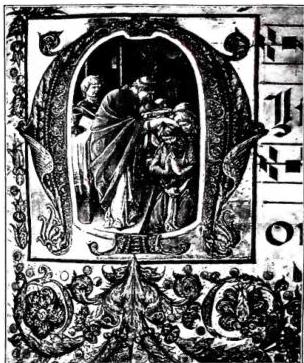
(fot. Alinari)
SACRAMENTI - L'Eucaristia. Ministra di Liberale da Verona (sec. xv). Corale della Libreria Piccolomini - Siena.
1930, pp. 89-94; P. Gounin, Sur la Grâce sacramentelle, in Rev. apolog., 54-55 (1932), pp. 129 sgg., 239 sgg.; Ch. B. Crawley, A defense of the common thomistic teaching on Sacramental Grace, Roma 1947; D. Bertetto, La Grazia sacrament., in Salesianum, 11 (1949), pp. 397-413. 5. Istituzione: H. Lennerz, Salva eorum substantia, in Gregorianum, 3 (1922), pp. 385-419, 524-47; J. Bittremieux, L'instit. des Sacrem. d'après st Bonaventure, in Etudes francisc., 35 (1933), pp. 129-32, 225-40, 337-55; A. D'Alès, Salva eorum substantia, in Ech. theol. Lov., 1 (1924), pp. 496-504; E. Guillaume, De instit. Sacram. iuxta A. Halemem, in Antonianum, 2 (1927), p. 437 sgg. 6. Numero settenario: J. De Ghellinck, A propos de quelques affirmations du nombre septénaire des Sacrem. au XIIe siècle, in Rech. de sc. rel., 1 (1910), p. 494 sgg.; M. Jugie, Theol. dogm. christian. Orient., III, Parigi 1930, pp. 15-25; E. Dhanis, Quelques anciennes formules septénaires des Sacrem., in Rev. d'hist. ecclis., 26 (1930), pp. 574-608, 916-50; 27 (1931), pp. 5-26. Antonio Piolanti
II. TEOLOGIA MORALE.
I. REQUIREMENTS IN MATTER AND FORM
In sacramental matter, it is necessary to attend to the will of the Divine Institutor, who willed that certain sensible things (res, matter) be called, together with determined formulae (verba, form), to constitute the sensible sign, producer of Grace, and, so that the unity of the sensible sign may be had, it is necessary that the two elements (res et verba, matter and form) be fittingly united among themselves and that they be certain and integral.1) Regarding certainty, outside the case of urgent necessity or notable spiritual utility, it is a grave sin to use matter that is not morally certain in the confection of the Sacraments. This is required both by the reverence due to the Sacrament, which could be exposed to the danger of nullity, and by the good of the one who receives it, who could thus be deprived of the Sacrament’s benefit. The certainty here required is a moral certainty: the doubt to be excluded is the doubt of fact, that is, when one remains hesitant as to whether this or that matter was destined by Christ as valid matter for the Sacraments. Therefore, in the Sacraments, probabilism cannot absolutely be used, the theory and practice of which concerns the doubt of law (cf. the proposition condemned by Innocent XI: Denz-U, 1131). Only two exceptions are admitted: the case of necessity or notable utility. Regarding the first, all authors agree that in case of necessity it is licit to administer the Sacraments even with doubtful matter, because the Sacraments are made for men, and thus when in case of necessity doubtful matter is used, the reverence due to the Sacrament is not violated, since it is used for the very end willed by Christ, our Lord. Nor is harm done to the good of the one who receives the Sacrament thus administered; indeed, what is done is directed to his advantage, to favor his salvation in every possible way. In case of extreme necessity, therefore, not only is it permitted, but it is obligatory to act in this way, it being the decisive moment for the salvation of a soul. Such is the case of a gravely ill child, not yet baptized, to whom Baptism is conferred with dubiously valid water, there being no other. Such is the case in which absolution is imparted, conditionally, to a dying person dubiously disposed. What has now been said for the case of necessity may, in the judgment of most, be repeated for the case of grave utility, though there is no lack of authoritative dissent.
2) As for the integrity of matter and form, it is necessary to distinguish between substantial mutation (which renders the Sacrament null) and accidental mutation (which allows the validity of the Sacrament, though it is sinful for the one who introduces it, unless driven by motives of necessity or other excusing motives). There is a substantial mutation of matter when the change or separation of words is such that it must be considered no longer that matter, but another. As an evaluative criterion for such alterations of matter, one does not resort to scientific formulae and language, but to the common manner of thinking and acting. The Sacraments, indeed, are within everyone’s reach, instituted for all, and even the evaluation of their elements must be made on the basis of a criterion accessible to all and not reserved for an elite of persons. There is, then, an accidental mutation when, despite the change made, the matter, in common judgment, remains the same, even if it contravenes the respect due to the Sacraments, reasons of convenience, or prescriptions of canon law. In concrete terms, such a mutation occurs: a) if the words are changed only materially, because others are used that have the same meaning; b) if the minister adds some other complementary word; c) if one or more voices are changed, or omitted, without however transforming the meaning of the phrase; d) if the minister, through haste or stammering, omits or changes letters of words (especially final ones). In these cases, even if the meaning were to remain ambiguous, it can be determined by the manifest intention of the minister.
Substantial mutations of matter and form that render the Sacrament invalid are gravely sinful, except simulation (v.). The sin is against the virtue of religion and sometimes against charity and justice. Accidental mutation, instead, which does not render the Sacrament null, if done without motive, in proportion to the measure of the alterations introduced and other circumstances, will be grave or light.
3) The union of matter and form in the confection of the Sacraments must be such as is necessary in the individual Sacraments so that the words are understood to be directed to that determined thing and such as to form with it a single sacramental sign. In particular: a) physical simultaneity is required only in the Eucharist, because the words of the form, “This is my body,” would make no sense if the matter were not before the priest at the moment he begins to pronounce the form. b) Moral simultaneity, strictly understood (that is, so that the words of the form and the application of the matter are morally together), is required in Baptism, Confirmation, Extreme Unction, and Holy Orders. Therefore, these Sacraments are certainly valid if the application of the matter is made before the last word of the form is pronounced, and vice versa. They are equally valid if the words are begun as soon as the application of the matter is completed. They are probably still valid if there is a very brief interval between matter and form. c) In the Sacrament of Penance, since Penance is ordered in the manner of a judicial process, in itself, between the instruction of the process and the sentence, there may intervene that interval which exists between the cognition of the judgment and the sentence, that is, an interval even rather long. But since the Sacrament of Penance is a singular judgment, in which the penitent must bring certain dispositions (attrition or contrition), which are not required and ordinarily not had in common defendants, the interval for the union between matter and form may of necessity be shortened due to the lack of perseverance in said dispositions. d) In Matrimony, which is celebrated in the manner of a contract, and in which both matter and form are contained in the mutual consent, it is sufficient that the consent of one supervenes while the consent of the other still persists, for the Sacrament to be valid.
4) Application of matter and form. — a) In the Sacraments in which matter and form must be applied to the subject, this must be executed by the same minister: thus is demonstrated by the common practice of the Church, by the common opinion of theologians; and, for Extreme Unction, also by the noted words of St. James (5:14-15). Moreover, since the administration of the Sacraments must be an action composed of two elements, namely, the application of the form to the matter, if one were to apply the form and another the matter, there would rather be two actions and not only one. Furthermore, the meaning of the form would often not be verified if one applied the remote matter and another pronounced the form, e.g., in Baptism. To this reasoning others, like Cajetan, respond that unity is given by the fact that the ministers act in the name of Christ; from this unity arises. Given the probability of this opinion, according to which the identity of the secondary minister in the application of matter and form would not be indispensable, in case of extreme necessity, it is not illicit to confer the Sacraments in the ways described above. b) In the Sacraments, instead, in which the minister pronounces the form and the subject provides the matter, it is the rule that one posits the matter and the other the form. Thus in the Sacraments of Penance and Matrimony.
II. REQUIREMENTS IN THE MINISTER OF THE SACRAMENTS
Minister of the Sacraments (here we speak of the secondary minister) is only the wayfaring man who is consecrated or at least legitimately deputed.
A distinction is made between the consecrated and non-consecrated minister, depending on whether he has received a special consecration or not. A consecrated minister is required for five Sacraments: Confirmation, Eucharist, Penance, Extreme Unction, and Holy Orders; whereas a non-consecrated minister suffices for Baptism, and is required in the Latin Church for Matrimony.
A distinction is also made between the ordinary and extraordinary minister. The ordinary minister is one to whom the administration of these Sacraments pertains by office; the extraordinary minister, on the other hand, is one who may administer the Sacraments only in case of necessity or by special delegation.
Finally, a distinction is made between the public and private minister. The former is one who administers solemnly, using all the ceremonies prescribed by the Ritual; the latter, however, is one who applies only the matter and form, omitting all other ceremonies.
1) The requirements in the minister for the valid administration of the Sacraments are as follows: a) due power, since not all may administer every Sacrament, but only those to whom Jesus Christ has conferred such power; man in the administration of the Sacraments is a mandatary; b) due intention, that is, to do what the Church does (v. above) and that this intention be at least virtual in the minister (v. Sacramenti); c) the correct application of the form to the matter.
2) The requirements in the minister for the licit administration of the Sacraments are: a) state of grace (v.); b) immunity from censures and irregularities, an immunity which in Penance may affect the very validity of the Sacrament; c) it is further required that the minister, in his action, act with due reverence. This respect sometimes demands that the conditional form be used rather than the absolute in the administration of the Sacraments. The conditional form is that by which the minister, through a condition (expressed in words or merely mental), intends to administer the Sacrament only if all the requirements for its validity are simultaneously present. This form must always be used in the repetition of the Sacrament: and when expressly required by the Ritual even in the first conferral, as in Baptism and Extreme Unction. In other cases, the condition must be used whenever the Sacrament, if conferred absolutely, might be exposed to the danger of nullity, or, if denied absolutely, would deprive man of a great good and place him in grave danger of perdition. Therefore, it is almost never licit to append a condition de futuro; indeed, all Sacraments thus conferred, except Matrimony, are null, because the moral coexistence of the elements is lacking. In Matrimony, the condition de futuro (suspensive, not resolutive) is sometimes even licit (v. CONDIZIONE). The Sacrament conferred under a condition de praesenti or de praeterito is valid if the condition is fulfilled or has already been fulfilled; otherwise, it is null. But reverence also simulation (v.) be removed from the administration of the Sacraments. The dissimulation of the Sacraments, however, is licit for a grave reason. It consists in performing a non-sacramental action under circumstances such as to make it appear that a Sacrament is being administered; d) it is further required that due attention be given, that is, internal attention, which excludes any distraction; e) a prudent solicitude for the validity of the Sacrament and thus a diligent inquiry into the matter and form must never be lacking on the part of the minister. If, due to a defect in some essential element, the previous administration of the Sacrament was certainly invalid, the Sacrament must be repeated in absolute form. If, however, there is only a prudent doubt about the validity of the Sacrament, it must be reiterated conditionally. If, moreover, there is no reasonable doubt about the validity of the Sacrament, even the conditional repetition is illicit. The malice of reiteration in this case is in itself grave, due to the irreverent use of the sacramental sign; nevertheless, given the circumstances (special psychological conditions, e.g., scruples or bad habit), grave sin is rarely incurred. It is to be condemned to repeat one or more words of the form; f) the observance of the prescribed rites is also required on the part of the minister, along with the necessary authorization to administer the Sacrament (license); g) finally, the administration of the Sacraments must be gratuitous. Canon 736 states: "For the administration of the Sacraments, the minister, for any reason or occasion, directly or indirectly, shall demand or require nothing, except the offerings mentioned in canon 1507 § 1 and (the fees imposed in provincial councils and meetings of bishops). He may not, therefore, demand or require, but the spontaneous offering is not forbidden; h) it is illicit to administer the Sacraments to an incapable subject. This, implying a most grievous abuse of a sacred thing, is an intrinsically evil act both on the part of the minister and on the part of the subject to whom the Sacrament is administered. It is also gravely obligatory to deny the Sacraments to the unworthy, unless the action is excused by a proportionately grave reason (v. INDEGNI).
5. Obligation to administer the Sacraments on the part of the minister
To judge the nature and gravity of the obligation, one must consider the duties with which the minister is burdened and the condition of the faithful who request the Sacraments.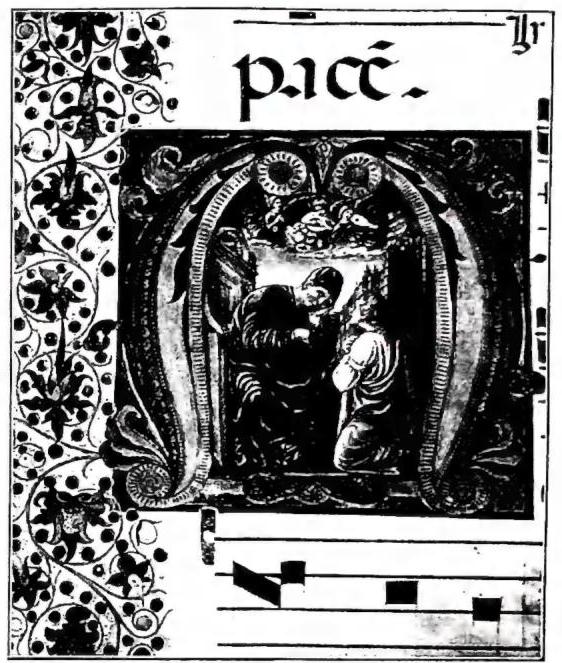
b) As for the ministers of the Sacraments, some are bound to administer them by charity, others by justice. a) Those bound by justice or by duty of office are those who hold pastoral ministry, and these are bound sub gravi to administer the Sacraments to their own subjects when reasonably
SACRAMENTS - Penance. Miniature by Liberale da Verona (15th century). Choir book of the Piccolomini Library - Siena.
The faithful reasonably request the administration of the Sacraments not only when they are bound to receive them by precept or by necessity to provide for their own soul (having committed a grave sin, facing grave temptation), but also when they request them out of pure devotion or spiritual profit. Pastors of souls are bound ex iustitia to administer the Sacraments because, in assuming the pastoral office, they have implicitly obliged themselves to fulfill its various duties and thus to administer the Sacraments to their subjects either personally or through others (can. 892). Those constituted in the pastoral ministry are bishops, parish priests, and their vicars for the faithful in general; for religious in particular, the care of souls is entrusted to Superiors.
In this ministry, one is bound sub gravi in itself, because the obligation is one of justice and the matter is grave (it concerns eternal salvation, justification, and the increase of grace).
In cases of extreme necessity of their subjects, the necessary Sacraments must be administered for eternal salvation even at evident peril of life. For this obligation to exist, three conditions are required: that there be moral certainty that the subject is in extreme necessity; that there be moral certainty or at least well-founded hope of success; and that it concern necessary Sacraments. The necessary Sacraments are: Baptism, Penance, and, for those who have not been absolved or are deprived of their senses, Extreme Unction. Viaticum (v.) should be classified among the necessary Sacraments. In grave necessity, the Sacraments must be administered even at grave and probable danger to one's own health. The same cannot be said in cases of common necessity; in such cases, one must be prepared to endure some inconvenience, but no more is required, because it is presumed that the pastor of souls did not intend to bind himself to grave inconvenience. b) Ex charitate, all other ministers who do not exercise pastoral care are bound, and the obligation is more or less grave according to the order of the virtue of charity. The obligation may become graver due to the necessity of avoiding scandal, which can easily arise on such occasions.
In particular: the faithful who find themselves in extreme spiritual necessity must be assisted even at great inconvenience and even at some risk to life, provided there is certainty of true necessity and some hope of saving one's neighbor. Extreme necessity is assimilated to common grave necessity, which occurs in times of contagious diseases. All ministers are bound sub gravi to administer the Sacraments to the faithful in grave spiritual necessity if they can do so without notable inconvenience.
Ministers are generally bound sub gravi to administer the Sacraments to the faithful who reasonably request them outside cases of necessity.
III. REQUIREMENTS IN THE RECIPIENT OF THE SACRAMENTS
Except for the Eucharist, all other Sacraments are effected through their application to the recipient.1) For the valid reception of the Sacraments, the following are required:
a) The capacity of the recipient. Every viator man, and only he, is a capable recipient of the Sacraments. The Sacraments were instituted by Christ to confer the first or second Grace. b) For the reception of other Sacraments besides Baptism, valid Baptism by water is required. The reception of the Eucharist itself, without Baptism, would be merely a material reception. c) For the reception of Holy Orders, the male sex is required. d) For the Sacrament of Penance, the use of reason is required. Likewise, for the valid reception of the Sacrament of Matrimony (as a contract). e) For Extreme Unction, in addition to the use of reason, a grave illness or old age is required (can. 940). f) For the Sacrament of Matrimony, in addition to the use of reason, freedom from another bond and physical capacity, at least in a radical sense, are required. For the valid reception of the Sacraments, however, the following are not required: a) neither faith nor probity in the recipient, as these elements do not constitute the Sacrament (cf. S. Congr. of the Holy Office, 19 Sept. 1677). Penance is excepted because its validity requires perfect contrition or at least imperfect contrition (attrition), which is part of the very constitution of the Sacrament. Now, contrition presupposes faith; b) neither any attention on the part of the recipient, whether internal or external; but intention (ordinarily habitual and implicit) is required. However, in children and the habitually insane, for the valid reception of the Sacraments of which they are capable, such as Baptism, Confirmation, etc., no personal intention is required (v. Sacramenti).
2) For the licit reception of the Sacraments, generally speaking, two conditions are required: that the recipient be endowed with the due dispositions; and that he request the Sacraments from a worthy minister. a) Whoever knowingly receives the Sacrament without the due dispositions commits a grave sin of sacrilege, because he renders useless the rite instituted by Christ as an efficacious sign of Grace. In particular, to receive the Sacraments of the living, the state of Grace is required. Therefore, lacking Grace, one commits sacrilege by receiving the Sacraments of the living (v. SACRILEGIO; STATO DI GRAZIA). Approaching the Sacraments of the living with habitual venial sin does not constitute sin; approaching them with an affection for venial sin will be a venial sin. There is no sin at all if one seeks in the Sacrament a remedy against this affection for venial sin. For the Sacraments of the dead (Penance and Baptism in an adult sinner), the due disposition is supernatural attrition. b) It is illicit to request and receive Sacraments from a certainly unworthy minister, that is, one who is a habitual sinner or who is in the proximate occasion of sin or is bound by censure. But since the request for the Sacrament is not in itself an evil thing, it is permitted to request and receive Sacraments from a sinful minister, not bound by censure, if there is a grave and proportionate cause. Indeed, it is licit, for a just cause, to cooperate materially in the sin of another, when it is not a thing evil in itself and when the minister can regain the state of Grace through perfect contrition.
Some authors maintain that it is licit to receive the Sacraments from an occult sinner, even if the minister’s unworthiness is certainly known. If, however, the minister is one struck by censure, the faithful may for any just reason request the Sacraments and sacramentals from him, provided he is not an excommunicated person to be avoided (vitandus), or a censure imposed by means of a declaratory or condemnatory sentence (cann. 2261 § 2, 2275, 2284). From an excommunicated person to be avoided (vitandus) or from one who is suspended or interdicted after a condemnatory or declaratory sentence, the faithful may, in danger of death, request sacramental absolution, even if other worthy ministers are present. If these are lacking, they may request from the same minister even the other Sacraments (cann. 2261, 2275 § 2, 2284). According to some authors, a most grave harm to be avoided, such as scandal, infamy, or a serious misfortune, is to be equated with danger of death. The same must be said of a minister who is not bound by censure but by a vindictive penalty, such as perpetual or temporary suspension. It is then licit to request the Sacraments when there is a just reason (can. 2298). If, however, the minister is one who has been deposed or degraded by a condemnatory or declaratory sentence, it is licit only in danger of death. If the minister is a public apostate, heretic, or schismatic, it is licit to request the Sacraments from him only in danger of death. Here, account must also be taken of scandal and the danger of perversion (S. Congr. S. Uffizio, 7 July 1864). – Vedi tavv. XCVII-XCVIII.