
CALVINO (CALVINUS, CAUVIN, CHAUVIN, CALVIN JEAN). - The most important initiator of Protestantism in France, Switzerland, and the Netherlands. Among the pseudonyms used by C., we recall: Martianus Lucanius, Carolus Passelius, Charles d'Espeville.
I. THE MAN
1. Youth and Apostasy
C. was born on 10 July 1509 in Noyon (Picardy) to Catholic parents, the second of six children. His father was an employee of the episcopal curia, and his mother was the daughter of a wealthy innkeeper from Cambrai. Destined for ecclesiastical studies, at only twelve years old Giovanni already held a prebend (of N. S. de la Gésine) and, after receiving the tonsure, also the chaplaincy of St-Martin de Martheville, which he later passed on to his younger brother. However, he did not continue in holy orders but, with the support of the Montmor family, went to study in Paris. In 1524 he began the philosophy course at the Collège de Montaigu, followed by theology. In 1528, at his father’s advice, he abandoned theologyto dedicate himself to law, which was supposed to open the way to a magistracy, and went to Orléans to study under Pierre de l'Étoile. Theodore Beza says that his companions called him « accusatif », meaning informer. He lived in seclusion, « sauvage et honteux », fond of tranquility and study (Opp., XXXI, p. 22). In 1529 C. attended the University of Bourges, where he met the humanist Giovanni Wolmar, who encouraged him to resume theological studies with the intention of winning him over to evangelism.
The times were indeed ablaze with religious novelty. In Paris, Giovanni had witnessed the first skirmishes of the Lutheran struggle against the Sorbonne and had lived amid the ferment of reformist ideas, seeing the first trials and even the first executions of the new heretics. A cousin of his, Pietro Roberto, known as Olivetano, had given him heterodox writings to read, which made an impression on his soul, planting the first seeds of religious crisis (Opp., IX, p. 51). The apostasy, slowly prepared, occurred in 1533, not without inner turmoil (ibid., V, pp. 358-416). The decisive step toward rebellion came with a speech he drafted at the request of Nicolas Cop for the inauguration of the academic year in the church of the Mathurins in Paris on 1 November 1533, in which he affirmed the principle of justification in a Protestant sense and defended heretics « as those who purely strove to insinuate the Gospel into the souls of the faithful ». Forced to leave the city, he wandered through France to Angoulême, Nérac, Noyon, Poitiers, Orléans, until in 1534 he took refuge in Strasbourg, which had become a stronghold of the Reformers, and in Basel in 1535. There he completed and published the work Institutio Christianae Religionis, openly opposed to Catholic doctrine, and after a journey to Ferrara in Italy at the court of Ercole II, whose wife Renata of France was his supporter, he went to Geneva in Switzerland, where the reformer Farel convinced him to stay to help settle the situation in favor of the heretics.
2. C. in Geneva (1536-38; 1541-64). - That very year (1536) the Council of Geneva, which had promoted the anti-papal movement, had decreed the destruction of altars in all the lands of Vaud, the demolition of images, and the suspension of every form of Catholic worship. Encouraged by these examples, Farel and C. proposed the Articles de regimine Ecclesiae with similar measures, which were accepted by the Deux Cents, who held legislative power in the city. By further decrees, worship was organized in a distinctly Protestant form, both regarding the Eucharistic Supper and the singing of Psalms, preaching, and the celebration of marriages. Elections favorable to the two reformers increased their power; but the « demonstration of faith », a kind of creed extracted from the Institutio Christianae Religionis, which they sought to impose on the citizenry, met with strong opposition from many Genevans who had accepted the Reformation only for political reasons of independence and not to submit to the yoke of preachers. Thus, in the new elections of 1538, the opposing party prevailed, and the new Council prohibited the two leaders from preaching. Having disobeyed the order, they were expelled from the territory. C. took refuge in Bern, then in Basel, until, invited by Bucer, he went to Strasbourg. There he found other leaders of the Reformation, including the two Sturms, Capito, and many French refugees. The three years he spent in the Alsatian city (1538-41) were among the most peaceful of his life. C., salaried by the city itself, gave public lectures on Holy Scripture, spiritually guided the French community, and could attend to his favorite studies. He then published the second edition of his Institutio, a celebrated Response to Sadoleto (1539), the bishop of Carpentras who had vainly attempted to bring the Genevans back to the ancient faith, and the Commentarius in Epistolam ad Romanos (1540). In the autumn of 1540 he married Idelette de Bure, the widow of an Anabaptist. In 1541 he participated in the colloquies of Haguenau, Worms, and Regensburg, while in Geneva the situation had once again turned in his favor, and the three Councils
of the city officially invited him to return. C., a most skillful politician, made them plead, delaying to heighten the desire for his return and presenting letters from some magistrates of Strasbourg who claimed him. Finally, to their pressing insistence, he consented, not without setting conditions that made him practically the arbiter of the situation. On 16 September 1541 he re-entered Geneva, obtaining the approval, with few modifications, of Les Ordonnances Ecclésiastiques de l'Église de Genève, with which he organized the entire domestic and social life of the citizens according to Calvinist doctrine (v. the text in Opp., X, p. 15 ff) and which became the fundamental state law for the Genevan republic. By 1543 all laws and customs were reorganized, and the civil constitution was completed. C. could be satisfied; he had imposed the ordinances he wanted and had, in a sense, become the uncontested master of the city.
3. Government of C
The direct contact C. had had in Strasbourg with the German Reformation allowed him to note its criticizable shortcomings. It had not improved morals but had subjected spiritual power to civil power and had fostered social disorder with its excessive spirit of insubordination and independence. The Genevan Church was therefore established by him on foundations that would avoid those errors. The State was to be subject to the Church, having no other reason for existence than to enforce divine law upon its subjects. Religion was the supreme arbiter of public life. With these principles, a government was constituted that, under a democratic appearance, was oligarchic. Effective governance depended on a few. The class of preachers with its General Assembly (Congregation) was the true dominator of public life. The ordinances had begun by affirming that God had provided for the constitution of the primitive Church with the creation of pastors, doctors, elders, and deacons; that was the « rectus ordo » that alone could be acceptable to Him. Geneva, therefore, would be governed accordingly.The pastors, or ministers of the Word, were the essential element of the community. They were tasked with preaching the Gospel, administering the Sacraments, teaching, admonishing, reproving in public and in private, examining and instituting future pastors. Calvin personally trained the first ministers, gathering them every Friday for scriptural and theological expositions. He regulated preaching, establishing three parishes in which sermons were held three times a week and on Sundays. Later, the practice of a daily sermon in every church in the city would be adopted. Calvin’s sermons were prepared with great care; they were not long, so that the entire service, with hymns and prayers, did not last more than an hour. The doctors were responsible for schools and the education of youth. The elders, twelve in number like the apostles, were charged with maintaining discipline. They were to be elected by the three councils from among men "of upright life, honest, blameless, above all suspicion, and, above all, full of the fear of God," and chosen in such a way as to represent all the city’s districts. The deacons, then, were to visit the sick, assist the poor, and aid the ministers.
The most characteristic organ of Calvin’s spiritual dominion was the consistory, a kind of tribunal composed of six ministers and the twelve elders, which convened weekly to oversee the morals of the citizens and their attendance at religious duties. In more serious cases, it handed the guilty party over to the council.
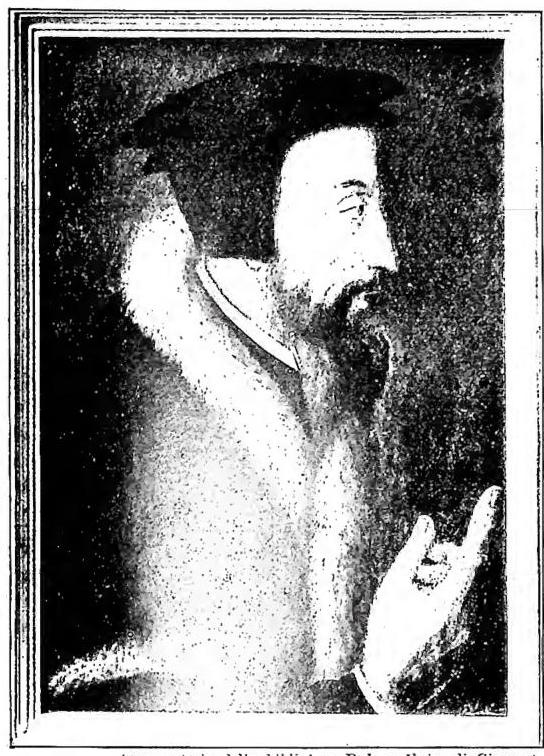
CALVINO - Oil portrait (16th century), preserved in the Public and University Library of Geneva.
No measure aroused as much hostility as this tribunal with its methods. Citizens found it harsh and contrary to civic traditions "to be summoned before a court of ministers, almost all foreigners," and "to be compelled to beg mercy from God and justice," not to mention that the consistory, by its very nature, encouraged denunciation. Many could not help but compare the despotic intransigence of the new yoke with the previous ecclesiastical government of the bishops, which had been far more lenient, and it did not seem reasonable to them that they had overthrown the latter only to fall into a worse situation. Hundreds of people were indeed tried and condemned. Thus, while Calvin’s establishment in Geneva in the first period (1542-46) saw the consolidation of his power, in the second (1546-54) he had to contend with violent opposition, which he managed to overcome only through his great firmness, tenacity, and severity.
During these years, Calvin, struck in his deepest affections by the death of his wife after that of his only son, still in infancy, became increasingly withdrawn and gloomy. Physically, he was tormented by migraines, stomach pains, and exhaustion. Yet his activity knew no respite. Religiously, he dedicated himself entirely to the Reformation, not only in Geneva but also intervening with his letters in Protestant matters throughout Switzerland, as well as France, Germany, and Sweden, while welcoming to his city the Huguenots persecuted by Henry II. Nor were doctrinal controversies lacking among fellow heretics; thus, in 1551, with Jérôme Bolsec, who had publicly attacked his teachings on predestination. Calvin succeeded in having his adversary expelled and in having his own doctrine officially consecrated. Nor did he cease composing literary works of a theological nature. Between 1546 and 1555, he published his Commentaries on the Old and New Testaments.
The most salient event of this period, however, was the reformer’s struggle with Michael Servetus. This Spaniard, who had already in 1530 published a heretical work on the Most Holy Trinity, scandalizing both Catholics and Protestants, and who since 1545 had been in epistolary correspondence with Calvin, had impugned many of his theories with an unpleasant tone of superiority. Calvin then wrote to Farel that "if Servetus came to Geneva, he would not permit him to leave alive." Now, precisely in 1553, the latter, having fled from Vienna where he had been condemned to the stake, had stopped for a night in Geneva, perhaps yielding to the irresistible temptation to see his rival up close. But, once recognized, he was immediately arrested. According to Genevan law, the accuser had to go to prison with the accused until the tribunal was convinced of the latter’s guilt. Thus, Calvin presented his own accusation, formulated in 40 articles, through one of his secretaries, who was soon released. On 15 August 1553, the first of those famous interrogations began, in which Calvin himself several times acted as accuser. From the proceedings, it became clear that if the trial had remained solely on theological opinions, it would have dragged on excessively; Calvin then accused Servetus of doctrines subversive not only of religion but of society, and the unfortunate man was condemned. The death sentence was legally unlawful and, according to Protestant principles of free examination, a contradiction; the ordinances of 1542 indeed recognized only banishment as a penalty. On the morning of the execution, Calvin visited the prisoner, who vainly implored mercy, and in fact, Servetus was led to the Place du Bourg-de-Four and burned alive. Calvin received many letters of congratulation, including one from Melanchthon (Op. Melanchtonis, XV, p. 268), but also severe criticism, especially from Sebastian Castellio, and in 1554 he had to write an apology for his act: Defensio orthodoxae fidei; yet this did not prevent him from being accused thereafter of a religious intolerance worse than that which he had reproached the old faith.
Politically, however, Calvin gained the upper hand over his adversaries with this episode, who had vainly sought an acquittal, and saw the 1555 elections favor the reformer. Then Perrin, leader of the opposing movement, attempted to promote an insurrection, which failed. His party, known as the Perrinists or Libertines, was dispersed with the expulsion of many members, of whom 60 were condemned to capital punishment, though fortunately only two were executed.
From then on (1555) until 1564, the year of his death, Calvin held full power. The alliance with Bern, the struggle against the Duke of Savoy, the formation of a new bourgeoisie with the classes favorable to Calvin who had immigrated from France, and the repression of opposing elements through the sentences issued by the consistory, made Geneva the best-organized fortress of Protestantism in Europe.
4. The Genevan Academy (1559)
Among the institutions founded by Calvin, the first true Protestant university of international character, both in its faculty and students, deserves mention: the Genevan Academy, destined to radiate and perpetuate his work, of which Théodore de Bèze was the first rector (Leges Academ. Genev. Promulgatio, Geneva 1559).As early as 1565, there had been talk of founding a university in Geneva, but the concession made by Charles IV had been revoked; Pope Martin V had issued another charter of foundation in 1418; and thus a college had arisen, later replaced in 1536 by the Collège de Rive, known as the Grande Eschole. Calvin expanded it and transformed it into a true university. The first public lecturers of the new academy were Chevalier, Bérault, and Tagaut, who gave it a classical note. Already in 1560, the first publication appeared, a Hebrew grammar by Chevalier, followed in the same year by a Latin version of Appian of Alexandria by Bérault. As for Jean Tagaut, he composed a Latin poem, Protrepicon ad Hieropolia, in honor of the holy city (Geneva), where Protestant fugitives from Europe found refuge, dedicating it to the people and the senate. Calvin rejoiced in these promising beginnings for his cause. By 1456, the number of students had already risen to 1500.
5. Final Years and Death (1559-64). - The last period of the reformer’s life was marked by physical and moral suffering and exhausting activity for the spread of Protestantism. Already in 1558, Calvin had suffered an attack of pleurisy and had begun to spit blood.
From 1560 onward, other ailments had been added, such as kidney stones, gout, and ulcers, so that by the beginning of 1563 he was almost continuously confined to bed, though he did not neglect writing and dictating, and even preaching when permitted. During this time, he composed the Commentarius in quatuor libros Mosis, in formam harmonice Digestus (1563) and the commentaries on the books of Jeremiah, finally completing his exegeses with the commentary on Joshua. Having become tubercular, he no longer rose from his bed. On April 2, 1564, Easter Sunday, he was carried to the temple to receive the Lord’s Supper for the last time, and on the 5th he made his will. He had not grown wealthy in governance, and his estate was modest, amounting to only 200 crowns. His final recommendations to the magistrates and pastors, disseminated by his supporters, had a self-panegyric character. The reformer would have assured them that he had taught the word of God without error and exhorted them to thank God for the dangers from which his actions had delivered them. He added the warning not to make changes or innovations, for all changes were dangerous and often harmful (ibid., XXI, p. 100), contradicting with these words his own conduct, which had been entirely one of innovation with respect to the previous faith. To the magistrates, he recommended the administration of justice with equity and moderation, thanking them for having so often tolerated him. His phrasing was a strange mixture of pious, humble, and devout expressions, combined with a lofty and exalted self-conception. In his final days, he prayed much and asked God for forgiveness. On the evening of May 27, 1564, C. died: he was fifty-five years old. The following day, he was buried at Plain Palais, with no tombstone, according to his wishes, to mark the place of burial (ibid., XXI, p. 106), so that even today his remains are untraceable. His death was not mourned. He himself, before dying, said in his message to the Church of Bern: «They feared me more than they loved me!» Beza, whom he had named his successor, delivered his panegyric, saying that with his death «splendida lux nobis erepta est» (ibid., XXII, p. 168), and Colladon wrote that on that day «the greatest light of the world had been taken up to heaven» (ibid., XXII, p. 105). But the system of repressions he employed and his «chagrin et difficile» character led many to curse him. His enemies spread the rumor that the reformer’s final moments had been under God’s curse, that he had died in despair, and that a certain Harennius, having slipped into his chamber, had lifted the cloth covering his corpse, revealing signs of a shameful disease. Tales that bear all the marks of slanderous legend, yet they indicate the mentality of the era and the animosity of not a few Genevans.
II. THE WRITINGS
Of the immense labor undertaken by Calvin as teacher, preacher, and writer, over 2,200 sermons remain in manuscript, along with a hundred works not only exegetical but also doctrinal, polemical, apologetic, liturgical, homiletic, and literary, to which must be added letters, opinions or responsa, and even an epinicion to Christ.The best early edition of Calvin’s Latin works is that published in Amsterdam in 1671 in 9 volumes; however, another in 7 volumes had already circulated, edited in Geneva in 1617 and the following years. A large portion of these works was translated into French and English. Among these editions, the collection Oeuvres en français de J. Calvin, recueillies pour la première fois. Précédées de sa vie par Théod. de Bèze, et d'une notice bibliographique par P. L. Jacob, bibliophile (Paris 1842) is well known, as are the translations by the "Calvin Translation Society," edited by Henry Beveridge (Edinburgh 1845-51).
A good critical edition is found in the Corpus Reformatorum under the title Ioannis Calvini opera quae supersunt omnia (59 vols., Brunswick and Berlin 1863-1900), begun by J. W. Baum, E. Cunitz, and E. Reuss, and completed by Lobstein and Erichson. A list of Calvin’s principal writings can be found in the Cyclopaedia Bibliographica by J. Darling (London 1854, cols. 554-56). The most recent French translation of the Institutio is that published in 4 volumes by J. Pannier (Paris 1936).
III. THE DOCTRINE
The term "Calvinism" serves to denote the body of heterodox theological doctrine proper to the Reformed Churches that draw inspiration from the school of CALVINO. This doctrine revolves around a particular interpretation of divine predestination, a distinctive conception of moral and social life, and a consequent form of worship and political system.Chronologically, Calvinism appears after Lutheranism and Zwinglianism, and dialectically it tends to surpass them, though without excluding their directives, which it seeks to fuse into a higher unity, to which it gives its own original character. Calvinism and Lutheranism converge and nearly identify in the doctrine of gratuitous justification, the imputation of Christ's merits, and fiducial faith, as well as in the denial of effective transubstantiation, the Eucharistic sacrifice, and the seven Sacraments, reduced to only two, differing thereafter in particular interpretations. In these, especially regarding the Sacraments, Calvinism draws inspiration from Zwinglian doctrine, though transcending II.
All three systems uphold the uniqueness of the Bible as the norm of faith. Holy Scripture, inspired by God, is held to be the sole infallible criterion, the foundation and norm of what must be believed and practiced. Yet while Lutheranism and Zwinglianism proceed to the private interpretation of Scripture under the influence of the Spirit, CALVINO is more rigid and does not admit free examination. The objectivity of Revelation, having God as its direct inspirer, presupposes that truth is already contained therein; this must be discovered beneath the letter (cf. Inst., ch. I, 20-21). Only the predestined arrive at understanding its profound meaning, for it is suggested to them, through the Holy Spirit, by conscience. Nevertheless, Calvinism reconnects with the other two conceptions when it rejects the living Magisterium of the Church, the supremacy of the Pope, the value of Tradition and of Councils, and when it denies the Catholic Church the authority to interpret and judge the true sense of Holy Scripture (Inst., ch. I, 21-35).
The doctrinal tenets most particularly proper to Calvinism may be drawn from the work Institutio Christianae Religionis, published by CALVINO in Basel in 1536, in which he established his principles. These were not subjected to further developments in subsequent years, but rather to refinements, deepenings, and clarifications. CALVINO always showed little inclination to correct or revise his ideas, and from the outset of his apostasy his system was already complete in nearly all its details.
Indeed, the Institutio became the foundation of the religious belief of Geneva and subsequently of Calvinism, and was regarded by the Genevans almost as a second Bible. The tanner proclaimed its doctrine "holy," forbidding anyone to speak of it in a contrary sense. CALVINO himself said it was more the work of God than his own. And in truth, this work, insofar as it preserves revealed truth—that is, the ancient faith in the enunciation of certain points of Catholic religion interwoven with errors—possesses aspects of profound spirituality and loftiest religiosity, which are precisely those that attract souls and minds, unfortunately led astray into heretical conclusions by CALVINO’s additions, interpretations, or negations. The topics treated may be inferred from the twenty-one chapters of the work (in the present exposition, reference is made to the 1553 edition edited by R. S. Oliva). In the first two chapters, CALVINO treats of the knowledge of God and the knowledge of man, the foundation of religion (ch. I-II). In the third and fourth, of the law and vows (ch. III-IV). Then of Faith and the Apostles' Creed (ch. V-VIII), of penitence (ch. IX), of justification by faith and the merit of good works (ch. X), of the similarities and differences between the Old and New Testaments (ch. XI), of Christian liberty (ch. XII), of human traditions (ch. XIII), of predestination and the providence of God (ch. XIV), of prayer (ch. XV), of the Sacraments in general (ch. XVI), of Baptism and the Supper (ch. XVII, XVIII), of the other five Sacraments, which he calls false (ch. XIX), of civil administration (ch. XX), concluding with the norms of a Christian life (ch. XXI). The same themes recur more concisely in the Catechismus Ecclesiae Generensis, that is, the formula for instructing children, which the reformer inculcated in ministers, including foreign ones, to reduce his adherents to the unity of faith.
From these sources, the pillars of Calvinist doctrine emerge clearly.
1. The absolute sovereignty of God, justification, and predestination. — All true wisdom, says CALVINO, consists in the knowledge of God and of ourselves. God may be known first from the spectacle of creation in its manifestations and from the providence that governs II. Secondly, from Holy Scripture, and finally from the interior testimony of the Holy Spirit. The knowledge thus derived of God must lead man to fear and reverence God and to understand that in Him every good must be sought and to Him every gratitude is due. It not only makes known to him the love, patience, and clemency of God toward men, but also the rigor of His vengeance against sinners, and thus man must be induced to will to serve God, to honor Him with the innocence of life and unfeigned obedience, and to rest entirely upon His goodness (cf. Inst., ch. I, 1-7). This knowledge must lead him to humility, for human nature, created in the likeness and image of God in Adam, is, through original sin, totally vitiated and corrupted, so that original sin, transmitted from father to son, is not merely the deprivation of all goods, but a contamination that has rendered human nature fertile in every kind of evil. Even free will is impaired, so that, practically, if not regenerated by God, men choose only between evils. In short, the corruption is such that man is, on his own, utterly incapable of any good and inclined to complete evil. To this weakness of the human will, God offers aid through His Grace; and the willing of good comes from grace. God promotes in man obedience to the law, and there is nothing good in man. Salvation is the work of God alone in all things. God is the Absolute, incomprehensible intelligence and will, inaccessible, legislating, sovereign, omnipotent, from whom man has total dependence, for the world of the finite has been contained from the beginning in the Infinite, which also contains its freedom. CALVINO speaks with theological equivocation and has already made assertions contrary to revealed truth and transmitted by the Catholic Church. In the logic of error, CALVINO proceeds. God, "absolute autonomy," is the living God; He acts, rejects and accepts, damns and saves; and seeks His own glory, disposing of men with absolute freedom, in the double predestination to faith, to Grace and to beatitude, or to infidelity and damnation. Salvation comes from God and is attained through faith, with the application of the redemption of Jesus Christ. Such faith is a complete trust in God, whereby the predestined does not place his trust in the observance of the Law or in his own righteousness, for then no one could be deemed just, "but setting aside every thought of works," which he must nevertheless observe, he turns to embrace "only the mercy of God, and turning his gaze from himself, directs it to Christ alone" (Inst., ch. XII, 2).
The law, in fact, has as its office "to teach, stimulate, and exhort to good," which, however, man never fully accomplishes, so that the true question is not "how we are just, but how, though unjust and unworthy, we are deemed just" (ibid.). The remedy lies in Christ, in whom God has liberally placed "all happiness for our misery, and all wealth for our poverty; in whom He opens His heavenly treasures, so that all our faith must look to Him, from Him must depend all our expectation, in Him must our hope be fixed and rest" (Inst., ch. XV, 1). The sinner, through faith, must pass to repentance, which has two parts: "mortification and vivification" (ibid., ch. IX, 2): the first is "the sorrow and terror of the soul conceived from the knowledge of sin and the sense of God's judgment." "When one is led to a true knowledge of sin, then he truly begins to hate and execrate sin; he sincerely regrets himself; he confesses himself wretched and lost, and desires to be different. If, with this, he is touched by some feeling of God's judgment, then he lies stricken and dismayed, trembles humbled and abased, becomes discouraged and despairs. This is the first part of repentance...; vivification is the consolation that arises from faith, when, namely, the man, prostrated by the consciousness of sin and struck by the fear of God, turning to the goodness of God, to mercy, grace, salvation, which is through Christ, lifts himself up, breathes, takes heart, and as if from death returns to life" (ibid., ch. IX, 2). C., reporting this doctrine, completes and summarizes it in these words: "repentance is the true conversion of our life to God, originating from a sincere and serious fear of God, which consists in the mortification of our flesh and the old man, and the vivification of the Spirit" (ibid., ch. IX, 4); through it, the predestined lays aside evil deeds, mortifies the passions, and strives for true justice, while with confidence in God's mercy, intimate and personal, he has the certainty that the promises of mercy made by the Lord are verified in him, and this assurance gives him peace. God deems him just, imputing to him not his sins, but the merits of Christ. Faith alone saves, and not works (ibid., ch. X, 2). This faith does not originate from man, but is the work of the Spirit, and is a gratuitous gift given by God to His elect. The election to have this saving faith, which characterizes the elect, depends solely on God, who grants it independently of any foreknowledge of human merits (ibid., ch. XIV, 6); all salvation depends exclusively on God. He predetermines by absolute decree what He wills to be done with every man, so that for some eternal life is preordained, for others eternal damnation: saved or lost, independently of anything other than the sovereign will of God. History will be nothing but the unfolding of a divine plan immutably preestablished, in which man acts to manifest the glory of God.
C. distorts the meaning of Pauline texts (Eph. 1:4; Col. 1:12; I Tim. 1:9; Rom. 9:11, and others) to uphold his dreadful doctrine of predestination to damnation, and he will impugn the doctrine of Ambrose, Origen, Jerome, and the entire Catholic tradition, which teaches otherwise (ibid., ch. XIV, 5-14).
This "antecedent" predestination of some to eternal damnation is one of the most characteristic points of Calvinian errors. He himself is aware of its harshness, and yet repeatedly affirms it: "alii ad salutem, alii ad damnationem przedestinantur" (ibid., ch. XIV, 1). And though he recalls that it is "audacity and impropriety" to penetrate the secrets of God, which are "a labyrinth from which one will find no exit" (ibid.), he dares to assert that such doctrine has been revealed by God through His Word (ibid.). He immediately perceives the difficulty arising in many minds: that then it is not worth striving for good works, because "if God by an eternal and immutable decree has fixed either life or death... and if by one's own works nothing can be done to change one's fate," it is better to plunge into every will and passion (ibid., ch. XIV, 22). C. calls those who reason thus "swine who with these impure blasphemies defile the doctrine of predestination" (ibid., ch. XIV, 22). But it is certain that the heretical manner in which he presents the sublime mystery of predestination, corrupting its entire content, logically leads to despair and the most foolish consequences.
C. moreover evidently cannot give a reason why God is merciful to His elect, except that it pleases Him to do so, and likewise regarding the reprobation of others, for which he finds no other explanation than the will of God, who wishes thus to "illustrate His glory in their damnation." He, who has abusively formed this false concept of predestination, is led to confess it decretum horribile (Comm. Ep. ad Rom., IX, 14) and inscrutable. Yet he does not shrink from even more dreadful explanations, saying that so that the reprobate may plunge to their destiny, they are deprived by God of the opportunity to hear the sacred word, or are hardened through the very preaching, making them blind and deaf. But whatever must be deemed just because God wills it so. With this, C. goes against the gentle doctrine revealed by God and taught by the Catholic Church, that God wills the salvation of all men, even after original sin, having given His beloved Son for the salvation of all (cf. Jn. 3:16; II Cor. 5:15; I Tim. 2:1-6), and that one will reap what one has sown, so that he who sows in his flesh will reap corruption from the flesh, but he who sows in the Spirit will reap eternal life from the Spirit (cf. Gal. 6:8). No one is reprobate except he who, sinning freely, has rejected the means of salvation offered him by divine Goodness, because salvation involves not only the efficacy of Grace but also the exercise of man's free cooperation. C., however, like heretics in general, abandoning the teaching of the Church, to which alone Jesus Christ promised the infallible assistance of the Holy Spirit, forgets the definitions of the Councils, particularly those of Orange (a. 520) and Valence (a. 855), and the doctrine of the Fathers, according to which "no one is predestined to evil" (Denz-U, 160, 200, 300, 316, 321, etc.), but as "no one is saved against his will," so he who perishes "is damned by the merit of his own iniquity" (ibid., 200, 316, 318). The will of God, though sovereign, is also holy, just, and loving, "and cannot damn anyone without merit on his part" (St. Augustine, Cont. Iul., III, 35). The Council of Trent (1545-63) will take up the question, defining the Catholic doctrine on justification and predestination, and condemning as heresies the errors of the innovators, and those of C. (Sess. VI, chs. 1-16; Denz-U, pp. 793-810 with the relative canons, ibid., pp. 811-43).
BIBL.:
A. Lang, Die Lehre Calvins über die Prädestination, München 1909; F. W. Kampschulte, Johannes Calvin, seine Kirche und sein Staat in Genf, Leipzig 1869-99; E. Doumergue, Jean Calvin, les hommes et les choses de son temps, Lausanne 1899-1927; A. V. HARAN, Lehrbuch der Dogmengeschichte, III, Tübingen 1909; J. Köstlin, Die schottische Kirche und die calvinische Reformation, Halle 1862; H. Bois, La justification dans Saint Paul et dans Saint Jacques, Paris 1901; J. Paquier, Le protestantisme et la justification par la foi, Paris 1903; A. V. Orelli, Calvins Institutio nach Form und Inhalt, Basel 1889; P. Wernle, Calvin und Augustin, Tübingen 1909; F. Buisson, Sébastien Castellion, Paris 1892; A. Erichson, Theodor Beza, Strassburg 1898; H. Strohl, La pensée de la Réforme, Paris 1951; V. anche CALVINISMO, GIUSTIFICAZIONE, PREDESTINAZIONE, RIFORMA.
A. M. Walz
The reaction to Calvinist doctrine was not only from the Catholic side but also from Protestants themselves, among whom Girolamo Bolsec; and later Arminius, who sought to reclaim human freedom and responsibility, teaching that the inherited tendency toward evil had not suppressed free will, and that God comes to the aid of all with "prevenient Grace." The Arminians attempted to draw closer to Catholic doctrine while remaining in error, and in fact combated Calvinist theories on predestination so vigorously that any sect which, following their example, does not adhere to Calvin's theories on this point is today called Arminian. Other Arminians maintained that divine reprobation was only applied in foreknowledge of original sin (postlapsarian), while the Gomarists declared it absolute and antecedent to the foreknowledge of any sin (antelapsarian). Calvin further elaborated his theory with the doctrine of "irresistible Grace" for the elect, which infallibly produces salutary acts by intrinsic virtue and cannot be resisted, and with the certainty that the elect must have of their perseverance. He also taught that sins do not remove predestination.
2. The Sacraments. - According to Calvin, the Sacraments are mere external signs instituted by Jesus Christ to comfort the weakness of faith and with which the faithful, in turn, testify before others to their piety toward God. In other words, they are symbols by which the Lord confirms the promises of His benevolence to the human conscience (Inst., ch. XVI, 1). They are not efficacious signs of Grace, as the papists teach, nor is there a difference between those of the Old and the New Law (ibid., ch. XVI, 22). According to the faith with which they are received, they preserve, foster, and increase the knowledge of Christ, and allow one to possess and more fully enjoy His riches (Inst., ch. XVI, 16). Calvin is very vague and diverges greatly from Catholic theology, according to which the Sacraments truly confer Grace upon whoever receives them duly (Council of Trent, Sess. VII). Calvin admits only two Sacraments: Baptism and the Lord’s Supper. Baptism serves to strengthen and increase faith; it is a distinctive mark of Christians and "a kind of diploma that assures that sins are erased in such a way as never to be remembered or imputed before God" (Inst., ch. XVII, 1). It is conferred only once, but its efficacy extends not only to the past but to the whole of life. Indeed, the Baptism received is a testimony that Christ’s redemption has already been applied, and thus, whenever one does not fall into sin, one must recall Baptism and thereby confirm oneself in faith, through which one is always certain and assured of the remission of sins: "He who believes and is baptized will be saved," says Calvin, applying in this sense the words of Mark (16:16) and thereby denying any further sacrament of Penance or Confession (ibid., ch. XVII, 4).
As for the Baptism of John the Baptist, it was the same ministry as that later entrusted to the Apostles, nor is there any difference between the two rites (ibid., ch. XVII, 7). Nor should the value of Baptism be considered from the hand of the one who administers it, but from the hand of God, from whom it proceeds (ibid., ch. XVII, 16). Circumcision differed from Baptism only as a ceremony, but had the same interior efficacy (ibid., ch. XVII, 22), and just as that was given to children, so too must Baptism be (ibid., ch. XVII, 23-51). The Lord’s Supper, on the other hand, is "the spiritual banquet in which Christ is called the living bread, and with which He feeds souls for blessed immortality. The signs are the bread and wine, which are sanctified into the body and blood of Christ, so as to represent their invisible communion" (ibid., ch. XVIII, 1). Calvin denies transubstantiation (ibid., 6) and the real presence of Christ, but admits a spiritual and dynamic (virtual) presence; it is "as if Christ Himself were present and allowed Himself to be touched by us" (ibid., ch. XVIII, 3). All the words spoken by Christ in the institution or promise of the Eucharist are interpreted by Calvin in a tropic and symbolic sense (ibid., ch. XVIII, 7 ff.). Calvin does not admit the Eucharistic Sacrifice but declares the Lord’s Supper useful, under both species, as a memorial of Christ, a symbol of Him that increases faith and the union of charity among the faithful, and because in Communion they receive "through faith" the virtue and benefits of the Sacrifice of the Cross. Thus, it is fitting to receive Communion frequently and not only once a year (ibid., ch. XVIII, 41-43), and under both species (ibid., 45-49). Calvin then denies the other five Sacraments—Confirmation, Penance, Extreme Unction, Holy Orders, and Matrimony—seeking polemically against the papists, whom he often mocks, to demonstrate that they are either of purely ecclesiastical origin or were instituted by Christ in a different sense from that attributed to them by the Church (ibid., ch. XIX).
In this part as well, the mixture of errors and truths stems from the fact that Calvin, like the other innovators, trusted too much in his own interpretation of the Holy Scriptures, departing from and abandoning the traditional teaching of the Church.
BIBL.:
J. Calvin, Institutio christianae religionis, ed. critica a cura di A. Tholuck, Berlino 1834-35; ed. critica a cura di E. Cunitz, J. W. Baum, E. Reuss, in Corpus Reformatorum, voll. 29-87, Brunswick 1863-1900; trad. franc. di J. Pannier, Parigi 1936-39; trad. ital. di G. Tourn, Torino 1971; H. Kolfhaus, Calvins Lehre von Abendmahl, Monaco 1909; E. Doumergue, Jean Calvin, Losanna 1899-1927; A. Lang, Die Theologie Calvins, Monaco 1909; P. Wernle, Calvin und Augustin, Tubinga 1921; J. Bohatec, Calvin und das Recht, Graz 1934; J. T. McNeill, The History and Character of Calvinism, New York 1954; V. anche ARMINIANESIMO; BOLSEC; GOMARISTI; PREDESTINAZIONE; SACRAMENTI.
A. M.
Rightly, therefore, the celebrated Dominican Father Ambrogio Caterino, at the beginning of the Third Session of the Council of Trent (4 February 1546), in the oration he delivered, explicitly alluded to the necessity of union with the Pope, of looking to Peter, who, according to the Lord’s word, confirms his brothers (Concilium Tridentinum, ed. Goerresiana, Freiburg im Breisgau [Sigla CT], IV, 585). The Council of Trent, therefore, in its action for the eradication of heresies, which was one of the principal aims for which it was convened (CT, IV, 548), did not fail to promulgate two preliminary decrees De canonici Scripturis and circa abusos ex Scripturis provenientes, which aimed to establish the truth denied by C., namely, that the rule, norm, and criterion for directing one’s life, as it appeared from the Holy Scriptures, was not Scripture alone, but the judgment of the Church through both Scripture and apostolic traditions. Indeed, Jesus Christ, in establishing His Church before ascending to heaven, commanded the Apostles to go into the whole world to proclaim His Gospel (Mt. 28:19), employing preaching: « Go into all the world and preach the Gospel to every creature... ». And in fact, the Apostles went forth to preach everywhere with the assistance of the Lord, who confirmed their word with miracles... (Mk. 16:15-20). Thus, the first proclamation of the Gospel was not made through writings, but through the word. And the Apostles, many of whom wrote nothing, and their successors, were zealous guardians of the truth and vigilantly ensured that no errors infiltrated the teaching, as is evident from what the Apostolic Fathers and Apologists recount regarding their prompt resistance wherever attempts were made to introduce changes into the deposit of Sacred Revelation. Therefore, Sacred Scripture was not the sole criterion of truth; Jesus promised His unfailing assistance and that of the Holy Spirit to the teaching Church, so that it—and not the private interpretation of individuals—would remain « the pillar and bulwark of the truth » (1 Tim. 3:15). And in entrusting to St. Peter « the keys of the kingdom of heaven » and giving him the charge to feed His sheep and lambs (Jn. 21:15), He promised that upon him He would build His Church, against which the gates of hell would not prevail (Mt. 16:18). All these promises assure that the truth of the divine message would be preserved uncorrupted and free from the taint of falsehood in « the Church with its visible head ». Therefore, the Council, to curb the presumption of those who, trusting in their own judgment, interpreted Sacred Scripture according to their own whims, making it say even what was purely their own imagination, recalled this truth, reaffirming that regarding the meaning and true interpretation of Sacred Scripture, « the sole legitimate interpreter was the Church alone, as she to whom Christ had entrusted the teaching and the incorrupt transmission of the truth » until the end of the ages, and that consequently, private interpretation of Sacred Scripture that went against the unanimous sense of the Holy Fathers was reprobated (CT, V, 91-92).
In subsequent sessions, after lengthy study congregations, the dogmatic decrees were approved, clearly defining the doctrine on the seven Sacraments instituted by Jesus Christ in the genuine sense handed down by apostolic tradition: namely, Baptism and Confirmation (Sess. VII: CT, V, 994 ff.); the Eucharist as sacrament (Sess. XIII, XXI) and as sacrifice (Sess. XXII: CT, VIII, 959-62); Penance and Extreme Unction (Sess. XIV: Denz-U, 894-906, 907-10); Holy Orders (Sess. XXIII: CT, IX, 620-22); and Matrimony (Sess. XXIV: CT, IX, 965-68). In their splendid enunciation and precise formulation, these decrees became the most objective and clear condemnation of Calvinist sacramental doctrine.
3. Morality, Church, and Worship. — C. rightly distinguishes between the morality of a mere philosopher and that of a Christian, and in accordance with Catholic teaching, he inculcates love for true justice. Man is not naturally inclined toward it, but is repeatedly called to it by God in Scripture, because God is holy, and union with Him presupposes sanctification; God cannot unite with one who lives in iniquity and impurity (Inst., ch. XXI, 1-2). Moreover, God the Father has presented Christ as the exemplar after which men must model themselves. They are called to be children of God, have been purified in Baptism, and it would be the height of ingratitude and unseemliness on their part if they did not strive for purity of life, all the more so as they are temples of God and called to eternal glory (ibid., ch. XXI, 3-4). In this, C. aligns with the traditional teaching of the Church and has beautiful pages, especially where he demonstrates that to attain this end, God has given His law of the Ten Commandments, which directs man in virtue, and that according to this law, man must act to give glory to God, remembering that he does not belong to himself but is God’s possession (ibid., ch. XXI, 6). The law of the Lord leads to subduing vices and passions, to exercising disinterested charity toward one’s neighbor, loving him according to God and the Apostle’s precepts (1 Cor. 13:4), and all the other virtues that Christ taught; which does not occur without mortification and self-denial (Inst., ch. XXI, 9-13). Self-denial must also lead to abandonment and total resignation to God in all that He wills concerning each one’s life, and to the patient acceptance of the crosses that true disciples of Christ must bear, the purposes of which C. illustrates with great wisdom (ibid., ch. XXI, 14-17). One must be ready to fight for the defense of justice, to endure ignominies and calamities for its sake, always aiming at Christian patience and not at earthly things, but at blessed eternity (ibid., ch. XXI, 27).
Nevertheless, even this present life, though full of miseries, is to be considered among God’s blessings for the elect, and man must give thanks to the Lord for II. Indeed, earthly life is filled with God’s benefits, which demonstrate His infinite goodness and kindle in the soul the desire to taste God better in the hereafter (ibid., ch. XXI, 28-29). Therefore, one should not fear death too much, all the more so as the predestined will enjoy eternity in the resurrection. As for the use of earthly goods, the rule must be moderation, detaching the heart from them and using them for good. C. also admits various
Calvin’s doctrine on vocations in men, to which each must correspond, knowing that they have been established by God for the common good and for each individual, so that in fulfilling one’s own task, one not only pleases God but also finds peace (ibid., ch. XXI, 30-36). This body of doctrine is substantially common to every Christian confession. However, Calvin adds some erroneous assertions of his own here and there; for instance, when he claims that concupiscence is already sin in itself; that all actions, even those of the just, are tainted by guilt and that man, until he is reborn by the work of the Holy Spirit, can do nothing but sin; that the Christian must scrupulously observe the law of God to render himself acceptable to Him, but without expecting any merit from good works, which possess none; that there is no difference between mortal and venial sins, all being equally transgressions of God’s will; that the law of the Old Testament continues to exist, abolished by Christ only in its ceremonial part. Calvin also makes erroneous comments on the content of the individual Commandments, as, for example, in the second, regarding the veneration of sacred images, in which he misrepresents Catholic doctrine. Nor should we forget the fundamental error of irresistible Grace for the elect, which, not being available to others, cuts off the impulse toward good in those who believe they are not numbered among them.
As for the society of the predestined, it constitutes the invisible Church and the communion of Saints. To it belong those who possess faith in the Calvinist sense, and only they. This Church is one, holy, and catholic (Catech. Eccl. Genev.: de Fide). There also exists a visible Church, composed of individual local Churches in which the word of God is preached and the Sacraments are administered in conformity with it (Inst., ch. VIII, 8). Where the word of God is violated and the administration of the Sacraments is corrupted, the visible Church ceases to exist. Calvin combats the Roman Church and the Papacy. The Pope is neither bishop, nor vicar of Christ, nor successor of Peter, nor head of the Church (ibid., ch. VIII, 129); he admits instead a hierarchy with Ministers of divine institution, but not in the Catholic sense, the ancient priesthood having been transferred to Christ alone (ibid., ch. XXIX). He also admits a universal priesthood of all the faithful, whose sacrifice is the praise of God (ibid., ch. VII, 5).
Individual churches are governed by Ministers or Pastors, assisted by doctors, elders, and deacons (laymen); the Ministers are all equal among themselves (ibid., ch. IV, 9). In every temple, the divine word must be preached and worship exercised, which consists primarily of the Lord’s Supper, sacred song, and prayer. In the second edition of the Institutio, Calvin treats prayer at length, and shows the influence of Catholicism. The official ritual that organizes the liturgy in Calvinist temples is entitled: Prontuario di Preghiere e di Canti Ecclesiastici, col modo di amministrare i Sacramenti e di consacrare il Matrimonio secondo l'usanza dell'Antica Chiesa (Geneva 1542). In it, Calvin drew inspiration from the models adopted by Luther and Zwingli, and from the Strasbourg Ordinance of 1539, which he had used during his stay in that city; nor did he omit certain forms of Catholic liturgy, such as the confession of sins in the manner of the Confiteor before Communion, the recitation of the Credo or Symbol after the Sermon, and the final blessing.
The result was a liturgical practice that the reformer sought to make ever more dignified. In its definitive form, the chanting of the Psalms with magnificent chorales was also included in the liturgy. Calvin had a sense of art and music, and had understood the importance they have in touching human hearts and transporting them to God, when used appropriately.
As for the Calvinist conception of the political system and its relations with the Church, it rests on these principles: the State is necessary and of divine institution; its function is the temporal prosperity of citizens in subordination to their spiritual good and thus dependent on the Church. It must therefore cultivate and maintain the external worship of God, defend religion and the Constitution of the Church. It is the duty of magistrates to protect the sacred ministry and thus remove all idolatry and false worship, destroy the kingdom of the Antichrist, and promote that of Christ. The Calvinist State is the secular arm of the reformed Church. The two powers are conceived in Calvinist theocracy in the relationship of the Church’s “supreme power” and the State’s “duty of dependence” (Inst., ch. VIII, 170-71; ch. XX, 4-28). This conception favored the rise of National Churches or Church-States in opposition to the supranational character proper to Catholicism.
Calvinist doctrines spread from Geneva with incredible rapidity. First in Switzerland, where the Catechismus Genevensis (1541), the Consensus Tigurinus (Zurich 1540), and the Consensus Genevensis (1552) were published and subscribed; in France, where they gave rise to the Huguenots, secession from the Church, and religious wars (Confessio Fidei Gallicana, 1559). In Scotland, the Confessio Scotiana prior (1560) and posterior (1561) were subscribed; in the Netherlands, the Confessio Belgica (1561); in the Palatinate, the Catechisis Palatina seu Heidelbergensis (1563); and after Calvin’s death, his Creed with its distinctive dogmas was adopted by a part of the Hungarians with the Confessio Czengerina (1570), by Poles with the Consensus Poloniae (1570-86), and spread in Prussia with the Articoli di Lambeth (1594) and in England with the Confessiones Marchicae (1613-45) and the Confessio monasteriensis and the Catechismus maior et minor Westmonasteriensis (1619-47).
Calvin’s success was due to a rare combination of circumstances, partly dependent on the man himself and partly on the environment and the era. As an innovator, he possessed, in addition to the qualities of a capable, strong-willed, and energetic leader, the ability to dominate with the force of his system, which was more logical and stringent than the Lutheran one; he also provided the reformed with a theology that more easily presented some sign of unity. Moreover, he upheld a high and spiritual morality and was one of the most distinguished writers of the new French literature, with classical and literary qualities superior to those of other reformers—gifts appreciated in the centuries of humanism. His chair, furthermore, was located at the center of Europe, at the crossroads and meeting point of all the movements of the time and of the most powerful nations, destined to shape history, and he had collaborators of various nationalities, whom he had succeeded in transforming into convinced and strenuous propagandists. Finally, the era was one of ignorance and religious disorientation, of heated controversies, political upheavals, and seething with anti-papal apostasy. It is no wonder that the sects detached from the unity of the Roman Church were polarized toward him. But like all movements and ideologies that separate and do not found themselves on the chair of truth established by Christ in the Pope, pastor of pastors, Calvinism too, after its initial successes, has withered, giving rise to new disintegration.
Today, there is no sect known by the name “Calvinist” alone. The two main groups inspired by Calvinist doctrines are called “Presbyterians” (v. PRESBITERIANESIMO).
A. M. VERGARA
Sulla dottrina calviniana in generale: A. Munro, Calvinista
in its Relations to Scripture and Reason, Glasgow 1856; E. Giran, Sébastien Castellion et la réforme calviniste, ivi 1914; A. Menzies, A Study of Calvin and other Papers, Londra 1918; H. Clavier, Études sur le Calvinisme, Parigi 1936; P. Chiminelli, Il Calvinismo, Milano 1948. Per l'iconografia di C. cf. E. Doumergue, Iconographie calvinienne, Losanna 1909.
Sulla dottrina calviniana in particolare: sulla giustificazione e predestinatione: L. Goumar, La doctrine du solut d'après les Commentaires de J. Calvin, Losanna 1917; H. Bauke, Die Probleme der Theologie Calvinis, Lipsia 1922; M. Bendiscioli, Il problema della giustificazione nel suo sviluppo storico, Brescia 1941. Sui Sacramenti e sulla morale: J. Beckmann, Vom Sakrament bei Calvin, Tubinga 1936; J. J. Majal, Étude comparée des deux morales luthérienne et réformée, Parigi 1901; A. Hunter, Teaching of Calvin, Glasgow 1920. Sulla Chiesa e lo Stato: A. Roget, L'Église et l'État à Genève du vivant de Calvin, Ginevra 1867; F. Cruc, L'action politique de Calvin hors de Genève, ivi 1909; K. Frohlik, Die Reichsgesetze Calvinis, Monaco 1922; M. E. Chenevrière, La pensée politique de Calvin, Ginevra 1937. - Sul culto: E. Stern, La théorie du Culte d'après Calvin, Strasburgo 1869; R. Will, Le Culte, ivi 1925; R. Freschi, G. C., la vita, il pensiero, il riformatore, 2 voll., Milano 1934; M. Thurian, Joie du Ciel sur la terre. Introduction à la vie liturgique, Ginevra 1946. - Articoli riassuntivi: J. Dedica, Calvin et Calvinisme, in DSp, I, coll. 23-50; A. Baudrillart, Calvinisme, in DThC, II, coll. 1398-1422; A. Lanz, L'attività dogmatica del Concilio di Trento nel primo, secondo e terzo periodo della sua convocazione (1545-49; 1551-52; 1562-63), in Veneranda Compagnia di S. Paolo, quad. 2, Torino 1944, pp. 11-31; quad. 3, ivi 1945, pp. 3-39. - Per la bibl., cf. Questioni di Storia moderna, a cura di E. Rota, Milano 1948, pp. 175-77; Y. Congar, s. V. in Catholicisme, II (1949), coll. 405-24. Arnaldo Lanz