
ESAU (Hebr. Èfaw). – Firstborn of Isaac and Rebecca.
The Bible explains this name, whose scientific etymological meaning eludes us, by reference to a physiological characteristic of the person, who was born covered with red hair. In the same way, his other name “Edom” (Gen. 25:30) is interpreted; in Hebrew ('édhōn) it means precisely “reddish” (= 'adhnōn).
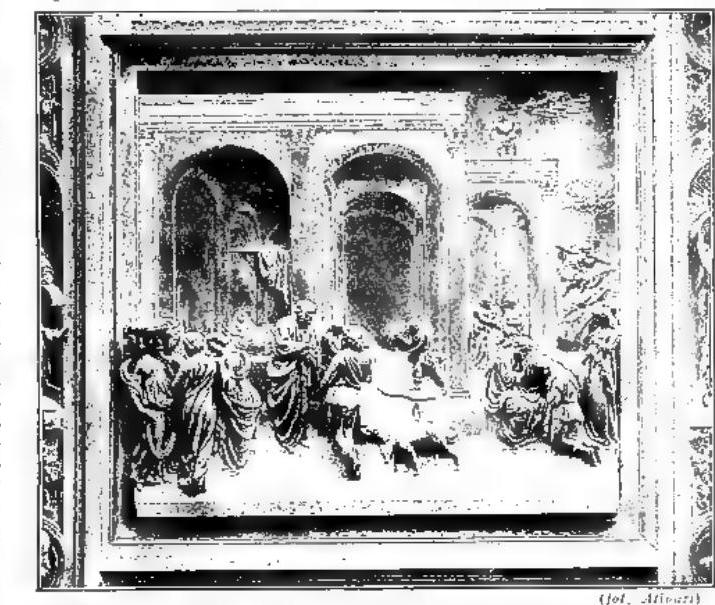
ESAU – Scene relating to E. and Jacob. Panel of the Gate of Paradise by Lorenzo Ghiberti (1425–52) – Florence, Baptistery.
(in B'ityri, Sarcologi, Iar. 1B, 1)
E. resolved to commit fratricide (ibid., 27:41), but Rebecca’s shrewdness prevented its execution. With the birthright, and in accordance with the divine designs, Jacob, whose history is described at length, became the heir to the patriarchal promises. E. was forced into a wretched life as a hunter (ibid., 27:39). Later the two brothers were reconciled; but, to avoid possible disagreements, they separated. E. withdrew among the mountains and steppes of Seir, the ancient name of Idumea; Jacob, however, went to Siciliani in Samaria. E. was therefore regarded as the ancestor of the Edomites, despised by the Jews as descendants of a man who had lost his patriarchal rights and of Canaanite women (ibid., 36:1 ff.).
Thus E. disappeared from Jewish history, to become the symbol of a wicked people rejected by God (cf. Ibid. 1:2, 30; Rom. 9:11), and as such he remained the protagonist of numerous rabbinic legends.
Bist.: E. bin Gorion - M. Katten, a. V. ENOCH. Iud., VI, pp. 261–65. Angelo Penna