
ISAAC. — Son of Abraham and Sarah, father of Jacob and Esau. He is the second of the great patriarchs of the Hebrew people. In Holy Scripture he is presented as the son of the promise, the heir of messianic blessings. Abraham had already had a son, Ishmael (v.), by Hagar, Sarah’s maidservant (Gen. 16). But the Lord foretold that another would be the heir and the blessed seed, the son that the free woman, Sarah, would bear him (Gen. 17:16–21; 18:10–14). Indeed, at the appointed time, Sarah, though ninety years old, gave birth to a son, who was circumcised on the eighth day and named Isaac (Yiṣḥāq = “he laughs”), not so much in memory of his mother’s incredulous laughter (Gen. 18:10 ff.), as for the joyful laughter that his birth brought to the family (ibid. 21:1–7).
Soon after, on account of the children, the rivalry between the two mothers, Sarah and Hagar, grew sharper. Ishmael, being older and of a domineering character, began to torment the young Isaac (Gen. 21:9 says only that Ishmael “played” with Isaac: doubtless these were unseemly pranks, cf. Gal. 4:29). Coexistence became difficult, and Abraham, yielding to Sarah’s urgings and at Jahweh’s express command, sent Hagar and her son away (Gen. 21:9–21).
At the age of forty Isaac married Rebecca, daughter of Bethuel, of the same lineage as Terah. The marriage negotiations were conducted by Abraham’s old and faithful steward, Eliezer, who brought the bride to Isaac from Haran in Mesopotamia (Gen. 24). After his father’s death, which Isaac buried in the cave of Machpelah near Mamre (cf. Gen. 25:8 ff.), he received from God a solemn confirmation of the promises made to Abraham, in words almost identical (Gen. 25:11; 26:2–5). After twenty years of childlessness, he prayed to Jahweh, and then had twin sons, Esau (v.) Jacob (v.), the latter of whom supplanted the firstborn, first inducing him to sell his birthright (Gen. 25:21–34), and then deceiving the aged father to obtain the blessing of the firstborn (Gen. 27). Though Isaac still favored Esau, once the deed was done he acknowledged Jacob’s acquired right and confirmed the blessing given, granting Esau a lesser, material blessing. At the time of this episode Isaac was 137 years old: having lost his sight, he thought his end was near. In fact, he lived another 43 years.
Like his father before him, Isaac also took refuge in Gerar
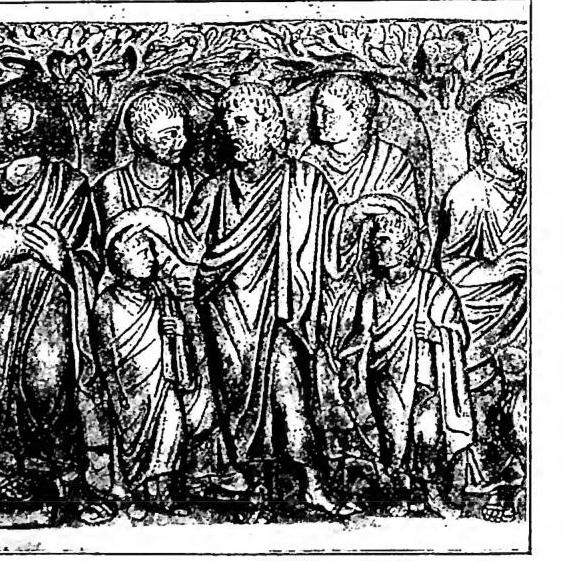
(from Wilpert, Sarcofagi, tav. 136, 1)
ISACCO
Blessing of Isaac. Detail from a 4th-century sarcophagus preserved in the Louvre, Paris.
(modern Tell Gemmeh, southeast of Gaza) in the land of the Philistines, during a famine that afflicted the region. There he devoted himself to agriculture, and thanks to the king’s favor and his own industry, he quickly improved his position, so much so that he aroused the envy of the Philistines, who began to harass him over the old matter of the wells. Isaac, a peaceful man and averse to conflict, left the region and returned to Beersheba, where Yahweh appeared to him once more; shortly afterward, King Abimelech himself came to reconcile with Isaac and renew the covenant of friendship (Gen. 26). During his stay in Ge-
rara, an episode similar to that which befell Abraham is recorded (cf. Gen. 20): Isaac, fearing unpleasant surprises, attempted to pass off his wife Rebecca as his sister; but when the truth was discovered, Abimelech assured him full freedom for himself and his wife (Gen. 26:6-11). It is uncertain whether the Abimelech mentioned here is the same as in the earlier account (Gen. 20), or, as seems more likely, a namesake son of Abraham’s friend. The similarity of the accounts has also led some to suggest a possible duplication of the same episode.
Isaac died in Hebron at the age of 180, and was buried by his two sons Esau and Jacob in his father’s tomb, in the cave of Machpelah near Mamre (Gen. 35:27ff.; cf. 49:31). The most important event in Isaac’s life is the sacrifice in which, by God’s command to Abraham, he himself was to be the victim; it is more commonly called the “sacrifice of Abraham.” It is one of the most celebrated episodes of the Old Testament (Gen. 22), highly venerated in Christian liturgy and art. Yahweh, by commanding Abraham to offer his beloved son Isaac in holocaust, put his faith and obedience to a severe test (cf. Heb. 11:17-19). The trial was happily overcome, and the Lord rewarded the patriarch by accepting a ram in place of the son, and solemnly confirming the promises already made. Indirectly, the practices of human sacrifice, common among the Semites and Canaanites, were also reproved. The biblical account (Gen. 22) is entirely a hymn to the greatness of Abraham, and from a literary standpoint is judged “a masterpiece of psychological representation” (H. Gunkel, Genesis, Göttingen 1901, p. 209).
Christian tradition has always seen in Isaac’s sacrifice a notable type of Christ’s sacrifice: in Abraham one may discern the Eternal Father who does not spare his Only Begotten (cf. Rom. 8:32) for the salvation of humanity; Isaac, bearing the wood for the sacrifice on his shoulders, in humble acceptance of his condition as victim, is an expressive figure of Christ ascending Calvary with the cross.
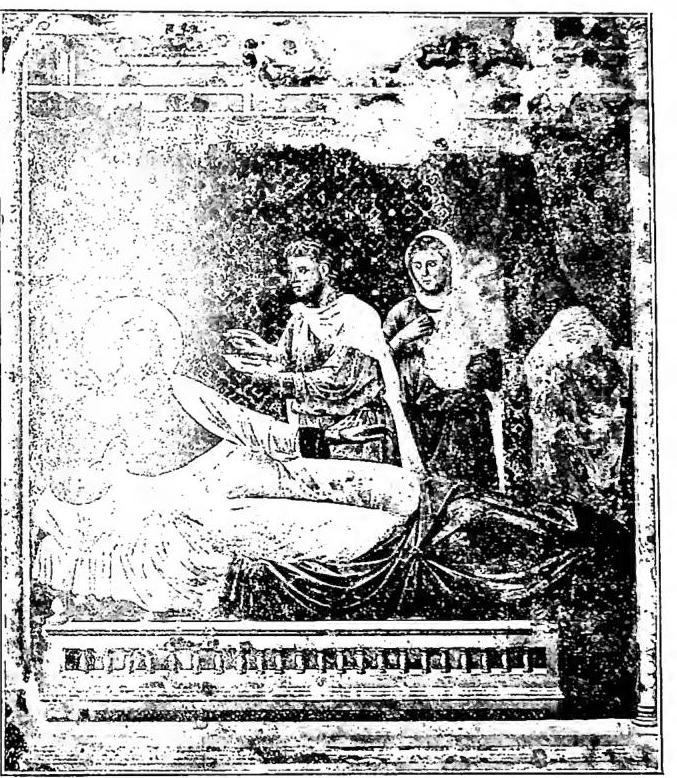
(photo Alinari)
ISACCO - Jacob, dressed in the garments of Esau, presents the food to I. (Gen. 27); fresco in the upper church of Assisi (13th century) attributed to the “Master of Isaac” and recently to Giotto.
Isaac, carrying the wood for the sacrifice on his shoulders in humble acceptance of his condition as a victim, is an expressive figure of Christ ascending Calvary with the cross to be immolated there; the ram offered in his place represents in some way the vicarious satisfaction of Christ. “Isaac Christi passuri est typus,” says St Ambrose (PL 14, 446), following Irenaeus (PG 7, 986), Tertullian (PL 2, 662), Cyprian (PL 4, 629).
In the Latin liturgy the sacrifice of Isaac is recalled in the prayers for the dying, and especially in the canon of the Mass after the consecration (“... sacrificium patriarchae nostri Abrahae”); moreover it holds a place of honour in the liturgy of Holy Saturday and the vigil of Pentecost.
I. IN ART
In early Christian art, apart from the numerous scenes of the sacrifice (v. ABRAMO), ISAAC sometimes appears blessing Jacob and Esau, as, for example, on a sarcophagus now in the Louvre Museum (Wilpert, Sarcofagi, p. 235, pl. 116, 1), or reclining on a couch in the act of blessing Jacob (Gen. 25:28), as in the mosaics of S. Maria Maggiore (Wilpert, Mosaiken, p. 434, pl. 11, 1); this scene was also in the basilica of S. Felice in Nola, as learned from St. Paulinus (Carm. 27, V. 62), and was also found in S. Ambrogio in Milan (v. E. Seletti, Iscrizioni cristiane di Milano anteriori al IX sec., Codogno 1897, p. 213).Later, this scene is again found in the Bible of St. Paul, in the cycle of the basilica of St. Peter (Wilpert, Mosaiken, p. 383); in that of St. Paul, as attested by cod. Barb. lat. 4406 (Venturi, V, p. 1351, fig. 137), in the cathedral of Monreale, etc.
Rarer is the scene of ISAAC when, having become blind, he calls Esau to him (Gen. 27:3), which was represented in the cycle of the Vatican Basilica (Wilpert, Mosaiken, p. 383). ISAAC, with Jacob and Esau, appears again both in the cycle of S. Giovanni ante portam Latinam and in those of Ferentillo and Monreale. The scene of the deception and disillusionment of ISAAC is in the upper basilica of S. Francesco in Assisi (Venturi, V, p. 139, fig. 113). At Nola, in the basilica of S. Felice, the episode of the Philistines blocking ISAAC’s water wells was also depicted (S. Paulinus, Carm. 27, vv. 618–619). Finally, the death and burial of ISAAC (Gen. 35:28–29) are portrayed in the Vienna Genesis (fol. 14, 27) (W. von Hartel and Wickhoff, Die Wiener Genesis, Vienna 1895, fol. 14, 27). Enrico Josi
TESTAMENT OF ISAAC, APOCRYPHAL — An apocryphal Jewish writing of the 2nd or 3rd century A.D.; it has come down to us, together with the Apocryphal Testament of Jacob, in Coptic, Arabic and Ethiopic versions, as an Abraham (v.).
Together they form a triptych, conceived and developed according to a uniform plan: the appearance of the archangel Michael, who gathers the members of the family around the patriarch; the latter, before dying, is granted a vision of the secrets of heaven and of the places of punishment; this is followed by moral exhortations. These last, lacking in the Testament of Abraham, are developed in the Testament of Isaac. In the three apocrypha there are some traits of Christian coloring, such as a prophecy of the birth of Jesus Christ, and references to Mt. 5:28, Rom. 1:18, Eph. 4:26, which, however, do not prejudice their Jewish origin. The three testaments have been published, in the Coptic text, by I. Guidi (Rendiconti della R. Accademia dei Lincei, 5th series, 9 [1900], pp. 157–80, 223–64); passages from the Arabic version have been translated into English by W. E. Barnes, in M. R. James, Apocrypha of the Old Testament, London 1920, pp. 131–54 (The Testament of Abraham; Appendix). — See pl. XV.
On this occasion the election was ratified by the emperor himself, who granted full freedom to the Christians. I. and the Persian bishops, however, accepted the conciliar canons then in force in the Byzantine Empire and brought by St Maruta, among which were alleged Nicene canons.
I. was recognized as katholikòs of the five metropolitan sees corresponding to the five provinces of the Persian Empire. It was still admitted, moreover, that recourse should be had in more important matters to the “Western” bishops, i.e., to the patriarchate of Antioch.